Episode 8963 of the series “words that mean wildly different things on different sides of the Atlantic”
Biscate seems like a useful word to have in your back pocket, but use it with care. In Portugal it refers to a side job, side huddle, or short term job. In the world of the gig economy, it seems like a good one to know.
Olha, aquele é mecânico nos estaleiros, mas faz uns “biscates” de electricidade por fora!
When this came up in online discussion, some Brazilian contributors found this funny because that’s not what it means in Brazil at all. Over there it refers to a woman who has lots of sexual partners – so equivalent to slut or slag or other derogatory terms.
A menina que ficava com todos garotos do colégio era chamada de biscate.
Today’s book exercise includes the phrase “de mãos a abanar”. Checking what ciberdúvidas has to say in the subject, it seems there are two possible variants, one more literal than the other
Ficar/Ir COM mãos a abanar usually means your hands really physically shake (but note, not shaking hands with someone else that’s “apertar as mãos” – you squeeze hands with someone.
Vir/Ficar/Ir DE mãos a abanar means to end up empty handed. Just like in English you can come away empty handed, without being able to gain from a situation, or you can turn up empty handed, with nothing to offer in a situation. The actual example in the book uses vir as the verb, but of course it depends on the situation you’re describing – whether they are setting off with nothing, coming away empty handed or whatever. I’ve also seen a Brazilian page describing “chegar de mãos abanando” which is obviously related. They use it to describe a situation where someone arrives at a party without a present or a bottle of wine or whatever. According to the writer this is related to immigrants to Brazil in the 19th century. If they were unskilled their hands would shake due to inability to use the tools of the trade. Pardon my skepticism but this sounds like bollocks to me.
Well, I mentioned it’s spring here in the northern hemisphere, so here’s my attempt at a translation of Primavera. I can’t find any videos of Amália singing it but I’ll drop a live recording of Mariza’s version here for those who don’t know it.
Ai funesta Primavera!
Todo o amor que nos prendera /All the love that had stuck to us Como se fora de cera /As if it were wax Se quebrava e desfazia /Broke apart and disintegrated Ai, funesta Primavera! /Oh terrible spring! Quem me dera, quem nos dera /If only I, if only we Ter morrido nesse dia /Had died on that day Ai, funesta Primavera /Oh terrible spring Quem me dera, quem nos dera /If only I, if only we Ter morrido nesse dia /Had died on that day
E condenaram-me a tanto /And they condemned me so much Viver comigo o meu pranto / To live with myself and with my mourning Viver, viver e sem ti / To live to live without you Vivendo sem no entanto / But living without Eu me esquecer desse encanto /forgetting that enchantment Que nesse dia perdi / That I lost in that day Vivendo sem no entanto / But living without Eu me esquecer desse encanto /forgetting that enchantment Que nesse dia perdi / That i lost on that day
Pão duro da solidão / The stale bread of loneliness É somente o que nos dão / Is all the give us O que nos dão a comer / What they give us to eat Que importa que o coração / What does it matter if the heart Diga que sim ou que não / Says yes or no Se continua a viver / If it keeps on living Que importa que o coração /What does it matter if the heart Diga que sim ou que não / Says yes or no Se continua a viver /If it keeps on living
Todo o amor que nos prendera /All the love that had stuck to us Se quebrara e desfizera / Broke apart and disintegrated Em pavor se convertia / It converted itself into dread Ninguém fale em Primavera /Nobody talk about spring Quem me dera, quem nos dera / If only I, if only we Ter morrido nesse dia / Had died on that day Ninguém fale em Primavera /nobody talk about spring Quem me dera, quem nos dera / If only I if only we Ter morrido nesse dia / Had died on that day
This site passed the thousand post mark a couple of days ago. One thousand posts in 6 years. That’s about one every two days on average. I’d barely believe I was capable of that level of commitment but look, here we are.
I feel a bit sorry for this fella trying to tell an interesting anecdote about that time he met the widow of Portugal’s favourite writer. Only one problem: Fernando Pessoa wasn’t married and, having died in 1935, even if he had been, it seems unlikely his widow would be in a fit state to hang around in museums having bants with Irish tourists.
People reckon he must have meant José Saramago, whose widow, Pilar Del Rio is still very much with us.
It’s so sad though. Great story, he’s showing interest in the local literature and football, it’s working, but he just muddled up the name. Oof. Totally the sort of thing I’d do but thank goodness, if it were me, there wouldn’t be anyone around to film it.
We tend to learn body parts early on in our language journey and we think we’ve got them all mastered because we’ve mastered how to sing “heads, shoulders, knees and toes” in Portuguese but there are all kinds of other body parts that don’t get a look-in: armpits (axilas), kidneys (rins), calves (panturrilhas ou “barriga de perna“), and so on.
One I came across today and probably should have known was “calcanhares” meaning heels. There are a few expressions involving heels, some of which are familiar and some less so
Calcanhar de Aquiles – the Achilles heel can be used figuratively to mean a person’s weak spot, just as in English
Dar aos calcanhares – is like the English expression “to show a clean pair of heels”, in other words, escape or run off quickly.
Não chegar aos calcanhares de alguém doesn’t really have an equivalent in English. If you don’t reach someone’s heels it means you are vastly inferior. A minha filha gosta de David Tenant mas na minha opinião, não chega aos calcanhares de Tom Baker.
And an English expression that doesn’t have a direct match in Portuguese would be “high heels”. In Portuguese the heel of a shoe has a different name: salto, so a salto alto is a high heel shoe. It’s a bit confusing because salto can also mean a jump, so salto alto sounds like it should mean a high jump, but the athletic event we call a high jump is “salto em altura” in Portuguese.
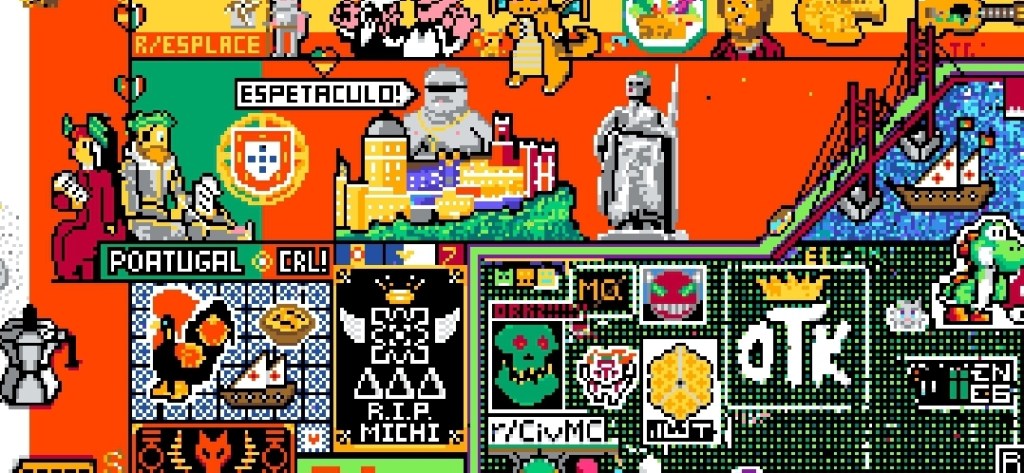
Just popped over to the r/place subreddit, which is a sort of giant collaborative artwork being created by millions of people, and I noticed quite near the middle there are a lot of Portuguese people carving out a little niche for themselves. I strongly approve.
I mentioned Eurovision a couple of days ago and it reminded me of this song, e Depois do Adeus by Paulo de Carvalho, which has to be a strong candidate for the Eurovision entry that had the most impact in the real world. As you can see, it’s straight out of the seventies, with the sideburns and the big collar, and it’s hard to imagine anything more Conservative sounding (although this guy, for example, thinks there is a social criticism buried in the poetry of the lyrics)
So how did it come to have an impact? In a way, it was catapulted to a place in history by its very conservatism. It was the Portuguese entry in the 6th of April 1974 in Brighton. It was pretty popular and wasn’t banned, so it was used as a signal on the 25th of April 1974 at 10.55, for the troops involved in the Movimento das Forças Armadas to get ready, armed and at their post. Nobody listening, who wasn’t in on the plot, would have thought it a strange choice, so if the leadership had had to back out at the last minute there would have been no suspicions aroused. Later the same evening, when it was decided that everything was in place and the plan could go ahead, a second song was played, namely Grândola, Vila Morena, which was a revolutionary song by Jose Afonso, that had been banned by the Novo Estado since its release in 1971. Once that was transmitted by Radio Renascença, everyone knew shit had got real. The convoy left their barracks and there was no turning back.
Here are the lyrics.
Quis saber quem sou /I wanted to know who I am O que faço aqui /What I’m doing here Quem me abandonou /Who abandoned ne De quem me esqueci /Who I had forgotten Perguntei por mim /I asked for myself Quis saber de nós /I wanted to know about us Mas o mar /But the sea Não me traz /Didn’t bring me Tua voz /Your voice
Em silêncio, amor /In silence, love Em tristeza enfim /In sadness, finally Eu te sinto, em flor /I feel you flowering Eu te sofro, em mim /I feel you, in me Eu te lembro, assim /I remind you like this Partir é morrer /That to leave is to die Como amar / Just as to love É ganhar /Is to win E perder /and to lose
Tu vieste em flor /I saw you in flower Eu te desfolhei /I plucked off your petals Tu te deste em amor /You gave yourself in love Eu nada te dei /i didn’t give you anything Em teu corpo, amor /In your body, love Eu adormeci /I slept Morri nele /I died in it E ao morrer /and by dying Renasci /was reborn
E depois do amor /And after the love E depois de nós /And after us O dizer adeus /The saying goodbye O ficarmos sós /And being alone Teu lugar a mais /Too much space for you Tua ausência em mim /Your absence in me Tua paz /Your peace Que perdi /That I lost Minha dor que aprendi /My pain that I learned De novo vieste em flor /I saw you again in flower Te desfolhei /I plucked off your petals
E depois do amor /And after the love E depois de nós /And after us O adeus /the goodbye O ficamos sós /The being alone
Hm, I don’t know if this TikTok is going to show up on WordPress but I’ve been enjoying trying to decipher this video as some extreme listening practice.
On first listen I could only get about 6 words and even now, after showing it to my wife I’m still not able to pick out everything. Being told they were talking about “CS” (Counterstrike, I assume) helped. Something like
Pra vocês que (…) joga o CS (…) caralho, tá aqui o meu tropa Fernando. Fernando, quantos anos já tens?
Dezanove
E qual é o teu rank do CS?
Dragon Lord
Ah pois é puto
Or in English
For all of you who (play fucking counter strike) I have my team-mate Fernando here. Fernando, how old are you?
Like all romance language nerds, whatever my shortcomings as a pub quiz competitor, I am definitely going to come through if the question is “Which two countries have the same name as a bird commonly eaten at Christmas?” Yesterday, in response to a tweet of mine about covid, someone said “Calma que o perú é para o Natal…” and although I understood the words as meaning “keep calm because turkey is for Christmas”, I didn’t really get what he was driving at. I asked the Missus about it and she reckons he’s just saying “there’s no point worrying about the future” or something along those lines. Don’t worry about it till it happens. OK, that makes sense.