I’ve seen Mariza before and she was excellent. She brought a lot of big names on your with her too, so if you live in my town, I’ll see you there!
Category: English
I Wonder If….
…being a trained singer helps you reproduce accents too. She is doing a great job here and she doesn’t even speak Portuguese. Maybe I should take singing lessons.
Carminho at the Union Chapel
I’m surprised there are still tickets left for this, given how in vogue she was at the time Poor Things came out, but there are still tickets to see her at one of the most delightful venues in London. I’m not going myself, because I’m expecting to be up to my elbows in work, but m’wife is, with all her sisters, and if you, dear reader, live near enough to make it, you should really snap up the last few tickets before they go.

Portuguese Comedy in London – a Second Chance
If, like me, you were intrigued by the prospect of seeing Joana Marques and Bumba na Fofinha performing in Clapham, but didn’t manage to get tickets before they were hoovered up, you’ll be glad to know they have added a second show. Those will go fast too though, so get your ticket now. I’ve got mine!
Interesting Courses
Having slogged through the Universidade Aberta course on Portuguese Literature and Culture, I don’t think I could handle another one, but I was quite drawn to the idea of something more general – an overview rather than a very academic deep dive, if you see what I mean. So I was quite excited to find this and dropped them an email to ask if they are still presenting it. It’s 25 hours long, which sounds detailed enough without actually hosing my entire personal life for the next 6 months!
Sadly, they’re not presenting it right now, apparently, because there aren’t enough takers, which is a shame, but they say of I know more people who might be interested. OK, well, I guess I am their marketing department now!
Well… Anyone else up for it?
Ser Poeta – Florbela Espanca
Here’s my translation of this Florbela Espanca soneto which I mentioned in passing in yesterday’s post. It’s quite easy to translate the words, but translating poetry usually makes it feel a bit leaden so I hope I don’t do it too much dirt. The main reason it caught my eye was the title of the song based on it: “Perdidamente”. It’s one of those words that’s really hard to translate on its own. How would you translate it_ It looks like it ought to be “lostly” but we don’t really have such a word in english. I suppose “hopelessly” or “desperately” are in the right area, but neither is quite the same. Sod it, I’m going to translate it as lostly and the Oxford English Dictionary can bloody sue me!
| Ser poeta é ser mais alto, é ser maior Do que os homens! Morder como quem beija! É ser mendigo e dar como quem seja Rei do Reino de Aquém e de Além Dor! É ter de mil desejos o esplendor E não saber sequer que se deseja! É ter cá dentro um astro que flameja, É ter garras e asas de condor! É ter fome, é ter sede de Infinito! Por elmo, as manhãs de oiro e cetim… É condensar o mundo num só grito! E é amar-te, assim, perdidamente… É seres alma e sangue e vida em mim E dizê-lo cantando a toda a gente! | To be a poet is to be taller, to be bigger Than men, to bite like one who kisses It is to be a beggar and give like one who is King of the Kingdom of Within and Beyond Pain It is to have the splendour of a thousand desires And not even to to know what one desires It’s to have in here a star that burns And to have the claws of a condor It’s to have an infinite hunger and thirst For a helmet, the mornings of gold and satin It is too condense the world into just one scream And it is to love you like this, lostly It is for you to be soul and blood and life in me And to say it, singing to everyone! |
Luís Represas – Na Curva do Horizonte
Morreu ontem Luís Represas, o cantautor* e ex’membro dos Trovante. Não o conheço bem, mas decidi experimentar os seus top 5 de vídeos no Tutube. Acho que já ouvi “perdidamente”, uma versão de “Ser Poeta” da escritora lendária Florbela Espanca” mas este dueto chamou-me mais a atenção
| Português | Inglês |
|---|---|
| A voz não veio de lá Quem me chamou eu não vi Se alguém ligou por ligar Quem me ligou não ouvi Entrei em casa e fiquei Em pé e quase a dormir Dos dias longos roubei Alguns minutos para viver para mim Só para não esquecer porque parti | The voice didn’t come from there I didn’t see whoever called me If someone called just to call Whoever called me, I didn’t hear I went in the house and stood there, almost asleep From the long days I stole Some minutes to live just for myself Just to remember why I left |
| Parti sem nunca partir Fiquei sem nunca ficar Saí sem nunca sair Voltei sem nunca voltar Falei sem nunca falar Gritei sem nunca gritar Guardei o que posso de mim Pensei e posso pensar | I left without ever leaving I stayed without ever staying I went out without ever going out I returned without ever returning I spoke without ever speaking I screamed without ever screaming I kept what I could of myself I thought and I can think |
| Felicidade faz bem Simplicidade maior A estrada não tem ninguém Mas tem um vento que cheira a amor Eu adivinho alguém Na curva do horizonte Se és tu que sinto chegar Não te escondas mais por trás do monte Sai Vem e dá-me a mão Vamos voar | Happiness is a good thing Simplicity is larger The street has nobody but it has a wind that smells like love I sense someone On the curve of the horizon If it’s you that I feel approaching Don’t hide yourself behind the mountain Come out Come and give me your hand Let’s fly |
| Parti sem nunca partir Fiquei sem nunca ficar Saí sem nunca sair Voltei sem nunca voltar Falei sem nunca falar Gritei sem nunca gritar Guardei o que posso de mim Pensei e posso pensar | I left without ever leaving I stayed without ever staying I went out without ever going out I returned without ever returning I spoke without ever speaking I screamed without ever screaming I kept what I could of myself I thought and I can think |
| Voltei sem nunca voltar Fiquei sem nunca ficar Saí sem nunca sair Pensei e posso pensar | I returned without ever returning I stayed without ever staying I went out without ever going out I thought and I can think |
*Obscure word this, but keen followers of this blog will remember it from the footnote of this post. It’s a cantor-autor – a singer-songwriter.
Portuguese Comedy in London
Only One Person Can Save Them Now…

Shouting At My Screen
This geography quiz channel comes up a lot on my feed and it’s usually quite informative but they’ve made a howler here. Can you spot it?
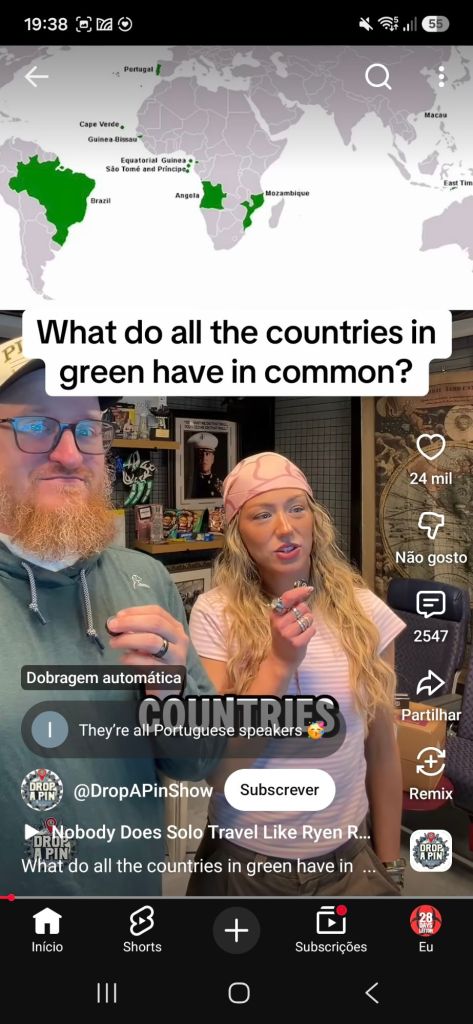
(answer: most of them are lusophone countries but Equatorial Guinea is the only country in Africa where Spanish is spoken)

