Yesterday’s post was about the strange case of Fernando Pessoa’s advertising slogan for Coca Cola in 1927. As I mentioned, there seem to be a few different perspectives on the motives of the people involved, but I don’t think the facts of the matter are in doubt.
Anyway, it turns out that there’s a short movie about the incident. It’s made by a French company but it’s in portuguese with English subtitles. Someone’s put it on Facebook. Hurry though, it might not be there forever. It’s a good length and very easy to follow, so I can recommend it even if your listening skills are underdeveloped.
The film has a slightly playful, surreal tone. The name of the drink os given as “Coca Louca” and it translates the slogan as “First you’re surprised, then you’re possessed”, then plays with that idea of possession by showing the minister for health convinced that the drink contains evil demons which need to be cast out by an exorcist with a bottle opener in the shape of a crucifix!
It also depicts the poet not as Pessoa himself but as Álvaro de Campos, one of the heteronyms, who appears in the film as a separate person, looking just like the man himself.
Someone told me that, given my proclivity for puns, I should check out Ana Galvão.
There are some videos online of her in a room and they are very dad-jokish, so if you like that, you might like this, but if you don’t, look away now, because this is just raw punnage from start to finish. I’ve put explanations below, partly to make myself understand them and partly for anyone who shares my love of crap jokes but maybe can’t follow what’s being said. I struggled a bit with some of them. If anyone thinks I’ve got any wrong, let me know in the comments!
She’s one of the co-hosts on this show, As Três de Manhã, so she’s not the person in the main frame of the video (That’s Joana Marques – even I know that) but she’s in the bottom-right corner, on the left.
1
Q. What do you call an epic shop that sells persianas (blinds or shutters on a house)?
A. Adamaestores – what? OK, Adamastor is like a giant sea monster who appears in Camões’s epic Os Lusíadas. It’s big, so I guess that explains the “epic” bit. Store explains the shop but but what does adamae have to do with shutters? A da Mãe? Do only mothers like blinds? I don’t get it. Nah, I was really “a bater na porta errada” with this one. Estores are shutters. So it’s just a pun on Adamastor and estores.
2
(Talking about someone called Lady Betty) In this case, I’m an analfabetty. Analfabeta means illiterate.
3
Q. What would the São Silvestre (a running race in Brazil) be called if all the participants were big strong men?
A. São Silvestre Stallone. Easy one.
4
So when you say I drink crazy teas… A crazy tea is a chálupa
Chá is tea of course, and I’ve talked about the word chalupa in a previous post.
5
Q. Do you know what you call someone who writes hate on the Internet and eats minty chocolate?
A. An After-Hater. Probably easy although I didn’t know they sold after eights in Portugal!
6
I want to introduce you to the father of João Paulo Sousa. It’s João “Pai-lo” Sousa, just a splice of Pai with Paulo.
7
“No melhor pano cai a Sancha” As Joana says, this doesn’t make sense but it’s based in an expression: no melhor pano cai a nódoa” Which means The stain lands on the best cloth. It’s a sort of pessimistic phrase like “the toast always lands butter side down”
8
Q. If I had a tea shop that was mine, what would it be called?
A. TisAna Galvão. Tisana is an infusion like a tea or herbal… Concoction.
9
Q. (Talking about the decline in coaching as coaches lose their clients) And do you know where the coaches will go when they no longer have clients?
There’s another video here but they’ve disabled embedding so I can’t post the whole thing. Here’s a breakdown:
1
Joana: It’s all dazzling for Emanuel. Now then, Ana, “Deslumbrante”
Ana: “Lumbrante”. (Deslumbrante means “dazzling” but it works as a dad joke because it sounds like “Diz ‘lumbrante'”)
2
Joana: Well, there’s chouriço-flavoured tea
Ana: Chá-riço
3
Caller: It’s a question of character, isn’t it, ending a marriage of 12 years by email
Ana: it’s not about character, it’s about characters.
4
Some slightly confused stuff about “Mick de Câmara Pereira” (pun on Mico de Câmara Pereira, a fadista who comes from a very aristocratic and well-connected family, as far as I can tell. I’d never heard of the bloke before, but that’s what Zé Google tells me, anyway)
5
Q. What do you call the automobile stand of a magician?
A. Car Tola.
A Cartola is a top hat. Car is obvious. Tola can mean a few different things. Usually when you see it it’s the feminine version of “tolo” meaning fool or foolish. It can also mean kinds of wood. Stand de automóveis can be a car showroom, but a stand more generally is usually used for a stand at an expo or a fair so I guess we’re thinking wood, wooden table, dais… Something like that. Oof. Hard work, this one!
6
Joana: He got a hug from Bruce Springsteen
Ana: You’d better believe it! An “Abruce” (just a pun on abraço and Bruce, obviously!)
7
There’s a tea-house in Alentejo. It’s called the Chá-Parro. Chaparro is a kind of small oak. There are restaurants called Chaparro in Alentejo, but I guess just because a lot grow there, maybe farmed for their bark, to use as corks.
Well, you’ve made it to the end. I admire your fortitude.
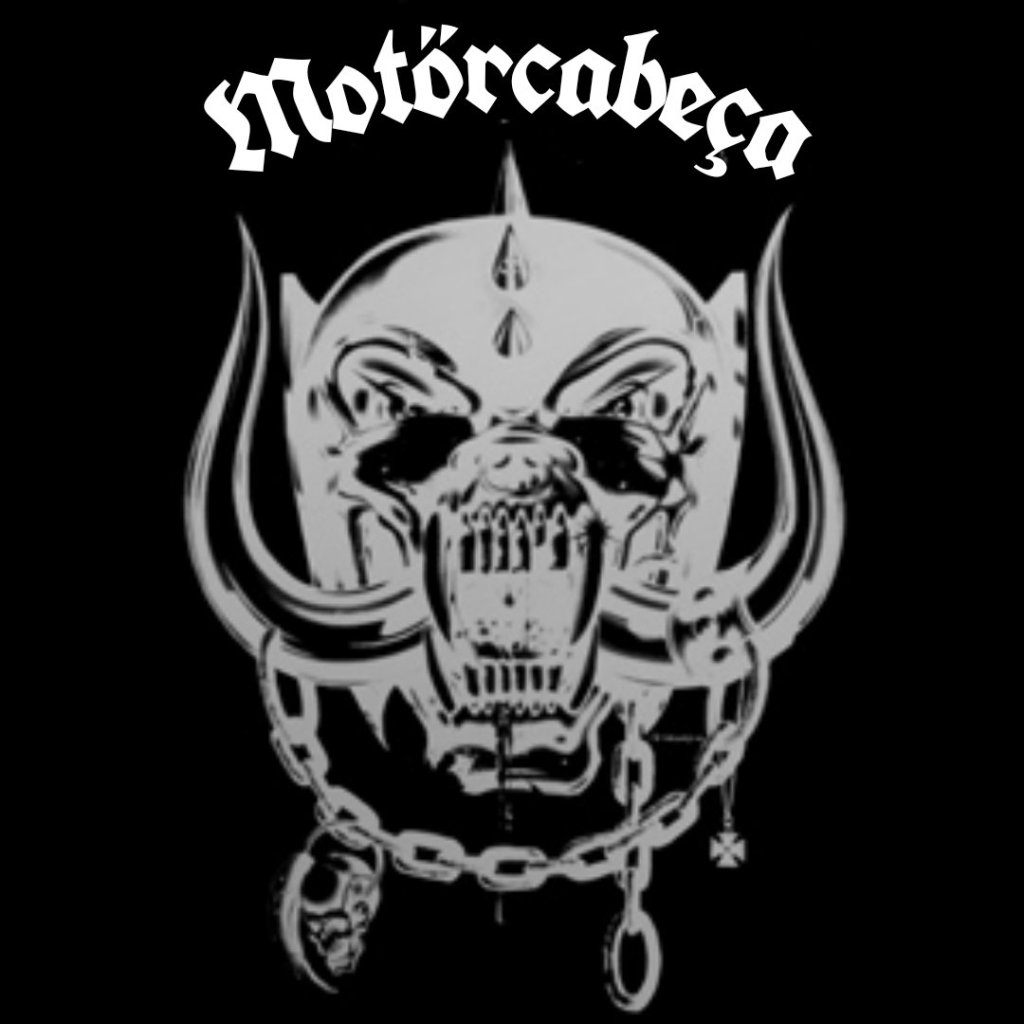
I have a book somewhere around here that is in (Brazilian) portuguese and it has umlauts in it. Actual, honest-to-god, heavy-metal style umlauts.
The Umlaut – or Trema in portuguese – is the pair of dots that appears above some vowels, mainly in germanic languages. They change the sound of the vowel, usually allowing it to be sounded instead of blending into another vowel like a diphthong.
As far as I can tell from the book, the Brazilians mainly seemed to use it in situations where you have a qu sound but you really want to pronounce the u. So there would be a difference between the que in “Freqüência” and “queda”: in the first it would sound like the que in the english word “frequency’, but in the second it’s just more like a standard que. It was dropped from european portuguese orthography in 1945 but the Brazilians kept using it, officially till the most recent acordo ortográfico. Now, I’ll let you speculate about whether Brazil’s decision to hang onto the Umlaut in 1945 might have been related to an influx of new arrivals from an entbusiastic umlaut-using european country at around that time, but I couldn’t possibly say.
Anyway, it’s officially baninated, but you can occasionally see examples in the wild. Here, for example.
There’s a proverb in portuguese that goes “De Espanha, nem bom vento, nem bom casamento”. From Spain, neither good winds nor good marriages.
I’m not sure about the winds. Where can a wind come from? Sea breezes off the Atlantic are probably OK but winds coming from from the south must be pretty hot. I doubt an easterly wind is going to be too bad in comparison. As for the marriage bit, I think it mainly refers to marriages between the royal houses. Occasionally they have cast a shadow over Portugal’s independence, but Portugal has been a republic for a century and it still persists. Odd. It’s a good one to throw out if you want to tease someone for their hispanophilia though.
It’s not that unusual for words to have multiple meanings but I came across the word “caqui” today and its two meanings are (1) basically the same as “khaki” in English and (2) a persimmon. I guess I’d assume if a colour is also a fruit you’d expect it to be the colour of that fruit: orange, raspberry, lime green, etc. But caquis aren’t caqui, are they?
Having said that, Khaki is a pretty confusing colour in English too. It has a different pronunciation in Britain vs the US, so when I first heard my dad use it, he was looking for paint for some toy soldiers we were painting and he said he needed “car-key colour” so I wondered why he wanted to paint them silver. Years later, when I was living in Maryland, working with adults with learning disabilities, a psychologist said he was wearing “cacky pants” and I guessed what he meant but it didn’t stop me chuckling childishly.
I haven’t done a song translation for while and I fancied having a go at “Cancao de Engate” by António Variações. There aren’t many decent videos of it and anyway he’s a bit hard to follow because of his distinctive singing style so if you don’t know it, try this orchestral acoustic version by Tiago Bettencourt
Cancão de Engate
My sense, going into it, is that it uses a lot of slightly oblique language so this is going to be a tricky one, but here goes…
Tu estás livre e eu estou livre E há uma noite p’ra passar Porque não vamos unidos Porque não vamos ficar Na aventura dos sentidos
You’re free and I’m free* And there’s a night to get through Why don’t we get together Why don’t we get Into the adventure of the senses
Tu estás só e eu mais só estou E tu tens o meu olhar Tens a minha mão aberta À espera de se fechar Nessa tua mão deserta
You’re alone and I’m alone too And you have caught my eye You have my open hand Ready to close On your lonely hand
Vem que o amor não é o tempo Nem é o tempo que o faz Vem que o amor é o momento Em que eu me dou Em que te dás
Come, because love is not time Nor is it time that makes it Come, because time is the moment In which I give myself And you give yourself
Tu que buscas companhia E eu que busco quem quiser Ser o fim desta energia Ser um corpo de prazer Ser o fim de mais um dia
You who are looking for company And me who is looking for whoever wants To be the end of this energy To be a body for pleasure To be the end of another day
Tu continuas à espera Do melhor que já não vem Que a esperança foi encontrada Antes de ti por alguém E eu sou melhor que nada
You keep waiting For something better that isn’t coming Because what you hope for has already been found By someone before you And I am better than nothing
Vem que o amor não é o tempo Nem é o tempo que o faz Vem que o amor é o momento Em que eu me dou Em que te dás
x3
Come, because love is not time Nor is it time that makes it Come, because time is the moment In which I give myself And you give yourself
x3
* I’m sorry, but I am a man of a certain age but I am already reading this in a Mr Humphries voice
Hey, well that wasn’t as bad as I thought it would be. One of the easier ones I’ve done, in fact!
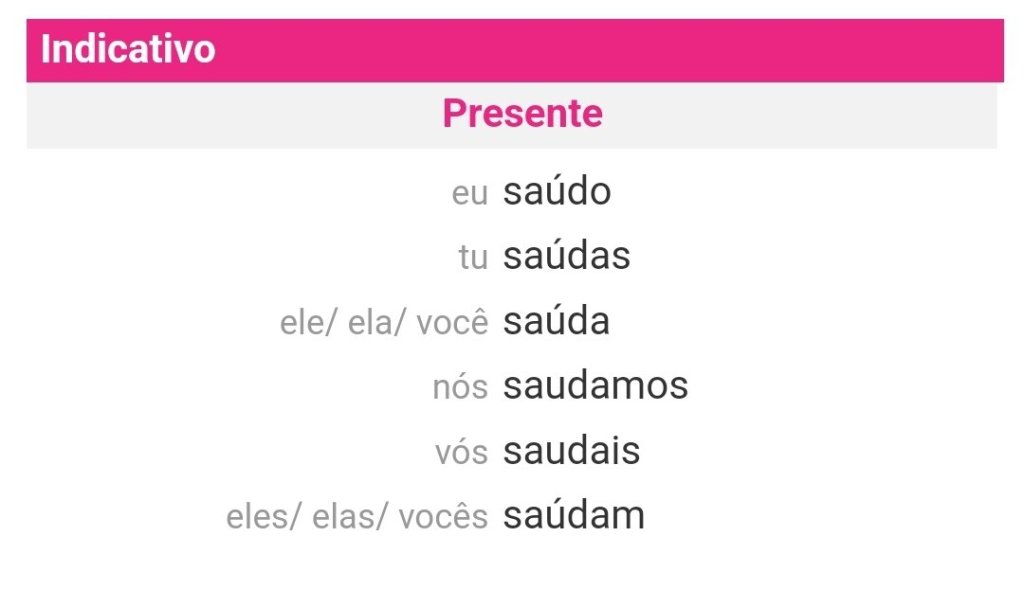
I had to use the verb “Saudar” in a sentence the other day. I don’t use it often and I was surprised to find that in the present tense most of the conjugations put an accent over the U:
This looked a bit weird to this foreigner. The first syllable or Saudar is pronounced to more-or-less rhyme with “loud” but saúdo is more like sa-OOD-oh, so it isn’t just cosmetic, it changes the sound of the root of the verb.
Not only is this not how conjugations usually work, it made me wonder whether there was any link to the word “saúde” (health). I asked in the portuguese fórum, but now I think of it, I probably should have just opened wiktionary. Basically, yes, they are distant cousins.
Saúde is from the Latin word for health or safety: salus.
Saudar is from salutare, meaning to protect, or to save. Well, it’s a verb form, but salutare and salus are certainly linked.
So in other words, although they have different meanings, they come from the same basic Latin root, with the L disappearing and the T gradually getting worn away to a D. Disappearance of soft sounds like Ls and Ds, and conversions of hard sounds like T and P to softer equivalents like D and B are both fairly common paths for Latin words becoming portuguese. So Potere in Latin became poder in portuguese, Sapere became saber, Salire became sair, videre became ver and so on.
Incidentally, saudade sounds like it’s in the same sort of area. Is that another long-lost cousin of Saudar and saúde? No, it used to be spelled Soudade, but it’s spelling changed over the yeas. It actually comes from the Latin Solitatem, meaning it’s related to Solitude in English and Soledad in Spanish.
Acabamos de ver um filme dos anos setenta, chamado The Wicker Man. (O Homem de… Hum… Espera lá… De Vime**) Já vi há anos, mas gostei ainda mais na segunda visualização. A minha filha vira dois filmes que copiaram o enredo, mas o original é o melhor e o maior.
O Homem de Palha
*OK, the title probably needs some explanation. Madeira is portuguese for wood. The star of the film is called Edward Woodward, and there’s an old joke that goes: What do you call a man with three planks of wood on his head? Redwood Woodwood)
**Nope. It’s called O Sacrifício in portuguese and O Homem de Palha in Brazil.
This is a good example of the way Portuguese words are easier to guess than English ones because it’s a much more “lawful” language that isn’t quite so promiscuous at absorbing foreign words and isn’t as cavalier about spellings.
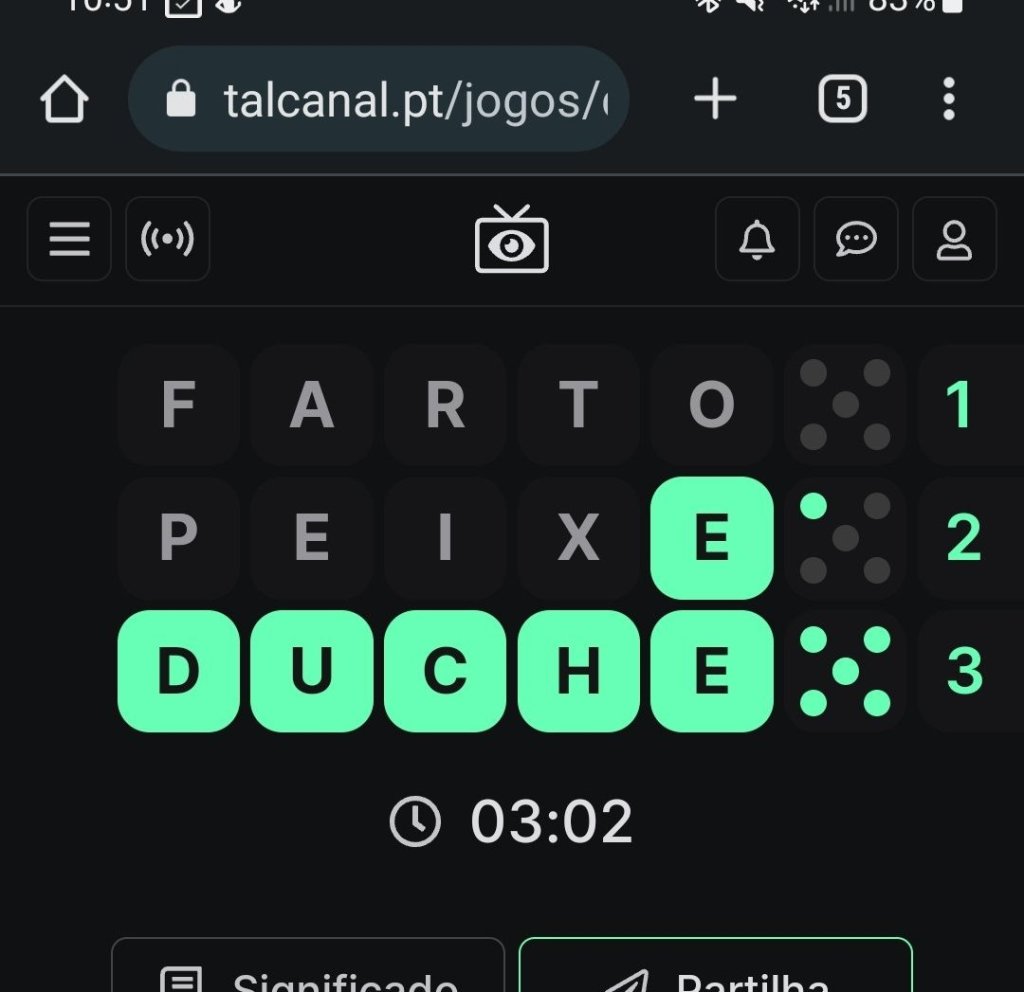
OK, so given that any portuguese word is going to have at least two vowels in it, and the game doesn’t seem to allow slang, plurals or (m)any verb conjugations, let’s crack on:
In the first row, we find out there’s no A or O
In the second row, I’m using Es and Is and one of the letters is in the right position. It has to be one of the vowels, because if not then there’s no E, I, A or O in it, which means our two vowels must both be Us and I don’t see that as likely… Maybe there’s a portuguese word that would fit, but I can’t think of one.
OK, so it’s either
_E___ with a U at position 4 (where else could it go?) seems unlikely.
__I__ with a U… Er… Somewhere… And I think that’s unlikely too
____E with a U in positions 2 or 3. Surely the only likely option.
Since I’ve already used a lot of consonants, there aren’t many options left. Has to be duche, right? Right.




 Luso
Luso 