I’ve been enjoying these lads – Bacalhau No Azeite – doing their rap videos on Instagram. It’s not exactly Kanye West but they have lyrics so I can follow what they’re saying and I quite like that. Strong recommendation for anyone who likes rap but isn’t too purist about it (or rather “anyone who doesn’t mind seeing the art form butchered in real time”)
Tag: Video
Morena
I did a Tiago Bettencourt translation the other day, so let’s have a go at “Morena” too, not becaue it’s my favourite song of his, but because it has some nice guitar work.
OK, potentially controversial decision: I’m translating “Morena” as “Brunette”, because that’s the closest I can get to a literal translation. It’s not quite right though, for two reasons. Firstly, there’s a sense of the person’s skin being tanned or olive-toned as well as their hair being dark brown; and secondly, I think referring to women as blondes, brunettes, redheads has a slightly disrespectful tone in english (at least in some circles) and I think that’s less true in portuguese. That’s partly a linguistic thing: in Portuguese it’s more usual to use an adjective as a noun – for example “um inglês” not “um homem inglês” – and partly because we have a tendency to overthink things in the english-speaking world, especially a certain very large country situated a few hundred miles north of Brazil. Anyway, with that dislcaimer, let’s crack on.
| Portuguese | English |
| Esta morena não sabe O que o dia tem para lhe dar Diz-me que tem namorado Mas sem paixão no olhar Tem um risinho pequeno E que só dá de favor Corpo com sede de quente Mas que não sente calor Mas que não sente calor Esta morena não dança Quando lhe mostro Jobim Talvez não goste da letra Talvez não goste de mim Cabelo negro sem regra Caindo em leve ombro nu Feito de morno passado E amor que nunca cegou E amor que nunca cegou Morena no fundo quer Tempo para ser mulher Morena não sabe bem Mas eu no fundo sei Que quando o véu lhe cai Quando o calor lhe vem Sempre que a noite quer Sonha comigo também Há sítios que ela não usa Por não saber que estão cá Há mares que ela não cruza Por não ser eu a estar lá É de mim que ela precisa Para lhe dar o que não quer Talvez lhe mostre caminhos Onde se queira perder Onde se queira perder Esta morena não chora Com um fado negro de Oulman Nem com um poema de O’Neill Na primeira luz da manhã Sabe de tantos artistas Canta-me letras de cor Mas não lhe passam por dentro Não lhes entende o sabor Não lhes entende o sabor Morena no fundo quer Tempo para ser mulher Morena não sabe bem Mas eu no fundo sei Que quando o véu lhe cai Quando o calor lhe vem Sempre que a noite quer Sonha comigo também Esta morena não corre Quando a chamo para mim | This brunette doesn’t know What the day has to give her She tells me she has a boyfriend But without any passion in her eyes She has a little laugh That she only gives as a favour Body that thirsts for warmth But doesn’t feel heat But doesn’t feel heat This brunette doesn’t dance When I show her Jobim Maybe she doesn’t like the lyrics Maybe she doesn’t like me Black, unruly hair Falling on a light, naked shoulder Made by boredom gone by And love that never blinded her And love that never blinded her Deep down, the brunette wants Time to be a woman The brunette doesn’t really know But deep down, I know That when her veil falls When the warmth comes back to her Whenever the night chooses She dreams of me* too. There are places she doesn’t use Because she doesn’t know they’re here There are seas she doesn’t cross Because I’m not there It’s me she needs To give her what she doesn’t want Maybe I’ll show her paths Where she wants to lose herself Where she wants to lose herself This brunette doesn’t cry with the dark fado of Oulman Nor with the poetry of O’Neill In the first light of morning She knows so many artists She sings me lyrics by heart** But they don’t get inside her She doesn’t understand their flavour She doesn’t understand their flavour Deep down, the brunette wants Time to be a woman The brunette doesn’t really know But deep down, I know That when her veil falls When the warmth comes back to her Whenever the night chooses She dreams of me too. This brunette doesn’t run When I call her to me |
*= Remember “sonha comigo” might look like “dreams with me” – implying they are sleeping together – but it means “dreams of me”, which is a different kettle of fish! One of those instances where the use of prepositions can give you a slightly different mental image if you’re not careful.
**= Letras “de cor” sounds like it should mean colourful lyrics but there’s an older meaning of cor that is the same as coração, so it’s just like the english expression “knowing something by heart”
How Fernando Pessoa Saved Portugal
Yesterday’s post was about the strange case of Fernando Pessoa’s advertising slogan for Coca Cola in 1927. As I mentioned, there seem to be a few different perspectives on the motives of the people involved, but I don’t think the facts of the matter are in doubt.
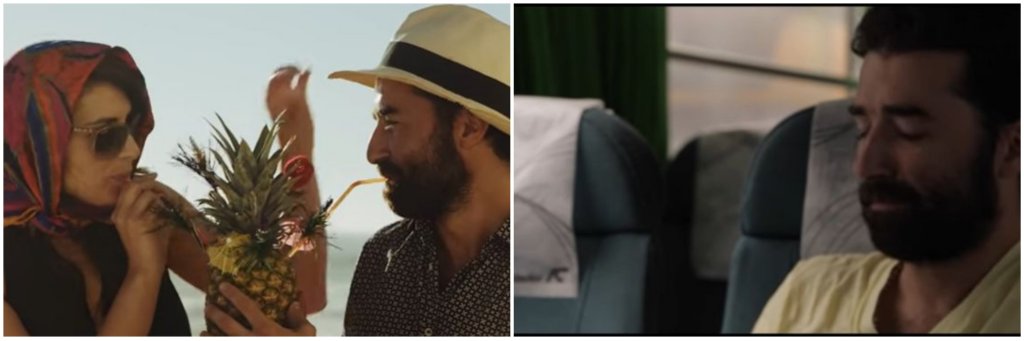
Anyway, it turns out that there’s a short movie about the incident. It’s made by a French company but it’s in portuguese with English subtitles. Someone’s put it on Facebook. Hurry though, it might not be there forever. It’s a good length and very easy to follow, so I can recommend it even if your listening skills are underdeveloped.
The film has a slightly playful, surreal tone. The name of the drink os given as “Coca Louca” and it translates the slogan as “First you’re surprised, then you’re possessed”, then plays with that idea of possession by showing the minister for health convinced that the drink contains evil demons which need to be cast out by an exorcist with a bottle opener in the shape of a crucifix!
It also depicts the poet not as Pessoa himself but as Álvaro de Campos, one of the heteronyms, who appears in the film as a separate person, looking just like the man himself.

Ana Galvão
Someone told me that, given my proclivity for puns, I should check out Ana Galvão.
There are some videos online of her in a room and they are very dad-jokish, so if you like that, you might like this, but if you don’t, look away now, because this is just raw punnage from start to finish. I’ve put explanations below, partly to make myself understand them and partly for anyone who shares my love of crap jokes but maybe can’t follow what’s being said. I struggled a bit with some of them. If anyone thinks I’ve got any wrong, let me know in the comments!
She’s one of the co-hosts on this show, As Três de Manhã, so she’s not the person in the main frame of the video (That’s Joana Marques – even I know that) but she’s in the bottom-right corner, on the left.
1
Q. What do you call an epic shop that sells persianas (blinds or shutters on a house)?
A. Adamaestores – what? OK, Adamastor is like a giant sea monster who appears in Camões’s epic Os Lusíadas. It’s big, so I guess that explains the “epic” bit. Store explains the shop but but what does adamae have to do with shutters? A da Mãe? Do only mothers like blinds? I don’t get it. Nah, I was really “a bater na porta errada” with this one. Estores are shutters. So it’s just a pun on Adamastor and estores.
2
(Talking about someone called Lady Betty) In this case, I’m an analfabetty. Analfabeta means illiterate.
3
Q. What would the São Silvestre (a running race in Brazil) be called if all the participants were big strong men?
A. São Silvestre Stallone. Easy one.
4
So when you say I drink crazy teas… A crazy tea is a chálupa
Chá is tea of course, and I’ve talked about the word chalupa in a previous post.
5
Q. Do you know what you call someone who writes hate on the Internet and eats minty chocolate?
A. An After-Hater. Probably easy although I didn’t know they sold after eights in Portugal!
6
I want to introduce you to the father of João Paulo Sousa. It’s João “Pai-lo” Sousa, just a splice of Pai with Paulo.
7
“No melhor pano cai a Sancha” As Joana says, this doesn’t make sense but it’s based in an expression: no melhor pano cai a nódoa” Which means The stain lands on the best cloth. It’s a sort of pessimistic phrase like “the toast always lands butter side down”
8
Q. If I had a tea shop that was mine, what would it be called?
A. TisAna Galvão. Tisana is an infusion like a tea or herbal… Concoction.
9
Q. (Talking about the decline in coaching as coaches lose their clients) And do you know where the coaches will go when they no longer have clients?
A. To the museum of coaches.
O Museu Nacional de Coches is a real place, but it displays horse-drawn carriages, not life coaches.
There’s another video here but they’ve disabled embedding so I can’t post the whole thing. Here’s a breakdown:
1
Joana: It’s all dazzling for Emanuel. Now then, Ana, “Deslumbrante”
Ana: “Lumbrante”. (Deslumbrante means “dazzling” but it works as a dad joke because it sounds like “Diz ‘lumbrante'”)
2
Joana: Well, there’s chouriço-flavoured tea
Ana: Chá-riço
3
Caller: It’s a question of character, isn’t it, ending a marriage of 12 years by email
Ana: it’s not about character, it’s about characters.
4
Some slightly confused stuff about “Mick de Câmara Pereira” (pun on Mico de Câmara Pereira, a fadista who comes from a very aristocratic and well-connected family, as far as I can tell. I’d never heard of the bloke before, but that’s what Zé Google tells me, anyway)
5
Q. What do you call the automobile stand of a magician?
A. Car Tola.
A Cartola is a top hat. Car is obvious. Tola can mean a few different things. Usually when you see it it’s the feminine version of “tolo” meaning fool or foolish. It can also mean kinds of wood. Stand de automóveis can be a car showroom, but a stand more generally is usually used for a stand at an expo or a fair so I guess we’re thinking wood, wooden table, dais… Something like that. Oof. Hard work, this one!
6
Joana: He got a hug from Bruce Springsteen
Ana: You’d better believe it! An “Abruce” (just a pun on abraço and Bruce, obviously!)
7
There’s a tea-house in Alentejo. It’s called the Chá-Parro. Chaparro is a kind of small oak. There are restaurants called Chaparro in Alentejo, but I guess just because a lot grow there, maybe farmed for their bark, to use as corks.
Well, you’ve made it to the end. I admire your fortitude.
Comemos Bem
Will I ever be good enough at listening to understand this sort of thing without the subtitles. Even with the subtitles it’s bad enough.
It’s Illegal, But You Can Do It
Discussing yesterday’s post with a friend, she pointed me to a sketch from a satirical show called Gato Fedorento (literally “Stinky Cat”) from 2007 which had a similar phrase in it. It’s actually not the same as the usage I’d heard, but it lives on as a meme, so I am definitely interested, and I spent some time understanding it anyway! The phrase is “É proibido mas pode-se fazer”.
The background is that in that year there was a referendum about reforming the abortion laws, which was quite a big deal in a largely catholic country. Marcelo Rebelo de Sousa had initially supported a referendum in 1997 but when it had finally come to the crunch ten years later he campaigned against it and set up a website critical of the plan called “Assim Não” (“Not like this”). Cynical political move or principled stand? Well, if I understand it, his reasoning was that in the ten years that had elapsed, he was out of power the Partido Socialista had launched the referendum, backed by a law they had written. The wording on the referendum remained “despenalização” (decriminalisation) but the law they were intending to pass was actually advocating “liberalização” (liberalisation), which he argued was slightly different. On top of that, there was an indication that women would be able to have abortions by their own choice, with no need to justify it on psychological, medical or other grounds, which he did not support. And he even goes on to paint a picture of a world where women are choosing abortions more-or-less at a whim. He is pretty ridiculous about it, actually. The bottom line was that he didn’t want to liberalise the conditions under which women could get abortions, he just wanted to take away the criminal penalty.
Here’s the original video.
(By the way, what’s the camera guy playing at? There are some really odd zoom shots and then, at about 2:00, he starts filming the guy through a glass on the table. That’s a pretty cool shot if you’re making an edgy police drama, but it’s weird AF in this context)
Anyway Gato Fedorento mocked him by having Ricardo Araújo Pereira repeat his speech (without the avant garde camera work) but spelling out the absurdity of how he wants it to work: “É proibido, mas pode-se fazer”. Or “It’s illegal but you can do it”.
Marcelo is the president now. Make of that what you will.
So This Happened…
I recorded my first YouTube video in ages as a way of challenging myself to talk more. Its about O Ano Sabático and it’s not terrible but there are a lot of hesitations and I’ve made some weird word choices in a few places: “aqui” in place of “agora” is particularly egregious. Watching myself like this let’s me see what I really sound like and gives me a way of seeing what I’m doing wrong.
Youglish

I heard about a site today that seems useful. Maybe it’s old news and I’m the last to hear about it, but it’s called Youglish and its purpose is to make it easy to find subtitled videos in your chosen language with specific words in the transcript, and – here’s the best part – it even let’s you specify European or Brazilian portuguese! Unlike YouTube it doesn’t give you a post to choose from. If you pick a word like “Guerra” for example, it takes you to a video play list with 198(!) videos in it and the first one is queued up right before the person says the word. So you can hear that and, if you want, croll back and forth. Then you click forward to the next video and maybe it’s a song that contains the word, or whatever, and you can skip ahead, hearing the word in different contexts.
A Lenda da Rã e o Boi

I came across a reference to A Lenda da Rã e o Boi (the legend of the frog and the ox) in “Ser Português” by António Lameira and wondered what it was. Nothing specifically portuguese, as it turns out. It’s one of Aesop’s Fables (As Fábulas de Esopo), so Lameira probably should probably have used ‘fábula’ instead of ‘lenda’ but whatever. I haven’t read them since I was little so I looked around and found this retelling of the tale from Sbroing.
Lost Motivation
Well I mentioned a few days ago that I’d lost my mojo and was trying to get going again and a few people got in touch to say they were in the same position. End of summer thing, maybe. It still feels like a struggle. The image I have in my mind is of watching a swan take flight. They’re heavy birds and their wings are only just large enough, so they have to really get up a good speed and flap like crazy to finally get up in the air. I feel like that – flapping the pages of Português Outra Vez to get myself airborne. It’ll be worth it when I’m up there though!
Anyway, YouTube put the latest Liz Sharma video in my feed this morning, and it seems relevant, so if you missed it, have a look.

