Another nugget from the book I’m reading: this time, it’s two phrases that are similar and can be easily confused
Ir ao encontro de = to agree with – “A minha opinião vai ao encontro da tua” (my opinions agree with yours)
Ir de encontro a = crash into – “O ciclista foi de encontro ao muro” (The cyclist went into the wall)
So in the mistake: “Concordo com o narrador e a minha opinião vai de encontro ao que ele afirmou” the student is saying they agree with the author and their opinions collide with his
One of the exercises in “A Actualidade em Português” is about superstitions and there are five that are similar to “knock on wood” or similar – phrases for warding off the effects of bad luck. By far the coolest is “Lagarto, Lagarto, Lagarto” (Lizard, Lizard, Lizard). I have no idea why that means what it means. Ciberdúvidas isn’t much help and neither is Andreia Vale’s “Puxar a Brasa à Nossa Sardinha”. Even m’wife didn’t know, only guessed that maybe it was because witches use lizards in their spells.
Anyway, while I was researching it, I came across this freaky advert for an art show which uses an old song from the 70s by Banda do Casaco called “A Ladainhas Das Comadres” which includes the phrase. Confusingly the first line is in latin (the portuguese equivalent would be “Afasta-te, Satanás” or “Vai para trás, Satanás”)
Vade retro Satanás [get thee behind me Satan – Latin]
T’arrenego Belzebu [I abjure you, Beelzebub]
A Jesus Cruzes Canhoto [To Jesus, crosses left-handed]
A Portuguese friend left a comment on one of my Instagram posts today where I was bragging about my skills in (a) pumpkin husbandry and (b) soup wrangling.
“Armado em carapau de corrida!”
Which is like um… Armoured in racing mackerel. Or something.
This took a bit of deciphering but basically I think she thought I was showing off and pretending to be an expert. Fair enough. It seems to be a common expression but I’d never heard it before. There’s an explanation here.
I keep seeing constructions like “bater mal” and “bater certo”, and couldn’t quite see why “bater” was being used. I asked and (after a brief kerfuffle with some brazilians who tried to tell me that it disn’t exist and made no sense) found out that it is an informal expression. Bater is the verb used for the beating of a heart or the ticking of a clock, and if it starts going wrong that’s bad, so if someone “bate mal” after – say – a blow to the head, he’s not quite himself. You can also “bater bem” (being in good form) and things can “bater certo” (be exact, precise, spot on).
There’s an example of Bater Mal near the beginning of this song by the Greatest Band Ever
Here’s the top Portuguese nugget from today’s conversation with my Brazilian language partner.
While discussing English idioms I mentioned the expression “break a leg” as used by actors and he replied that the Portuguese equivalent is “muita merda” (a lot of shit).
I came across another reference to monkeys and branches in Bruno Nogueira’s Mata Bicho podcast: “Cada macaco no seu galho”. It reminded me of the one I mentioned a few weeks back. I guess Portuguese speakers must really like monkeys because I can think of at least two other monkey-related expressoes: “Vai pentear macacos” and “macaquinhos na cabeça” (here). This new one means “Each monkey on his own branch” or, less literally “people should mind their own business”.
It’s mentioned in a song here (#braziliandialectklaxon)
By the way, I always thought Mata Bicho meant something like “bug killer”, which it kinda does but it’s an expression that can mean a tip (in some places) or a little drink taken at breakfast time. So I guess “hair of the dog” then…?
Favourite new phrase of the week: “Macaco velho não pisa em galho seco.”, which means “An old monkey doesn’t step on a dry branch”, in other words, an experienced person doesn’t make stupid mistakes. I’m not sure how region-specific it is (I heard it in a Mozambican film). And of course, if using it, make sure and get that “lh” sound right in “Galho”, because if you pronounce it “Galo” it’s a “cock” and “Gálio” is “galium”, and monkeys seldom step on either of those things, no matter how dry or otherwise they might be.
I came across this phrase in “A Terrível Criatura Sanguinária“, a short story by Nuno Markl, which I read at Hallowe’en. Yes, I’m old enough to use an apostrophe in Hallowe’en.
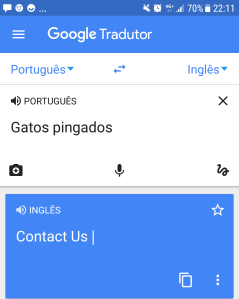
Gatos Pingados
Literally, it means “wet cat” or maybe more like “dripping cat” I think – the “pingado” is related to “pingo” in Pingo Doce, a chain of supermarkets. I had to ask because gTranslate was utterly baffled.
Idiomatically, apparently, a wet cat is someone at a poorly attended event, or who maybe was paid to show up. As with a lot of things, the exact meaning varies with time and place. In the story the protagonist worries that only a few Gatos Pingados (stragglers just there for the free food perhaps?) would shown up at his funeral and it’s been shown that there were a few Gatos Pingados (paid supporters who hire themselves out to pad out an audience) at Trump rallies, for example.
 One of the exercises in “A Actualidade em Português” is about superstitions and there are five that are similar to “knock on wood” or similar – phrases for warding off the effects of bad luck. By far the coolest is “Lagarto, Lagarto, Lagarto” (Lizard, Lizard, Lizard). I have no idea why that means what it means. Ciberdúvidas isn’t much help and neither is Andreia Vale’s “Puxar a Brasa à Nossa Sardinha”. Even m’wife didn’t know, only guessed that maybe it was because witches use lizards in their spells.
 Luso
Luso 