I was interested in this passage from Maremoto, the book I finished the other day. In the passage, the protagonist, Boa Morte, is standing around near a bus stop when a guy he’s never met comes up and starts accusing him of stealing and generally giving him a hard time. Xingar is a good word here: to verbally abuse someone. O homem está a xingá-lo
“Chamou-me preto de Guinea, farrusco vai para a tua terra, escarumba eu sei lá que mais, aqui na rua há quem diga que pareço realeza, não sei se é verdade, o povo Cuanhama é conhecido pela sua majestade”
Maremoto – Djaimilia Pereira de Almeida
It’s obviously got a strong racial angle: preto being a word for black that is not exactly polite (“negro” is the more acceptable word). I’ve heard it described in a news program as the Portuguese equivalent of the N word, but it certainly doesn’t seem to be that, judging from the contexts I’ve seen it in. It definitely has a charge to it though. Likewise, Farrusco is related to skin colour, but its literal meaning is more like “sooty”. “Vai para a tua terra” means go back to your own country and Escarumba is just a general, derogatory term for a black person.
I was initially confused as to why he then goes on, in the second part of the sentence, to talk about royalty, but I was probably being stupid: he’s just turning the situation around. The guy haranguing him can only see his colour and is making all kinds of assumptions about him, but he says among people who know him better, he is considered to have a regal bearing. It seems quite a good way of dismissing the idiot as an irrelevant know-nothing.
When I asked about this online, quite a few people said it wasn’t necessarily a racist incident. Say what now? It’s true that the book doesn’t say for sure that the aggressor in the situation is white, but everything about the terms he’s using – three words in quick succession that make specific reference to Boa Morte’s skin colour – just make me think that the speaker doesn’t share that skin colour. I pointed this out, but the Portuguese peeps replied that there were rivalries and snobberies between black Portuguese people and Africans and then within the African community between different nationalities and tribal groupings and that it’s not unheard of for different groups to say ostensibly racist things to each other as a result. Nobody from within Portugal contradicted this point of view; nobody said it sounded like a racist incident. Every Portuguese person who expressed an opinion said it seemed ambiguous to them.
Mmweellll, I’m from outside the culture so I’m reluctant to flat out contradict them but I must say that gets a big 🤔 from me. If anyone else reading this knows the book, I’d love to hear how you read it and whether or not you agree.
Anyway, it all sounds a bit grim, doesn’t it, but Djaimilia Pereira de Almeida is a good enough writer that she can handle a pretty heavy subject with a lightness of touch. It’s quite a funny scene, believe it or not!
I came across a useful addition to the Ordinal Numbers post I did a while ago. Enésimo is like “umpteenth”. When something has been repeated a lot of times but you’ve lost count of how many.
Hey, do you want to try a little game? It’s a game about games. Meta.
Here are some descriptions in Portuguese of British children’s games. See if you can work out which one I am desperately trying to describe in my clunky, awkward Portuguese. They’re all traditional playground favourites – the original challenge was to list the games that would be included in Squid Game if it were to be remade in your own home country, so they should be pretty recognisable but I’ll put the answers at the bottom.
Credit section: didn’t come up with the list: I pinched it off a friend on another site but it “bateu certo com as escolhas que eu faria”. The very kind u/dani_morgenstern corrected the first 6 of the texts and u/H_doofenschmirtz sorted the last, but I’ve made some minor changes since, so any remaining goofs are my own)
Probably a bit of a clue here, but which one is it?
Game 1
Neste jogo, uma pessoa é escolhida para ficar no centro do campo (provavelmente um parque infantil ou recreio ou uma parte da rua). Os concorrentes (quantos mais melhor!) ficam por um lado. Quando o bulldog está pronto, grita o nome do jogo e os outros correm do seu lado para o lado oposto sem serem derrubados. Cada jogador apanhado fica no centro com o primeiro e o processo repete-se até um único jogado fica por apanhar. Essa pessoa é o vencedor. Como podem imaginar, este jogo causa muitos ferimentos. Existe uma versão menos violenta, no qual o so tem de tocar nos outros em vez de os atirar ao chão mas isso é uma seca.
Game 2
Este jogo era um dos mais cruéis possíveis, uma vez que a pessoa que estava a apanhar (em inglês dizemos “It”*) (“aquilo”? Ou talvez “A Coisa”, como a tradução do romance de Stephen King) tinha de perseguir os outros jogadores, geralmente do sexo oposto (pelo menos naquela altura, perseguir os do mesmo sexo nunca, nunca, nunca aconteceria!). Ao apanhar alguém, o caçador e o caçado davam um beijo, um ao outro. Digo que o jogo é cruel porque toda a gente corria muito devagar quando era alguém bonito ou um beto a caçar, mas andava muito depressa quando o perseguidor era alguém feio ou impopular. Muitas vezes, gritavam “Oh! Que nojo”. Os nerds, os esquisitos, os de roupas fora da moda nunca se sentiriam** mais excluídos do que durante este jogo.
Game 3
Ui! Como descrever este jogo? Sei lá. OK, prestem atenção, pois isto vai ser difícil: temos cá em Inglaterra uma espécie de árvore que nós chamamos “Castanheira de Cavalo” mas o nome português é Castanheira da Índia. Os seus frutos são quase iguais às castanhas bem conhecidas, vendidas nas ruas durante o outono, tirando dois factos importantes: têm um sabor nojento*** e são muito venenosas. Portanto, em vez de comer os frutos, utilizamo-los num jogo. Furamos as castanhas com um espeto (de metal. Não somos ferreiros****). Depois enfiamos uma corda pelo buraco e fazemos um nó por baixo. Para que a castanha balance na ponta da corda.
No início do jogo, o primeiro jogador ergue a sua castanha e bate na castanha do outro. Continua assim até o jogador falhar o alvo e então os dois jogadores trocam posições, com o segundo a bater na castanha do primeiro. O vencedor é o último com uma castanha não partida.
Game 4
Há argumentos sem fim sobre o nome deste jogo. Assim como o terceiro, é um jogo daqueles que têm nomes diferentes nas várias cidades e zonas do país. Mas é um jogo bem simples.
Dois jogadores (ou quatro se quiserem jogar em equipa) ficam de pé***** aos lados opostos da rua. O primeiro jogador joga a bola (normalmente uma bola de futebol******) para o outro lado e tenta faz a bola bater na berma e saltar de volta para o seu próprio lado. Dobram os pontos se apanharem a bola antes que ela bata no chão. Depois tem oportunidade de fazer uma tentativa******* de bónus do centro da rua, e continuam assim até que falharem. O jogo termina quando a mãe dum jogador o chamar para jantar. O vencedor é o concorrente com mais pontos quando rebenta a bolha.
Quando era novo, este jogo era o mais aborrecido de sempre mas ao mesmo tempo, viciante. Só jogávamos se não houvesse nada mais para fazer mas uma vez que começávamos, continuávamos durante a tarde toda. E há quem ande a jogar na nossa rua em 2021 ainda que existam portáteis e consolas.
Game 5
Este jogo é muito parecido com o Luz Vermelho, Luz Verde, o primeiro desafio na série. Um jogador está de pé, longe dos outros. Está pessoa é… Uma espécie de animal… Os restantes perguntam-lhe as horas e se por exemplo a resposta for “três” os jogadores dão 3******** passos na sua direção. Podem avançar com grande passos ou delicados passinhos. O seu objetivo é aproximar-se do outro lado e tocar nas costas do animal, mas há um perigo. A qualquer momento, em lugar de dizer as horas, o animal pode gritar “hora de jantar” e correr atrás dos concorrentes mais próximos. A primeira pessoa a ser apanhado torna-se o animal da próxima ronda.
Game 6
Este jogo é muito mas mesmo muito fácil. O objetivo é pontapear uma bola de futebol contra as nádegas dum amigo.
É isso. Esse é o jogo.
Game 7
Este jogo era muito popular nas ruelas de Middlesborough mas quase desconhecido noutros lugares. Um grupo de jovens (aposto que eram todos rapazes) juntavam-se no jardim duma casa alheia. Em voz baixa, diziam “pedimos desculpa, estamos no seu jardim” e iam repetindo esta frase, em voz cada vez mais alta até que uma pessoa dentro de casa ouvisse o barulho e espreitasse lá para fora. Naquela altura, os jovens todos tinham de circundar a casa e escapar através do quintal por trás, por qualquer rumo disponível: por cima da cerca, através da sebe, a evitar os cães ou as galinhas. Ninguém furtava nada. O nome é um mistério. Rapazes, hem?
Answers
British Bulldog
Kiss Chase (The Portuguese version of this game is called Bate-pé.)
Conkers/Cheggies
Kerby/Gutters
What’s The Time Mr Wolf? (the Portuguese equivalent of this is called “Mamã da licença?”)
Red Arse (this is the only one I hadn’t actually played before – the person who wrote the list is younger than me so maybe it’s after my time)
Theft and Shrubbery
Theft and Shrubbery provavelmente não existia na realidade – um comediante contou a história num programa televisivo e afirmou que era verdadeira mas… 🤔)
Correction Notes
* in Portuguese the equivalent to “you’re it” is “és tu a apanhar”.
** I thought I’d be clever here and use mesoclise because it’s in the conditional tense but it’s a negative statement so you have to use proclise. Don’t know what either of those words mean? Don’t worry, it’s not as complicated as it sounds. It’s just about where the pronoun goes, relative to the verb.
*** One of the weird idiosyncrasies of the language is that the verb “saber” can mean “ter sabor” (see here, definition #9) but it seems to be a bit tricky to use. I tried “sabem nojento” but that was a no.
***** It’s always struck me as odd that there isn’t a dedicated word for “stand” in Portuguese, you just have to say ficar/estar de pé (stay/be on foot)
****** Football is the name of the game, not the object so you can’t just say “comprei um futebol”, it has to be a football ball. Uma bola de futebol.
******* I went a bit too literal here and used “tiro” (shot) but no, unless there’s a gun involved, it’s not that.
******** You give three steps (dar), not make three steps (fazer) or take three steps (apanhar)
I’m a 40 days into my long march to C1 proficiency. I’m doing pretty well. Here’s what I’ve been doing in each of the goals:
Make a new Twitter account, tweet only in Portuguese – Done! I’ve been updating daily, trying to pass as an illiterate Portuguese guy. 52 followers so far and nobody has come out and denounced me as an imposter but I daresay they are thinking it. I did have one person – a Brazilian – refer to me a a Tuguinho, which I enjoyed. She was a nutjob though so it probably doesn’t count.
Watch one Portuguese movie or series episode per week. Done! So far, half way through a series called Crónica dos Bons Malandros and I’ve watched one film. I don’t watch much telly generally so this is hard work.
Finally finish “A Actualidade em Português*” Done!
Then do one esercise of Português Atual* C1 or one from this course per day. Done! I’ve hit at least one exercise per day, usually quite a lot more. I’m about two thirds of the way through the book now and I’ll start on the course next.
Only read Portuguese books (exception for work-related books that I need to read for career development). Done. I’ve read no books in English since the start of the challenge apart from a work-related book about spreadsheets.
Listen to mainly portuguese audio. Could probably be better tbh. I’ve listened to quite a lot but it’s still in the minority.
Memorise one Portuguese poem per week. I’ve done four: Coroai-me De Rosas by Ricardo Reis, Segue o Teu Destino by the same author, Flagrante by Antonio Zambujo and Tenho Pena de Quem é o Meu Amigo by Gregório Duvivier. So I’m one short. This is really painful to be honest.
Write something each day on the Portuguese Writestreak subreddit. Done! My streak is up to 40 days now.
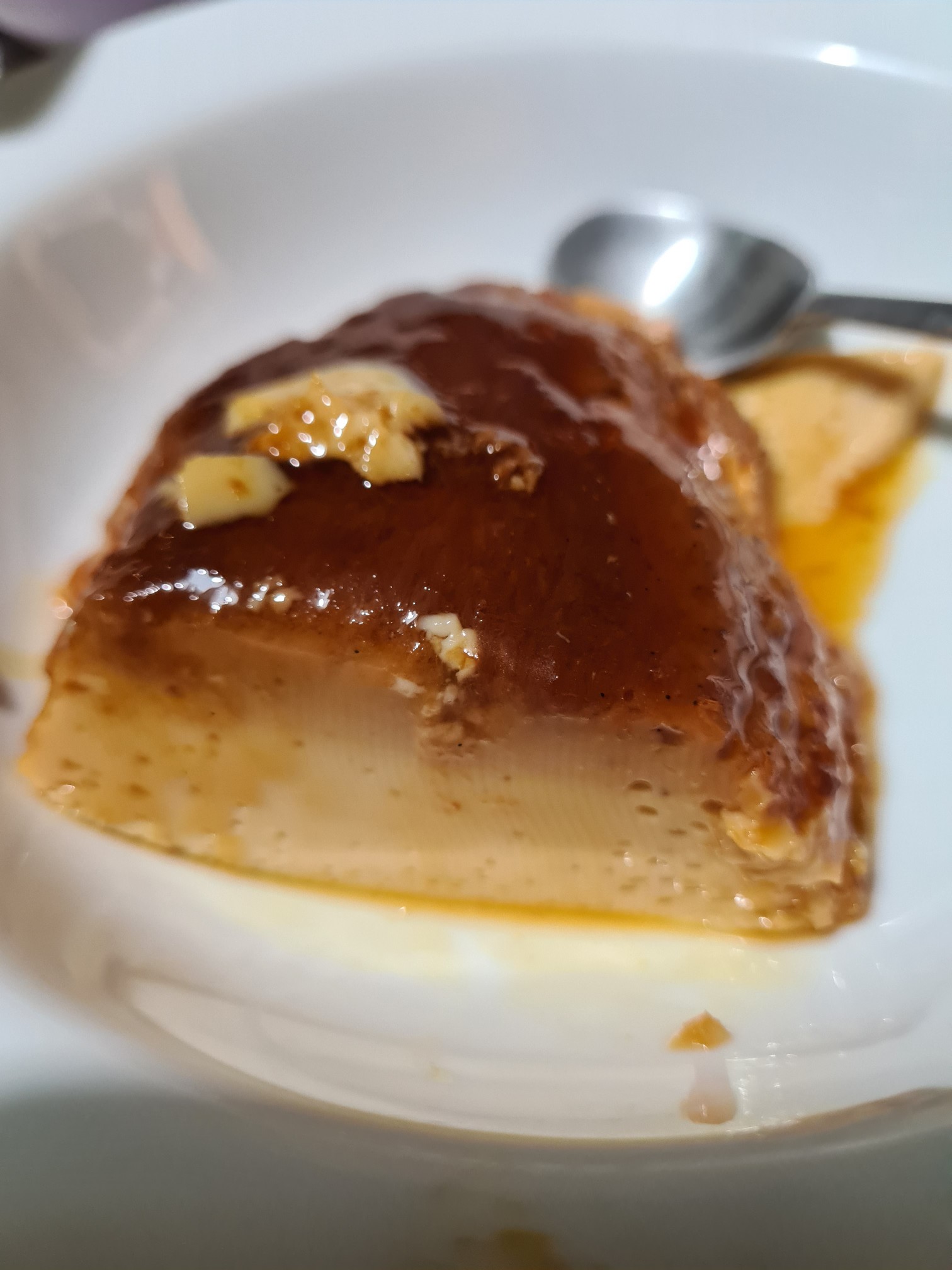
I’ve done some side-quests too! My first one was the project I did to try and understand the outline of Portuguese politics; then I went to see a night of (mostly) Portuguese music and this week I tried my hand at cooking a pudding called Pudim de Leite Condensado from a Portuguese recipe.
Behold its majesty!
Pudim de Leite CondensadoThe goodness within!
So that’s how I’m doing. The schedule is a lot easier than I expected. I’m finding it a faff to fit the weekly goals in, especially now I’m in full time work again, but I’ll keep plugging away!
Found our today that the word nora has two meanings. One is Daughter-in-law (I already knew this one) and the other is Waterwheel. Why those two things? I dunno.
Anyway, i was straight in there with a pun. I asked my wife to proof-read it for me to make sure I hadn’t ballsed up the grammar too badly. She’s very patient.
Here’s a confusing instance of double-meanings from the C1 exercises.
The question is to find synonyms for a list of words. One of the words is “Confuso” and the options it gives are (a) desordenado (b) esclarecido (c) desarrumado (d) obscuro.
The answer is obviously (a) right? Right? Well, no, it’s (d) according to the book. I went to the Porto Editora dictionary and it seems to support my claim.
But wait, what’s that in the second row?
Nooooo!
I posted on the Portuguese subreddit in a we-was-robbed-ref kind of way and most people agreed that (d) was the best answer.
Priberam gives the same two definitions but in a different order of precedence.
Bit of a mess really. I don’t think the question is well written but it’s worth bearing in mind that Confuso has a slightly different weighting from its English equivalent.
A review of the book I’ve been reading. Thanks to Dani Morgenstern for the corrections.
Acabo de fechar a capa deste livro juvenil. É um livro daqueles que não tem um enredo muito bem definido mas está cheia de emoção. O narrador é um adolescente cujo avô faleceu recentemente. O rapaz, que se chama Edgar (também conhecido pela alcunha* “Rígel”) está a correr e a pensar. O livro é um registo dos seus pensamentos. Afirma que o dia em questão era simultaneamente o pior e o melhor dia da sua vida. O pior porque o seu avô desapareceu pela chaminé do crematório acima** e o melhor porque a Joana (irmã do seu amigo Júlio) beijou-o. Os sentimentos saltam na sua cabeça, tornando cada vez maior e o próprio Edgar sente-se maior. É o Rígel, uma estrela, uma supergigante azul, 18 vezes maior e milhares de vezes mais brilhante do que o sol. A corrida ajudá-lo a fazer sentido dos seus pensamentos até ao final quando está capaz de falar sinceramente com a Joana.
Supergigante de Ana Pessoa
* I originally used “apelido” here, since that’s the translation gtranslate gives for nickname. At the time I thought this was weird since apelido also means surname. Sure enough, the person marking the work was confused and said Alcunha was the better choice. Apelido is only used that way in Brazil, it seems.
I updated the list of portuguese graphic novel recommendations. I keep seeing peeps on social media asking for decent easy reads, and I find it’s helpful to have a list I can point to. It’s almost twice as long now!
If you look over there on the right 👉 on a laptop or down on a phone 👇 you’ll see there are a few of these resources pages now, covering learning resources and so on.






 Luso
Luso 