Here are a couple of things that have come up recently that I thought were worth pointing out. basically, it boils down to this: singers are lying to us. Wake up, sheeple! The global songwriting elite, at the behest of the pentaverate, are deliberately spreading misinformation because they only care about their rhyme schemes and something called “poetry”, whatever that is.
Me explaining lyrics of “A Cabritinha” to the boys at Kew-Anon
We’re sometimes told that learning song lyrics can help us to learn portuguese. Well, up to a point. We learn quite a lot from it, but there is something you need to remember – and it’s what we call poetic license. Basically, singers need to make their lines scan, and they need to make everything rhyme, and as a result, what you get sounds good but isn’t always the most natural speech. This is true in english too of course: it’s near Christmas now, and no doubt many foreigners are listening to Christmas songs. Do we really say “The bells are ringin’ OUT for Chrismas Day”? Not really. And have you ever heard anyone who wasn’t singing say “Have YOURSELF a merry LITTLE christmas”? Obviously we have to be aware that there’ll be stuff like this in portuguese lyrics too.
I’ve had a couple of instances lately where I’ve phrased something a certain way in a text and been told it was wrong and I’ve thought, wait, I’m sure I’ve heard that structure in a song. One was “Que desmancha prazeres que eu sou” (“what a spoilsport I am!”). When challenged on this I appealed to Chief Judge Ana Bacalhau who sings this lyric in one of Deolinda’s songs:
Sou da geração sem remuneração. E não me incomoda esta condição. Que parva que eu sou.
It’s not ungrammatical of course, but it has more syllables than it needs to have. It doesn’t need two “ques” and it doesn’t need the pronoun either.
In another context, I told someone: “nao há obrigaçãoalguma”. I would normally use “nenhum(a)” but I’d heard it with “algum(a)” in the following line by notable sadness-enjoyer, Ana Moura, and I decided to try it out for myself:
Cantá-lo bem sem sequer o ter sentido Senti-lo como ninguém, mas não ter sentido algum
But apparently that line should really “não ter sentido nenhum” but it obviously didn’t sound as good in the wider song so they seem to have just switched it. Terrible! If we can’t trust fadistas to teach us the true path, who can we trust?
Next time I see that Ana Moura, she owes me a beer.
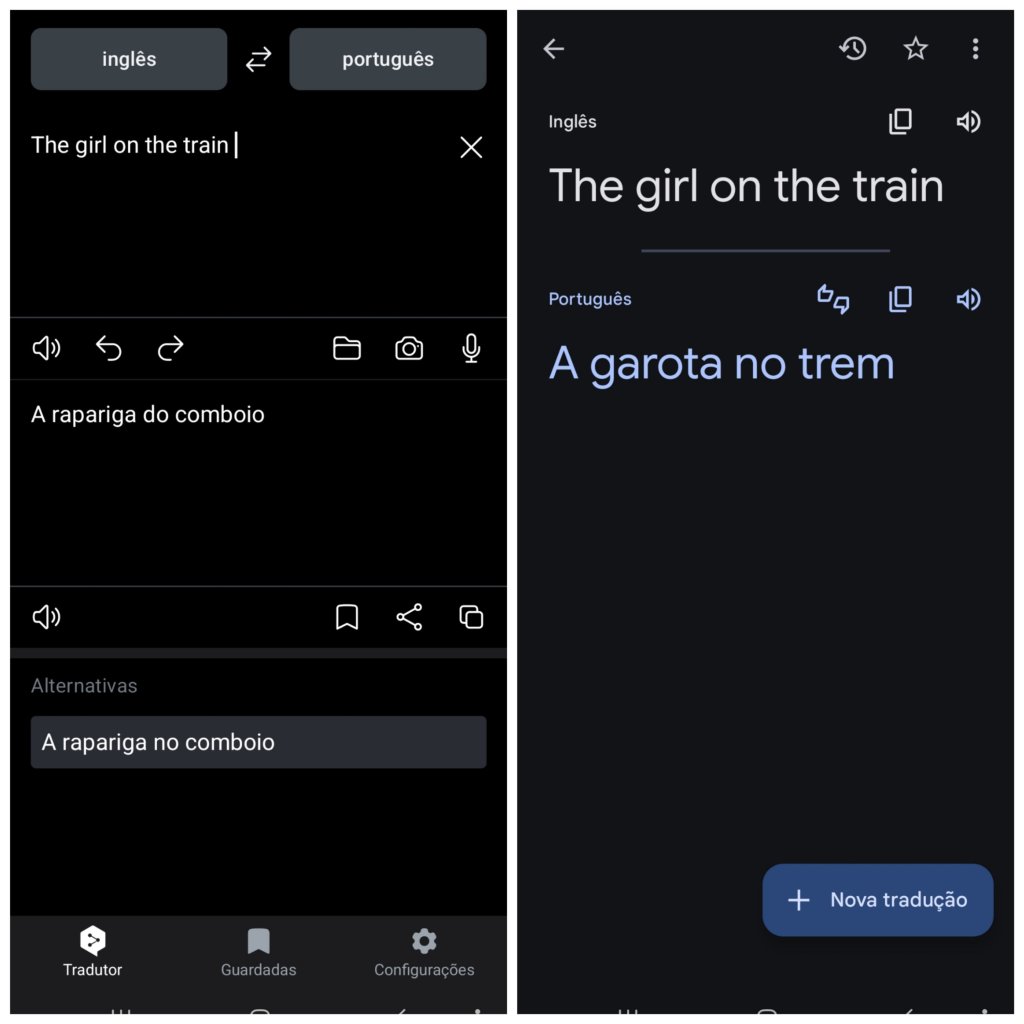
So I was asked a question about something I said in the post about Linguee the other day. I said that I thought Google Translate (aka Gtranslate) was better than Deepl for certain things. Both are translation apps, but Deepl is usually thought of as better at European portuguese, so people will usually recommend it. That’s usually good advice: if you didn’t know any Portuguese and you wanted to translate something into European Portuguese you’re usually better off with Deepl.
Deepl (left) correctly translates this book title into European Portuguese while Gtranslate comes up with the Brazilian version.
So why did I say Gtranslate was better? Because we’re language students, so I think we usually don’t want the app to do all the work for us. English-Portuguese translation isn’t something we need often. But what we do want is the opposite: we want it to check our work by translating it back into English because of it can understand it then that’s a pretty good indicator that we got it right.
So for example, if I’ve written “Este carro é muito carro”, what I want is for it to say “this car is very car”, so I know I’ve goofed; I’ve put an extra r in “caro”. If it translated it correctly as “this car is very expensive”, I wouldn’t notice my idiocy.
And so I thought Deepl would be less useful because it is AI and it’s cleverer, which means if you did something like this it would be more likely to guess what you meant and translate it correctly, hiding the error and lulling you into a false sense of security.
Líliana, (whose website The Talking Sardines caters for early stage learners around A1/A2), asked for an example so I tried a few. Want to see if I was right? Read on!
Let Battle Commence
OK, so let’s put both apps in the Thunderdome together and see which emerges victorious. Two apps enter, one app leaves. In each round, I have presented the translators with a sentence with a couple of minor errors. Remember, it’s a backwards competition. What I want is for it to give the wrong answer because that’s more useful than hiding the mistake.
In each case, Deepl on the left, Gtranslate on the right
“Gosto de escreve contas de fada”
Escreve should be an infinitive “escrever” and a fairy tale is a “conto de fado”, not a “conta de fado”
Deepl responded to “conta de fada” better, by translating it literally. Gtranslate is cleverer (ie less useful) because it has hidden the mistake, but Gtranslate also makes change suggestions – in the middle of the screen it asks: “Será que quis dizer…”, meaning “Did you mean to say…” and there it gets bonus points for spotting the grammatical error in escrever and suggesting I change it. Great!
Result: tie! Each spotted one mistake and ignored the other.
Well, this is a surprise. Maybe I was too harsh on Deepl?
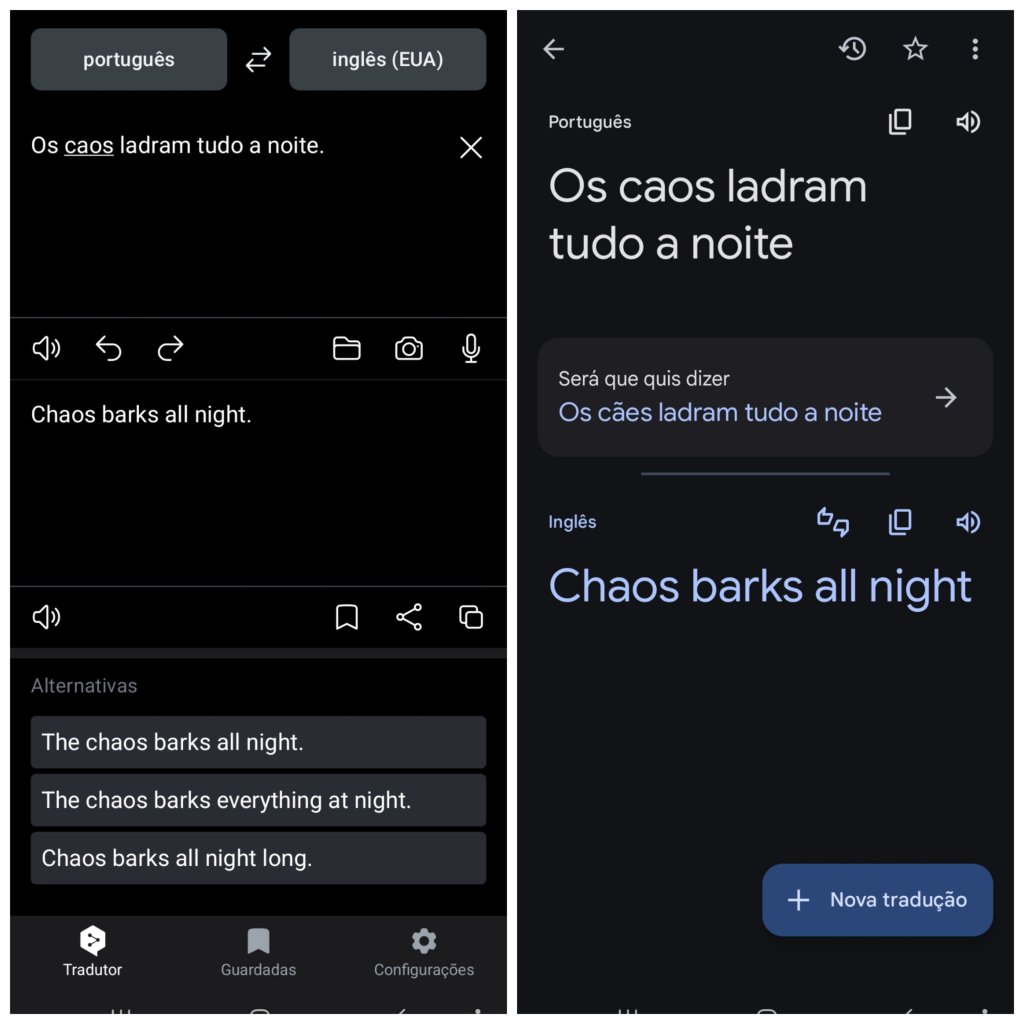
“Os caos ladram tudo a noite”
The word cão (Dog) has one of those weird plurals: cães. The word “caos” does exist but it means “chaos”. Oh and and obviously I’ve used “tudo” (everything) in place of “toda” (all).
This would make a great album title, wouldnt it? Gtranslate has a helpful suggestion, but both have correctly translated one mistake and erased the other
Result: tie! Both get one right, one wrong. Whether or not you want it to spoon feed the answer is a matter of taste so I don’t give Gtranslate extra points for that.
“Estou na quinda a trater dos porcos”
Quinta and tratar are both spelled wrong
Deepl is just freestlying. I don’t even know what it’s thinking there. Gtranslate has translated it correctly (not helpful) but it has very cleverly and helpfully suggests that I fix both spelling errors. Great work!
Result: Gtranslate is victorious. Initially it loses marks for ostensibly ignoring the errors, but it scores top marks for prompting me to fix both, not just the first. Deepl only highlights one mistake.
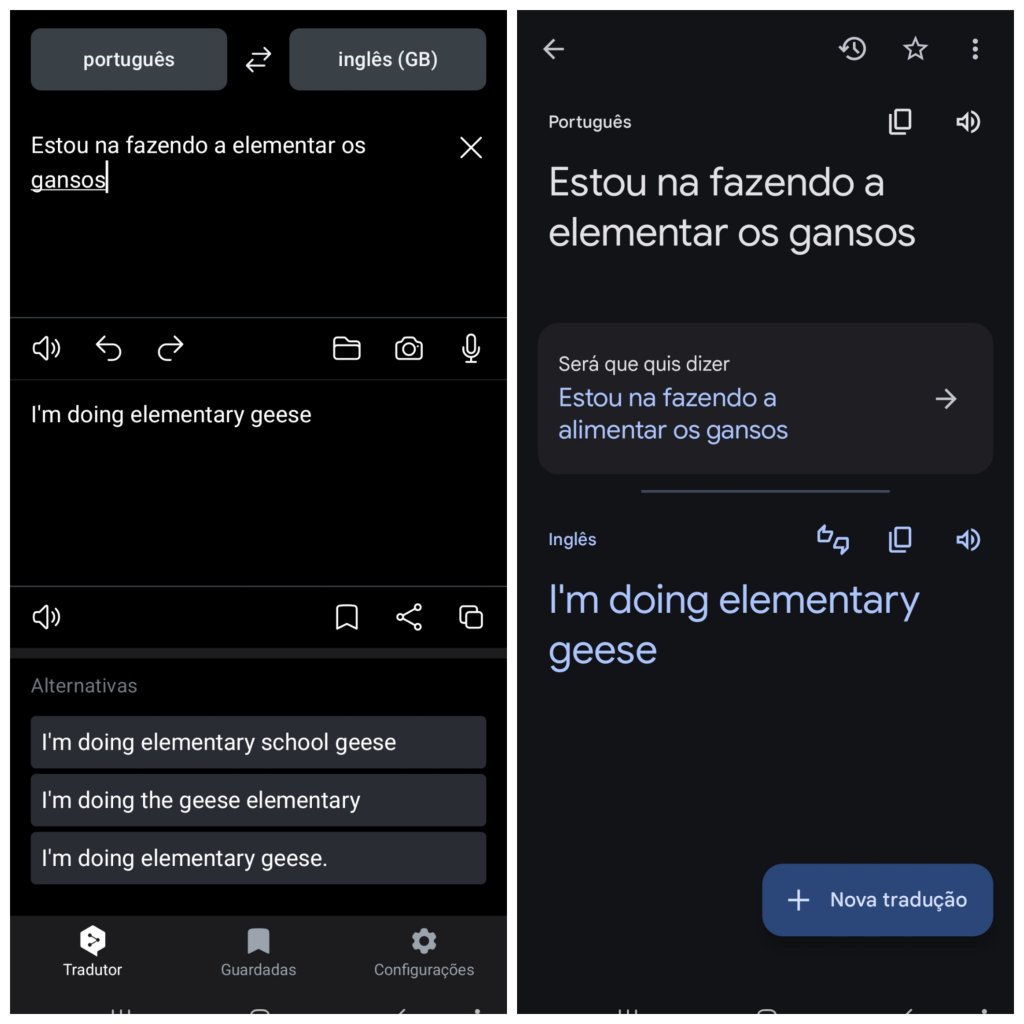
“Estou na fazendo a elementar os gansos”
Fazenda is another word for farm (I think I’m right in saying it’s more specifically a larger, family owned farm), whereas fazendo is just the present participle of fazer. And the verb I’m looking for is “alimentar”.
Both helpfully mistranslated both words. Gtranslate is correctly able to suggest the correction for one of them at least.
Result: tie! Both have done their job correctly, translating garbage into garbage. Whether or not you want the extra help Gtranslate gives you is a matter of taste.
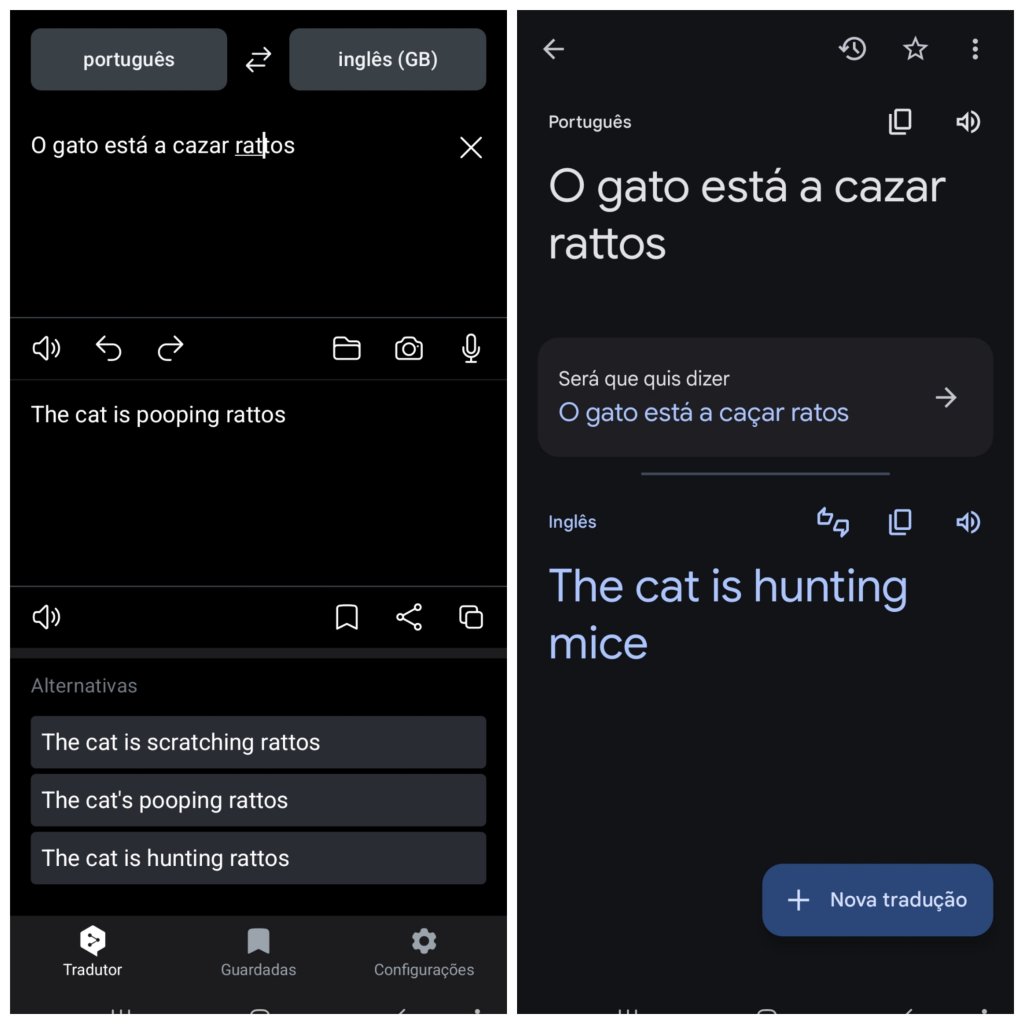
“O gato está a cazar rattos”
Caçar and ratos are both spelled wrong.
Deepl tries to be clever and interpret cazar but guesses the z is supposed to be a g. It has no idea what I am talking about with the extra t in rattos. Good. Gtranslate cleverly translates both words correctly, which is unhelpful, but it redeems itself by suggesting corrections for both words.
Result: Deepl is victorious. Although gtranslate has clearly done a better job here, I think I would prefer Deepl’s confusion, prompting me to rethink what I’d written, so I’m reluctantly awarding it the laurels here.
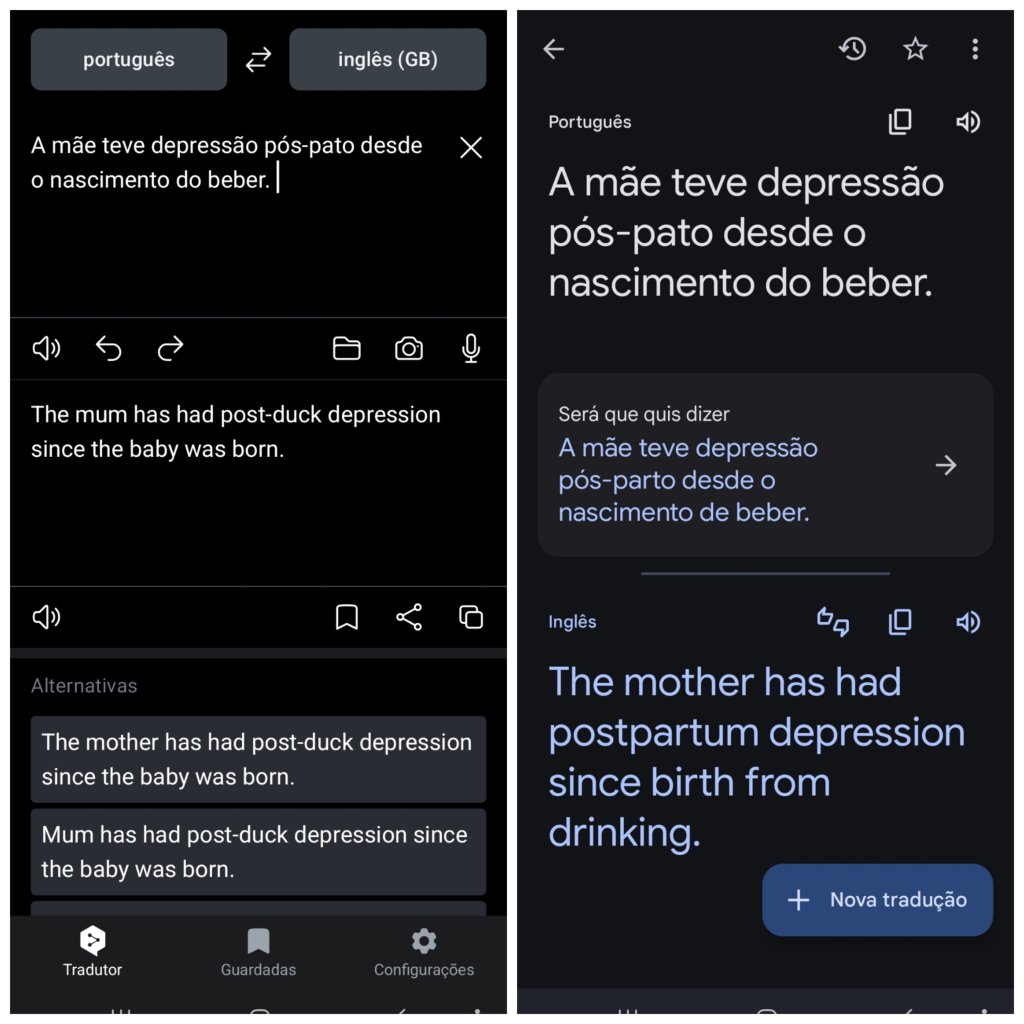
“A mãe teve depressão pós-pato desde o nascimento do beber.”
Postpartum depression is missing an r and bebé has gained one.
Deepl helpfully produces surreal results on the first mistake but annoyingly airbrushes out the second. Gtranslate unhelpfully takes the first error in its stride but does a better job of highlighting the second. It also provides a suggested correction in which it suggests a spelling change, so between its two parts of its reply it has correctly flagged both errors.
Result: Gtranslate wins another round.
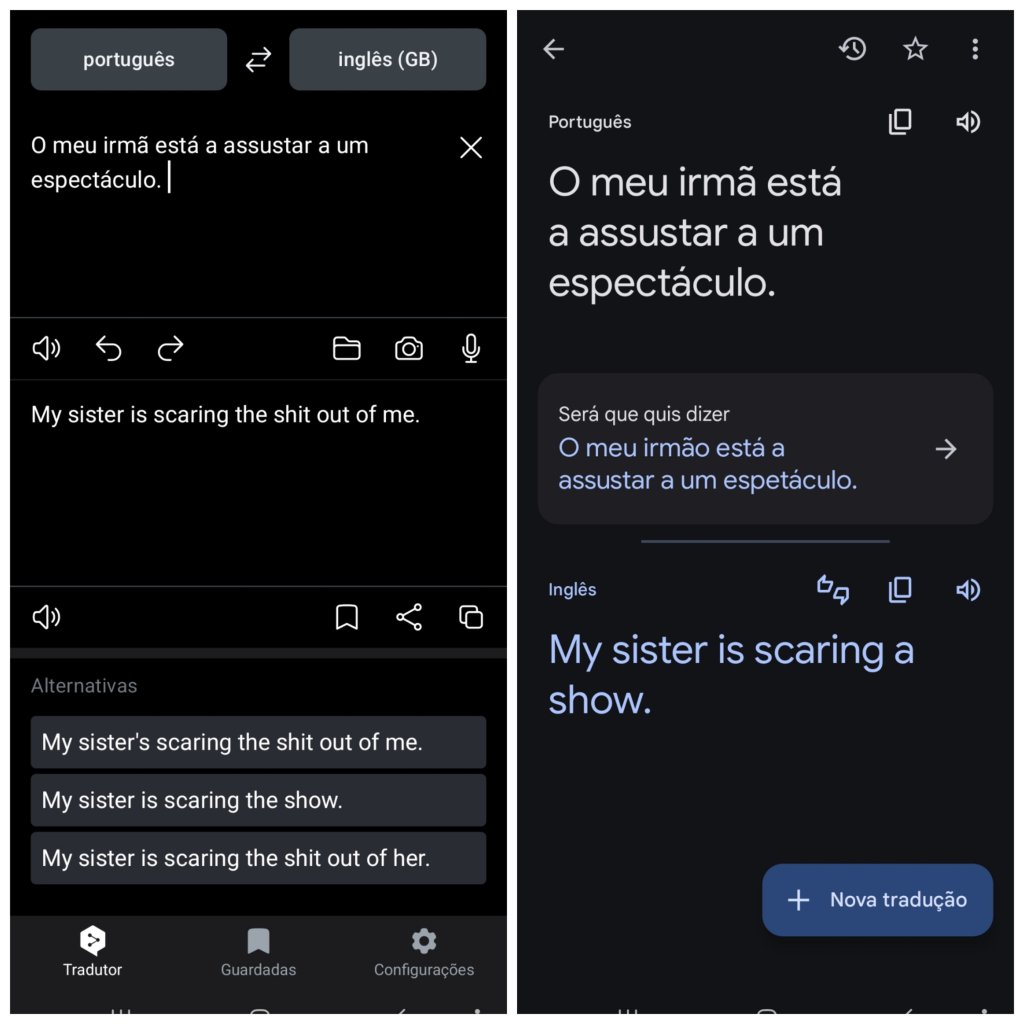
“O meu irmã está a assustar a um espectáculo”
Irmã is feminine and the “o meu” should match. The verb should be assistir, not assustar
Deepl is reliving childhood trauma. Well, that’s fine, at least it acknowledges something is wrong. Gtranslate keeps a level head, correctly mistranslates the word that is incorrect. It also offers a suggestion to harmonise the gender of irmã.
Result: Gtranslate is a clear winner since it gives a far more precise indication of what’s wrong without peeing in its pants.
Conclusion
As I said at the beginning, Deepl remains the best for English-Portuguese translation, but as the results show, in most cases, Gtranslate is better for reverse-translation in situations where you want to check your own written portuguese.
I was surprised by the results. I was expecting Deepl to be more accomplished at working around errors. It was far more hit and miss than that, but it’s undeniable in most cases that what Gtranslate offers is much more useful than what Deepl offers. You’re much more likely to be able to fix your errors that way.
Remember, this isn’t going to be enough on its own. My process is usually:
Read the text and correct obvious errors.
Paste into Gtranslate, correct what it mistranslates.
Paste into FLiP to check for syntactical errors. FLiP has its blind spots and will occasionally flag a valid word, but by and large it’s helpful.
Show to a teacher and/or post it here and wait for someone to tell me i have 38 more errors to fix.
I just noticed Linguee now has a menu right at the top of the page showing a Deepl-powered translator built into it and a “write” tab for syntax-checking. Unfortunately that last one only covers a few languages so far and portuguese isn’t one of them but it’s on the cusp of covering all the useful features: a contextual dictionary, a translator that’s better than gtranslate and soon a page that replicates the features of FLiP. Maybe now I won’t have to have three tabs open at once when I want to check my portuguese texts.
The problem with Deepl, of course, is that it’s too clever. I like to paste my portuguese texts into a translator and, if it correctly renders it into english I know I’m on the right track. Google is good for this: it will translate it back to english stupidly, making your mistake obvious, but Deepl will more likely just work around the error and translate it properly, so in a way, Google Translate is more useful because more stupid.
I like the way Linguee is shaping up though, and I will keep an eye on that Write tab!
I’ve updated the resources pages. If you’re new to the site, these are fixed pages that I update from time to time with some of my favourite learning ideas, lists of portuguese audios and anything else that seems useful.
Has anyone else tried the interactive version of Português Em Foco?
I decided to get book 4 because I’d heard good things about it, and although I’m sticking with Português Outra Vez for the time being, I thought I’d have a look at the first few pages because I was curious.
The content looks really good. Here I am in the first exercise and straight away it’s giving good, challenging exercises about how the clichés and verbal tics in everyday conversation reflect on underlying cultural attitudes. I’m not finding it easy to use though. For example, in my browser (Chrome) it is basically unusable and I can’t even scroll up and down the text on the screen. So, I got the Blink Learning app, and that seemed to be much better. I can read the text and listen to a guy reading it out, so I was quite happy, but then when I get to the interactive exercises…
I find the layout challenging. I have to write synonyms or explanations for each of the given words of phrases, but the space for text is tiny: I have to write in those tiny white rectangles on the right hand side of the screen! Now, I can do that, but the boxes don’t expand, as far as I can tell, so I can’t see the text as a whole, meaning I can’t check for any typos or anything.
Later, there are interactive exercises based on multiple choice that allow the user to validate the answers chosen, which is great, but there are also pages that need the user to record spoken answers. Well… Fine, but I assume the book doesn’t come with an actual human doing the marking, so when I’ve written or recorded an answer, how will I know whether or not I was correct?
The package only says it is a “Livro aluno e caderno exercícios”, so perhaps it’s expecting me to be paired with a tutor who will hold up that end of things, or that I’ll mark my own homework by also buying the teacher guide, but that seems to negate the idea of it being an interactive book, surely?
I dunno, I’m not feeling very energetic at the moment so maybe I’ll leave it for a day when I have more spoons and then press on to see what happens, but it’s not looking great so far.
I was bowled over by Jéssica Cipriano’s version of Madredeus’s O Pastor when I watched it the other day, shortly after hearing her version of Olá Solidão. It’s so, so good. When she really cuts loose at around 4.20, my eyes were filling up and my soul left my body. I think the pianist, David Antunes, was right there with me too. Holy shit! How is this woman not a million times more famous? How do I not even see an album of hers on Spotify? How is she not smashing Eurovision? It’s some sort of conspiracy to hide her from the ears of foreigners, I reckon.
Here’s the original from the 1990 album, Existir. You can see it’s got a richer musical arrangement, and the singer’s voice is beautiful in an ethereal way. but it’s too ethereal for me, and the band has never really grabbed me for that reason, even though they were the first portuguese band I ever listened to. They remind me of bands like Clannad, the Cocteau Twins and Enya. I feel like the voice is being used as a musical instrument; there’s not much emotion there and the words don’t really matter so much so it’s hard to get into.
Português
Inglês
Ai que ninguém volta Ao que já deixou Ninguém larga a grande roda Ninguém sabe onde é que andou
Oh, nobody goes back To what they left Nobody lets go of the big wheel Nobody knows where they’ve been
Ai que ninguém lembra Nem o que sonhou Aquele menino canta A cantiga do pastor
Oh nobody remembers Not even what they dreamed That child sings The song of the shepherd
Ao largo Ainda arde A barca Da fantasia O meu sonho acaba tarde Deixa a alma de vigia Ao largo Ainda arde A barca Da fantasia O meu sonho acaba tarde Acordar é que eu não queria
In the distance It’s still burning The boat Of fantasy My dream ends late Leave your soul on guard In the distance It’s still burning The boat Of fantasy My dream ends late Waking up is what I didn’t want
Today’s translation is from Os Quatro e Meio. Why are they called that? You’d think, wouldn’t you, that maybe there were 5 of them but one was a dog so they only count him as half because he can’t play the mandolin. But no, there are six of them. So… what, are three of them dogs? How many mandolins do they need in one band? I’ve googled it but I’ve no idea how to account for the numerical disparity* Anyway, they hail from Coimbra and they are alumni of the student music scene down there but they branched out and found themselves a following in the country as a whole. They seem very earnest young men and you can see how they’d appeal to people who like easnest young men, preferably with eyebrows and suits, and it’s a good pop song: simple, catchy and with plenty of scope to let loose on the vocals In fact, here’s Jéssica Cipriano absolutely singing the hell out of it with a very minimal musical accompaniment and it’s even better than the original. I’d never heard of her before but she has an absolutely phenomenal voice.
The translation is mostly pretty easy, although I struggled a bit with “Fiz bandeira de um velho ditado / Melhor só que mal acompanhado”. Nothing hard about it, but when I translate it the two lines didn’t seem to fit together which made me think I’d missed something and I tried experimenting with alternative meanings of “acompanhar”. For example, it’s the verb Google Mail uses when it asks if you want to follow up an email that you’ve sent and not had a reply. So I was thinking maybe “it’s only better than barely following things up….” Desparate stuff. Anyway, the punctuation makes the difference because of course “Melhor só que mal acompanhado” is the ditado mentioned in the first line. He decided to live by the idea that it’s better to go alone than in bad company
Português
Inglês
Eu já fui assim Tão focado em mim Sem querer conselhos De ninguém Fiz das nuvens lar Saltei sem olhar Crendo que no fim sairia tudo bem
I used to be like that** So focused on myself Without wanting advice From anyone I made a home in the clouds I jumped without looking Believing in the end it would be fine
Fiz bandeira de um velho ditado: “Melhor só que mal acompanhado” Nem pensava em apoiar os pés no chão Olá, solidão Olá, solidão
I made a flag of an old saying: “Better alone than in bad company” I never thought of keeping my feet on the ground Hello solitude Hello solitude
Eu tinha um lugar Com vista pra o mar Que ninguém chegou a conhecer Voei rente ao céu Tudo era só meu E o que ainda não era Iria ser
I had a place With a sea view That nobody ever got to know I flew close to the sky Everything was all mine And whatever wasn’t yet Was going to be
Olho em volta, agora estou sozinho Não liguei às placas do caminho Nem parei pra perguntar a direção Olá, solidão Olá, solidão
I look around, now I’m alone I didn’t pay attention to the road signs I didn’t stop to ask directions Hello Solitude Hello Solitude
Fiz bandeira de um velho ditado: “Melhor só que mal acompanhado” Nem pensava em apoiar os pés no chão
I made a flag of an old saying: “Better alone than in bad company” I never thought of keeping my feet on
Olho em volta, agora estou sozinho Não liguei às placas do caminho Nem parei pra perguntar a direção Olá, solidão Olá, solidão
I look around, now I’m alone I didn’t pay attention to the road signs I didn’t stop to ask directions Hello Solitude Hello Solitude
Eu já fui assim Tão focado em mim Sem querer conselhos De ninguém
I was always like this So focused on myself Without wanting advice From anyone
* EDIT: A helpful reader has suggested this web page as the source of the name: “Começámos por ser só cinco. Salvo seja, já que o Rui [Marques, contrabaixista] não tem dimensão para isso. Não é que o valor dele ano seja igual ao dos outros mas a estatura dele deixa um pouco a desejar” – I assume that “ano” is a typo for “não” or possibly “anão” heh heh
** Thanks to Liliana for suggesting I tweak the tense here (see comments below 👇)