Here’s a confusing instance of double-meanings from the C1 exercises.
The question is to find synonyms for a list of words. One of the words is “Confuso” and the options it gives are (a) desordenado (b) esclarecido (c) desarrumado (d) obscuro.
The answer is obviously (a) right? Right? Well, no, it’s (d) according to the book. I went to the Porto Editora dictionary and it seems to support my claim.
But wait, what’s that in the second row?
Nooooo!
I posted on the Portuguese subreddit in a we-was-robbed-ref kind of way and most people agreed that (d) was the best answer.
Priberam gives the same two definitions but in a different order of precedence.
Bit of a mess really. I don’t think the question is well written but it’s worth bearing in mind that Confuso has a slightly different weighting from its English equivalent.
A review of the book I’ve been reading. Thanks to Dani Morgenstern for the corrections.
Acabo de fechar a capa deste livro juvenil. É um livro daqueles que não tem um enredo muito bem definido mas está cheia de emoção. O narrador é um adolescente cujo avô faleceu recentemente. O rapaz, que se chama Edgar (também conhecido pela alcunha* “Rígel”) está a correr e a pensar. O livro é um registo dos seus pensamentos. Afirma que o dia em questão era simultaneamente o pior e o melhor dia da sua vida. O pior porque o seu avô desapareceu pela chaminé do crematório acima** e o melhor porque a Joana (irmã do seu amigo Júlio) beijou-o. Os sentimentos saltam na sua cabeça, tornando cada vez maior e o próprio Edgar sente-se maior. É o Rígel, uma estrela, uma supergigante azul, 18 vezes maior e milhares de vezes mais brilhante do que o sol. A corrida ajudá-lo a fazer sentido dos seus pensamentos até ao final quando está capaz de falar sinceramente com a Joana.
Supergigante de Ana Pessoa
* I originally used “apelido” here, since that’s the translation gtranslate gives for nickname. At the time I thought this was weird since apelido also means surname. Sure enough, the person marking the work was confused and said Alcunha was the better choice. Apelido is only used that way in Brazil, it seems.
Quite a long text, this. I split my review up over three days. Thanks to Dani Morgenstern for the corrections. I’ve put quite a few footnotes at the bottom where the mistakes were interesting enough to warrant it.
As you’ll see in the text, I had quite a bit of trouble getting hold of a copy due to the only online supplier, FNAC, refusing to guarantee delivery due to the supply chain mess we have referendummed ourselves into, so if you’re in the UK and interested in this, you might have to wait a while.
Tive oportunidade de ver este filme num festival de cinema português há dois anos mas estava doente. Logo depois, chegou a covid e a estreia do filme foi andou adiada*. Finalmente, quando reabriram as lojas online, havia problemas com as encomendas internacionais nesta ilha parva. Enfim, depois de tantos obstáculos, a minha sobrinha (que é muito simpática) entregou-me uma cópia** depois de fazer férias na Madeira. Tenho tantas coisas para dizer! Mas não quero sobrecarregar as professores, portanto irei escrever mais amanhã e provavelmente fico com alguns pormenores até o dia a seguir***!
O filme que mencionei ontem conta a história de um grupo de estrangeiros que chegam a**** Portugal em 1975 para participar na criação de uma melhor sociedade depois da queda do Estado Novo. São marxistas e passam o verão numa quinta cooperativa. Os protagonistas apresentam-se no início do filme. “O meu nome é Mick e tenho 18 anos” diz um idoso de sessenta e tal anos, e os outros também se declaram “jovens” de grande idade. Fiquei curioso, mas acontece que os realizadores tomaram a decisão de usar habitantes da aldeia, agricultores das cooperativas e até uns estrangeiros que realmente fizeram a peregrinação ao centro da ação pós-revolucionária. Portanto, cada pessoa na tela tinha cabelos cinzentos mas protagoniza a um jovem radical e idealista*****. Além disso, utilizam iPhones e não há tentativa nenhuma de recriar o mundo dos anos setenta. É uma ideia gira, com resultados mistos. Mas vou escrever mais amanhã!
A filme tenta esboçar as atitudes dos portugueses e dos estrangeiros e das****** pessoas de diversas gerações em relação ao sexo*******. Naquela época, a Europa estava em plena revolução sexual mas Portugal tinha sido reprimido por um governo conservador e por uma igreja que andava de mãos dadas. Os estrangeiros trabalham nos campos (mesmo que sejam fracas, comparados com os camponeses) e trazem com eles a cultura da igualdade dos géneros e do amor livre. Às vezes, este contraste entre culturas é iluminador ou até engraçado, sobretudo quando o idealismo dos jovens faz parte do diálogo. Por exemplo, há uma cena em que três estrangeiras aparecem num sonho dum jovem marxista (um jovem com barba grisalha!) Afagam os seus próprios seios ao tentar seduzi-lo. “Fumo, Pedro, não só em casa mas na rua e no mercado também.” “Não há melhor método de mudar as relações de produção do que beijar em público e fazer muito amor”. Infelizmente, há cenas um bocado menos efecazes e até embaraçosas, mas isso não me importa muito. Adorei o filme e fico contente por tê-lo visto.
*adiado (delayed) not atrasado (late)
**I used the word “exemplar” which is the word I usually use for a copy of a book but although not fully wrong, “cópia” was given as a suggested improvement in the context of a film.
*** O dia a seguir (the day to come) not o dia depois (the day after)
****They arrive “a Portugal” not “em Portugal”. A good example of an unexpected preposition change between languages. We would definitely arrive in Portugal, not at it.
*****I started off translating, in my head “each one… Had grey hair but they portrayed…”. But in Portuguese you don’t tend to use the “they”, so this shift from singular to plural in the same sentence doesn’t really work, and my “protagonizavam jovens radicais…” got switched to “protagonizava um jovem radical…”.
****** I keep making this mistake. In English we would say “of the Portuguese and the foreigners but in Portuguese it has to be” of the Portuguese and of the foreigners.
******* it would sound weirdly formal in English but the “em relação” is necessary here.
I updated the list of portuguese graphic novel recommendations. I keep seeing peeps on social media asking for decent easy reads, and I find it’s helpful to have a list I can point to. It’s almost twice as long now!
If you look over there on the right 👉 on a laptop or down on a phone 👇 you’ll see there are a few of these resources pages now, covering learning resources and so on.
Here are a few expressions gleaned from the C1 book
Em casa de ferreiro, espeto de pau (In The blacksmith’s house, the skewers are made of wood) People who have skills they use in work don’t use them for their own benefit.
Cada cabeça sua sentença – everyone has their own opinion
Nem tudo o que luz é ouro – all that glimmers is not gold. Easy one, this. The only thing that grabbed my interest was that “luz”. I’d only ever come across this word as a noun so I had a hard time choosing it as an option in the exercise, but it’s actually part of the verb “luzir” in this context.
Quem canta, seus males espanta – is another that threw me since it sounds like it’s saying “whoever sings will shock you with their evil deeds” which is probably right for Michael Jackson, but “espanta” can also mean scare something away or chase it away, and “males” can be a person’s woes or troubles, not actual evils, so it just means if you sing a song you’ll chase your blues away. OK, cool.
Zangam-se as comadres, descobrem-se as verdades – When the godmothers start arguing, the truth will come out. In other words, when people start getting heated they tend to say things they would normally keep to themselves
Ladrão
O ocasio faz o ladrao – the opportunity makes the thief. This seems to be used slightly differently. If you look around various sites, some people take it as meaning that a person driven by circumstances might steal but isn’t to be regarded as a born thief; others take it as more like “if you don’t take care of your stuff someone is bound to nick it”. A middle way seems to be “People might be tempted to steal if there isn’t a strong motivation for them not to”. That seems to be how this guy interprets it anyway,and he mentioned a reference by Machado de Assis who says “Não é a ocasião que faz o ladrão, o provérbio está errado. A forma exata deve ser esta: a ocasião faz o furto; o ladrão já nasce feito”.
It’s definitely a pessimistic expression, anyway!
Em águas de bacalhau – I keep seeing this one and forgetting what it means. Apparently it comes from the fact that cod fishing used to be very dangerous, back in the day, and you were quite likely not to come back from a fishing trip if you went off to the cod fishing waters. So if something “deu/ficou/continuou em águas de bacalhau” then basically it came to nothing and had no result.
Trazer água no bico – bring water in your beak – do or say something sneaky or with a hidden agenda
Dar água pela barba – Give water in the beard (“sweat through the beard, I guess?) If something dá água [pela barba, it’s something very complex and challenging
Here are a few that are easier, because they’re equivalent to english expressions
Fazer crescer água na boca – to make the mouth water
Como peixinho na água – like a fish to water
Enquanto há vida há esperança – where there’s life there’s hope
Em terra de cegos quem tem olho é rei – in the land of the bline, the one-eyed man is king
Cao que ladra nao morde – his bark is worse than his bite (lit “A dog that barks doesn;t bite”)
Quem semeia ventos, colhe tempestades – sow the breeze, reap the whirlwind
I hit an exercise that had quite a lot of expressions I hadn’t heard before
Um amigo de Peniche – comes from a British action during the succession crisis of the 1580s. Nine years after the Spanish seized the portuguese crown, a force led by Francis Drake landed near Peniche ostensibly to restore the crown to Dom António, Prior do Crato, but really to prevent the Spanish launching another armada and, in the process, also doing quite a lot of looting and attempting to seize the Açores to sever the route if the Spanish silver trade. So an Amigo de Peniche is a friend who is only really looking out for what they can get out of the friendship and doesn’t really give much in return. Apparently people from Peniche are self-conscious about being associated with treachery and never miss an opportunity to tell you the true origin.
Peniche TrutherYou used to call me on my cellphone, to help restore you to the throne
Um unhas de fome – a grasping, tight fisted person
Um atraso de vida – a harmful or annoying life problem
Um amostra de gente – a very small person
Um mãos-largas – a very generous person. Note that here (and in a couple of other expressions, the article “um” doesn’t seem to match the noun. That’s because this is a description of a person, and the default is singular and masculine, even if they are described as having wide hands – mãos largas – feminine and plural.
Um bom garfo – a gourmet
Um cabeça de alho chocho – if you are an old shriveled garlic head, you’re a forgetful, absent minded person.
Um bota de elástico – someone who dresses, acts, or thinks in an old-fashioned way
Writing letters of complaint is a popular exam exercise. I’ve pinched a couple of phrases from a C1-level example, highlighted in the text
Londres, 5 de Outubro 2021
Assunto: Apagão* do site
Exmo Sr Zuckerberg
Venho por este meio*” apresentar uma reclamação relativa ao assunto em epígrafe***. Ontem, tentei entrar no seu site, Facebook, para ver memes sobre gatinhos mas o site estava em baixo. Ao falhar desta tentativa, dirigi-me ao Instagram mas isto também não deu êxito. Fui forçado a falar com a minha própria família e a ouvir as opiniões da minha esposa e da minha filha sobre o Squid Game. Fiquei com marcas mentais que provavelmente nunca se curarão. Devido a esta situação, gostaria de ser ressarcido pelo honorário do meu psicanalista e uma indemnização por danos causados. 2 biliões de dólares deverão ser suficiente. Sem outro assunto de momento e aguardando uma resposta da vossa parte**** Com os melhores cumprimentos _________
* “Apagão” “em baixo” are phrases I pinched from recent news articles but I don’t think the terminology is very fixed. The marker changed the latter to “tinha ido abaixo” But I’ve left it as it was since I guess the Jornal de Notícias has its reasons.
**This phrase is something like “I hereby”. Super-formal, obviously.
***This is referring to the title line so only works if you’ve written a subject at the top of the letter
****More formal boilerplate – Not having anything further to say and awaiting a reply in your part.
The recipient reacts to my complaint letter
My wife tells me people really do write in this sort of formal style. Probably not about cat photos, but still…
Translating one of the poems I’ve been learning. It’s by Ricardo Reis, one of Pessoa’s Hetronyms. I found it a bit inspiration-postery at first but it’s really grown on me, especially the last two lines of the first verse and the last two lines of the last:
Portuguese version
Translation
Segue o teu destino. Rega as tuas plantas. Ama as tuas rosas. O resto é a sombra De Arvores alheias.
Follow your destiny Water your plants Love your roses The rest is just the shadow Of other people’s trees
A realidade Sempre é mais ou menos Do que nós queremos. Só nós somos sempre Iguais a nós próprios.
Reality Is always more or less Than we want We alone are always Equal to ourselves
Suave é viver. Grande e nobre é sempre Viver simplesmente. Deixa a dor nas aras Como ex-voto aos deuses.
It’s easy to live It’s great and noble always To live simply Leave pain on the altar Like a votive offering to the gods
Vê de longe a vida. Nunca interrogues. Ela nada podes Dizer-te. A resposta Está além dos deuses.
Look at life from afar Never question it It can’t tell you Anything. The answer Is beyond the gods
Mas serenamente Imito o Olimpo No teu coração. Os deuses são deuses Porque não se pensam.
But serenely Imitate Olympus In your heart The gods are gods Because they never think of themselves
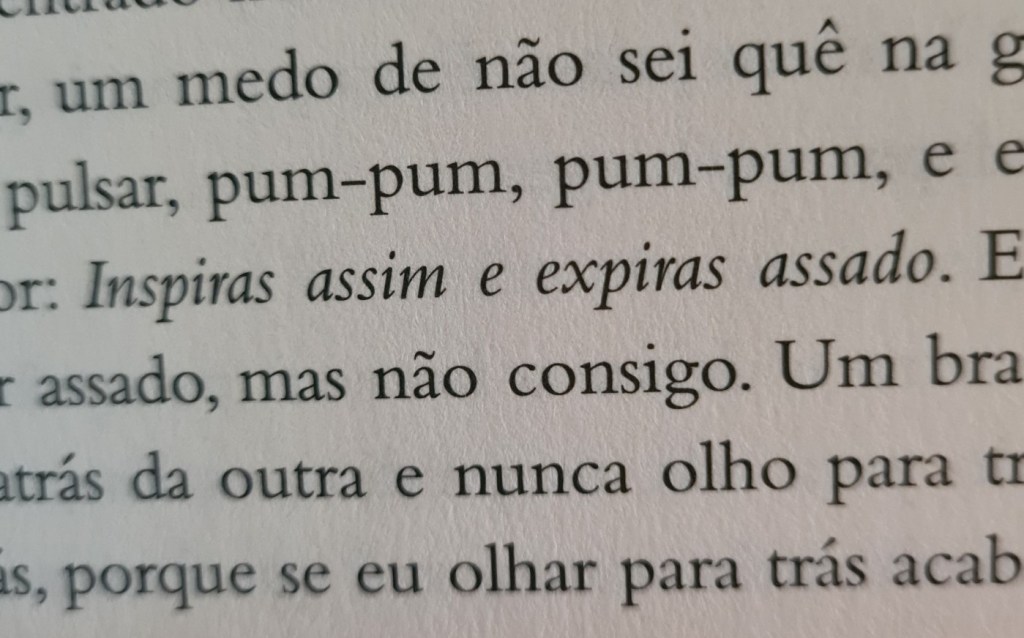
Here’s another one of those posts where I find some weird thing in a book and I bring it to the blog and drop it on the doormat like a cat with a mouse. Check out this rodent corpse:
“Inspiras assim e expiras assado”
The first bit is easy: “You breathe on like this” but what’s with “Assado”? Assado means “roasted”. But according to Priberam, “assim e assado” is an expression meaning “like this and like that”. So breathe in like this and breathe out like that.



 Luso
Luso 