So here’s a good example of half-understanding a song and completely missing the point. I always thought this song was about a Moorish (Moroccan, Saracen, Muslim) sorcerer of some kind, but swotting up on my Ana Moura lyrics ahead of next week’s concert, I found out that it’s not that at all. Apparently a Moura is a fairy-tale creature from old Galician and portuguese legends. Reading the description on the Wikipedia page, it sounds an awful lot like a djinn/genie of Arabic folktales, so it’s not wholly fanciful that the moor in the sense of Moorish invaders (Mouros) and the Mouro/Moura of legend are bound up in some way, but it certainly illustrates the point that relying on half-understanding most of the words in a song can be deceptive!
Tag: culture
A Música
I’m just putting a list together of Portuguese music that I can listen to on Spotify and I have been looking at lyrics/translations of songs. There are still loads of tracks on my iPod that I can’t quite follow so I have to figure out what the words are. It’s a pretty good way of learning vocabulary. As usual, I am often quite surprised at the humour hiding in what sounds like a fairly straight-faced song. Like this one for example: I had no idea what they were saying, but once I saw the words on the screen this whole world of content poured out of it and now I can enjoy it on a whole other level.
The list is here, by the way. It has a couple of non-European accents – Os Mutantes (Brasil) and Cesaria Évora (Cabo Verde) but apart from that it’s sound.
I think I’m something of a freak for not liking DAMA since everyone asks me if I do. They must be like the Portuguese Coldplay or something – one of those bands that seem to be inexplicably popular despite their overpowering blandness. I only like one song and that has a Brazilian rapper on it so I can’t listen to that either.
Língua Dos Pês
I mentioned a little while ago that I was intrigued by a Luisa Sobral song called “Língua Dos Pês”, which means “The Language of Ps” or if you prefer “P Language”. As it turns out, this is a song with a back-story. It’s a made-up language, similar to the Pig Latin or Egg-language (aka Eggy-Peggy or Egglish) that you might be familiar with if you went to the right school. It isn’t a proper language or even a secret code, more of a language game you can play just for the fun of it.
Like everything else in Portuguese, it has a European and a Brazilian variant. As you know, this blog is fully on-side with Europe, so we’ll stick to that. Basically, all you need to do is repeat each syllable of each word, but with a P at the start, either before the vowel or in place of the consonant. So for example the name of Luisa’s album is also her first name, Luisa, which, in Língua dos Pês is Lu–Pu–I–Pi–Sa–Pa.
It sounds quite nice in Portuguese:
da-pa ten-pen-ta-pa-ção-pão son-pon-o-po-ra-pa de-pe u-pu-ma-pa me-pe-tá-pá-for-por-a-pa*
which is why she is able to sing a song in it, but it’s awkward in English:
He-pe-llo-po My-py name-pame is-pis Col-pol-in-pin
and similarly, eggy-peggy sounds like a disaster in Portuguese
Peggor eggexeggempleggo eggestegga freggasegge
And it gets worse if you use the actual Portuguese word for egg:
Povoor ovoexovoemplovoo ovoestovoa frovoasovoe
Geggood legguck preggoneggouncegging theggat!
It’s interesting that certain types of language game suit specific languages better than others, although I admit I don’t know quite what it means.
OK, are you ready to look at that video again? Well, the one I posted last time, from the children’s TV show “Panda and Friends” was pretty toe-curling, but there’s a much better version here in an an interview with O Observador. She talks a bit about the track and the album in general, then starts singing Língua Dos Pês at about 5:42 and carries on with “Onde Foi o Avô?” (“Where did Grandpa go?”) and her single “João”.
If you need any help, there’s a translation of the song here but only into straightforward Portuguese. You’ll have to do the rest yourself!
Further reading:
Wikipedia Page about Língua dos Pês, with various dialects (includes links to other similar dialects in other languages)
The Brazilian equivalent if you’re interested is called Língua do P.
*=this is a line from a poem by José Jorge Letria. I heard it on a podcast and didn’t understand the whole thing but picked out “A poem born of an impulse, of a fever… of the sonorous temptation of a metaphor” early on. Ooh yeah, more of that please!
Portuguese Views of Brexit
Here in the UK, everyone’s nerves are shredded. It’s the 22nd of June, the day before the referendum. At this stage, nobody is going to change their mind and on Twitter, conversation quickly moves from disputing the veracity of a statistic to name-calling, blocking and general unpleasantness.
That being the case, I thought I would go further afield and look at some Portuguese reporting on the Brexit on the grounds that looking in from the outside might give some useful perspective. A few days ago, I blogged about the delightful description of Boris Johnson by Miguel Esteves Cardoso in a column in Público (cf “Learning from the Brexiteers“) but I have come across some other examples, too. As you would expect, it’s a mixture of fear for the future of the EU and the Western Alliance more broadly, versus a sort of mystified bafflement about why we are having this collective hissy-fit, and I’ve even seen a few saying “sod ’em” and describing the UK as “the Crying Child of Europe”. It’s a fair cop.
First of all, I was interested to see some views from Portuguese people living in Britain. Here’s one in the Jornal de Notícias, and another in Bom Dia Europa. The worry for existing residents is twofold. First of all, although it’s unlikely there would be mass deportations, nobody knows what post-brexit Britain will be like, so it’s not impossible, and with the mood getting as ugly as it is. I know my wife and some of her friends are already sensing a higher level of ambient resentment against them from people whose opinions are formed by the Daily Mail and Daily Express. Secondly, Portuguese people will have a higher level of hassle and inconvenience moving about,. Presumably it’ll be the same for Brits living in Spain who will be lose a lot of their current rights and entitlements. And we haven’t even got into things like VAT harmonisation and the nightmare small businesses will face dealing with paperwork, reclaiming money and on and on. Some of the interviewees are small business owners and there’s a level of concern about the unknown consequences as they see the remain campaign being forced onto the back foot by the giddy, unthinking optimism of the leave campaign for some ill-defined future. Some are considering leaving.
Next, let’s look at a blogger – César Agosto – who writes for Homo Causticus on WordPress. He has blogged a few times on the referendum and related matters such as the last general and mayoral elections. I don’t know anything about him but I guess he must live here, or visit often, or at least be a keen bifewatcher because his blogs draw on a knowledge of history and pop culture. In “As Propostas Por Favor” he rightly highlights the lack of a clear sense of what is to come after Brexit, and the problem that causes in trying to decide whether or not you want to support it. In Life on Mars he uses the TV show of the same name as a jumping-off point to illustrate differences between the seventies, when the first EEC referendum took place and the modern world, where we are now holding the second one on the European Union. The first is typified by the famous debate between Tony Benn (much-revered eccentric hero of the left) and Roy Jenkins (mainly remembered, I think, for his speech impediment). Each one is measured and forceful, defending their views (basically: economics vs democracy) without rancour (just as well… I don’t like to think what would happen if Roy Jenkins were to say “Rancour”).
What he could add, but kindly doesn’t, is that the second is typified by the sight of useless, workshy UKIP MEP Nigel Farage telling Herman Van Rompuy ” I don’t want to be rude but, really, you have the charisma of a damp rag and the appearance of a low-grade bank clerk”. And this is what our country has come to after forty years. Other modern figures get a mention too, and not just the usual suspects. Redwood gets a mention, and Cameron’s Eton demeanour is contrasted with Sadiq Khan, famously the son of a bus driver. Bizarrely, he is described as charismatic, although to me he seems to disappear into the background on any stage he’s on, even when he’s actually speaking, but hi ho.
In the news media, there is some sympathy for the idea that the EU is in need of a good kick in the arse. For example, José Pedro Teixeira Fernandes says “Long Live the European Union – and Down with the technocracy of Brussels and Frankfurt” while José Vítor Malheiros proclaims “The EU has turned Europe into a brothel” and argues that the brexit might just cause a welcome return of democracy to the region. Portugal, of course, has had its fair share of problems with the EU, and has more cause for complaint than our whining. With that in mind, Paulo Pisco calls the brexit vote “A national egoism” and defends the humanist spirit of the European project against the xenophobia and selfishness of one nation that seems to want to dominate it completely. Actually, Público is buzzing with columnists looking for an angle on the story, so you can take your pick, really.
Finally, there’s an article I can’t even read in its entirety because it has a paywall but I liked the first few lines. As you know, last week some deranged idiot, driven on by some misplaced sense of fighting against “traitors” shot and killed his local Member of Parliament, Jo Cox, near a constituency surgery. There was – and still is – a heated and rather nonconstructive debate about the extent to which the tone of the Leave Campaign’s rhetoric fed a climate of violence that led to the attack. In “I am Jo“, João Duque invokes the memory of “I am Charlie” to stand with her against violence and for European values. Paraphrasing the first three sentences:
If Jo Cox died because she believed the UK is important to the EU then I am Jo
If she believed that a more diverse Europe can be richer and more stable then I am Jo
If Jo Cox believed that democracy will allow wisdom to prevail then I am Jo
UrbanGay – Portuguese Blog
I came across another site via Twitter and a shared interest in Practice Portuguese. Urbangay covers Portuguese as one of its main strands- along with running and gay culture in general. If you are gay and studying Portuguese, you’ll almost certainly be interested in some of his posts on the history of gay life in Portugal, or on the Lisbon scene (have a look here), but even if you’re not, there are plenty of interesting blog posts, including one about language-learning resources. It covers some of the same ground as my “Language Hacks” post but he has some other ideas and I’ve plundered it for my own study. Go and have a look.
O Patio Das Cantigas
I watched the remake of the 1942 classic today. Why? Why did I bother? As far as I can tell, it’s not as funny and not as easy to understand as the original. If you’re considering it, save your money and watch the real thing on Youtube.
The DVD doesn’t have Portuguese subtitles, only English ones. The youtube video has Portuguese subtitles but (my sources inform me) they’re not very accurate. It looked like a much better film though: Better acting, not trying as hard, and they talk at a more manageable pace. I’ll do it properly next time.
As Cartas
Letters are right at the end of the textbook I’m using but they come up in some of the mock exams I’ve looked at so I thought I’d better get familiar with them
1 – Formal
Londres 20 de Maio de 2016
João Imaginário
Faculdade de Letras da Universidade de Lisboa
Alameda da Universidade
1600-214 Lisboa
PortugalExcelentíssimo Senhor
Desculpa de não ter escrito mais cedo. Tive dores nos dedos por causa de tocar demasiado o violão e por isso não pude usar o teclado.
Fiquei espantado e encantado ao receber a sua oferta de tornar-me Professor de Português. Depois de muita consideração, acho que devo recusá-la neste momento porque preciso de mais pratica. Pode ser no próximo ano?Obrigado outra vez
Os melhores cumprimentos
18ck
2 – Informal
Londres 20 de Maio de 2016
Caro Jose
Obrigado pelo livro que enviou-me para o meu aniversário. Não tenho lido livros de China Mievile, mas gosto muito de ficção científica e ouvi que é um escritor interessante. Estou contente por saber que a sua equipa ganhou o tri campeonato, seja lá o que isso for.
Um abraço
18ck
So it looks like Caro is the rule for starting letters in informal situations and Excelentíssimo (or “Exmo”) for formal. I have also seen “Prezado” (“esteemed”) but I believe that’s more of a Brazilian thing.
The sender’s address only seems to be the town and date in the format shown. Recipient addresses have the format:
[Recipient Name]
[Housename] (optional)
[Streetname] [Streetnumber]
[Locality]
[7 digits] [TOWN]
[PORTUGAL] (if posting internationally)
Endings seem to be “os melhores cumprimentos”, “Atentamente”, or further down the scale of formality, “um abraço” (seems to be common between men) or something with beijo or beijinho.
Formal letters also seem to use v/ for Vosso and n/ for Nosso. I haven’t seen these anywhere except on the formal letter sample in Lathrop and Dias, which is sort of weird.
Uma Tradução Nova
Tentei de traduzir um outro canção de Deolinda. Olhe o video debaixo (O vestido dela é impressionante, né? A voz também, mas o vestido… diacho!)
Parece muito mais difícil do que o ultimo. As palavras são bastante simples mas há algumas frases que no pude entender no inteiro. Ainda o título é um osso duro a roer. Espero que o resultado não é tão longe do verdade!
Song at the Side
Forgive me, learned men, aesthetes,Poetic spirits, gentle souls,For the falsity of my genius andMy wordsWhat is the scholarship that I sing,What is life, wonder,What is beauty, grace,But I just aspire to the artOf planting potatoes.Forgive me for every little thing,but there is nobody here who sings fado.If you came to hear Deolinda,You came to the wrong place.We are in a house next door.We all went to a house next door to us.I know well that there are writerly trowels,Literary plasterers and hard-working poetsAnd poets who are true masonsOf letters,And they sing in genuine art, the humble fishermanThe modest seller of fishAnd so the singer should devote herself to fishing.Forgive me for every little thing,But there is nobody here who sings fado.If you came to hear Deolinda,You came to the wrong place.We are in a house next door.We all went to a house next door to us.Why not do what I like.I sing with disgust the fact thatI am hereAnd somewhere I know someone unsuitableTakes my place.No one is happy with what he hasAnd there is always someone coming and theyAre as good as us;But that someone is usually notWho they should be.Forgive me for every little thing,but there is nobody here who sings fado.If you came to hear Deolinda,You came to the wrong place.We are in a house next door.We all went to a house next door to us.And it is the change I propose;It is not a fearful stepIn dark utopias,It is as simple as changinga radio station…I propose that they change with you andPut their lives right.
Portuguese Somersault
Eastbourne doesn’t have much to recommend it but it has – or had when I lived there, anyway – an absolute jewel of a bookshop. It was a massive, sprawling affair with three floors and no recognisable system. Sometimes there was a parrot upstairs. And it was there that I first came across a book called “Portuguese Somersault” by Jan and Cora Gordon. I’d never heard of it before and I haven’t heard much of them since, either. To my surprise, though, they are still known today, and there’s a chap who has taken the time to curate a fan site, with biographical details and more about their various travel writings, which you can find at janandcoragordon.co.uk.
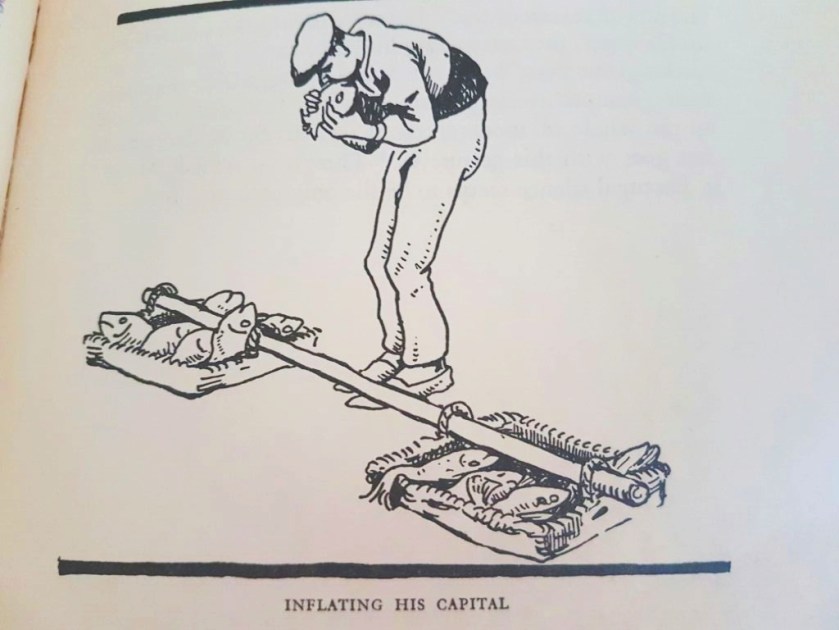
The book is actually two books, written in 1926 and 1933, detailing their travels in the country. They are reflective travellers who took the trouble to learn something of the language and to investigate their own preconceptions of the country. Along the way, they made sketches, and these are scattered throughout the chapters as illustrations. Here, for example, is a fish seller blowing into his fish to make them look bigger so he can get a better price. Cool eh?
I read it yonks ago and can’t actually remember a whole lot of it, to be honest. Maybe it’s due for a re-read. What I do know is that the “Somersault” of the title is a reference to the dramatic change in the country between the two visits. 1926 was the year of the coup that overthrew the Primeira República Portuguesa and established a dictatorship which, by 1933, when they returned, had become known as the Estado Novo (New State), led by António de Oliveira Salazar.
One small, dark detail stuck in my mind that gave me a little premonitory shudder: On page 75, they meet a Portuguese girl who had been separated from her parents during the Great War and left with relatives in Germany. Growing up, she believed herself to be German. When she was finally reunited with her parents, ten years later, she was pleased of course, but it came as a huge shock to her to find that she wasn’t a German at all. What a jolt that must have been to a girl who felt herself to have a “German Soul”. Now, at the age of seventeen, she would have less freedom than before. Worse, she would have to marry a Portuguese man who wouldn’t even understand her German love. Well, I think we can all see how this sort of cultural dislocation would be a shock to anyone. What I thought was telling, though, was when she describes her disappointment at finding out that she wasn’t who she thought she was:
“They want me to be a nice Portuguese girl but I can’t because, you see, I’ve been brought up as a German girl, and I was taught in the school that the Germans are the higher race, aren’t they? Do you see that?”
Jan and Cora note this as a minor personal tragedy but don’t comment on the idea that Germans are teaching children to feel themselves superior to everyone else. And this just ten years from German bombs falling on neighbouring Spain at the start of the Civil War, thirteen years from the start of the Second World War. The Salazar government was neutral in both, but gave military and logistical support to the Nationalist (and German) side in Spain and was broadly sympathetic to Hitler, only staying out of World War Two because of long-standing alliances with Britain.
Well, it’s easy for me, with the benefit of hindsight, to read more into this incident than the Gordons did. I certainly don’t mean to suggest that they should have seen the future in that one little tale, but I thought it was a fascinating little glimpse into what was happening under the surface of Europe in the inter-war years.
Birthday Swag
The bundle of Portuguese swag I ordered on my birthday has arrived after only five days, which is a lot better than Amazon can manage these days. Nice work FNAC!
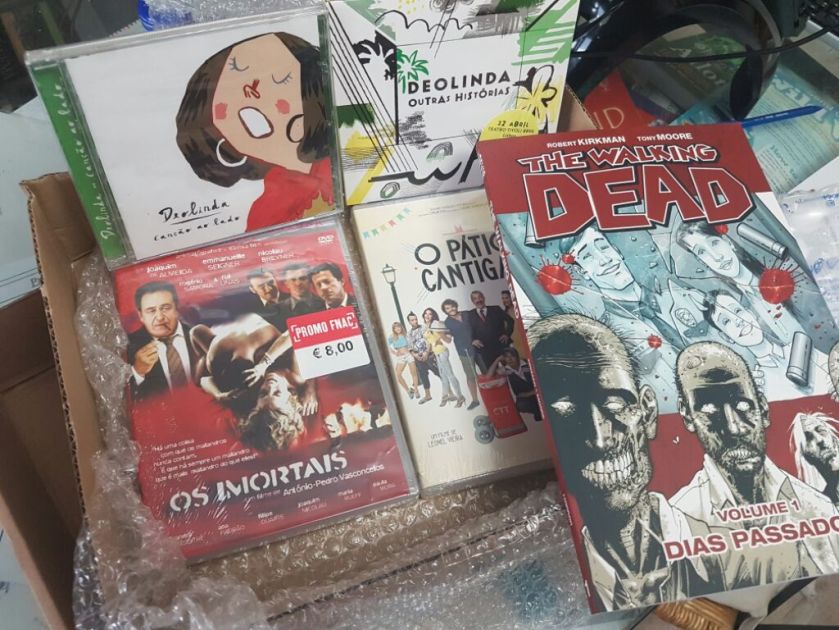
The Postman brought me…
Dias Passados – Walking Dead Vol 1. I’ve never read any of these or seen the series so I guess I might as well use “it’s homework” as an excuse to start.
Os Imortais [Amazon link
O Pátio das Cantigas by Leonel Vieira,which is a modern remake of an old classic. I probably should have bought the old classic, but I’m an idiot so I got this instead
Canção ao Lado and Outras Histórias by Deolinda [Amazon links here


