My First Actual, Proper Portuguese Joke
I had this idea for a joke in Portuguese yesterday while I was studying and I decided to turn it into a tweet. The verdict seems to be that it’s a bit crap.
One guy on iTalki liked it when I put it up for corrections but everyone else said “I can see what you’re driving at but I didn’t actually laugh”. And it got zero retweets on Twitter.
The english translation, though, got 54 (and counting!)
…which is more than any other tweet I’ve ever done with the exception of a photograph of a train cake I made for my daughter’s birthday party that was so bloody awful that it briefly catapulted me to Twitter-fame. I’m not really sure what this means. I mused on iTalki…
Fiz uma “tweet” com a piada em português e então fiz um outro com uma tradução em inglês (a piada corre bastante bem em inglês também: “Arctic”/”Article”). O tweet inglês retweetou-se cinquenta-e-dois vezes, e o português… nada! Talvez este facto mostra que a piada não é engraçada em português, mas provavelmente somente mostra que a maioria dos meus seguidores não falam português!
…but I wonder is it purely because so few lusophones saw it or is there something specific about the humour that gets lost in translation?
Tickling the Lusophones
Obviously, some things are never going to translate because the humour hinges on a pun that wouldn’t exist in the other language. Like these:
p: qual é o animal que tem mais que três olhos e menos que quatro? r: piolho
p: qual é o instrumento musical que tem mais que três e menos que quatro anos? r: piano
(taken from here)
These jokes only work because the portuguese words pi+olho=piolho (π+eye=louse) and pi+ano=piano (π+year=piano). That’s a total dead-loss if you wanted to translate it.
In other cases, joke formats are specific to a time and place. The Portuguese don’t have lightbulb jokes, for example, so when I sent this to my teacher, she didn’t recognise it as a part of a wider tradition.
Quantos Brasileiros precise para mudar uma lâmpada? Nenhum. Lâmpada não mudou por causa do acordo ortográfico
To be honest, I think I’m a long way from understanding whether there is some impassable barrier to fully understanding what tickles another nation. I’d love to find out though!
Mnemonics
In the meantime, jokes and puns are a great way of brushing up your language skills and helping you remember stuff in a way that isn’t boring. Along the way, you get an insight into what makes people laugh in other countries. Here’s a guy getting his head around an old joke in English, for example. I happened to see it on iTalki today. They can be bilingual or just in the target language.
One of the simplest examples of puns as language-learning tools would be a mnemonic. Maybe you didn’t even realise that’s what you were doing when you came up with a mnemonic, but it’s all about the word play, baby, whether it’s acrostics, poems or puns. For example
You use a puxador when you want to push a door open
A puxador is a door handle and it is pronounced “pushadoor”. This is great until you find out that “puxar” actually means “pull”, not “push”. Push is “empurrar”, but even as you’re telling other people about this annoying fact, and tweeting “FML” about it, you are actually embedding all three new words in your mind in a single bad-luck anecdote, so it actually works better for being misleading.
 One of my favourite apps, Memrise, encourages users to make “mems” – pictorial mnemonics – to help each other remember words. I have only done one because although I have ideas, who has that kind of time?
Here…
*points right*
…is my Mem for “As Cuecas”
Consoantes Perdidos
Another favourite joke format is the Lost Consonant. This is a format developed by Graham Rawle of the Guardian, back in the late eighties. He used to write a sentence that had one consonant omitted from one word, totally changing the meaning of the sentence. What I like about these is the challenge of making the grammar of the sentence work properly with or without the missing letter. That makes it a fun challenge for a person learning to write sentences in other languages, and to be honest, I suspect that I haven’t got it right every time when I have tried it. For example
which means
Increase the battery life of your mobile phone by not washing it in bleach
with the added c in “bateria” you get
Increase the life of the bacteria on your mobile phone by not washing it in bleach
But does the grammar actually make sense in either or both of these sentences? Christ knows, and I can’t even think how I would explain all this to a Portuguese person so they could judge. They’d think I was off my head.
There are some examples of original Graham Rawle Lost Consonants here.
Twitter Lost Consonants in English (#lostconsonants)
Twitter Lost Consonants in Portuguese (#consoantesperdidos)
Cartoons
I have already banged on at length about Astérix cartoons as the gateway to better vocabulary, but there are plenty of cartoons out there on the web if you know where to look and they can be quite instructive. Like this for example:

It works because “nada” means “nothing” but it’s also the second person singular imperative form of the Portuguese verb “nadar” – so it means, “hey, person I know reasonably well – you need to swim now!” And there’s no better way of remembering that fact than by laughing at this joke!
I found a new comic I like called Zorg & Borges recently. I think it’s on this page but the Publico website seems to be horrifically slow right now so apologies if this sends you to the wrong place. There’s a single example of it on here for sure though!
 Hoje, dois artigos no jornal “Publico” chamaram a minha atenção. Nos dois o objecto é Portugal e a sua lugar em Europa. O primeiro artigo se publicou ontem, no aniversario do “revolução dos cravos”. Este artigo diz que um quinto da população do Portugal têm saudade do “Estado Novo” (o governo de Salazar e, depois dele, Marcelo Caetano, que dominaram o pais entre 1933 e 1974). Surpreendi-me. Não entendo como tanta gente num pais como Portugal podem sentir simpatia por um governo que tinha muitas características do fascismo! O artigo sugere que uma razão importante atrás desta simpatia de autoritarismo está a crise económica. E esta conclusão parece razoável: Nos tempos difíceis, as vezes, algumas pessoas voltam-se aos partidos que oferecem respostas fáceis, mensagens claros e uma imagem de força. Felizmente, a maioria dos Portugueses não concordam. Eles orgulham-se do seu pais e da sua revolução.
 Os Feijões, os feijões
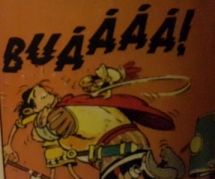
  I mentioned in a previous post that the Portuguese seem to use “Tiquetaque” in place of “Tick Tock”. This made me dig out my old Astérix comics and check out the sounds made by people and things during the course of a story
 Dogs, I’m less sure of. Dogmatix is called Ideiafix in Portuguese (Asterix character names, on their own, are probably a subject for a blog post for someone with more linguistic skillz than I have now). In the books I have, the only noise he makes is “CAiMM!” but that sounds more like a yelp than a bark. I googled it and apparently the more conventional dog noise is “Au Au”. OK, I can believe that.
 Moving on to inanimate objects, how about knocking on a door?