While looking for the meme in that last post, I came across this remarkably optimistic one. I don’t know how they got off so lightly!
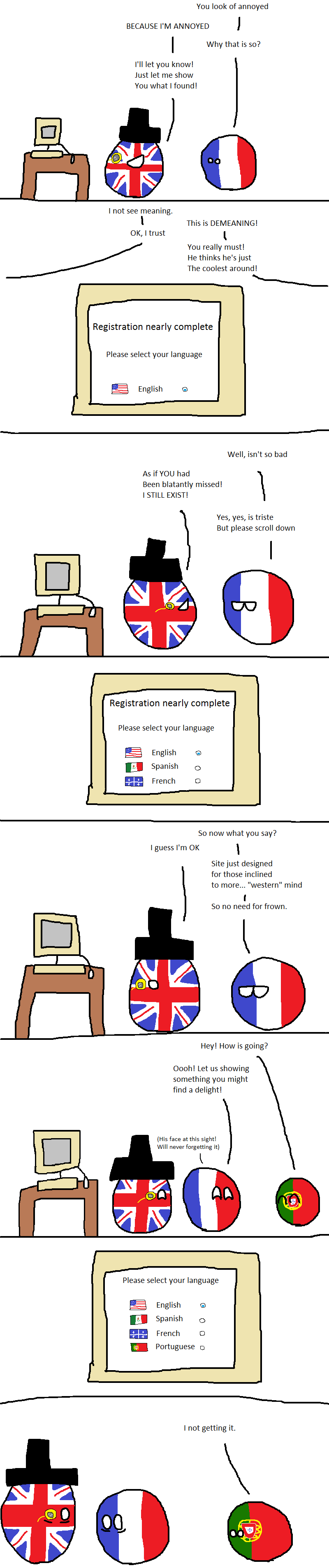
While looking for the meme in that last post, I came across this remarkably optimistic one. I don’t know how they got off so lightly!
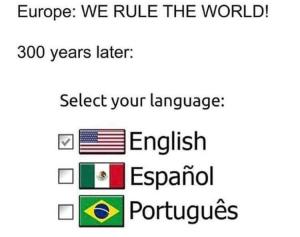
I’ve mentioned a couple of times (here and here) now that I have had long, rambling discussions with Brazilians about whether the third person singular (the “we” form) in the past perfect tense is identical to the present tense. It is in Brazilian but not – or at least not normally – in european portuguese.
I actually ran into a portuguese guy from Beira Alta who says that, where he lives, they say the two words the same way (not surprising) and spell them the same way too (more surprising). We had a bit of a chat about it back and forth and he agreed that the accent in the written form was helpful (I agree 100%) but he wasn’t going to change the way he spoke (also agree 100%) and like a lot of Portuguese people, he felt like the Acordo Ortográfico was an annoying imposition from on high that he didn’t really buy into.
I feel like this was quite a useful conversation for both of us. For me because it’s good to learn about different accents and ways of speaking and I hope also for him because most people in most countries don’t really reflect on their own language until they hit something unexpected, and I like to think that by having this conversation he enjoyed thinking about his own language as much as I do. For example, I mentioned that the two versions (falamos and falámos, say) would both have the stress on the second syllable and he said no, they don’t stress the word anywhere. I guarantee you, there is no portuguese word that is spoken in a flat, robotic monotone. I made a joke about how most words in portuguese are either oxitono (stressed on the last syllable) or paroxitnono (penultimate syllable) and a few are proparoxítono (antepenultinate) but maybe there needed to be a new word “nenhuresitono” for words that are stressed nowhere.
I have learned a lot about my own language from talking to foreigners who were trying to learn it and I really hope his encounter with this confused British chap was helpful for him in the same way.
* I talked a lot about proparoxítono during my brief obsession with Chico Buarque’s excellent song Construção. If you haven’t heard it, I strongly recommend it because it is educational but more importantly its effing brilliant. Yes, I know it’s in Brazilian portuguese, but it’s worth making an exception for! My original post about it, complete with the video, is here and I’ve continued to bang on about it here and here
LinkedIn allows you to make profiles in other languages now, so I wrote a brief description of what I do as a header for a portuguese version. It might take a whole to get together enough motivation to do the same for my entire carer history though!
Sou um consultador informático, especialista em migração de dados. Possuo um conjunto de conhecimentos técnicos através dos quais ajudo os meus clientes a transferirem as suas informações para uma nova infraestrutura. Moro em Londres e trabalho principalmente com câmaras municipais inglesas mas gostaria de trabalhar com clientes portugueses. Adoro Portugal e sou apaixonado pela língua portuguesa.
No picture with this one. When you read it, you’ll be glad I didn’t take a picture. Thanks to Dani for the corrections.
Durante três anos e tal, o meu lote na horta comunitária esteve protegido por um dispositivo que espanta raposas, gatos e ratos mas principalmente raposas. Isto porque houve uma vez uma raposa que deixou o seu cocó nas folhas dum morangueiro. Que nojo!
Mas recentemente, esse assustador de animais ficou avariado e deixou de fazer barulho quando uma criatura se aproximava. Ora bem, a Mãe Natureza mostrou o seu desprezo face às travessuras dos seres humanos: hoje, quando cheguei, vi que uma raposa derrubara a máquina, deitara-a no chão e cagara logo no centro do alto-falante!

Este livrinho é um conto que descreve o afastamento da avó paterna duma família depois da morte do seu filho (o pai do narrador). É breve, claro, mas a autora Cláudia Oliveira, consegue retratar o percurso da tragédia de modo simples para que entendamos a tristeza da situação.
“O Dia em que Deixei de Falar com a Minha Avó” is available from kobo and kindle. It’s a short read. The vocabulary is a little difficult for newer readers, so keep a dictionary handy but it’s short so it’s not going to feel like a slog or anything.
Catching up in the texts I’ve written over the last few days. Here’s the portuguese version of the question about the word Bravo
Vi este meme…
… no Twitter e fiquei* surpreendido porque achava que “bravo” não significava corajoso (=Brave em inglês). É um falso amigo.
Porém, a conta é brasileira. Será que a palavra tem outro significado no outro lado do Atlântico? Ou… O quê?
*I wrote “estava” which means I was already in that state. Fiquei is more like becoming surprised. Its a clearer distinction in portuguese.
Obviously this one was written a few days ago. Thanks to Dani for the corrections.
Aproxima-se o décimo segundo dia após o Natal e estou a pensar em como lidar com a árvore de Natal. O ano passado, a árvore deixou cair tantas agulhas que passámos mais de uma hora a limpar e a arrumar a sala de estar, o corredor do apartamento e o corredor do prédio. Não me apetecer repetir essa experiência! Penso abanar e bater os ramos da árvore antes de a levar. Se sacudirmos as agulhas para que caiam num único sítio será mais fácil eliminá-las todas.

(it worked… Partially… The hallway looked like a forest floor on the way back)
Uns dias atrás, escrevi sobre O Ano Sabático. Depois de carregar a opinião no Goodreads, vi alguns vídeos sobre o mesmo livro no YouTube. Fiquei surpreendido quando ouvi a apresentação do livro pelo autor. A história foi inspirada por factos verídicos: ele próprio, quando nasceu, tinha um gémeo idêntico que morreu após poucas horas.
Os outros vídeos eram opiniões do Booktube Português, ambos por mulheres: a primeira apresentadora disse mais ou menos o que eu penso, embora haja pontos de desacordo: ela percebeu algo de redentor na história, contudo eu achei-a mais pessimista. Mas não importa, estava cheio de curiosidade para ouvir as opiniões de outros e não quero negar o que ela disse: é óbvio que ela entende português melhor do que eu!
Um efeito secundário de estar fora do país durante a passagem do ano é que não comecei o ano com a onda (ainda que temporária) de abstinência e boas intenções. Até no segundo dia do ano, nem sequer consegui de vestir roupas normais. Correr, fazer Yoga, escrever blogues e todas as atividades valorosos que me prometi fazer ficaram para qualquer outro dia.
A minha filha também não fez nada. Declarámos (com acento*) amanhã o primeiro dia do ano. Ontem e hoje não contam.
*This set off a whole new wave of discussion when a second Brazilian corrector told me it was wrong about accents in the pretérito tense. If you’re curious, this is what finally reconciled the cognitive dissonance on the subject!
Interested to see this meme pop up on a Brazilian Monty Python fan account.
What’s so surprising? Well, bravo is a false friend. It doesn’t mean corajoso, it means raivoso: angry in other words. Or rude and uncouth.
I asked around and found out that bravo means either “brave” or “angry” in Brazil. And of course they chose the word in this meme because they were dovetailing it with the English words of the song. It actually can mean brave in Portugal too but its very, very unusual, as you can probably imagine – it must be confusing as hell to have one adjective that can mean two different things and could plausibly mean either of them in a lot of everyday contexts. It’s the eighth meaning given in the dictionary, so it’s worth knowing, but probably best avoided in everyday speech.
Even weirder, there is a regional word, brabo, which means angry and is a synonym (but not a mis-spelling, apparently!) or bravo and means angry (but definitely not brave!) it’s the first I’ve heard of it and only one (brazilian) guy mentioned it, so although it is in Priberam, this seems obscure enough that you can probably ignore it.
Update: a few more replies have come in and reminded me that, of course, bravo can also mean “well done”, just as it does in English.
I mentioned “rude or um uncouth” as possible meanings but maybe I should have gone for something like “rough” or “uncultured” since it can be used in relation to food to mean something like “wild” – espargos bravos =wild asparagus, carne brava= grass fed beef, etc. A sea can be bravo of it is rough and stormy, and there’s a type of apple called Maçã Bravo de Esmolfe. Yes, bravo, not Brava, even though maçã is feminine.
 Luso
Luso 