Occasionally people write to me and tell me they’ve found this blog helpful in some way and I’m always really delighted that someone else out there in the darkness is going through the same struggles with grammar and has found something in these pages they can use to help them improve.
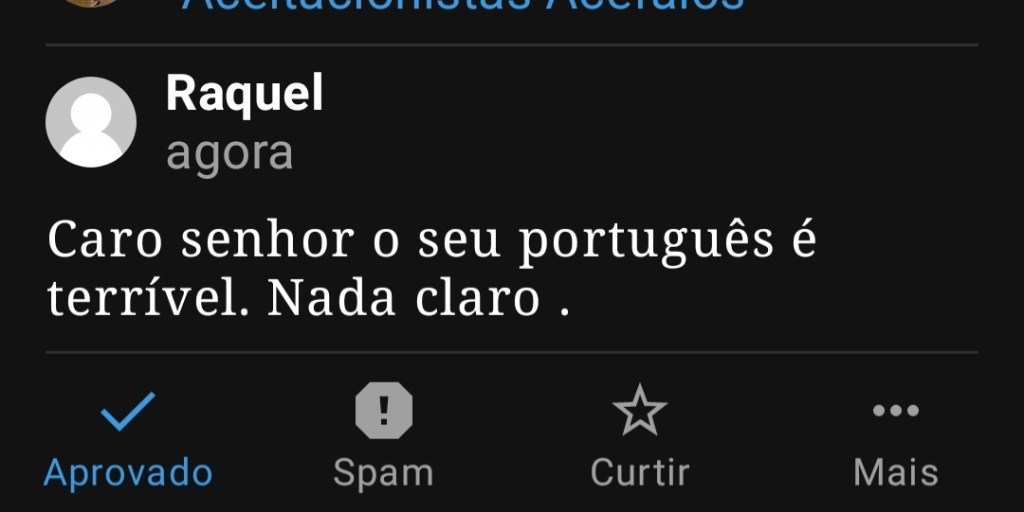
This is the first time someone has taken the trouble to tell me how shit my Portuguese is though. Well, that’s not very motivating is it? Oh well, never mind. The text of the day was about vaccine denialism and conspiracy theories, so I’m going to salve my ego by telling myself that she’s probably a tinfoil-hat-wearer and that her urge to fling poop at random language bloggers has more to do with seeing her beliefs challenged than it does with whatever defects she found in the text.
But obviously there’s still a lot to do so I’ll keep working hard and hope not to attract too many more critics! *wipes away tears with pages torn out of Português Atual 3*
Here are some short texts with footnotes pointing out some of the gotchas.
Aprendizagem de Uma Croma*
Estou a ensinar a minha filha a escrever código python. Leva sempre** três vezes mais tempo do que é necessário porque lhe falta a confiança*** e de cada vez que experimentamos uma coisa nova ela começa com “Ó pai, não consiiiigo, não é posííível” e por aí a diante até que ela olha novamente e repara na solução.
Hoje, programámos o “jogo da velha****” e durante os férias*****, vamos fazer um jogo antigo tipo arcade, chamado Snake (“Cobra”). Valha-me Deus! Irei precisar de tanta paciência.
Not that kind of python
*=Cromo/a means nerd
**=Leva sempre not sempre leva. “It takes always…” not “It always takes…”
***=I always find the construction of this kind of sentence difficult because it’s so far from English. We’d say “she lacks confidence” but in Portuguese it’s more like “confidence is lacking to her”
****=noughts and crosses /tic tac toe
*****=There are different words for holiday and they have different meanings so it’s worth taking time to pick the right one. Férias =time off work, so it’s the correct word here because I’m talking about the couple of weeks off school. There’s also “Feriado” which is a statutory holiday such as Christmas day itself, New Year etc. And finally there’s “Festas” which is more like a party ora celebration but “Boas Festas” os the nearest Portuguese equivalent to the American “Happy Holidays”
Um Caminho Longo
Ontem, dei uma voltinha daqui ao outro lado da cidade. O meu percurso seguiu as curvas do Rio Tamisa desde Richmond (ao oeste) até à* barreira contra inundações (ao leste) o meu plano era fazer a viagem de ida e volta que teria sido 50 milhas, mas depois de chegar à meta, estava com bolhas nos pés e as minhas pernas estavam rígidas e sem vida. Manquei mais cinco milhas mas não me senti capaz de regressar, portanto virei para a estação e fui de comboio para casa.
*=The “from” and “to” is interesting since the words used are “desde” (which is also used to mean “since”) and até (which usually means “until”). On top of that, it’s not just “até” but “até a/à” – until to (the) barrier.
I also learned a new word “entrevado” which describes the state I was in when my legs had ceased working: crippled.
The Coliniad
A Festa de Natal
Eu e o meu irmão falámos com o nosso pai ontem. Ele disse que não culpa o governo pelas festas de natal do ano passado, uma das quais teve lugar no apartamento do primeiro ministro e outras nos escritórios dos funcionários quando o mundo estava em plena crise.
Nós ficámos espantados. Posso perdoar muito na resposta à pandemia que apanhou muitos países de surpresa, mas isso vai alem* do que é aceitável na minha opinião. Traíram a nossa confiança.
*This was suggested as an improvement to my “é fora” – it’s outside of what’s acceptable. Instead, it says it goes beyond what’s acceptable.
I asked on the Reddit about why Desempenhar wasn’t the opposite of Empenhar. Empenhar means “to make an effort”, and the prefix “des” is like “dis” in english and it usually reverses or negates the meaning of whatever word it’s attached to and makes it into an antonym. So for example, “Fazer” means to make or do, and “Desfazer” mean to take something apart; “Cansar” means to get tired, “Descansar” means to rest, “Ordem” means “Order” and “Desordem” means “Disorder” and so on. So desempenhar looks like it should mean “make no effort” (“Hoje é dia de folga, pá. Vou me desempenhar o dia inteiro!”) but it doesn’t, it means “to perform”.
Why? Is there some sort of mysterious etymological tale to tell here? Same question for their noun forms, empenho (effort) and desempenho (performance).
Joe Desempesci discovers the difference between flammable and Inflammable
As it turns out, it’s just one of those things like Flammable and Inflammable in english, where the prefix just doesn’t really have any effect. A few interesting points came up in the comments
Butt_Roidholds listed some other examples of this sort of thing:
Abrir = open / Desabrir means leave off doing something… hm… I’m not absolutely sure about this one. Abrir can mean “Open the proceedings” – ie, start something, so desabrir meaning cease doing something actually does seem to be an antonym
Obstinado = obstinate / Desobstinado = something like “disoriented” but it’s not very clear – it isn’t defined in Priberam and Infopedia just says “ver desaustinado”. It seems like an odd fish and I won’t be using it!
Inquieto = disquieted / Desinquieto = exactly the same as inquieto! Why does this even exist though? They already have the word “quieto”, so why the double negative?
Aliviar = alleviate / desaliviar = alleviate.
And other users, TheSingingBowl and Vilkav chimed in with
Abrochar = to fasten with a brooch, or to button up / Desabrochar = open or unbutton, can also refer to the opening of a flower. These seem like pretty decent antonyms but the person who suggested them added a laughing emoji so I think it might have to do with the other (rude) meaning of “broche”.
Largar = let go / Deslargar = let go. Yep, definite example.
As for theories about how the words got like this, the most interesting one was from Grenarius who suggested maybe Desempenho came from the word “penhor” which is like “pawn” in the sense of something given as security for a high interest loan, and when you would “se empenhar” you were incurring an obligation which you would then discharge, so desempenha is an antonym of “se empenha” in that sense: you are performing some work to pay off your debt. It’s a minor stretch but not out of the realms of possibility
I’ve just updated the Textbook page of the blog with a new set of books I’ve heard about.
Susana Morais is the creator of the Portuguese Lab Podcast and Academy and she’s written a couple of story books aimed at portuguese learners: A Casa Na Bosque for intermediate learners (B2) and A Baú das Coisas Perdidas for beginners (A2). They each come with an audio version read by the author and some questions at the end to test your comprehension. I have the B2 version and have listened to the first few minutes. It looks like a really useful addition to the ever-growing list of resources for learners.
Looking out at the landscape today, compared to when I started, when it was pretty much just the Practice Portuguese podcast – and even that was pretty shonky in the early days – there’s really quite a lot of good stuff out there for anyone wanting to ;earn european portuguese.
Anyway, the links above go to the Kobo versions, which is what I’m using, since it allows me to listen to the audio and read all on one device, but you can get a printed version or several other ebook options via her website Storyglot.
The Utopia Portuguese Film Festival usually takes place on the UK but this year, owing to travel restrictions, I guess, it’s only available on the web. Its free though, and that’s my favourite price so I’m definitely in!
It takes place this coming week: the 12th to the 19th and you can sign up for the films here. I feel like the first one is probably going to be the most useful for my studies but I’ll be out all day so I’ve no chance. The offerings on the following Sunday look good too though, especially the very last presengation: Cinzas & Rasgança.
I’m really chuffed to see Livraria Bertrand now has an audiobook section and an app for ebooks and audiobooks. You can find the page here, and it’s a little underdeveloped at the moment, but so was Audible when I first joined so I’m not giving up on it. The link takes you to the front page of the portuguese audio section, but if you look in the menu on the left-hand side you’ll see there are subheadings for history, science, classics and so on, so you can rummage around and see if anything takes your fancy.
The most annoying aspect of it is that it doesn’t have a preview feature so you can’t find out if the reader is European or Brazilian. Some are obvious, but I picked out a couple that I knew seemed like a good bet – O Vendeador de Passados by José Eduardo Agualusa and Vidadupla by Sérgio Godinho and can confirm that they are both european portuguese. Yippee!!! There are a couple of others by Godinho but as for the rest, I dunno. If you sample any, I’d love it if you could tell me what you thought in the comments. Share the knowledge!
I’ll add these to my Portuguese Audiobooks Pagein the few days. In the meantime, if anyone knows anything about any of the other books, I’d love it if you could tell me about it in the comments. Let’s share the knowledge! We learners have to stick together!
I occasionally wonder what the point of all this is. The aim of language is to communicate but I am a fairly introverted person and I seem to get more and more socially awkward with each passing year, to the point where, unless I’m in really good form, I’m not really capable of holding a relaxed conversation in my own language, let alone in another one. Perhaps as a result of that, I am still very backward in my use of the basics of Portuguese that would maybe come quite naturally to someone who was used to having conversations with people. I’m studying for the C1 exam, which is quite advanced, but I’m still making really basic errors, mixing up ser and estar, using a instead of para, using the wrong tense or gender.
Some days I just feel like I’m only doing this so I can read more books. Well, there’s nothing wrong with that, but it seems a bit self-centred and not really in the spirit of… I dunno, reaching out across the sea and making connections with other people in other places or whatever.
I was at the Portuguese embassy yesterday at a book launch and I went thinking I’d speak to people in Portuguese and just immerse myself in that for an hour or so, but I ended up sitting and reading a book before the presentation and then afterwards got talking to some other British people, in English, until one of them did the “oh, I’ve just spotted someone I know on the other side of the room” move and I didn’t really have the mental energy to go and find someone else to talk to so I just sort of slunk away without saying goodbye or thanking the author or the ambassador. Le sigh.
Anyway, these moods come and go, and I suppose the main thing is to not make any rash decisions while under the influence of negative thoughts. Just keep working and wait till the positivity returns and I can maybe make plans for how to be less of a total disaster.
No texto de ontem falei do vídeo do Diogo Bataguas/Batuta/Batman/QualquerCoisa*. Mas não mencionei a maior estrela do vídeo, o Toy. Para ser sincero, nunca antes tinha ouvido falar desse senhor, mas andei à procura de vídeos das músicas dele. Parece que é boa música de festa mas não senti me uma grande pulsão* em comprar os seus álbuns.
Mas percebo o génio de contratar um cantor famoso daquele estilo de música para gravar o tema duma rubrica dum programa televisivo.
*=in the original version of yesterday’s text, I got Diogo Bataguas’s name wrong and called him Diogo Batuta.
**=not really the right word. I’m reading a book that has Sigmund Freud as one of its characters and he uses this word – it means an urge, in the psychological sense. It would have been better to say something like “não me senti compelido a comprar…”
Toy: Bataguas not included
Thanks to Dani for the grammar corrections. She’s also given me some factual corrections which I’ll pass along so as not to give the wrong idea:
The video is a web series, not a TV show. Diogo Bataguas is “um moço singelo” (a simple, innocent lad) who asks for contributions from his fans in order to be able to pay his team – namely, Sandro, who is always hungry
Toy doesn’t just sing party songs as I’ve described here, he also does emotional ballads and TV soap opera theme songs but he’s also known for being an interesting personality. He gave away tickets to his wedding to random fans and he… Invented a style of driving with his knees…? Speaking as a cyclist, this doesn’t exactly endear me to the bloke, to be honest, but apart from that he seems OK. One fellow learner told me (s)he had met him in a seafood restaurant in Azeitão and he had spoken warmly and at great length of his love for Canadian audiences. Telling this story later, (s)he found out that virtually everyone who has ever been to any restaurant in Azeitão has had a similar experience because he is “um senhor bastante gregário”.
This is a short text trying to fit in as many expressions of will, intention or desire as possible. The expressions are from the Camões Institute’s C1 course. Thanks to Dani for the corrections.
Está nos meus planos fazer uma corrida daqui a três semanas. Tenho ideias de melhorar o meu desempenho da última corrida. Morro de vontade de manter uma velocidade alta durante a corrida inteira. Não suporto (a idea de)que* os meus tempos possam voltar a ser de mais do que uma hora como nas corridas do verão passado. Fiquei eufórico quando corri dez quilómetros em 55 minutos em outubro. Claro que preferia correr ainda mais rápido! Tenho ganas de ganhar a corrida mas não é provável e no fim das contas, deliro com cada corrida na qual ultrapasso os meus limites. Um dia claro cairia muito bem, e viria mesmoa calhar** se houvesse um vento forte nas minhas costas. Queira Deus que o clima*** esteja bom porque morro de aborrecimento quando corro em condições cinzentas e ventosas.
*=”I can’t bear (the idea) that…” This construction needs a noun immediately after it and when the verb does come, it’s subjunctive.
**=”vir a calhar” is a weird one and I think I got it wrong in the original text. Calha is a gutter so I took “vir a calhar” as something negative but it’s more like “being channelled in the right direction” so, like “cair muito bem” it has a sense of things turning out well by good luck. There’s a ciberdúvidas article about the expression if you want to know more. Anyway, the long and the short of it is, I made such a mess of this sentence that the marker didn’t really get what I was driving at at all 😔
***=I wanted to write “o tempo” but since that means “time” as well as “weather” it seems like it would be super-confusing here! Clima is more like “climate” than weather of course, so it sounds a little bit off.
What the troubled brain is saying is “And what if we’re living in a simulation or matrix and the OVNIs are the mouse pointers”
OVNI is “Objeto Voador Não Identificado” – A UFO in other words. I’ve heard Disco Voador (flying disc, flying saucer) too, but that was easier to decipher. This one needed a bit more legwork.





 Luso
Luso 