Posted in English

Picklist Perplexity

I found this exercise very, very hard. Even when I got the results back, I still couldn’t make sense of why the right answers were the right answers. I asked about it and got an answer but before I read it I’m going to write out a translation and try to sort it out in my own head… OK, what have we got?

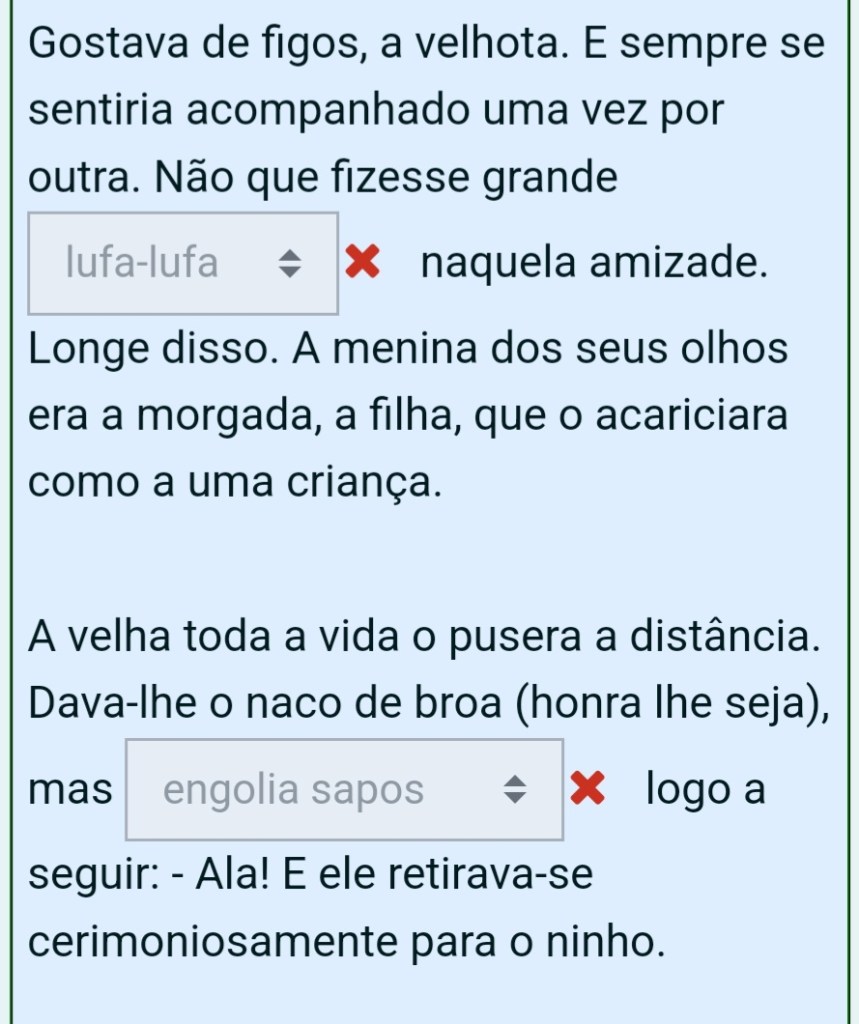
She liked figs, the old woman. And he’d always feel himself accompanied from time to time. Not that she made a big ________ in that friendship. Far from it. The Apple of her eye was the only daughter, the child who had patted him when she was little.

And options for that space are “lufa-lufa” (being busy with lots of tasks), “finca-pé” (a firm stance) and bate-papo (chit-chat)

And then…

The old lady, all her life, had kept him at a distance. She gave him a loaf of bread (honor indeed!) but she _______ straight afterwards: – get away! And he took himself away cerimoniously to his bed.

And options for that one are “engolia sapos” (swallowed frogs – meaning did something she really didn’t want to do), “borrava a pintura” (smudged the painting) or… Something else, i can’t remember.

Uyth, in the Portuguese subreddit, explained that this is from a book called Bichos by Miguel Torga, which is embarrassing because I’ve read that and I still didn’t get it! It’s a very difficult book though, so it’s no wonder it was chosen for an advanced course like this. When I read it I felt all at sea and I only really managed to follow two or three stories.

Anyway, in the first case, finca-pé was the right answer because taking a firm stance on friendship means making an effort to keep it going. And in the second case, borrava a pintura – smudged the painting – means she undid the effects of something good she’d done. So after giving the animal (a donkey, if I remember rightly) the lump of bread, she chases him away.

OK, I can see that. Wow, so hard though! Some of the exercises were super-easy, so this one came as a real shock!

Posted in English

Lã LO Land

I spotted an expression I hadn’t seen before, out in the wild, on twitter

It’s pretty hard to tell what’s going on in the video because they talk over each other a lot (which seems to be quite common in Portuguese TV), but apparently the guy speaking at the beginning is Miguel Carvalho, a journalist at Visão and the younger but slightly awkward looking fella is Pedro Frazão, a vet who was recently elected as a member of the Assembleia da República, representing the right-wing populist “party”, Chega. Frazão accuses Carvalho of making false statements and Carvalho comes back with “It isn’t me who will be judged tomorrow for spreading fake news, it’s you”.

Leaving aside whether “I know you are but what am I” is the killer move the tweeter seems to think it is*, the last sentence of the tweet is where the juicy goodness is:

O veterinário foi à lã e saiu tosquiado

The vet went for the wool and got sheered

This seems like a really good way of describing when someone’s cunning plan backfires and they end up looking stupid. I had a look around to see if it was something he’d just made up, but it’s a fairly common expression and there are a few versions of it online. The version Priberam gives is “Ir buscar lã e vir tosquiado“.

In case you’re tempted to feel sorry for Frazão for being talked over and taunted like this, it’s worth pointing out that he’s a loathsome little weasel who deserves no sympathy whatsoever. He made headlines a while back, having a pop at Joacine Katar Moreira, the annoyingly woke member of the Assembleia in a smallish party called Livre.

Pedro Frazão's fingers
Pedro Frazão, showing his fearless conservative principles

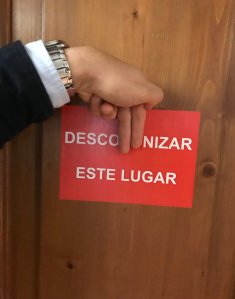
She had put up a sticker on a door of her office saying “descolonizar este lugar” (decolonize this place). That’s quite annoying, but his response was worse. Shortly before she was expected to leave the Assembleia, he took a picture of the door with his fingers over the LO, leaving it saying “desconizar este lugar” which can only be translated as “decuntify this place”. In case that wasn’t enough douchebaggery, he sealed the deal with an emoji of a plane taking off, which I read as implying she should not only leave the Assembleia but also leave the country and go back to Guinea Bissau, where she was born. She responded by reporting him to the police. The whole thing was a fairly squalid episode, with him definitely the villain of the piece.

So I’m not wildly in favour of debates where people talk over each other and accusé each other of lying, but if anyone is going to be verbally roughed up on TV, it might as well be him.

LOL. Or as Frazão might put it, 🤚L

And the line in the tweet about getting sheered is gold. I will definitely use that in future.

* UPDATE – I seem to have misunderstood. Carvalho wasn’t just talking about the court of public opinion: Frazão really did face an actual court judgement on the following day for having defamed a fellow politician. This puts it in a different light – friends, we are witnessing a murder here, live on camera

Posted in English

Nearly Done

I’ve quite nearly finished the C1 course, y’know. I wasn’t expecting to be ready for the C1 exam this spring, but I might just sign up in May because it’s going well: the advanced material is not so hard and I think I can pass with another 3 months to play with, despite still, still, making so many mistakes and never quite feeling ready, I have passed almost all the in-course tests first time.

Posted in English

A Garota Wow!

This video from A Garota Não is giving me goosebumps today. The lyric is written by João Quadros, who is a comedy writer, twitter sage, irritant and sometime collaborator with Bruno Nogueira.

OK, OK, I don’t know an awful lot about Quadros to be honest, so apologies if that last sentence doesn’t do him justice. He seems to have been around for a while and to have written some classics of comedy. He also seems to be one of these people who some people absolutely adore and some people can’t stand. I must say, I didn’t know he’d written anything that could result in this loveliness. I mean, I know her voice and her guitar are doing the heavy lifting in this video, but you don’t write music like that and go to all that effort for any old drivel.

tudo começa numa estrada que termina no Alaska

há um sinal que tem escrito a letras vermelhas: deixe aqui os seus sonhos

desenhou o mapa de tudo o que não conseguiu

com coordenadas de objetivos falhados

o X afastava-o dos lugares onde seria feliz

um mapa de oportunidades desperdiçadas

de chances comprometidas

e de atalhos sem fim.

A Garota Não has an album on iTunes that has its share of bangers. I dunno though, I think I like her videos best: she has a few like this that are based on poems she’s read, or raps she’s heard and decided to interpret in her own way, sometimes singing in harmony with herself in a separate box.

One of them is based on a small fragment of this video by Classe Crua, which is probably the only rap ever written that mentions Theresa May. Weird.

Then there are some covers of songs in English (Wuthering Heights by Kate Bush and Ready or Not by the Fugees) and they’re good too, but we’re here to learn Portuguese, so let’s not get distracted.

Posted in English

Have I Mentioned How Much I Like Comics?

I think I’ve banged on about comics a few times, mainly in the page I wrote about the best Portuguese graphic novels.

Just to show it’s not just me though, I can testify that my daughter, who has just started A Level French, and is a big fan of the Walking Dead video game series, has been getting just as much out of the French version of the Walking Dead graphic novel series as I got out of the Portuguese ones. She’s only a couple of volumes deep but she’s already better able to unravel complicated sentences, recognise new vocabulary that has come up before, and read out loud. I’ve been nagging her for ages to try the Astérix books but they’re not something that appeals to her and I’m glad she’s found her way to a series that suits her.

Posted in English, Portuguese

The Yogaing Dead

Here’s a text I wrote, with correction notes at the bottom. Thanks to Eqdif and Dani_Morgenstern for the help. I’ve finished my thirty day yoga experiment now but as you can see we’re still using it as a family workout despite the lack of floor space in our flat. Writing about yoga on here has brought me a lot of new follows and likes from yoga-related bloggers, which is nice (hello yoga peeps!) but I hope they don’t think I’m some sort of fitness influencer because I can’t live up to that kind of expectation!

This isn’t the routine we were doing but it’s by the same instructor and it seems to fit the theme of the text!

A minha filha anda cada vez mais obcecada com a saga* Walking Dead, traduzida em francês. Mas ela precisa de ajuda portanto lemos juntos. Hoje passámos umas horas a ler. Uma vez que não tinha feito o meu yoga diário** (29 dias malta!), sugeri “faz uma sessão de Yoga comigo e depois lemos mais umas páginas.” ela concordou mas com pouco entusiasmo.

Durante a aula, estavamos de pé, ela no meu lado esquerdo, com as ancas dobradas***, as cabeças viradas para baixo e os braços pendurados frouxamente em direcção ao chão.

A professora disse “vira a cabeça para a direita”. Obedecemos. “Depois, volta para o centro… Agora, vira a cabeça novamente mas desta vez para a esquerda.”

Virei a cabeça na direção dela. Ela estava ainda virada para mim. Os nossos olhos encontraram-se e ela gemeu “Riick Grrriiimes”. Desatámos às gargalhadas.

* Although Série can be used it’s used to refer to a TV series, and I’m talking about the series of graphic novels, hence the word saga instead.

** Despite ending in an a, yoga is masculine apparently.

*** what I’m describing here is what the yoga instructor calls a “forward fold”, but the expression I tried to use – “dobrados da anca” = “bent from the hips” doesn’t really work so I’ve used the suggested “with our hips bent”. TBH, it’s a slightly odd phrase even in English, so I shouldn’t be that surprised but I’m pretty sure it’s how she describes the pose.

Posted in English

One Hundred Days of Blogitude

Today is the hundredth day in a row I’ve posted on here. I didn’t really set out to make it a target but reposting my corrections and the occasional random though has all added up quickly. It’s helping keep me going; as work gets busier and it’s tempting to just skip a day, I’ve got these daily reminders to keep me motivated: one hundred days of blogging and recently passing 140 days (20 weeks) of daily writing on Writestreakpt as part of my epic quest for C1 dominance. It would be painful to break the streak now, so I keep powering on, harnessing my OCD to good effect.

Now if only I could remember it all…

Posted in English, Portuguese

Lisboa Não é Hollywood

Here’s an attempt at translating the song “Lisboa Nao é Hollywood” by Os Azeitonas. It doesn’t seem to haave a translation on lyricstranslate so I thought I’d make one. Seems like quite a simple song but it’s really, really tricky!

Chega Cândida de capeline 
Cândida arrives wearing a capeline*
Como ela respira saúde**
She's glowing with health
Quase que parece a Marilyn
She almost looks like Marilyn
Ao chegar*** a Hollywood
On her arrival in Hollywood
Mas sem tapetes encarnados
But with no red carpets
Sob os seus pés de dama
Under her ladylike feet
Os seus sapatinhos delicados
Her delicate little shoes
Apenas pisam na lama
only step in the mud
Lisboa é paleio de Aljube****
Lisbon is well known to criminals
Por entre ruas, esquinas
Among its streets and corners
Também tem suas colinas, mas
It has its hills too, but
Lisboa não É Hollywood
Lisboa isn't Hollywood
Lá vai Cândida a correr atrás
There goes Cândida, chasing
Seu peito diz sorria
Her spirit***** says smile
Mas nos seus dentes nunca brilha o flash
But the flash of a photograph has never
Da fotografia
Lit up her teeth
Lá vai Cândida a mandar beijinhos
There goes Cândida, blowing kisses
Com o seu jeito rude
In her rude way
Como quem atalha caminho
Like someone taking a shortcut
Para chegar a Hollywood
To arrive in Hollywood
Lisboa é paleio de Aljube****
Lisbon is well known to criminals
Por entre ruas, esquinas
Among its streets and corners
Também tem suas colinas, mas
It has its hills too, but
Lisboa não É Hollywood
Lisboa isn't Hollywood
Como ela cai na trama
How she falls into the trap******
E vai esbanjando******* virtude
And squanders her virtue
Pelo passeio da fama mas
On the walk of fame, but
Lisboa não É Hollywood
Lisboa isn't Hollywood
Olha Cândida na solidão
Look at Cândida, all alone
De capeline, rouge e baton
In her Capeline, rouge and lipstick
Não foi parar ao panteão
She didn't end up in the pantheon
Morreu na vala comum
She died in the gutter
Lisboa é paleio de Aljube****
Lisbon is well-known to criminals
Por entre ruas, esquinas
Among its streets, and corners
Também tem suas colinas, mas
It has its hills too, but
Lisboa não É Hollywood
Lisboa isn't Hollywood

* = It’s a kind of hat apparently. Never heard of it!

**=Respira Saúde = Literally “breathes health” so visibly healthy, confident and in good form, not just “is healthy”. Researching this on the web, there’s some use of it in a more loreal way, meaning “breathing in a healthy way”, eg giving up smoking, but it is used as an expression too.

*** = I wrote about this “Ao + infinitive” construction a couple of months back and I seem to have seen it everywhere since.

**** = This line is a real enigma. The word aljube with a small letter can be a dark prison or a cavern. The fact that it’s written with a capital letter in all the sources I can find seems to imply that it’s a reference to A Cadeia do Aljube, which was the name of a prison (cadeira) that has been in existence since the peninsula was colonised by the muslim imperialists in the 8th century. The name Aljube comes from the arabic for a well. After the reconquista, its use changed but certainly by the twentieth century it was being used for political prisoners of the fascist Estado Novo, and had a pretty terrible reputation. These days, it’s a museum of resistance and liberty. “Paleio” means gossip or small talk, so the sentence “Lisboa é paleio de Aljube” doesn’t make a whole lot of sense. My wife didn’t know what they were driving at. I asked around on reddit and had four different replies, all different. The two closest guesses were along the lines of “a rumour in the prison”, meaning it was something lowlifes and criminals talk about, which is why I’ve translated it as “well known to criminals” but others have suggested “A trick in a cavern”, or even “pillow talk” (because Aljube can also mean alcove, and “de alcova” in Brazilian Portuguese can imply something relating to sex). Meh, its slightly odd that there’s a lyric like this that no two listeners can agree on the meaning, but there are plenty of songs on English that are obscure and ambiguous so I suppose I shouldn’t be that surprised!

***** = Not sure about this one either. “her chest says smile” just sounds weird but one of the lesser meanings of peito is “ânimo” so I’m interpreting it as she’s making an effort of will to smile…? But at least one of the people who replied to my question about paleio said that there was an implication that Cândida is a prostitute so maybe there’s some sort of implication that people are smiling at her cleavage…?

****** = Another iffy one: Trama can be a thread, either literal or in the sense of a unifying plot-line of a book (in fact, I think I used it in a a book review a couple of days ago!) or even a tram line. I wondered if we were supposed to imagine her literally tripping on a tram track but it didn’t seem to fit well with the next line.

******* = fantastic! I only learned this word a week or two ago, doing one of Paulo Freixinho’s old crosswords and here it is again!

By the way, I see Os Azeitonas are candidates for this year’s Eurovision but they’ve come down a long way since they lost their most talented dude, Miguel Araújo, and the song is vanilla AF.

Posted in English, Portuguese

Expressões

Expressions from the C1 course – I’m going to rewrite them here to help me remember them

Acordar com os pés de fora – This is like “wake up on the wrong side of the bed

Abrir o coração – Similar to English; say what you really think, get your feelings out in the open

Abrir o jogo – This one is a bit different from English expressions that mention the start or a game (“Game on” or “kick-off meeting”) It means to reveal details… I guess a game-related metaphor would be “blow the whistle” perhaps?

Abrir os olhos a alguém – Easy one, this. It just means warn someone or convince them of something

À sombra da bananeira – Not bovvered

Agarrar com unhas e dentes – to hold on for dear life

(Dar) Água pela barba – A desperate situation. I misunderstood this when I first heard it. It sounds like someone sweating through their beard, perhaps due to hard work or fear, but according to this blog post, it’s because the prow of a ship is called a barba, and when the water is up to there you know you’re in trouble!

Arregaçar as mangas – Just like in English, roll up your sleeves, get down to business.

Balde de água fria – Disappointment

Barata tonta – a dizzy cockroach. Someone who is acting erratically, or is disorientated

Bater as botas – Beat your boots, equivalent to kick the bucket, pop your clogs, buy the farm

Bater na mesma tecla – keep bashing on the same keyboard key: to persist in saying or doing something to an annoying degree

Baixar a bola – Calm Down

Cabeça de alho chocho – Someone who’s head is like withered garlic is, as you would expect, just someone distracted or forgetful

(dar uma) Calinada – (to say) something stupid or ungrammatical

Tem cara de caso – To gave a worried expression

Cabeça nas nuvens – Just like in English, head in the clouds means delistracted

Coisas do arco da velha – Weird things especially weird old things. My train of thought when I heard this that arco must mean ark, as in ark of the covenant: a chest or trunk where granny kept all her weird old-time junk but arco doesn’t have that meaning in Portuguese. According to the Internet, it just means the old lady’s rainbow.

Comprar gato por lebre – To get swindled. You’re supposed to imahine trying to buy a hare as food and getting sold a dead cat instead.

Cortar as vazas – To stop someone doing something. The relevant meaning of vaza here seems to be as a “trick” in a game of cards such as Bridge, so I guess cutting it would be a strategy to stop an opponent getting an advantage…? Vaza can also mean an emptying or hollowing out of something.

Chorar sobre o leite derramado – To cry over spilt milk

Com a corda no pescoço – With the rope around the neck, ie, under pressure or threat

Com a faca e o queijo na mão – I love this one. Someone is in a position to be able to resolve matters is said to be “with the knife and the cheese in their hand”

Com uma perna às costas – Effortlessly. Equivalent to “with one arm tied behind your back” except in Portugal, its a leg

(ter as) Costas quente – (to have) safety and protection because someone has your back

cravar – literally means to nail something, but as, an expression, to ask for a loan or scrounge something.

Dar/Bater com o nariz na porta – To Look for something and not find it

Dar o braço a torcer – To a it you were wrong about something and change your mind.

Dar com a língua nos dentes – Tell a secret

Dar uma mãozinha – Give someone a hand, just like in English

Dar troco – To answer someone’s comment or insult, to clap back

(Ter) Dor de cotovelo – Another favourite of mine: having pains in your elbow is a Portuguese expression for feeling envious. Not to be confused with “falar pelos cotovelos” which means to talk a lot.

De olhos fechados – as in the case of “com uma perna às costas”, this means you have no trouble doing something. It’s so easy you can do it with your eyes closed.

Engolir sapos – To do something you really don’t want to do. Nuno Markl uses it in describing the attitude of a lot of communist voters in 1986, forced to “engolir o sapo” of voting for Soares because it was better than voting for Amaral de Freitas.

Estar com os azeites – To be bored or annoyed with something

Estar de mãos atadas – as in English “my hands are tied” means I can’t do anything

Estar de/Ficar de trombas – Roughly equivalent to “to have a long face”. In fact, since tromba means trunk, you could probably rewrite the famous joke about the horse walking into a bar in Portuguese but you’d have to make it an elephant.

Estar-se nas tintas – To be completely indifferent to something.

Encostar a roupa ao pelo – Bater em alguém.

Estar giro – to be fun or pretty

Estar fixe – to be cool or good

Estar feito ao bife – knackered. Nobody seems quite sure where this came from but my Brazilian friend said think of a beef that has been tenderused by bashing it repeatedly wuty a spikey mallet. That.

Fazer um negócio da China – Pull off a big great business deal

Fazer vista grossa – To turn a blind eye

Fazer uma tempestade num copo de água – To make a big fuss – a storm in a tea cup, except it’s not a teacup, it’s a glass of water

Gritar a plenos pulmões – To scream at the top of your lungs

Ir desta para melhor – Just like in English, to go to a better place is to die.

Ir aos arames – To get annoyed

Lavar a roupa suja – Washing your dirty laundry is equivalent to airing your dirty linen in public: discussing personal stuff in a public setting.

Levar a peito – Taking to the chest is similar to the English expression ctake it to heart. On other words, take it personally and get offended by something.

(Ter) Maus fígados – to have bad livers means to have a bad temper

Meter os pés pelas mãos – to put your feet in your hand means to get muddled and mix things up.

Meter o rabo entre as pernas – To out your tail between your legs, to submit.

Onde Judas perdeu as botas – Where Judas lost his boots; in the middle of nowhere. See also “cu de Judas”

Pão, pão, queijo, queijo – This is what you say when something is completely clear, unambiguous and well-defined.

(estar com os, ter os) Pés para a cova – To have your feet in the grave is just like you’d say “one foot in the grave” on English.

Pendurar as botas – To hang up your boots is to retire, especially from a sport.

Pensar na morte da bezerra – To think about the death of the calf just means to be distracted

(ser uma, ter uma) Pedra no sapato – To have a problem that needs resolving

Pôr a pata na poça – To put your foot in it, just like in English, except that the portuguese are more specific about “it”. It’s a puddle.

Pôr mãos à obra – Put your hands to work.

Pôr os pontos nos is – Just like in English, to dot the i’s means to take great care over your work

(ficar com, ter) a pulga atrás da orelha – To lack confidence, or be mistrustful

Pôr-se a pau – to be very careful, be on guard

Pôr água na fervura – To put water in the boiling water means to try and calm someone down.

Pôr paninhos quentes – According to the C1 guide, this means to try and conciliate, for example when a friend has acted badly and you are trying to defend them, but when I looked around for the origin, I found Priberam defines “paninhos quentes” as “temporary solutions”, so this would be something like papering over the cracks. Both meanings seem to exist, so… 🤷🏼‍♂️

Prometer mundos e fundos – Make grand promises you can’t keep

Procurar uma agulha num palheiro – Just like English, look for a needle in a haystack

Sem pés nem cabeça – Illogical, meaningless.

Ser um troca-tintas – To be a turncoat, or modify your opinions according to your audience.

Tirar o cavalo (ou cavalinho) da chuva – Everybody’s favourite Portuguese expression, this. To bring your little horse in out of the rain means to finally give up on something.

Trepar paredes – To climb the walls, meaning to be completely desperate

Trocar alhos por bugalhos – To swap garlic for oak apples, meaning to mix up two completely unrelated things.

Ter lata – To be cheeky

Uma mão lava a outra – One hand washes the other, just like the English expression, except when we use it it sounds a bit sinister, implying two people are covering for each other in sometjing dishonest, but the definition is that this is just teamwork, basically. Again, looking around the web, I get the feeling people are using it in a slightly less sympathetic way than the official course definition claims, and more like the English version but I could be wrong.

Vira-casacas – a turncoat, literally!

Voltar à vaca fria – To return to the original subject after a digression.