Posted in English

Abesbilico

One of my favourite things is trying to work out what the hell is going on in slang and social media lingo. Take this one for example…

“Abesbilico” is the “bué” of this generation.

So um… Eh?

First of all, bué. Bué is a word that entered Portuguese via Quimbundo, a language spoken in Angola. It can be used an adverb or a quantifier meaning “a lot”. “Leio bué” =I read a lot, and “Há bué gente” means “There are a lot of people” . This seems to be pretty well known. I first came across it as part of “bué fixe” – very cool.

And what about Abesbilico? I’d never heard of it before.

Tia Branca

Apparently it’s used a lot by Tia Branca who is a presenter on some kind of sex advice show on RTP. It seems to mean something like “gobsmacked”. Hunting around, I can find people asking about it in 2009 when it seems to have surfaced. Nobody seems to be quite sure about its origin. Possibly a splice of “Abismado” and… Something else. I definitely hadn’t seen it in the wild till I saw this but it might be a generational thing: if you search twitter for it, it seems to be getting used about ten times a day, so it’s out there, and I even came across memes of Tik Too teens lipsynching to Tia Branca saying “Este silêncio é propósitado, estou abesbílica”

Posted in English

You Say Patudo, I Say Patão

Unfinished business from yesterday’s moorhen-related content: suppose the birds who wanted to body shame the moorhen had decided to call him a fat duck instead of bigfoot? How would they do that? They could say “pato gordo” or “pato gordinho” of course, but is there a shorter option?

Portuguese speakers tend to use the -inho ending on a lot of words as a diminutive, so patinho is little duck, gatinho is little cat and so on. Augmentatives – endings that make a word bigger or stronger are a little rarer and less regular, but substituting – ão for the final o is quite a common way of doing it. Or -ona if it ends in an a.

So in this case, patão would be a chonky duck. You probably won’t hear this very often in Portugal. Things are more likely to be – inho than – ão, but there’s a supermarket in Brazil called patão, and the word does exist in priberam, so it’s not just a Brazilian thing.

I’m trying to think where I’ve heard these kinds of endings: garrafão is a huge bottle, facalhão is a big kitchen knife, and I think I’ve seen it used for outdoor work knives (maybe even a machete?) in some contexts too. Barrigão is used to mean a big belly, whether it’s big because there is a baby in there or because the owner is too fond of Sagres.

You have to be a little careful with these though. I think, because they are quite rare, they might be used for humorous affect and you probably don’t want to accidentally say the wrong thing. Mulherão, for example: how’s that going to come across? Tall woman? Great woman? Fat woman? Coarse woman? It might depend on the context or that tone of voice, so unless you’re supremely confident I’d just leave it out if I were you.

There are other endings too. I can’t really do justice to them without, basically, rewriting this article from Practice Portuguese word for word, so if you want to know more, I’d say toddle on over there and see what the boys have to say on the subject.

Posted in English

Patudo

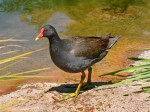
Here’s another nugget from social media. I saw a meme on Instagram about depressed animals which, unfortunately, I can’t really reproduce here because it had someone’s user name in it, but no worries: the interesting bit was off to one side, where a sad-looking moorhen was thinking “As outras aves chamaram me patudo. Body shaming é tão 90s”

What were they saying to body-shame the poor moorhen? Well, my first thought was that pato means “duck” so maybe patudo is like an exaggerated form of that word, meaning something like “big duck” or “fat duck”. But I looked it up and after an initial double-take when I saw that there is a kind of tuna called a patudo, I saw what was really happening. The root of patudo isn’t from “pato”, it’s from “pata”. It means big-footed. And it’s true, moorhens really do have massive feet for wading through the bogs. Poor moorhen! Coitadinha de gallinula!

Posted in English

Arguing Again

One of the annoying things about being on twitter in Portuguese mode is that I often see things in English I want to reply to but I don’t want to break character and can’t be bothered logging into my normal account. Solution: I just reply in Portuguese, knowing full well that the person won’t understand.

I upbraided someone for a pet peeve of mine: posting made up Orwell quotes. I mean, if you are going to post a bold quite about the importance of truth in a world of fake news, at least take the time to find out if it’s a fake quote.

The guy took umbrage, told me I should “speak English” and said I was showing my stupidity. So I replied with…

Childish? Yes, but I’m calling it homework so it’s allowed.

Posted in English

Biblio

The Bertrand Bublio App (mentioned on the Audio Books page) is annoying me. I’ve been listening to Vida Dupla by Sérgio Godinho but it pauses every minute or so and I have to keep tapping the screen to make it move on. I think it’s a bug where it needs permission not to suspend when the screen goes blank or when a notification comes in or… I dunno… Something. Maybe tomorrow’s writing task will be uma carta de reclamação about the issue.

Posted in English

D-I-S-P-O

One of my pet theories is that every tech company has a guy somewhere in the organisation whose job title is “visionary architect of making everything slightly worse”. He (and I’m sorry to be one of those dudes who disses other dudes to ingratiate himself to his female readers, but yes, I’m sure he’s a he) is the one behind all those little changes to apps that make them look sleeker but leave the user frustrated and annoyed because they are harder to use. Anyway, the guy who holds that role at google translate has obviously been busy because its latest incarnation is hugely irritating. Well done, mate.

It remains quite useful though. I’ve just written a text about street food and I mentioned a disposable glove. As usual, when I finished, I pasted it into gtranslate to see what it thought I’d said. It translated it as “available glove” because I’d used a false friend: Disponível. The word is obviously related to disposable but it means available. It’s easy to see the link. If you’ve ever heard anyone say “I’m at your disposal”, the person wasn’t asking to be thrown in the bin, they were saying they were available to help. So the meanings must have drifted apart relatively recently but it’s worth knowing the difference.

What should I gave said? Descartável. That’s easy too. You can discard them.

E depois, queres um pastel de nata?

Posted in English

Perdi a Minha Carteira

Fui ao supermercado na quarta-feira e, no dia seguinte, não encontrava* a minha carteira. Vi nos bolsos das minhas calças, mas sem êxito. Liguei ao supermercado, andei lá e de volta a procurar pelo chão, mas não tive sorte. Provavelmente está algures em casa, mas acho que cheguei a hora de cancelar uns cartões de crédito. Uma chatice**.

* A good example of how not to translate too literally. I was thinking “I couldn’t find” = “Não consegui encontrar” but that’s not very Portuguese. Não encontrava is the way to go: I wasn’t finding it.

** o wrote “que chatice” (what a nuisance!) because its what I hear sometimes and I sometimes see on twitter people post some delicious treat they’re eating with the caption “Que chatice!” but apparently that’s more of a conversational thing and the best way of saying it in a written text is “uma chatice” – (which was) “a nuisance! ”

Posted in English

A Portuguesa: TL;DR

For the benefit of anyone who is too lazy to read that last post, here it is in the form of a meme. I actually posted it on a world history Facebook group and it was modded out of existence almost immediately. Not surprising I suppose but I thought there might be one or two people willing to do the work to decipher it.

Henrique Lopes de Mendonça dealing with some critics of his new national anthem, A Portuguesa.
Look, I Made a Meme

Posted in English

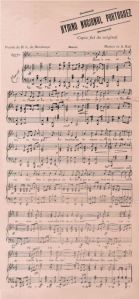
A Portuguesa

This post is long overdue. I said back in November that I was going to do a post about the Portuguese national anthem but I haven’t got around to it yet.

National anthems are often written in the heat of some patriotic fervour, often caused by conflict with another country. God Save the Queen, for example, has an apocryphal verse that someone tried to shoehorn in, about fighting the jocks* although contrary to what the nationalists might have you believe, it was never part of the official national anthem. I think if you did a survey of all the countries whose national anthems specifically refer to Britain being evil it’d probably be about two-thirds of them. The United States for a start: the Star Spangled Banner is about looking out for the flag and hoping it doesn’t get blown to bits under the British shelling. Well that’s fair, we have put ourselves about a bit and we were pretty much the last empire to openly call itself an empire so people remember us for that and that’s often set down in writing. So in a sense, national anthems are like Taylor Swift break-up songs but on a diplomatic scale.

Surprisingly, despite being our oldest ally, Portugal is a former member of the BBC (The Britons are Bastards Club) too, because they used to have us in their anthem. Oh my god, Becky, why are you so obsessed with us? Well, here’s why:

Portugal became a Republic in 1910 as a result of a chain of events sparked by the British empire reneging on its treaty and issuing an ultimatum – in 1890 – claiming the land in between Mozambique and Angola which the Portuguese had intended to settle, as part of a strategy referred to as “A Mapa Cor-De-Rosa”. The monarchy was powerless to stop Britain and the Portuguese people were pissed off about it. The opinion of the Africans on the matter was not sought. Anyway, the resulting crisis saw the monarchy replaced by a Republic and, a few years later, the Estado Novo. Portugal’s Hino Nacional (National Anthem), called “A Portuguesa”, was written in response to the initial crisis in the last decade of the 19th century, and it is everything you’d expect from an anthem – “Heroes of the sea, noble people, valiant, immortal nation, lift up again today the splendour of Portugal”. Stirring stuff. But the chorus originally ended with a call to arms: “Contra os Bretões marchar, marchar!” March, March against the British!

Luckily, long before it was adopted as the national anthem in 1911, cooler heads had prevailed. They had time to think it through and they decided not to pick a fight with the most powerful nation on earth at the time, so the new anthem had the slightly less incendiary “March, March against the cannons”, which saved a lot of awkwardness.

O hino nacional de Portugal

Soirce: Wikipedia Data: 1890 Letra: Henrique Lopes de Mendonça
Música: Alfredo Keil

I
Heróis do mar, nobre povo,
Nação valente, imortal,
Levantai hoje de novo
O esplendor de Portugal!
Entre as brumas da memória,
Ó Pátria, sente-se a voz
Dos teus egrégios avós,
Que há-de guiar-te à vitória!

Às armas, às armas!
Sobre a terra, sobre o mar,
Às armas, às armas!
Pela Pátria lutar!
Contra os canhões
marchar, marchar!

II
Desfralda a invicta bandeira
À luz viva do teu céu!
Brade a Europa à terra inteira:
Portugal não pereceu!
Beija o solo teu jucundo
O oceano, a rugir d’amor,
E o teu braço vencedor
Deu novos mundos ao Mundo!

Às armas, às armas!
Sobre a terra e sobre o mar,
Às armas, às armas!
Pela Pátria lutar!
Contra os canhões
marchar, marchar!

III
Saudai o Sol que desponta
Sobre um ridente porvir;
Seja o eco de uma afronta
O sinal de ressurgir.
Raios dessa aurora forte
São como beijos de mãe,
Que nos guardam, nos sustêm,
Contra as injúrias da sorte.

Às armas, às armas!
Sobre a terra e sobre o mar,
Às armas, às armas!
Pela Pátria lutar!
Contra os canhões
marchar, marchar!

*It’s OK, I’m Scottish, I can say the J word