Posted in English

Divided by a Common Language: the plot thickens…

English, espanhol, português

I’ve mentioned a couple of times (here and here) now that I have had long, rambling discussions with Brazilians about whether the third person singular (the “we” form) in the past perfect tense is identical to the present tense. It is in Brazilian but not – or at least not normally – in european portuguese.

I actually ran into a portuguese guy from Beira Alta who says that, where he lives, they say the two words the same way (not surprising) and spell them the same way too (more surprising). We had a bit of a chat about it back and forth and he agreed that the accent in the written form was helpful (I agree 100%) but he wasn’t going to change the way he spoke (also agree 100%) and like a lot of Portuguese people, he felt like the Acordo Ortográfico was an annoying imposition from on high that he didn’t really buy into.

I feel like this was quite a useful conversation for both of us. For me because it’s good to learn about different accents and ways of speaking and I hope also for him because most people in most countries don’t really reflect on their own language until they hit something unexpected, and I like to think that by having this conversation he enjoyed thinking about his own language as much as I do. For example, I mentioned that the two versions (falamos and falámos, say) would both have the stress on the second syllable and he said no, they don’t stress the word anywhere. I guarantee you, there is no portuguese word that is spoken in a flat, robotic monotone. I made a joke about how most words in portuguese are either oxitono (stressed on the last syllable) or paroxitnono (penultimate syllable) and a few are proparoxítono (antepenultinate) but maybe there needed to be a new word “nenhuresitono” for words that are stressed nowhere.

I have learned a lot about my own language from talking to foreigners who were trying to learn it and I really hope his encounter with this confused British chap was helpful for him in the same way.

* I talked a lot about proparoxítono during my brief obsession with Chico Buarque’s excellent song Construção. If you haven’t heard it, I strongly recommend it because it is educational but more importantly its effing brilliant. Yes, I know it’s in Brazilian portuguese, but it’s worth making an exception for! My original post about it, complete with the video, is here and I’ve continued to bang on about it here and here

Posted in English

Bravo

Interested to see this meme pop up on a Brazilian Monty Python fan account.

What’s so surprising? Well, bravo is a false friend. It doesn’t mean corajoso, it means raivoso: angry in other words. Or rude and uncouth.

I asked around and found out that bravo means either “brave” or “angry” in Brazil. And of course they chose the word in this meme because they were dovetailing it with the English words of the song. It actually can mean brave in Portugal too but its very, very unusual, as you can probably imagine – it must be confusing as hell to have one adjective that can mean two different things and could plausibly mean either of them in a lot of everyday contexts. It’s the eighth meaning given in the dictionary, so it’s worth knowing, but probably best avoided in everyday speech.

Even weirder, there is a regional word, brabo, which means angry and is a synonym (but not a mis-spelling, apparently!) or bravo and means angry (but definitely not brave!) it’s the first I’ve heard of it and only one (brazilian) guy mentioned it, so although it is in Priberam, this seems obscure enough that you can probably ignore it.

Update: a few more replies have come in and reminded me that, of course, bravo can also mean “well done”, just as it does in English.

I mentioned “rude or um uncouth” as possible meanings but maybe I should have gone for something like “rough” or “uncultured” since it can be used in relation to food to mean something like “wild” – espargos bravos =wild asparagus, carne brava= grass fed beef, etc. A sea can be bravo of it is rough and stormy, and there’s a type of apple called Maçã Bravo de Esmolfe. Yes, bravo, not Brava, even though maçã is feminine.

Posted in English

Divided by a Common Language: the Aftermath

I mentioned a couple of days ago that I had been incorrectly corrected by a Brazilian tutor who had taken exception to my use of the word “ficámos”. History seems to have vindicated my position: I was right and managed to get this across without offending the fella who had incorrected me. The following day, I used a different verb in the same tense – declarámos – and was corrected by a different Brazilian guy. Bless ’em. I guess they’re new teachers, maybe being helpful as a new years resolution and I’m sure they’ll be a big help once they figure out how to differentiate between the European and Brazilian learners.

Posted in English

Divided by a Common Language

I wrote something the other day that included the word “ficámos” as a past tense of ficar, meaning “we stayed”, and a Brazilian guy has told me it should be ‘ficamos”. I’ve told him that I am pretty sure this is one of those differnces between PT-PT and PT-BR: Portugal uses an -ámos ending in the past perfect, but in Brazil -amos is used for both present and perfect (lol, no scope for confusion there!) but he’s insisting that no, his way is correct. I feel a little arrogant contradicting someone whose native language is portuguese but I’m pretty sure I’m right on this one so I’m just ignoring the bloke and carrying on regardless.

Priberam (portuguese) on the left vs conjugação.com (brazilian) on the right

As I mentioned a few months ago in my comparison of the two types of Portuguese, Brazil has a larger media and a more powerful cultural impact in the world so they don’t always notice the smaller group of people speaking the European variant across the atlantic. The same is true of the US media hegemony co-opting English. There’s no use complaining (*pauses to wipe away bitter British tears*), it just is what it is. So if you’re asking someone for advice or corrections, it’s best to say what variant you’re learning to avoid misunderstandings, but if someone tries to help and gets it wrong (like this bloke is doing, I think) you have to be sensitive in how you reply. Anyone who honestly tries to help someone online is a good person. If they get it wrong from time to time, that doesn’t make them bad: a gentle reminder should sort things out with no hurt feelings. I used to have a portuguese friend who would absolutely lay into Brazilian teachers who corrected European portuguese learners but I think she was being unreasonable and I’d always try to calm her down because it made me cringe to think that someone had tried to help me and was getting a verbal battering for their troubles. I definitely don’t want to do that, but I’m going to politely suggest that I think he’s mistaken!

Posted in English

New Year, New Uwu

Feliz Ano Novo, fellow slaves to the grammar. May 2023 bring us all the linguistic wins we so richly deserve!

We were in France for the new year. France is a country to the south of us where they speak a language that’s a bit like portuguese but not as good. We’ve only been here a couple of days to see in the new year and it has been lovely, but we’re waiting for the Eurostar to take us home. The announcer has just told us that owing to the bad weather, the platform is slippery and “please take special care of it”, which I just find delightful, imagining myself tucking the platform into bed, giving it some camomile tea and a foot massage and tiptoeing out of the room. Aww, so cute!

As usual, it’s hard work, communicating in French. I used to be reasonably fluent so long as the conversation didn’t get too heavy. Now, every time I open my mouth, portuguese verbs elbow their way to the front of my tongue, shoving French conjugations out of the way. Sometimes I can get pretty far into crazy mishmashes of the two and it leaves me feeling a bit awkward. My daughter is better but she is a bit self-conscious too. She does a great job in what she plans to say but doesn’t like to speak spontaneously. We have a competition of who can go longest without “getting Englished” – in other words, making the person we’re speaking to just start speaking to us in our own language because it’s easier.

There’s no reason to be self-conscious though. Speaking someone else’s language is absolutely a compliment to them. It shows you’ve made an effort, and it’s basically always appreciated, whereas just launching into English is arrogant and douchey, so just go for it, and if it doesn’t work out, well, no worries, try again. What’s the worst that can happen? Well, short of picking the wrong words and accidentally buying twitter or divulging your location to the Romanian police, the worst most people can imagine is being laughed at. Is that really likely though? Would you ever laugh at someone from overseas speaking your language? And even if someone laughs, is it going to be malicious laughter? Again, it seems unlikely. Sometimes you might just trigger someone’s delighted reaction at an odd combination of words, like the French train announcer who’s concerned about the wellbeing of the platform, but that’s ok. Keep a sense of humour about it, and you’re all good.

Posted in English

Soa

Soa on Netflix

Acabo de ver um filme chamado Soa. É um dos filmes portugueses na Netflix portanto achei que seria fixe e também um bom método de praticar ouvir português. É um documentário que fala sobre o papel do som na vida do planeta e de nós, os habitantes.

Basicamente, acabei por desistir, desiludido. Embora o filme fosse português, a maior parte dos participantes eram anglófonos e havia também alguns japoneses, alemães e espanhóis.

Ainda por cima, não achei o argumento muito interessante. Não me agarrou a atenção. Não o recomendo.

Posted in English, Portuguese

Óculos

I used this text to ask a question about a book I’m reading. It’s about the difference between “seu” and “dele” – which are both ways of expressing possession but they’re used slightly differently. Thanks to Butt Roidholds for the correction and to the assembled Reddit multitudes for the answers.

Será que alguém me* pode ajudar? Estou a ler um livro, no qual o protagonista fica obcecado com um músico que se chama Luís Stockman. Na página 91, vai a uma sala de concertos à espera de falar com o Stockman e tem no seu bolso os óculos dele (que foram perdidos num outro concerto e que o protagonista conseguira obter).

Descrevendo a aparência do Stockman o autor diz: “Reparou que tinha uns óculos novos, de armação mais grossa do que a dos seus (ou, no fundo, dos dele), e um cachecol preto em volta do pescoço.”

Custa-me compreender esta frase. Entendo todas as palavras, sem problema, mas o qual é o significado dos parênteses? A diferença entes “dos seus” e “dos dele” neste contexto?

*”que” is attractive so the pronoun has to go first

So I get the general point of “seu” (meaning his, her or its) and dele being a way of saying “of him”. The first one changes with the gender of the owned object (becoming sua for feminine objects), whereas the second changes with the gender of the owner, (becoming dela if it relates to a woman or a girl, say) so it can be useful for making an ambiguous sentence clearer. If a man and a womam go somewhere to get her in “seu carro”, whose car is it, but if its OK “o carro dela” Then you know its the woman’s car.

This one is a little weirder because there no gender problem to untangle but nonetheless the author is trying to be emphatic. He’s saying “He noticed he was wearing new glasses, the frames of which were thicker than his (or rather, of him) and a scarf around his neck.”

Opinion seems to be that it was just underlining the fact that he was referring to the original subject of the sentence – ie, Stockman, not the protagonist.

More about seu and dele on Ciberduvidas

Posted in English, Portuguese

Bandeiras e Mapas

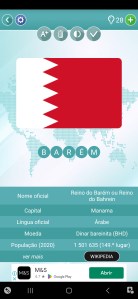
The Flag of Bahrain in Portuguese
Here Comes Bahrain Again, Falling I’m My Head Like A Memory

Ando a jogar “Quiz de Geografia” porque quero saber mais sobre as bandeiras do mundo, mas a língua padrão do meu telemóvel é PT-PT, portanto os nomes dos países têm de ser escritos em português também. É um ótimo método para aprender os nomes portugueses de vários países pequenos que ainda não sei porque raramente penso neles, tal como “Quirguistão”, “Camboja” e “França”.

The name of the app is “Quiz de Geografia” in my phone but I have all its settings in portuguese (as discussed here) so it might present as something else if you haven’t taken this gung-ho approach. As with many things, names of countries and capitals are subject to orthographic reform

Posted in English

Easy as ABC

False friends are always fun to deal with, and I saw a pretty good example today in a social media post by a Brazilian who was trying to translate “Fui alfabetizado nos Estados Unidos” into English. Obviously as an English speaker, you automatically try and englishify it as “I was alphabetised in the United States”, imagining João arriving at the airport and being placed in an ordered list between Joana and Joaquim.

It’s a lovely image but no, it’s not that, obviously. Alfabetizar means to teach literacy – so he was taught to read and write in the United States. It’s not a very common word, but you’ll see a related adjective – analfabeto (illiterate) – quite often when people are criticising each other’s poor grammar online so hopefully it won’t be that hard to remember.

And are you ready for the word to use when you need to put your words in alphabetical order? It’s “alfabetar” without the iz. So not that different, but you probably want to keep them straight in your head or you’ll get funny looks when you explain to someone that you have been procrastinating from study by teaching your CDs to read. In fact, if they’re under 25 you night have to explain to them what a CD is first.