The concept of a Jobsworth just came up in a conversation I was having in english/portuguese. I guess more British people, especially older brits, will know the word but for the benefit of anyone else, it’s basically an annoying petty official who acts as an obstacle due to excessive adherence to pointless rules. It was a very common trope in the 70s and 80s.
Anyway, while I was looking it up, I noticed some images showing portuguese definitions of similar concepts:
It sounds like it’s basically identical, according to this description, but if you search for “Síndrome de Porteiro” on twitter you see a slightly different trend in how it’s used day-to-day. It seems like the most common usags is when someone will only say bom dia, boa tarde or boa noite and won’t participate in any further smalltalk. OK, i can see that. And of course I can see there are a few populist types accusing journalists of having the syndrome if they dare to report something that contradicts their worldview. It’s definitely the same kind of idea but i think it has a slightly different tone.
I also saw a few people using “Síndrome de Porteiro de Wakanda”. It’s not totally clear what they mean by this. I looked at lots of examples but couldn’t quite work out what they were driving at. In one case it was about a Moroccan being described as white by a black woman, in another about white people arguing over Kamala Harris’s ethnic status and in others complaining about light skinned Latinos. So… Something to do with exaggerating or being very particular about someone’s ethnicity??? The nuance here is pretty hard to parse, especially since there’s obviously a lot of sarcasm in play. I don’t think it’s an expression I’m ever going to need to use though so maybe it doesn’t matter, but I like to think about these things in the hope of getting a sense of how phrases are used in the real world.
essa síndrome de porteiro de wakanda dos norte americanos kkkkkkk… é para dar boas e altas RISADAS https://t.co/1sO2YEbNuW
Incidentally, m’wife says Síndrome should be written as Sindroma but that seems to be out of date information because they both exist and the first spelling seems to be favoured by priberam. I don’t see any evidence that the AO is in play so it might just have changed over time due to shifting fashions.
So here are a couple of videos from the same guy. They are quite sweary so if you have a portuguese relative within earshot, you might want to use headphones. I was interested in the prepositions more than the swearing and I’ll tell you why when you’ve watched them. In fact, the whole post is quite sweary, even the English bits. If you are a child, reading this, please ask your parents to hide your device until your eighteenth birthday and then carry on reading.
As you can see, he’s pretty funny. In each case he’s giving versions of the same expression:
Não faz frio nem orvalho mas está a chover para caralho.
Não faz chuva nem orvalho mas está um frio do caralho
If you don’t already know, caralho is one of the rudest words in the language. But what’s going on with those prepositions just in front of each? Why is it para in the first instance and do in the second? I threw the question open to the floor.
In both cases we’re using the bad word to emphasise how strongly we feel about the situation, but you lead into it with para when what you are emphasising is a verb. “Esta a choverpara caralho”, “Os ovos andam caros para caralho”, for example.
On the other hand, if its a noun you’re emphasising, you lead in with do: “Está um frio do caralho”, “Cão do caralho passa toda a noite a ladrar”
It’s hard to draw a direct analogy to English swearing, not least because we wouldn’t even say “está um frio…” (“it’s a cold”). We’d treat frio as an adjective, not as a noun. But I’m sure you’ll be familiar with the fact that swear words are pretty flexible in how they’re used. So you could have ‘It’s cold as fuck” or “It’s raining like fuck” or “It’s a huge fucking storm”. Portuguese seems to have a rule about how the caralho is linked to the thing it’s referring to though so it seems to be one of those rare cases where portuguese is less complicated than English.
Trying the same as yesterday but this time I’m going to list all the verb/preposition combinations out before I start.
(While I was doing this, my sister-in-law, who is madeiran, came over and tried to do one of the questions in the opposite page. She couldn’t do them either, so I don’t feel so bad now)
The verbs to choose from today are
Agir
Agir contra = to act against
Agir por = to be motivated by
Agir segundo = to act in accordance with
Agir sobre = to act on something, produce an effect
Falar
Falar com =to speak with
Falar de = to make criticisms about
Falar sobre = to talk about, express opinions about
Falar em = to mention, refer to
Falar para = to speak on the telephone to someone in another location, to direct your speech toward
Falar perante = to speak on front of an audience
Falar por = to speak for someone, as a representative
Meter
Meter em = to put inside
Meter-se
Meter-se a = to dedicate oneself to, to roll up one’s sleeves and start doing something
Meter-se com = to direct one’s words at, to provoke, to challenge
Meter-se em = to dedicate oneself to something, to shut oneself in somewhere, to interfere in
Meter-se por = to go somewhere
Pensar
Pensar de = to have an opinion about
Pensar em = to reflect on something, to have an intention of
Pensar por = to do someone’s thinking for them
Pensar sobre = to think about, to have an opinion about
Saber
Saber a = to taste of
Saber de = to know about
Telefonar
Telefonar a = to phone someone
Telefonar de = to phone from somewhere
Telefonar para = to phone a place
Ter
Ter com = to have some relation with
(ir) Ter com = to meet with someone
Ter alguma coisa contra = to have something against
Ter de = to have to do something
Ter alguém por = to consider something (tenho-o por boa pessoa means you believe someone is a good person)
Holy prepositions, Batman
This feels much easier than yesterday’s. The expressions aren’t so similar. Anyway, here we go with the questions.
A Isabel é de ideias fixas: há nove meses meteu-se a aprender russo e já fala muito bem ✔️
Estamos a pensar em fazer uma viagem à Índia, talvez em Setembro ✔️
Na cerimónia académica, o estudante mais velho falou pelos colegas de turma ✔️
O José queria ajudar o neto, mas não podia porque não sabia nada de informática ✔️
Vais ter com a Ulrike ao Chiado? É um sitio muito bom para passear ✔️
O professor de História é “um livro aberto”: consegue falar sobre todos os assuntos com facilidade. ✔️
Os meus vizinhos são escandalosos, andam sempre a se metem em complicações ✖️ meter-se em (meh, right verb, wrong tense)
A família do homem-bomba declarou que ele agia pelas suas convicções religiosas ✖️ agiu segundo
O que é que pensas deste primeiro ministro? Eu acho-o um competente.✔️
Tenho a Fernanda por uma pessoa leal e honesta. ✔️
A mãe telefonou para o consultório do médico, mas não conseguiu falar com ele. ✔️
As alunas chinesas queixam-se e dizem que os portugueses se metem constantemente com elas. Elas acham-nos muito atrevidos*. ✔️
O réu, acusado de homicídio, argumentou que agiu por legítima defesa e agiu sobre os interesses da família. ✖️ Agiu em/ agiu pelos
Pedro, tens de pensar seriamente no seu futuro, não podes continuar nessa indolência. ✔️
Mete o dinheiro no bolso porque podes perdê-lo ✔️
Tens de acabar o trabalho quanto antes, já estamos atrasados na entrega. ✔️ (the answer actually gives “temos” but I think this works if you imagine one person’s work holding up an entire project team..?)
Detestava ouvir falar de outros pessoas, sobretudo quando era crítica gratuita. ✔️
A que é que te sabem essas batatas fritas? Acho-as horríveis. ✔️
A nossa filha, no seu doutoramento, teve de falar perante uma audiência de mais de cem pessoas. ✔️
Tens de dar a tua opinião, não posso pensar por ti ✖️ falar por
É difícil provar que ele não agiu por má-fé. ✖️ Tenha agido de
*nice word: cheeky
Well, that was much better but still left a lot to be desired…
I’ve been stalled in my textbook for quite a while. It’s quite hard to get through because the exercises are so samey. For example, at the moment I am working through a section in which you have to fill in blanks with verb/preposition combos. The section is 58 pages long with about 20 per page so I era thousand questions of the same type. This would be OK if they gave examples or pointers to teach you something before you embark on the exercise, but it really expects you to go and find the answers from some other source (in my case, the Guia Prático de Verbos com Preposições, which I definitely recommend even if I don’t recommend the textbook!)
It’s pretty exhausting and doesn’t make me feel motivated at all. I think I probably need to switch because ploughing through this isn’t yielding results.
Anyway, let’s have a go – I’m just going to straight up do my homework on here and mark it in real time.
Chegamos no Porto, de manhã, fomos do comboio das sete e regressamos ao fim da tarde ✖️ Vamos ao/Vamos no = We are going to Porto. In the morning, we’re going by train at 7.0p and return at the end of the afternoon. This is a bad fail. The tenses are all wrong, even. I think if I’d gone back and checked this one I’d have spotted it but I didn’t.
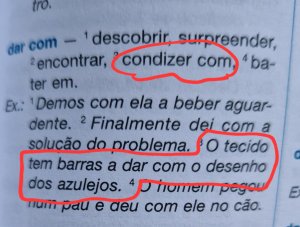
A cor das cortinas dá-se com as tonalidades usadas na decoração da sala ✖️ dá com =The colour of the curtains matches the tones used in the decoration of the room. I guessed “dar-se com”, which usually means “to get in with” would also mean match, but “dar com” is the right answer. It has a few different meanings but “condizer com” (to match) is one.
O autocarro 31 vai para a cidade universitária? ✖️ Passa pela = Bus number 31 goes through the University town?
O Pedro deu-se pela janela do comboio para admirar a paisagem. ✖️ Chegou-se à = Pedro went close to the train window to admire the countryside.
A Maria andava completamente obcecada por uma colega: lançou-se em si, constantemente, a pensar nele e não conseguia concentrar-se no trabalho. ✖️ Dava por =Maria was completely obsessed with a colleague: she was aware of him at all times, thinking about him and she couldn’t concentrate on work.
Emagrecia de dia para dia: os médicos passaram a pensar que fosse cancro. ✖️ Chegaram a = she was getting thinner day by day: the doctors had reached the point of thinking it was cancer.
A mãe quando o viu partir, de tão comovida, pôs-se a chorar. ✔️ Good lord, I’m on question (g) and this is my first right answer???
Como a Laura quase nunca sorri, muitas vezes passa por antipática. ✔️
Depois de muitos desgostos e desilusões, a Marta, deprimida, deu em alcoólica ✔️
Todas as cenas do filme nãopassaram dum manicómio ✖️ se passam num = All the scenes take place in a madhouse. This is a really good example of me getting it wrong because I got the wrong idea about what they were trying to say. I thought it was a bad film and every scene was like a madhouse.
Oh god, I’m so lost…
Esse aparelho tão esquisito dá para quê? ✔️
Acho que há pouco comida, as sardinhas não chegam para tanta gente ✔️
Não posso ir a um café a meio de manhã ✖️ passar sem = I can’t do without a café at midmorning.
A Helena dá-se bem com todos os seus colegas de trabalho. Assim o ambiente é ótimo. ✔️
O cão-polícia lançou-se sobre ladrão e conseguiu dominá-lo ✔️
OK at this point I had some wine. Let’s see how my success rate changes
O Rui vai a frequentar concertos, desde que namora com aquela pianista ✖️ passou a = Rui started going to concerts ever since he started dating that pianist
Estamos fartos de tentar modos diferentes de resolver a equação matemática mas não conseguimos chegar à solução. ✖️ Dar com = We’re exhausted from trying different ways to resolve the maths equation but we can’t find a solution
A empregada pôs os pratos e os talheres sobre a mesa para o jantar dos patrões. ✔️
O deputado do partido “Os Verdes” foi ontem a Dublin, onde esteve dois dias e deu uma conferência. ✖️ Chegou de = The MP from the Green Party arrived yesterday from Dublin where he was for two days and gave a conference.
O António foi para Bruxelas com um contrato de trabalho de três anos. ✔️
Abriu a porta de repente e deu com o filho mais novo a fumar às escondidas. ✔️
Oof, pretty terrible. Maybe I need to keep ploughing on because I’m really not doing well with these! That’s what? 11/21? Even with a reference book to hand. Terrible!
A video drifted into my feed yesterday by someone I’d never heard of before and it looked interesting so I listened to it while I was getting ready to go out. The chap who made the video is a linguist and he decided to weigh in on the controversial topic of pronouns and how they are being used, mainly in English, mainly by younger people in relatively affluent communities. If you don’t know why pronouns are controversial, well, consider yourself lucky, but basically whether we refer to people as he or she or something else, and under what circumstances is currently occupying a lot of social media and traditional media output. Frankly I’m baffled, but middle-aged people being baffled by stuff the youngs are obsessed with isn’t exactly news, is it? 🤷🏼
Anyway, as weird as it is in English, it’s even weirder in languages like portuguese where gender-specific pronouns are ascribed not only to people but to pens, apples, books and the concept of liberty*.
I’ve written a few posts about pronoun shifts a while ago um… Now where did I leave those? I started with this one, and a few people said the pun on the word “neuter” was problematic but that doesn’t seem to have stopped me repeating the crime a few weeks later when I really expanded on the subject here and then for a little reprise here.
Anyway if that kind of thing is something that interests you, I can recommend the whole video: it’s full of thought-provoking stuff. On the other hand, if you’re not, no worries because I only wanted to focus on a few seconds in the middle anyway. So, let me at least tell you why I decided to contradict him despite the fact that he is an expert and I am not.
At around 8 minutes and 25-ish seconds, he is discussing instances of relatively new pronouns that have been drafted into languages, relatively late in their development and he says “Portuguese has the impersonal ‘a gente'”. Except he says it in a Brazilian accent so it’s more like “a Genchee”.
Why, Brazilians? Why?
Gente is a feminine, singular noun that refers to a group of people but it’s true that portuguese speakers do use “a gente” as a stand-in for a group of people in place of “we”. It makes the grammar simpler because you don’t have to wrap your tongue around the nós form of the verb, you can just conjugate it in the third person singular – “a gente fala…” in place of “nós falamos”. It sounds a bit odd to English speakers but it works. As far as I can tell, it’s much more common in Brazil but it does exist in Portugal too. Of course it’s very informal, but I think it’s wrong to say it’s a pronoun. Even though it’s playing a similar role in the sentence – filling in in place of what could be a list of names, you could say the same about other collective nouns. Take “The family” as in “The family are getting together for Christmas” which could easily have been “We are getting together for Christmas”. Or what about “guys” in situations like “It’s just the guys, together again” or “hello guys, and welcome to another video”. Definitely not pronouns, right, but they are really fulfilling the same role as “a gente”.
Using nouns as stand-ins for people happens in formal speech too. You will almost certainly have heard people addressing each other as “o senhor” or “a senhora” or even “o doutor” Again, these are behaving in a fairly pronoun-like way, but they’re both nouns. You’re just talking to the person in the third person. “How is the gentleman?” instead of “How are you?” It’s the same kind of thing.
I felt like I was being a but of a reply guy, challenging someone in their academic discipline. Luckily we are both dudes, so I can’t be accused of mansplaining but even so, it’s a bit… Well, let’s say “hubristic”.
The Results Are In, You Bastards
So, I made a reddit poll to ask native speakers on r/português to tell me if I’m right in my thinking. To my huge annoyance, judging by the early results, ‘yes, it’s a pronoun” seems to be winning over “no, it’s just a noun”. It’s a pretty close result in Portugal but overwhelming in Brazil.
In my defence, democracy is overrated. But if that brilliant argument doesn’t convince you, the explanation someone gave is that although “gente” is a noun, “a gente” os technically known as “uma locução pronomial” with “the same value as the personal pronoun ‘nós'” só it’s not a pronoun per se, but it works like one. Meh, I can live with that form of words, I think.
Finally, a European speaker said he was taught never to use it as a pronoun because it was “extremamente errado” and whenever he used it his grandpa would say “A gente? Agente é da polícia!”
Preach it!
*Respectively: lady, lady, gentleman, lady, if you’re keeping score.
Following on from yesterday’s whingeing about South Americans behaving like North Americans, here’s an interesting linguistic side note from the same Instagram account. Sorry, I’ll get back to european portuguese soon, I promise!
My first assumption was that maybe this was some sort of racist graffiti in Portugal – after all, the hashtags talk refer to xenofobia and “brasileiro em Portugal”. So, I asked around, but it turns out to be something else entirely. They’re all in Brazil and the different spelling is down to the difference between people’s perception of Brasil and the reality for average Brazilians. Brasil is a very unequal society with a lot of poverty and a lot of social problems, but also with an amazingly wide variety of plants and animals, as well as indigenous cultures. Brazil is the international spelling used by the United Nations, so in this context it has come to represent some other version of the country. Some people in the discussion said it was a stand-in for “the international elites”, whereas others see it as representing outsiders’ view of Brazil: tourism, beaches and a big statue of Christ the redeemer. In BraZil all the men are sexy helicopter pilots and all the women are beautiful, tanned and interestingly waxed. So, spelled with a Z, it represents either the rich who are ruining the country or the fantasy that is eclipsing the reality. Either way, there’s a dichotomy between the real Brasil and this fake Brazil that doesn’t understand it, is killing it, and doesn’t deserve it.
The specific phrases come from a song by Elis Regina called “Querelas do Brasil”. Querela can be a libel, an indictment, a dispute or a sad song. I’ll let you make your mind up about what, specifically, she’s going for here. It certainly doesn’t sound like she’s railing against the one percent: it sounds very upbeat, but Brazil has its own rhythms so that doesn’t necessarily mean it’s not serious. She spends a lot of time listing things she likes about the country. I must admit, I didn’t recognise half the words but there are a lot of wild animals in there, an indigenous hero, some places… So I get the idea that at least some of it has to do with Brazil the state not deserving Brasil the paradise on earth, but I’m sure there are layers to it I’m missing.
As a result of a recent conversation about racism (following on from a book I read – there’ll be a review here in a day or two) a Brazilian guy on reddit pointed me to an account on Instagram called brasileirasNaoSeCalam. It’s basically one of these accounts that seeks to ginger people up for a particular cause by telling you how absolutely terrible everything is. In this case, quite a lot of the posts are just quotations from Brazilians in other countries recounting times they were victims of racism. The vast majority of them are in Portugal.
It’s quite interesting from a sociological point of view because of course there are racists in every country and knowing what kinds of stereotypes people have about each other tells you something interesting about the country. There is definitely racism against Brazilians in Portugal. I’ve seen videos and I have spoken to people who have some really unpleasant views about them all being thieves and whores, but I’m a bit unclear about the extent of that racism and I’m curious to know more.
But just as there is racism in every country, microaggressions (ie perceived slights which are held to be evidence of a deep seated hostility) are everywhere too, mainly thanks to the steady creep of absolutely terrible ideas from the USA. And my sense is that a lot of these posts fall under that heading. And in a way, that’s interesting in itself because learning what people see as a microaggression can tell you something about the shape of paranoia in a particular demographic. Take this for example:
(I’m doing an online course and my teacher always turns up with two video options for us to watch: one in Brazilian and one in English “for anyone who doesn’t like Brazilian”
From the comments, the reason for the complaint is that some people find the use of “brasileiro” in place of “português de Brasil” to be evidence of hatred, and the fact that she thinks some people might prefer to hear a foreign language rather than a São Paulo accent just adds insult to injury. This seems a little over-sensitive, but more importantly, I think it’s pretty obvious that there are plenty of alternative explanations for why English is being offered alongside Brazilian. For example, Portugal has a pretty good record of welcoming refugees and asylum seekers from Syria, Venezuela and Ukraine, among others. It must be a hard transition for those people to make given how much harder it is to learn portuguese than English. Of course it’s not practical to have videos in every language, but English is practically a universal esperanto these days, and it seems very likely that someone who is still struggling to learn portuguese might find it easier to follow an English language video than one that is in a strong, unfamiliar accent.
The irony is I think the teacher is being unfairly accused of racism just because they are making the course more accessible for all immigrants, and not exclusively catering to the needs of oversensitive Brazilians. Quite a lot of the quotes on the site are in the same vein: they’re minor or open to more charitable interpretation or just frankly unlikely-sounding.
Don’t get me wrong, there are definitely some real racist incidents on there, but I get the impression it’s one of those accounts where all the followers want to tell their victimhood story and the net effect is that it becomes a huge echo chamber and everyone inside is in a state of constant fear and rage, way out of proportion to the real situation. I’d love to find some good journalism on the subject though. When I say good journalism I mean (a) uses data competently and thoughtfully and (b) doesn’t pepper their narrative with the word ‘privilege’.
I’ve mentioned a couple of times (here and here) now that I have had long, rambling discussions with Brazilians about whether the third person singular (the “we” form) in the past perfect tense is identical to the present tense. It is in Brazilian but not – or at least not normally – in european portuguese.
I actually ran into a portuguese guy from Beira Alta who says that, where he lives, they say the two words the same way (not surprising) and spell them the same way too (more surprising). We had a bit of a chat about it back and forth and he agreed that the accent in the written form was helpful (I agree 100%) but he wasn’t going to change the way he spoke (also agree 100%) and like a lot of Portuguese people, he felt like the Acordo Ortográfico was an annoying imposition from on high that he didn’t really buy into.
I feel like this was quite a useful conversation for both of us. For me because it’s good to learn about different accents and ways of speaking and I hope also for him because most people in most countries don’t really reflect on their own language until they hit something unexpected, and I like to think that by having this conversation he enjoyed thinking about his own language as much as I do. For example, I mentioned that the two versions (falamos and falámos, say) would both have the stress on the second syllable and he said no, they don’t stress the word anywhere. I guarantee you, there is no portuguese word that is spoken in a flat, robotic monotone. I made a joke about how most words in portuguese are either oxitono (stressed on the last syllable) or paroxitnono (penultimate syllable) and a few are proparoxítono (antepenultinate) but maybe there needed to be a new word “nenhuresitono” for words that are stressed nowhere.
I have learned a lot about my own language from talking to foreigners who were trying to learn it and I really hope his encounter with this confused British chap was helpful for him in the same way.
* I talked a lot about proparoxítono during my brief obsession with Chico Buarque’s excellent song Construção. If you haven’t heard it, I strongly recommend it because it is educational but more importantly its effing brilliant. Yes, I know it’s in Brazilian portuguese, but it’s worth making an exception for! My original post about it, complete with the video, is here and I’ve continued to bang on about it here and here