Posted in English, Portuguese

Vazios

I did the compreensão da leitura test from the DAPLE (C1) exam yesterday. It’s the one available on the Universidade de Lisboa site at the bottom of the course description here. I did pretty well on most of it but the wheels really came off on the last exercise so I’m going through the answers and trying to work out why it is the way it is.

Complete o texto com as palavras que faltam nos espaços 1-20. A cada espaço corresponde apenas uma palavra. Escreva as palavras na folha de respostas.

André Nave, Diogo Madeira e Bruno Nunes são três amigos que lançaram em novembro passado um sítio na Internet [1] podemos conhecer sugestões diversas sobre a cidade de Lisboa.

O sítio, chamado Onde Lisboa, [2] recordes de popularidade. A ideia surgiu quando os
três amigos [3] a necessidade de criar um espaço virtual onde os estudantes, os
residentes e os turistas pudessem encontrar informação que não [4] dos guias turísticos, por exemplo a questão do estacionamento gratuito.

O sítio dispõe de um separador [5] exclusivamente aos estudantes. Desde locais para
fazer impressões à lista de cantinas [6], os estudantes conseguem aceder a um conjunto de informações úteis em qualquer situação. [7] além disso, há um espaço dedicado ao desporto, à cultura e ao comércio.

O André e o Diogo fazem pesquisa de campo, sendo responsáveis pela [8] de informação e de fotografias que ilustram os artigos. Acabam [9] envolver os amigos nesse processo e estão sempre disponíveis para aceitar sugestões de [10] visita o sítio. Bruno Nunes diz que é comum encontrar espaços que não se [11] referenciados na Internet.

Nesses casos, o Onde Lisboa passa a [12] uma referência na divulgação desses espaços. À [13] que os proprietários do sítio vão fazendo pesquisas, vão descobrindo [14] vez mais coisas e aí constroem novos conteúdos.

O projeto está em permanente autoavaliação e os três amigos não sabem, ainda, [15]
proporções o projeto poderá atingir. [16] que vamos ter, em breve, um Onde Porto ou um Onde Coimbra? O tempo o [17].

Para já, Bruno, Diogo e André, os três mentores desta ideia já considerada genial, [18] as suas atividades profissionais com este projeto. Não têm uma ambição desmedida para o projeto e preferem que ele [19] crescendo aos poucos. Afinal, Roma e Pavia não se fizeram num dia. E é melhor [20] pelo seguro, para não dar razão ao ditado popular “quem tudo quer tudo perde”.

in http://www.ruadebaixo.com/

  1. “Onde” or “Em que” are given as answers, but since the instructions say only one word per space, I am declaring the second one bullshit and the correct answer is Onde
  2. Bateu. It beat the record. Embarrassingly, I got the point of the sentence wrong and thought “recordes de popularidade” was the actual content of the site so I wrote “contem”. This was moronic and I like to think if I’d gone back and checked my answers I’d have spotted the idiocy, but I didn’t
  3. viram/identificaram. Straightforward enough
  4. consta. This word constar has a few different meanings here but I think the relevant one is “to be written in”. Note that it’s folled by “de” and not “em” though. I stuggled to think of a single word that fit here and ended up writing “veio” – the information didn’t came from, the tourist sites. Nope.
  5. dedicado. I wrote “reservado” which isn’t a million miles away but it’s not right
  6. disponíveis. I wrote “baratas” but there’s no need to assume they’re only talking about value for money of course. A lot of people like to travelin luxury.
  7. Para. For some reason, madness seized me and I wrote “por”. Ugh.
  8. atualização. I said “escolha” – the choice of information. Hm… I don’t think this is a terrible answer, but atualização (“update”) definitely sounds better
  9. por. Acabar por means “to end up doing…” so this makes sense
  10. quem. This is a relative pronoun referring to person so it makes sense too
  11. encontram. I didn’t notice the “se” and wrote “for”. Lack of attention there. Always read the question carefully!
  12. ser. Passar a ser means it comes to be, so this makes sense
  13. medida. “À medida que” makes a lot of sense – it means something like “to the extent that…”. For some reason, I blanked and ended up writing “proposita” instead. Wild guess, and it doesn’t even make sense because the a wouldn’t have an accent on it if it was “a propósito” (“By the way”)
  14. cada. Cada vez mais means “increasingly” or “more and more” so this makes sense
  15. que. I wrote “quantas” for reasons which seemed to make sense at the time
  16. Será. “Será que” is a sort of impactful way of leading into questions where you’re maybe a little skeptical or want to build up some expectation.
  17. dirá. the expression is obviously equivalent to “time will tell”, but I used “contar” which is used for telling a story and it should be dizer: O tempo o dirá”. Time will say it!
  18. conciliam. This verb can mean conciliate, and something like “synchronise”, but I think the sense it means here is “combine elements that are apparently divergent or incompatble” according to Priberam.
  19. vá. I wrote Anda, which is on the right lines. According to this Ciberdúvidas page, andar+gerundio is valid (it’s example 5 on the page) but ir+gerundio has more examples and it explains that teh ir+ version is more like a slow development over time, where as andar+ was more like a repetitive action, so that must be ahy anda wasn’t the correct answer
  20. jogar. Jogar pelo seguro: play it safe! Should have guessed that one, although I’d never seen it before.

Posted in English

Cinzas

So I was at the banana museum, admiring the many curved fruits, when I noticed a chart displaying “O Valor Nutritiva do Banana”, listing the amount of fat, sugar, fibre and so on. I neglected to get a picture of it, but you can see it at the very bottom of this page.

So um… What? Why would cinzas (ashes) be in a banana? I puzzled it out and decided it means “potassium”. OK, OK, hear me out. We were in a museum so it seemed at least possible that the tabke was very old. When potassium was first discovered it wasnt really understood but it was known to be alkaline and to be present in ashes. In fact the name “potassium” comes from “potash”, a compound derived from wood ashes. So maybe at some point along the timeline people knew that this unidentified stuff was in a banana but they hadn’t got around to giving it a name yet.

Apparently, I was overthinking it. Cinzas, when it appears in a nutritional chart, jusy refers to the literal ashes or unburned inorganic residue left over when the food has been dried and the fats etc burned off. They can be analysed to figure out what minerals are in there but for some reason, that hadn’t been done by whoever made this table so they have just aggregated the potassium, sodium, calcium, magnesium, etc into one item: cinzas.

Posted in English

Desafogadamente

I came across this word today and was strangely pleased by it. The root of it is the verb “afogar” whose main meanings are “to drown” or “to submerge”, but which has some related meanings which go along the lines of “to impede” or “to choke”, both of which make sense: you can imagine how being impeded or stifled might feel, figuratively, like being immersed in water, of how being choked or strangled would deprive you of breath just as surely as being drowned would.

So building on “afogar”, or rather its past participal “afogado” we’ve got the prefix “des” making it negative and the suffix “mente” making it an adverb, and we end up with “desafogadamente”, which you could literally render as “undrownedly”, but seems to be used to mean something like “freely” or “without hindrance”. Excellent stuff! Definitely using that at the next chance I get!

Affogato
Affogato (image courtesy of Leva Kisunaite)

Afogar is quite an easy verb to remember if you’re a fan of delicious Italian treats because you’ve probably come across an affogato. If you don’t know it, it’s a dessert consisting of a scoop of vanilla ice cream with coffee poured over it. This combination of cold and creamy with hot and bitter is literally “affogato al café” or “drowned in coffee” and it’s the same word, just italianified.

Posted in English

Typo… Or is it?

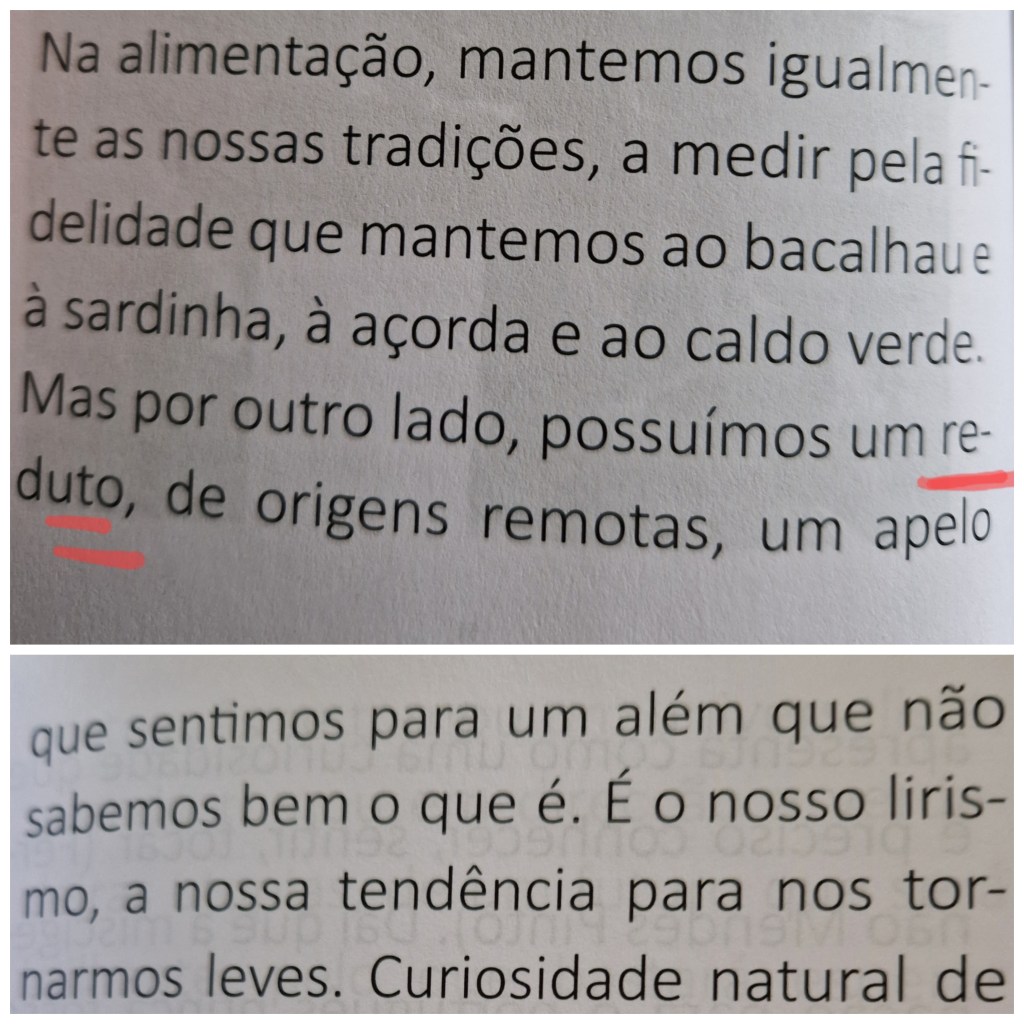
I couldn’t work out what this word was doing here. Reduto is like redoubt, so it’s a kind of fortress… So what’s it doing in this sentence? I didn’t know so I asked.

He’s saying that, despite their natural conservatism, portuguese people have a redoubt – an unvanquished corner of their heart – where they nurture a longing for something else out there.

OK, makes sense. I thought I’d found a typo but instead I found some new vocabulary.

Posted in English

Obscure Word of the Day

The book I’m reading is pretty hard. I judge these things in how often I have to reach for the dictionary and this one is about three times per page. I’ve just come across a really surprising word: “pechisbeque”.

Duas camisolas de malha iguais, de cores diferentes, um pólo cor-de-rosa, uma caneta, um par de brincos de pechisbeque, dentro de uma caixinha acolchoada, dois perfumes em miniatura

As Telefones – Djaimilia Pereira de Almeida
Pinchbeck jewelry
Pinchbeck / Pechisbeque

Not only is it unfamiliar, but what it’s describing isn’t even something I’ve come across in my half century of life. The English equivalent is Pinchbeck and its an alloy of copper and zinc that resembles gold. Is it just me? I’d never heard of it.

Posted in English

Don’t Risk it for the Biscate

Episode 8963 of the series “words that mean wildly different things on different sides of the Atlantic”

Biscate seems like a useful word to have in your back pocket, but use it with care. In Portugal it refers to a side job, side huddle, or short term job. In the world of the gig economy, it seems like a good one to know.

Olha, aquele é mecânico nos estaleiros, mas faz uns “biscates” de electricidade por fora!

https://www.dicionarioinformal.com.br/biscate/

When this came up in online discussion, some Brazilian contributors found this funny because that’s not what it means in Brazil at all. Over there it refers to a woman who has lots of sexual partners – so equivalent to slut or slag or other derogatory terms.

A menina que ficava com todos garotos do colégio era chamada de biscate.

https://www.dicionarioinformal.com.br/biscate

Navigating slang is more complicated in Portuguese than in English because there seem to be quite a lot of examples of differences like this.

Posted in English

The Heels Are Alive

We tend to learn body parts early on in our language journey and we think we’ve got them all mastered because we’ve mastered how to sing “heads, shoulders, knees and toes” in Portuguese but there are all kinds of other body parts that don’t get a look-in: armpits (axilas), kidneys (rins), calves (panturrilhas ou “barriga de perna“), and so on.

One I came across today and probably should have known was “calcanhares” meaning heels. There are a few expressions involving heels, some of which are familiar and some less so

Calcanhar de Aquiles – the Achilles heel can be used figuratively to mean a person’s weak spot, just as in English

Dar aos calcanhares – is like the English expression “to show a clean pair of heels”, in other words, escape or run off quickly.

Não chegar aos calcanhares de alguém doesn’t really have an equivalent in English. If you don’t reach someone’s heels it means you are vastly inferior. A minha filha gosta de David Tenant mas na minha opinião, não chega aos calcanhares de Tom Baker.

And an English expression that doesn’t have a direct match in Portuguese would be “high heels”. In Portuguese the heel of a shoe has a different name: salto, so a salto alto is a high heel shoe. It’s a bit confusing because salto can also mean a jump, so salto alto sounds like it should mean a high jump, but the athletic event we call a high jump is “salto em altura” in Portuguese.

Posted in English

Tips So Hot They’re (In)Flammable

I asked on the Reddit about why Desempenhar wasn’t the opposite of Empenhar. Empenhar means “to make an effort”, and the prefix “des” is like “dis” in english and it usually reverses or negates the meaning of whatever word it’s attached to and makes it into an antonym. So for example, “Fazer” means to make or do, and “Desfazer” mean to take something apart; “Cansar” means to get tired, “Descansar” means to rest, “Ordem” means “Order” and “Desordem” means “Disorder” and so on. So desempenhar looks like it should mean “make no effort” (“Hoje é dia de folga, pá. Vou me desempenhar o dia inteiro!”) but it doesn’t, it means “to perform”.

Why? Is there some sort of mysterious etymological tale to tell here? Same question for their noun forms, empenho (effort) and desempenho (performance).

Joe Desempesci discovers the difference between flammable and Inflammable

As it turns out, it’s just one of those things like Flammable and Inflammable in english, where the prefix just doesn’t really have any effect. A few interesting points came up in the comments

Butt_Roidholds listed some other examples of this sort of thing:

  • Abrir = open / Desabrir means leave off doing something… hm… I’m not absolutely sure about this one. Abrir can mean “Open the proceedings” – ie, start something, so desabrir meaning cease doing something actually does seem to be an antonym
  • Obstinado = obstinate / Desobstinado = something like “disoriented” but it’s not very clear – it isn’t defined in Priberam and Infopedia just says “ver desaustinado”. It seems like an odd fish and I won’t be using it!
  • Inquieto = disquieted / Desinquieto = exactly the same as inquieto! Why does this even exist though? They already have the word “quieto”, so why the double negative?
  • Aliviar = alleviate / desaliviar = alleviate.

And other users, TheSingingBowl and Vilkav chimed in with

  • Abrochar = to fasten with a brooch, or to button up / Desabrochar = open or unbutton, can also refer to the opening of a flower. These seem like pretty decent antonyms but the person who suggested them added a laughing emoji so I think it might have to do with the other (rude) meaning of “broche”.
  • Largar = let go / Deslargar = let go. Yep, definite example.

As for theories about how the words got like this, the most interesting one was from Grenarius who suggested maybe Desempenho came from the word “penhor” which is like “pawn” in the sense of something given as security for a high interest loan, and when you would “se empenhar” you were incurring an obligation which you would then discharge, so desempenha is an antonym of “se empenha” in that sense: you are performing some work to pay off your debt. It’s a minor stretch but not out of the realms of possibility