Posted in English

I’m Espertacus!

I was presented with a pun the other day and I totally failed to get it. It was in the context of one of those puzzles where you have to work out how to resolve an apparent contradiction: there are two parents and two children in the car but there are only three people. How is that possible? The answer is that it’s three generations: grandpa, dad, son, where the dad is also the son of the grandpa. One of the guesses was along the lines of maybe it’s a gay couple, and when they realised it couldn’t be that because even in Ron DeSantis’s Florida, homosexuals don’t count as only half a person, they said “Estou muito pouco esperta”.

So where’s the pun? In English, we might say someone who immediately tried to introduce an LGBT theme into an unrelated discussion is “Woke”, but someone who gets riddles straight away might be “Clever”. Actually, let’s say “smart” – I don’t know why, but I feel this american, practical sort of cleverness is the best one to use in this context, because both “Woke” and “Smart” can be translated as “esperto”. So the person was saying that they’d got the joke wrong by being “not so smart” but also saying they weren’t one of these woke people.

I marked it down as something to look into and I have because I’m a nerd. As far as I can tell from the canonical meaning of esperto on priberam and the more slangy definition on dicionário informal, esperto doesn’t mean the same as “Woke” as its used in English now: meaning the person holds a range of well-manicured opinions related to identity politics that are simultaneously censorious, emphasising and exacerbating social division as much as possible and also weirdly corporate-friendly and able to be used in a LinkedIn post without the slightest trace of irony. No, rather, esperto is more literally “awake”. It’s related to the word “despertador” (alarm clock) so it goes back to the original meaning of woke – that you’re awake, that you’ve had your eyes opened to injustice.

So it works as a pun, but don’t get carried aeay: I don’t think you could say of an earnest and slightly preachy young person that they were “esperto”. Woke is apparently used in portuguese. I doubt the cultural salience is exactly equal (people my age using it in a “tut tut, what is the world coming to” way, and people under thirty acting as though trying to destroy other people’s lives over a tweet was “just being kind”), but it does exist. Here, for example, at 4:20, where you can see other Americanisms like “boomer”, and “policamente correto”

So what about the other meaning of esperto? Why did I say smart was a better translation than clever? Or, put another way, what’s the difference between being inteligente and being esperto? The Açoriano podcast Helfimed explains it in this video using an analogy, starting at 3.38

He says, in his amazing accent, that if you imagine 2 people who have never seen electric light, and they’re put in a room and then the lights are turned off. They both see there’s a light switch on the wall (how they see this in the dark, we’re not told) and they can see it’s something unfamiliar. The inteligente is thinking well, maybe it controls the light, but maybe it’s a trap. And if it does turn on the lights, how does that work? They’re seeing the problem in a more holistic way, maybe. The esperto, on the other hand, is more practical, operating at the level of cause and effect, and so he just cracks on, finds out what works, and gets results.

So that’s that. I think I’ve done a thorough job of over-analysing the hell out of that, haven’t I.

Posted in English

Let’s Speak Atlantian

Peçonhenta

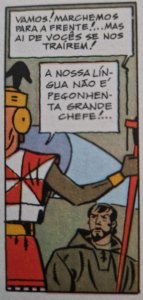
There are a couple of interesting bits in this little “quadrinho” from the graphic novel I’m currently ploughing through. Both the speakers are members of lost races. The chap who looks like a monk is actually a villain and some sort of Prince in the lost continent of Atlantis, while the fella who looks like some sort of inca is a member of some sort of barbarian tribe on the border of Atlantis, but still under the ocean.

Monk-looking guy: Let’s go. Let’s walk on, but woe betide you if you betray is.

Inca-looking dude: Our tongue isn’t poisonous, big chief.

“Aí de você” is obviously some sort of set expression. The main place I can find it is in the gospel of Matthew chapter 11, verse 21, where it’s used in place of the English “woe to you” (that’s a pretty universal translation in the ESV, KJV and NIV). I’ve translated it as “Woe betide you” which is even more archaic but I had a primary school teacher called Mrs Watson who used to say “woe betide you if…” (insert misdemeanor here).

And given the general missionary/indian vibe of the costumes (even though that’s not who they are meant to be) I thought “Língua Peçonhenta” would be something stereotypical like “forked tongue” and I wasn’t far off, but it’s “poisonous tongue”. I would have expected “língua venenosa”, since that’s the usual adjective you’d expect. Good word though!

Posted in English

Ouvidos de Mercador

I never remember to use idiomatic expressions in the real world but I pulled out “Fazer Ouvidos de Mercador” the other day, while simultaneously making a pun, and I felt like a black belt

Posted in English

Ceca e Meca

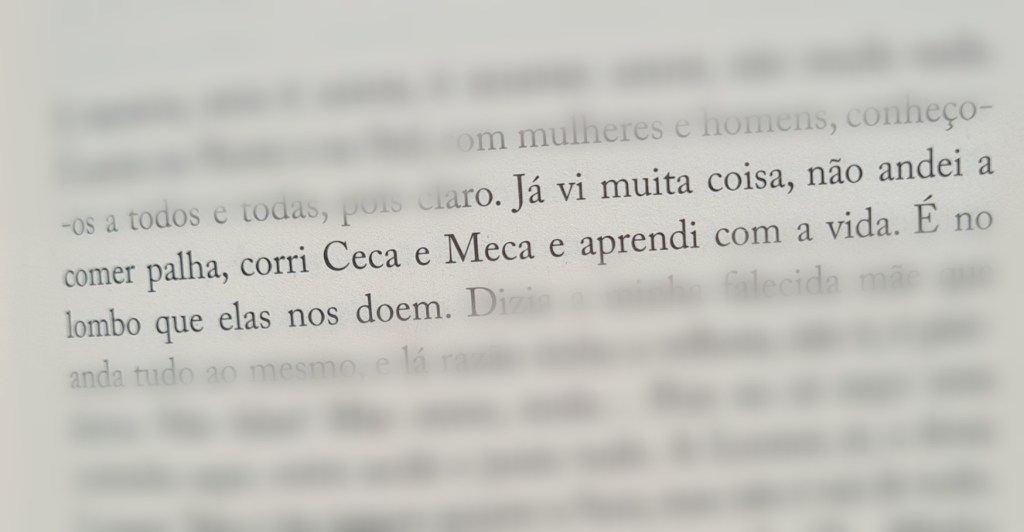
já vi muita coisa, não andei a comer palha, corri Ceca e Meca e aprendi com a vida.  É no lombo que elas nos doem
Ceca e Meca?

I was intrigued by this sentence. Ceca e Meca? What the heca… um… I mean what the heck’re those?

Meca is easy – it’s just what we would call Mecca. Ceca needs a little more digging: it’s an arab word that means treasure-house, but it was the popular name of the great mosque in Córdova during the muslim occupation of the iberian peninsula. So according to Ciberdúvidas, the expression “correr Ceca e Meca” recalls the pilgrimages made by arabs between the holy places in southern europe and in the middle east itself. In other words, it means you’ve been all over, you’re well-traveled.

What about the rest though? Já vi muita coisa – I’ve seen a lot. Não andei a comer palha – I haven’t just been eating hay (this seems to be related to the expression “todo o burro come palha” – she just means she doesn’t just believe what she’s told). Corri Ceca e Meca e aprendi com a vida – I’ve been all round the world and I’ve learned about life.

I’m not really sure about “É no lombo que elas nos doem”. Lombo is sometimes translated as loin, but it’s really about the area in the upper back, below the shoulder blades, either as a cut of meat or on the human body. So… i think she’s saying something like “They stab you in the back”. Not sure though. Doer means hurt, not stab. Maybe she just means things wear you out and make your back ache…? Hm, I think I might askabout that one. I’ll keep you posted.

Posted in English

É Uma Expressão Portuguesa Com Certeza

This beautiful gift was sent to me on Reddit and I went in search of the original. Its a blog post from a few years ago. As I have probably mentioned before, people who mark language exams live a good idiomatic expression, and the author of this piece has constructed an entire blog post out of nothing but expressions. There’s hardly a single word that isn’t part of one. It’s a magnificent achievement and certainly a lot more fun than the C1/C2 workbook I am ploughing through, where fully one third of the book is about expressions.

Posted in English, Portuguese

Roupa Dope

Some examples from the book I’m using, with idiomatic expressions relating to clothing. (Roupa). Example sentences are difficult if you’re working on your own because of course there is no model answer to check so I am just shamelessly posting them as my daily text on writestreakpt

Diz-se que o ex-ministro dos Negócios Estrangeiros recebeu luvas com origem na Rússia. (Receber luvas = take a bribe)

A crise financeira provocou desemprego no Sul da Europa portanto os cidadãos tiveram de apertar os cintos. (apertar o cinto = tighten one’s belt)

A Rebeca é uma verdadeira mexeriqueira que corta sempre na casaca de alguém de que não gosta. (cortar o casaco = talk smack about someone)

Os meus amigos trabalham na Televisão Estatal e quanto à realização de programas, sabem as linhas com que se cosem. (saber as linhas com que se cose = to be expert in some skill)

À beira do Douro, em Vila Nova de Gaia, estão localizadas as famosas caves do vinho do Porto onde se encontram garrafas de se lhes tirar o chapéu. (ser de se lhe tirar o chapeu = to be worthy of taking one’s hat off to)

Estou num beco sem saída. Preciso de descalçar esta bota (mistura de metáforas!) (descalcar a bota = resolve a problem)

O bisavô dela foi fazendeiro em Minas Gerais. Era trabalhador e gastava pouco pelo que conseguiu juntar um belo pé-de-meia. (juntar um pé de meia = save)

Não gosto de amigas com língua-de-trapos. (língua de trapas – a malicious gossip – someone who might cortar o casaco de alguém, in fact!)


Posted in English, Portuguese

Expressões

Another batch of expressions from the C1/2 Textbook I’m using

Passar pelas brasas (pass through the coals) =have a little sleep

Dar barraca (give a shed) = provoke a scandal

Surdo como uma porta (deaf as a door) =deaf as a post

É outra loiça (It’s different crockery) =much better (food)

Estar em maus lençóis (be on bad sheets) = be in a sticky situation

Falar de poleiro (speak from a perch) = Speak arrogantly, get on your high horse

Ser um bom garfo (be a good fork) = be a lover of good food

Eira
Eira

Sem eira nem beira (without a floor or a roof*) = very poor

Estúpido como uma porta (stupid as a door) =daft as a brush

Atirar o barro à parede (throw the clay at the wall) = test the waters to see if someone might be receptive to your idea

De cortar à faca (you could cut it with a knife) =same as the English expression – when the atmosphere is so tense or oppressive that you feel like you could cut it with a knife

Cascos de rolha (corked casks) = a long way off.

De fio a pavio (from string to wick) =from beginning to end. (I think we’re supposed to think of a candle burning all the way down)

Entrar em parafuso (go into a screw) = go into a tailspin, panic

*=There was a bit of debate over this one. Eira is a kind of floor or patch of ground in a village, where harvested grain is threshed and sieved ready for storage. Beira is a word we usually hear when talking about the seaside (“beira mar”) but it can be the eaves of a roof. The phrase is sometimes expanded to “Sem eira nem beira nem ramo de figueira”, adding that the poor bugger doesn’t even have the branch of a fig tree.

Posted in English

Freudian Slip

The exercises in the book I’m working through have themes to them. The last few have all been expressions involving body parts. The other day included one that said “Fugir a boca para a verdade” (The mouth runs rowards the truth) meaning if you don’t keep it under control, your mouth just blurts out what’s really on your mind. The very same day, I saw someone using it because George W Bush had given a speech and, as this tweeter commented, his big stupid mouth had done exactly that.

Here are a few of my favourites from the same exercise

Sete cães a um osso – lots of people are trying to lay claim to one thing, or the attention of one person

Estar debaixo da língua – equivalent to “on the tip of my tongue”

Ficar com um nó na garganta – equivalent to “have a lump in one’s throat”

Ter as costas largas – to be able to cope with a lot of responsibility

Posted in English

O Dialecto Madeirense

This video was published on Twitter on Thursday (O Dia Mundial Da Língua Portuguesa). The first speaker is Francisco Louçã, an MP (“Deputado”) from the Bloco Esquerda and he’s introducing a PSD colleague named Carlos Rodrigues, saying he will now address the chamber in his “Madeiran Dialect”. Rodrigues then replies in a way everyone thinks is hilarious…

I can’t understand what he’s saying so I cheated and looked at the parliamentary transcript which is here, and you can read the surrounding context about the dialect (it’s not a dialect really, it’s an accent – mainlanders can be a bit snobbish about it though). Anyway, after reading the transcript… I was none the wiser!

Louçã: – Sr. Presidente, para surpresa da minha bancada, acaba de ser-nos comunicado que um Sr. Deputado passará a dirigir-se ao Plenário no “dialecto” madeirense. (…)

Rodrigues: – Quanto a dialecto, só tenho uma coisa a dizer-lhe, Sr. Deputado Francisco Louçã – e agora, mesmo em jeito de brincadeira: “o grado azoigou e foi atupido na manta das tanarifas”!

Grado exists in Priberam but none of the meanings seem to fit. Azoigar is in there too (although the spelling is “azougar”, because it’s one of those words that can be written with an ou or an oi) and now we’re starting to see the pattern because the definition is

[Portugal: Madeira]  Morrer (falando-se de animais).

Ah, if course – he’s replying using a madeiran expression, full of madeiran words. So, turning to a specialist madeiran page… We get the following

The dog (grado) died (azoigou) and was buried (atupido) on the pumpkin (tanarifa) terrace (manta).

Tanarifa is the sketchiest word there. The meaning is given as “boganga”, which, if you follow it, actually refers to a kind of squash/pumpkin. I’ve also seen people translating it as “alface” (lettuce) but most people seem to translate it as banana. So… I dunno… Conjure up whatever mental image you like on that one! I’ve translated manta (which normally means “shawl” or “blanket”) as terrace because in madeiran agriculture, a manta is a terrace on the side of a mountain where you can grow crops.

So… That’s all very well but what does it actually mean? Not sure. I thought maybe it was like “Os cães ladram e a caravana passa”. In other words, your yapping doesn’t really count for much. My wife, who is madeiran but hasn’t lived there for ages, didn’t recognise it either but thought it was more likely that the speaker is comparing his opponent’s argument to a dog in a race which he’s very proud of and thinks will win the race but it won’t because it’s dead and buried in the vegetable patch.