My wife is making me watch this Madeiran cooking channel. I was unsure at first because the accent and the regionalismos were hard to get past, but it’s great. She’s hamming it up a bit, apparently: she’s playing a character of an old-time islander. I guess in English terms it’d be like someone doing a strong Welsh accent.
The food looks flippin’ great though: traditional and full of delicious calories. The camera work is fantastic and I would give my right arm for her massive clay mixing bowl. And although I hardly understand her dialogue I’m enjoying trying.
Also sort of hoping Mrs L will cook some of these things…
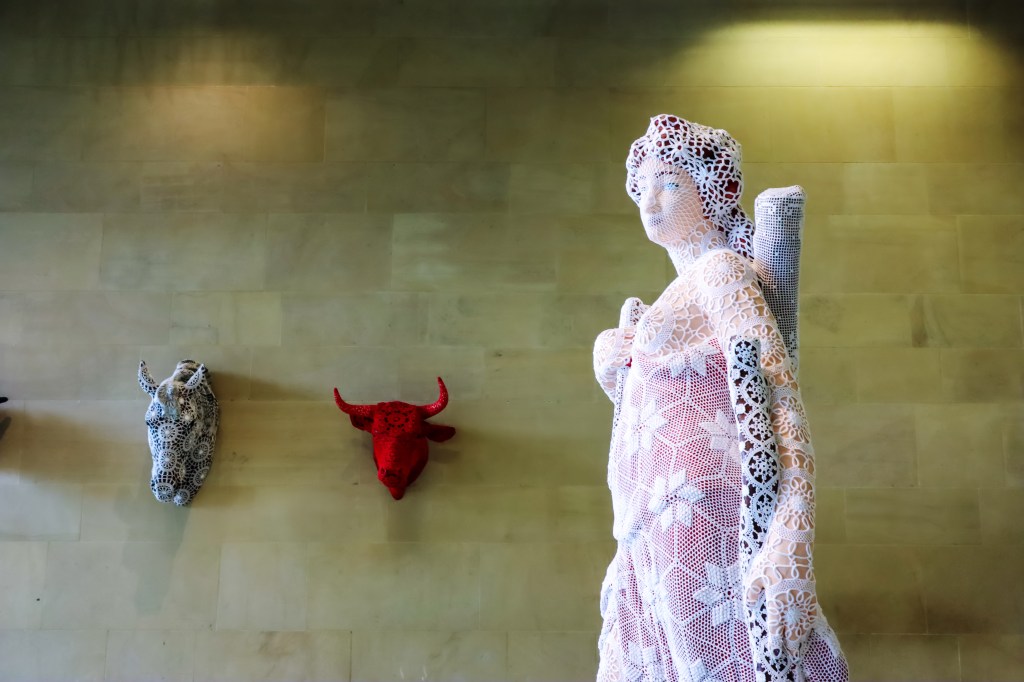
Ouvi falar desta artista recentemente (Onde? Quando? De quem? Nem sequer me lembro!) e decidi fazer uma pesquisa. Não estou a par das correntes do mundo artístico: poucas vezes entro numa galeria e se, por acaso, ouvir algo sobre a arte moderna os factos entram por um ouvido e saem por outro. Mas o site da artista impressionou-me muito: ela oferece um vasto leque de competências na criação das suas obras: há estátuas de ferro forjado, corações de Viana construídos de talheres de plástico, um carro enfeitado de ouro, um helicóptero com penas cor-de-rosa e brilhantes por todo o lado no exterior (o transporte pessoal de Elton John?) e algumas esculturas tão extensivas* que parecem cenários de filmagem! Além da arte, está a utilizar uma espécie de engenharia.
Até certo ponto, lembra-me a obra do Bordalo II, cujas esculturas alegram as ruas de Portugal. Ambos produzem obras de tamanho impressionante e cores marcantes, mas enquanto as dele são feitas de materiais reciclados, como garrafas, pneus e embalagem, dando um ar improvisado e bruto aos seus animais fofos, as obras de Joana Vasconcelos são compostas de materiais requintados; brilhantes e limpos; mesmo que os materiais escolhidos sejam frequentemente fora do normal (por exemplo “a noiva”, feita de milhares de tampões), o objetivo é tornar o quotidiano belo, quase o oposto do outro artista.
As obras de Joana Vasconcelos podem ser encontradas neste canto da Internet**. É deslumbrante, até na ecrã. Numa galeria, hão de ser ainda melhores!
Some of Joana Vasconcelos’s artworks
*This is probably a weird choice of adjective for a sculpture but there are some that really spread out over a wide area of ground which is why I’ve said they remind me of a film set in some sort of Sci-fi scenario, but you’d normally want something more like “gigante” or “imenso”, I think.
**Another daft choice of words. Why “corner of the Internet”? Well, that’s just what we used to call a website when I was into amateur web design in the early 00s. “Welcome to my corner of the Internet”. I won’t change it here, but it’s a good reminder that if you choose to express yourself in interesting, colourful ways like this, your audience might not think “gosh, how quirky and charming” they might just think “you have clearly made a mistake and we won’t know what you’re taking about” so maybe sometimes it’s better to stick to taking like a sensible person.
I was bowled over by Jéssica Cipriano’s version of Madredeus’s O Pastor when I watched it the other day, shortly after hearing her version of Olá Solidão. It’s so, so good. When she really cuts loose at around 4.20, my eyes were filling up and my soul left my body. I think the pianist, David Antunes, was right there with me too. Holy shit! How is this woman not a million times more famous? How do I not even see an album of hers on Spotify? How is she not smashing Eurovision? It’s some sort of conspiracy to hide her from the ears of foreigners, I reckon.
Here’s the original from the 1990 album, Existir. You can see it’s got a richer musical arrangement, and the singer’s voice is beautiful in an ethereal way. but it’s too ethereal for me, and the band has never really grabbed me for that reason, even though they were the first portuguese band I ever listened to. They remind me of bands like Clannad, the Cocteau Twins and Enya. I feel like the voice is being used as a musical instrument; there’s not much emotion there and the words don’t really matter so much so it’s hard to get into.
Português
Inglês
Ai que ninguém volta Ao que já deixou Ninguém larga a grande roda Ninguém sabe onde é que andou
Oh, nobody goes back To what they left Nobody lets go of the big wheel Nobody knows where they’ve been
Ai que ninguém lembra Nem o que sonhou Aquele menino canta A cantiga do pastor
Oh nobody remembers Not even what they dreamed That child sings The song of the shepherd
Ao largo Ainda arde A barca Da fantasia O meu sonho acaba tarde Deixa a alma de vigia Ao largo Ainda arde A barca Da fantasia O meu sonho acaba tarde Acordar é que eu não queria
In the distance It’s still burning The boat Of fantasy My dream ends late Leave your soul on guard In the distance It’s still burning The boat Of fantasy My dream ends late Waking up is what I didn’t want
Her’s another translation – this time “Eu e o Meu País” (me and my country) by Oquestrada. It has a weird bit of anglo-french wittering at the start and I’ll just pretend that doesn’t happen. I wish I had a video of them doing it live but every one I’ve found has been shonky fan footage.
The song itself isn’t that deep either. The bit I really like is the very beginning. Freguesia is one of my favourite words for some reason, and that second line is great, plus the sense you have of her dashing around everywhere trying to hug the whole country. So that’s the only reason for the translation. If you want an objectively better video of them playing an objectively more stompy song, check this out.
Portuguese
English
De distrito em distrito de freguesia em freguesia e quando os teus braços chegam aos meus nós somos só um, somos um só nós somos um só, somos só um eu e o meu país
District by district Parish by parish And when your arms reach mine We are one, we are one We are one, we are one Me and my country
Ouvi dizer que me amavas, adoravas, entendias ouvi dizer que me querias, me estimavas, percebias e se à noite me sorris de dia pouco me falas mas se à noite me sorris de dia pouco me falas de dia pouco me falas
I heard you loved me, adored me, understood me I heard you wanted me, esteemed me, noticed me And if at night you smile at me By day you hardly talk to me And if at night you smile at me By day you hardly talk to me By day you hardly talk to me
I wanna dancing with myself I wanna dancing with myself e é tanta a rotunda que já nem sei chegar a ti neste silêncio, neste pantanal sou turista acidental neste anúncio, neste postal sou turista acidental mas e tu, tu oh tu meu país mas e tu, tu oh tu meu país diz-me diz-me onde ficas tu neste postal
I wanna dancing with myself I wanna dancing with myself And there are so many roundabouts I don’t even know how to get to you In this silence, in this swamp I’m an accidental tourist In this advertisement, in this postcard I’m an accidental tourist But you, you, oh you, my country But you, you, oh you, my country Tell me where you are on this postcard
Sérgio Godinho, singer, writer and all-round renaissance man, has been working for 50 years now and Radio Comercial produced this really nice video of other musicians covering one of his best known songs. Of course, this sort of ensemble cast has been besmirched by that Imagine song in 2020, but they go a long way toward redeeming it.
I don’t recognise all the participants but I’ve definitely mentioned A Garota Não, António Zambujo, Miguel Araújo, Tiago Bettencourt, Ana Bacalhau, Claudia Pascoal, Tim from Xutos e Pontapés. I’m a little surprised I’ve never mentioned Camané apart from a couple of passing references. His eyebrows alone deserve their own blog post. And I’d been thinking of doing something about Os Quatro e Meia, but hadn’t got around to it yet
Aside from playing spot the celebrity, there’s a lot to look at in the video: there are shots taken in front of A Ponte D Luís in Porto, the Padrão dos Descobrimentos, and a mural by Vhils. You should also be able to spot where they’ve tried to mock up some of his album covers too. Compare this discography – I can see a couple (Samuel Úria and David Fonseca), but I feel like I’m probably missing some because a few of the scenes look so staged that they seem like the director is trying to set up the shot – like at 2.02 Diogo Piçarra is sitting on a park bench and as he sings the line he puts his elbow up on the backrest, then 7 seconds later at 2.09 João Só does the exact same thing but on the other side. That’s not a coincidence! Likewise the weird quantum superposition of Rita Redshoes on the same bench at 1:56 looks like it’s not just random.
A lot of them I’d never heard of before, or heard of but never sat down and listened to, so I picked on a few who took my interest:
Capicua is quite interesting – she’s one of the first on screen. She’d broken the dress code by just turning up in normal clothes instead of being in her finery. I am not a rap aficianado, so I wasn’t really moved by her stuff, but her videos are quite interesting and worth a look. My favourite actual song is “Maria Capaz“, which is obviously a wordplay on Maria Rapaz, and I like that she’s turned it around and made it a good thing like that. Very good!
I feel like there’s split in the genders of the singers: Most of the guys are showbiz veterans like Palma, Abrunhosa and Ribeirinho, all grizzled and weatherbeaten. Then there are people like Zambujo and Araújo in the next generation down, younger than me but not exactly spring chickens; and there is a fair sprinkling of young dudes in there too. The women, on the other hand, are almost all young, hot and immaculately groomed. I don’t really see any female fadistas of that older generation, coming out of retirement. I wonder if they were asked. The only woman I noticed who looks like she had done the hard miles and approaching his level of seniority was Mafalda Veiga, who is straight after Capicua. She seems to have done quite a lot of duets with the other musicians in the video (here) and I liked that there was someone there representing for us grown-ups.
Buba Espinho is the least rock star-looking person I’ve ever seen and I checked out a video of his and it’s charming because he acts like a big ol’ doofus as well. His music’s Ok though and I don’t hold it against him that he isn’t trying to be super-cool in the american style. There are videos of him doing more straightforward Fado too and he looks more at home there.
Carolina Deslandes is also fine but I didn’t feel the need to buy all her music. That’s a shame because she has an amazing voice.
Rui Ribeirinho seems like an interesting guy. He’s from a band called GNR – not to be confused either with Guns ‘n’ Roses or with the Banda da Guarda Nacional Repúblicana. They’ve been around since the eighties and they’re still rockin’. HOLD THE PHONE – My wife’s just told me she met him at a party once! What the actual fuck?
Rita Redshoes is someone I’d heard of but never paid much attention to. I quite liked this video where she is surrounded by Caretos… wait, why don’t I have any posts about Caretos? I could have sworn I’d written about them a few months back but I can’t find it now. Oh well, add it to the to-do list. Rita Redshoes has a very diverse back catalogue. There are some in english, this children’s show and even some relaxing white noise to send you to sleep!
Pedro Abrunhosa is another name I know but I’ve never listened to. I can’t say I was that interested to be honest. Sorry, Pedro. He’s been around a long time though. I might put him on my Spotify for a while and see if I can find something I like. Listen to the crowd on this video – they love him!
Sara Correia has a cracking set of pipes – she really belts it out, sailing that line between fado and more commercial pop, a bit like Ana Moura. She and Abrunhosa have collaborated before in the past on a fundraiser for Ukraine and it’s really powerful. Better when she’s singing than him, it must be said, but powerful all the same. Oh and she’s singing at Cadogan Hall in February – right, get that one in the diary!
Let’s do the lyrics, shall we? Lots of passive voice here: it’s going to be difficult to render it into english without sounding affected but I’ll do my best.
Portuguese
English
A principio é simples, anda-se sozinho Passa-se na rua bem devagarinho Está-se bem no silêncio e no borburinho Bebe-se as certezas num copo de vinho E vem-nos à memória uma frase batida Hoje é o primeiro dia do resto da tua vida Hoje é o primeiro dia do resto da tua vida
At first it’s simple, walk alone It happens in the road, nice and slowly It’s OK in the silence and the noise Certainties are drunk in a glass of wine And a well-worn phrase comes to mind Today is the first day of the rest of your life Today is the first day of the rest of your life
Pouco a pouco o passo faz-se vagabundo Dá-se a volta ao medo, dá-se a volta ao mundo Diz-se do passado, que está moribundo Bebe-se o alento num copo sem fundo E vem-nos à memória uma frase batida Hoje é o primeiro dia do resto da tua vida Hoje é o primeiro dia do resto da tua vida
Little by little, the step becomes slow One takes a turn to fear, a turn to the world It’s said that the past is dying Breath is drunk in a bottomless cup And a well-worn phrase comes to mind Today is the first day of the rest of your life Today is the first day of the rest of your life
E é então que amigos nos oferecem leito Entra-se cansado e sai-se refeito Luta-se por tudo o que se leva a peito Bebe-se, come-se e alguém nos diz bom proveito E vem-nos à memória uma frase batida Hoje é o primeiro dia do resto da tua vida Hoje é o primeiro dia do resto da tua vida
And then friends offer a place to sleep One enters tured and leaves refreshed And fights for everything that’s taken to heart Drinks, eats, and someone says “Enjoy!” And a well-worn phrase comes to mind Today is the first day of the rest of your life Today is the first day of the rest of your life
Depois vêm cansaços e o corpo fraqueja Olha-se para dentro e já pouco sobeja Pede-se o descanso, por curto que seja Apagam-se dúvidas num mar de cerveja E vem-nos à memória uma frase batida Hoje é o primeiro dia do resto da tua vida Hoje é o primeiro dia do resto da tua vida
Afterwards comes tiredness and the body weakens One looks inside, little remains Asks for rest, no matter how short Doubts are washed away in a sea of beer And a well-worn phrase comes to mind Today is the first day of the rest of your life Today is the first day of the rest of your life
E enfim de uma escolha faz-se um desafio Enfrenta-se a vida de fio a pavio Navega-se sem mar, sem vela ou navio Bebe-se a coragem até dum copo vazio E vem-nos à memória uma frase batida Hoje é o primeiro dia do resto da tua vida Hoje é o primeiro dia do resto da tua vida
And in the end, a choice becomes a challenge Life is confronted in its entirety Navigating without a sea, without a sail or a ship Courage is drunk from an empty cup And a well-worn phrase comes to mind Today is the first day of the rest of your life Today is the first day of the rest of your life
E entretanto o tempo fez cinza da brasa E outra maré cheia virá da maré vaza Nasce um novo dia e no braço outra asa Brinda-se aos amores com o vinho da casa E vem-nos à memória uma frase batida Hoje é o primeiro dia do resto da tua vida Hoje é o primeiro dia do resto da tua vida
And meanwhile time turns the coal to ash And another high tide follows a low tide A new day is born, on the arm another wing Loves are toasted with house wine And a well-worn phrase comes to mind Today is the first day of the rest of your life Today is the first day of the rest of your life
Fazendo os exercícios lacunares no livro “Qual É a Dúvida”, deparei com uma palavra desconhecida que me atrapalhou. O objetivo desta questão especifica era decidir se o substantivo precisa, ou não, de um artigo indefinido (um, uma):
“Tenho ______ Malhoa e…. (blábláblá)”
Acabei por deixar vazio o espaço porque achava que “Malhoa” era uma doença qualquer. Confundi-o com maleita, apesar da letra maiúscula. Mas a resposta certa é “um” porque Malhoa era um artista, portanto “um Malhoa” é um quadro pintado por aquele artista. Igualmente em inglês, os ricos dizem “I have a Picasso on my yacht” ou não sei o que é, não sou Jeff Bezos, mas o importante é que “🇬🇧 a Picasso” e “🇵🇹 um Malhoa” têm a mesma forma portanto não é nada difícil!
Mas quem é este gajo, Malhoa?
Segundo a Wikipedia, o artista nasceu em 1855 e começou a sua formação com 12 anos. Fez parte de uma tertúlia de artistas portugueses chamada “O Grupo do Leão”. Apesar de ser pioneiro do movimento naturalista, a sua obra era reconhecida como sendo muito parecida com a corrente artística impressionista que estava muito a moda naquela altura.
Faleceu em 1933 e foi sepultado no Cemitério dos Prazeres. Existe um museu dedicado à sua memória.
Once again I’m indebted to Cristina of “Say it in Portuguese” for correcting the errors in the original draft
I was sorry to hear Sara Tavares (who I’ve written about on here before) had passed away yesterday. She had been diagnosed with a brain tumour a decade ago, but, as I understand it, had recovered. It seems to have come back recently, which I wasn’t aware of and I was shocked to hear she was dead.
Forty five is no age, and it’s a great loss to music. I hadn’t realised previously that she was also a former eurovision entrant, as well as all those awards and collaborative projects. She really achieved a lot.
Translation time! This song is fantastic and I love it. I first heard it as a small segment, used as the theme for a podcast called Assim se faz Portugal, hosted by Maria Rueff. the singer, Fausto Bordalo Dias, known simply as Fausto, is a well-regarded artist who has been making music for decades and is still going. He released his first album 5 years before the end of the dictatorship and soon after was drafted into the colonial war in Guinea, but he was a conscientious objector, and he went on to be active politically. And it really shows in this song, from a 1977 album called Madrugada dos Trapeiros (Dawn of the ragpickers).
The song is structured using the idea of a folk dance called a Roda or “Baile Mandado” (guided dance – you can see an example here, which gives you a better idea of what the song is building on), where everyone has their place and they’re being given instructions, but instead of dance steps, what’s happening is the usual round of the poor being oppressed because they are ruled by people from a different class who don’t share their values, but “o baile vai terminar” and I guess there’s a parallel between mandador (The person who calls the intructions at the dance) and the boss, going on in the first verse especially
Portuguese
English
Senhoras e meus senhores, façam roda por favor Senhoras e meus senhores, façam roda por favor, cada um com o seu par Aqui não há desamores, se é tudo trabalhador o baile vai começar. Senhoras e meus senhores, batam certos os pézinhos, como bate este tambor Não queremos cá opressores, se estivermos bem juntinhos, vai-se embora o mandador Vai-se embora o mandador
Ladies and gentlemen, Form a circle please Ladies and gentlemen, Form a circle please Each one with their partner There are no heartbreaks here If everything is working The dance will begin Ladies and gentlemen Stamp your feet right in time to this drum We don’t want oppressors here If we’re getting on well together The boss can leave The boss can leave
Faz lá como tu quiseres, faz lá como tu quiseres, faz lá como tu quiseres Folha seca cai ao chão, folha seca cai ao chão Eu não quero o que tu queres, eu não quero o que tu queres, eu não quero o que tu queres, Que eu sou doutra condição, que eu sou doutra condição
Do what you like Do what you like Do what you like The dead leaf falls to the ground The dead leaf falls to the ground I don’t want what you want I don’t want what you want I don’t want what you want Because I’m from a different class Because I’m from a different class
De velhas casas vazias, palácios abandonados, os pobres fizeram lares Mas agora todos os dias, os polícias bem armados desocupam os andares Para que servem essas casas, a não ser para o senhorio viver da especulação Quem governa faz tábua rasa, mas lamenta com fastio a crise da habitação E assim se faz Portugal, uns vão bem e outros mal
From old empty houses, abandoned palaces The poor make homes But now every day The well-armed police Clear the floors What are those houses good for If not for the gentry To live off speculation Whoever governs makes a blank slate But deeply regrets the housing crisis And thats how it goes in Portugal Some do well and others badly
Faz lá como tu quiseres, faz lá como tu quiseres, faz lá como tu quiseres Folha seca cai ao chão, folha seca cai ao chão Eu não quero o que tu queres, eu não quero o que tu queres, eu não quero o que tu queres, Que eu sou doutra condição, que eu sou doutra condição
Do what you like Do what you like Do what you like The dead leaf falls to the ground The dead leaf falls to the ground I don’t want what you want I don’t want what you want I don’t want what you want Because I’m from a different class Because I’m from a different class
Tanta gente sem trabalho, não tem pão nem tem sardinha e nem tem onde morar Do frio faz agasalho, que a gente está tão magrinha da fome que anda a rapar O governo dá solução, manda os pobres emigrar, e os emigrantes que regressaram Mas com tanto desemprego, os ricos podem voltar porque nunca trabalharam E assim se faz Portugal, uns vão bem e outros mal
So many people without work They don’t have bread or sardines And they don’t even have a place to live They wrap up against the cold Because people ate so thin Raging with hunger The government gives a solution It tells the poor to emigrate And the emigrantes that returned But with so much unemployment The rich can return because they never work And thats how it goes in Portugal Some do well and others badly
Faz lá como tu quiseres, faz lá como tu quiseres, faz lá como tu quiseres Folha seca cai ao chão, folha seca cai ao chão Eu não quero o que tu queres, eu não quero o que tu queres, eu não quero o que tu queres, Que eu sou doutra condição, que eu sou doutra condição
Do what you like Do what you like Do what you like The dead leaf falls to the ground The dead leaf falls to the ground I don’t want what you want I don’t want what you want I don’t want what you want Because I’m from a different class Because I’m from a different class
E como pode outro alguém, tendo interesses tão diferentes, governar trabalhadores Se aquele que vive bem, vivendo dos seus serventes, tem diferentes valores Não nos venham com cantigas, não cantamos para esquecer, nós cantamos para lembrar Que só muda esta vida, quando tiver o poder o que vive a trabalhar Segura bem o teu par, que o baile vai terminar
And how could anyone else, having such different interests, Govern the workers? If that guy who lives well Living off his servants has different values They don’t come to us with songs, We don’t sing to forget We sing to remember That this life only changes When power is held by Those who live to work Hold your partner tight Because the dance is about to end
Faz lá como tu quiseres, faz lá como tu quiseres, faz lá como tu quiseres Folha seca cai ao chão, folha seca cai ao chão Eu não quero o que tu queres, eu não quero o que tu queres, eu não quero o que tu queres, Que eu sou doutra condição, que eu sou doutra condição
Do what you like Do what you like Do what you like The dead leaf falls to the ground The dead leaf falls to the ground I don’t want what you want I don’t want what you want I don’t want what you want Because I’m from a different class Because I’m from a different class
Here’s another song translation. This one’s a real old-school fado from Lucília do Carmo, mother of Carlos do Carmo and friend of Alfredo Marceneiro, who I’ve mentioned on here before because he sang the original Casa da Mariquinhas. I don’t know what the story of this song is but it’s from the Salazar era and it’s giving me strong Fado, Fátima, Futbol vibes.
Portuguese
English
Lisboa, Casta* Princesa Que o manto da realeza Abres com pejo Num casto beijo Lisboa tão linda és Que tens de rastos aos pés A majestade do Tejo Lisboa das Descobertas De tantas terras desertas Que deram brado No teu passado De beleza tens a coroa Velha Lisboa Da Madragoa Quantos heróis tens criado!
Lisboa, Chaste Princess Whose royal robe You open shyly In a chaste kiss. Lisboa, you’re so lovely That you have trailing at your feet The majesty of the Tejo. Lisboa of the discoveries of so many deserted** lands That made you famous*** In your past You have the crown of beauty Old Lisbon From Madragoa So many heroes you’ve created!
Sete colinas São teu colo de cetim Onde as casas são boninas Espalhadas num jardim**** E no teu seio Certo dia foi gerado E cantado Pelo povo sonhador O nosso fado
Seven hills Are your satin skirts***** Where the houses are beautiful Spread out in the garden And on your breast Some day was brought into being And sung By the people who dream Our Fado
Lisboa, tardes doiradas Dos domingos, das toiradas Em que luzia A fidalguia E em que esse sangue valente Mostrava que havia gente A quem a morte sorria Lisboa, terra de fama Tens a tristeza de Alfama E a poesia Da Mouraria E nos teus velhos recantos Eu sei lá quantos Tu tens encantos Dos tempos da valentia!
Lisboa, golden afternoons Of Sundays, of bullfights In which shone The nobility And in which that brave blood Showed that there were people Who smiled at death Lisboa, famous land You have the sadness of the Alfama And the poetry Of the Mouraria And in your old corners I don’t know how many You have enchantments Of the times of bravery
* Casta can mean “caste” is it’s a noun, but I think this is an adjective: the feminine form of “casto”
** 🤔
***Brado can also mean “a shout” but I don’t think that makes sense, given teh following line, so assume this is what she means.
****This is the lyric I found for this song but I’m pretty sure she says “espalhado em jardins”
*****It’s weird that this one word, colo can mean two completely different parts of the body, but hey ho. I’ve taken it as meaning the skirts arranged on a lap, because we don’t really have a word for the top part of a woman’s chest, above the breast, and I’m not writing “breast”. Anyway, a breast is mentioned a few lines later – how many breasts do you need, people? Her son is always singing about them too!
I’m in a translation mood again, and this one is a more traditional number: Lisboa, Menina e Moca by legendary fadista Carlos do Carmo. It’s pretty well known, and I hear it very often, so this is one of those songs to be aware of. The title is literally “Lisbon, Girl and Young Woman”, and he’s basically talking to the city as if it it was a girl and he was trying to – as the young folk say – rizz it up. It strikes me as a tiny bit cringe, but maybe that’s my cultural perspective. Let’s dive into the lyrics and see what it’s like. The version I’ve chosen is from an appearance on The Voice Portugal, and it’s notable because he breaks off part-way through to tell the young people in teh audience to stop clapping because it’s fado, not rock, which is a classic old dude move. That’s enough of your malarkey, Jack!
Portuguese
English
No Castelo ponho um cotovelo Em Alfama descanso o olhar E assim desfaço o novelo de azul e mar Á Ribeira encosto a cabeça Almofada da cama do Tejo Com lençóis bordados à pressa na cambraia dum** beijo
I put one of my elbows on the castle I rest my gaze on the Alfama And like that, I undo the knot* of blue and sea I lean my head on the Ribeira The pillow on the bed of the Tejo With hastily-embroidered sheets, in the cambric of a kiss
Lisboa, menina e moça***, menina Da luz que os meus olhos vêem, tão pura Teus seios são as colinas, varina**** Pregão que me traz à porta, ternura Cidade a ponto-luz, bordada Toalha á beira-mar, estendida Lisboa, menina e moça, amada Cidade mulher da minha vida
Lisboa, girl and woman, girl By the light my eyes see, so pure Your breasts are he hills, sea lady The call that brings me to the door, tenderness CIty with points of light, emroidered Towel by the seashore, stretched out Lisbon, girl and woman, loved City, woman of my life
No Terreiro eu passo por ti Mas na Graça eu vejo-te nua Quando um pombo te olha, sorri, és mulher da rua E no bairro mais alto***** do sonho Ponho um fado que soube inventar Aguardente de vida e medronho******, que me faz cantar
On the Terreiro, i pass by you But in Graça, I see you naked When a pigeon sees you, it smiles, you are a woman of the road And in the highest suburb of the dream I give you a fado that I knew how to invent Brandy made of life and fruit that makes me sing
Lisboa no meu amor, deitada Cidade por minhas mãos, despida Lisboa, menina e moça, amada Cidade mulher da minha vida
Lisboa on my love, laid City by my hands, undressed Lisbon, girl and woman, loved City, woman of my life
*Novelo usually means a ball of thread or a cotton reel, but can mean a complicated thing, so I’m thinking he’s talking about a knot that he’s undoing, rather than a cotton reel – it just seems to make more sense in the context but I could be wrong.
**I couldn’t make any sense of this and thought he was saying “dei um beijo”, but that ain’t it chief! He’s just comparing the lightness of a kiss to the lightness of the material. There’s an explanation of all this needlework metaphhor here if you want to know more.
***I’m, translating moça as woman, not young woman, because I think it sounds better. FIght me! By the way, Menina e Moca is also the name of an early portuguese novel by Bernadim Ribeiro. Maybe there’s a link?
****Eesh! How to translate this? I think he’s saying she’s a woman who lives by the side of the sea – the second meaning given on Priberam – and that woudl make a certain amount of sense.
*****Referring to the Bairro Alto neighbourhood, of course, a wretched hive of wine and fadory if ever there was one