I came across another site via Twitter and a shared interest in Practice Portuguese. Urbangay covers Portuguese as one of its main strands- along with running and gay culture in general. If you are gay and studying Portuguese, you’ll almost certainly be interested in some of his posts on the history of gay life in Portugal, or on the Lisbon scene (have a look here), but even if you’re not, there are plenty of interesting blog posts, including one about language-learning resources. It covers some of the same ground as my “Language Hacks” post but he has some other ideas and I’ve plundered it for my own study. Go and have a look.
Tag: culture
O Patio Das Cantigas
I watched the remake of the 1942 classic today. Why? Why did I bother? As far as I can tell, it’s not as funny and not as easy to understand as the original. If you’re considering it, save your money and watch the real thing on Youtube.
The DVD doesn’t have Portuguese subtitles, only English ones. The youtube video has Portuguese subtitles but (my sources inform me) they’re not very accurate. It looked like a much better film though: Better acting, not trying as hard, and they talk at a more manageable pace. I’ll do it properly next time.
As Cartas
Letters are right at the end of the textbook I’m using but they come up in some of the mock exams I’ve looked at so I thought I’d better get familiar with them
1 – Formal
Londres 20 de Maio de 2016
João Imaginário
Faculdade de Letras da Universidade de Lisboa
Alameda da Universidade
1600-214 Lisboa
PortugalExcelentíssimo Senhor
Desculpa de não ter escrito mais cedo. Tive dores nos dedos por causa de tocar demasiado o violão e por isso não pude usar o teclado.
Fiquei espantado e encantado ao receber a sua oferta de tornar-me Professor de Português. Depois de muita consideração, acho que devo recusá-la neste momento porque preciso de mais pratica. Pode ser no próximo ano?Obrigado outra vez
Os melhores cumprimentos
18ck
2 – Informal
Londres 20 de Maio de 2016
Caro Jose
Obrigado pelo livro que enviou-me para o meu aniversário. Não tenho lido livros de China Mievile, mas gosto muito de ficção científica e ouvi que é um escritor interessante. Estou contente por saber que a sua equipa ganhou o tri campeonato, seja lá o que isso for.
Um abraço
18ck
So it looks like Caro is the rule for starting letters in informal situations and Excelentíssimo (or “Exmo”) for formal. I have also seen “Prezado” (“esteemed”) but I believe that’s more of a Brazilian thing.
The sender’s address only seems to be the town and date in the format shown. Recipient addresses have the format:
[Recipient Name] [Housename] (optional) [Streetname] [Streetnumber] [Locality] [7 digits] [TOWN] [PORTUGAL] (if posting internationally)
Endings seem to be “os melhores cumprimentos”, “Atentamente”, or further down the scale of formality, “um abraço” (seems to be common between men) or something with beijo or beijinho.
Formal letters also seem to use v/ for Vosso and n/ for Nosso. I haven’t seen these anywhere except on the formal letter sample in Lathrop and Dias, which is sort of weird.
Uma Tradução Nova
Tentei de traduzir um outro canção de Deolinda. Olhe o video debaixo (O vestido dela é impressionante, né? A voz também, mas o vestido… diacho!)
Parece muito mais difícil do que o ultimo. As palavras são bastante simples mas há algumas frases que no pude entender no inteiro. Ainda o título é um osso duro a roer. Espero que o resultado não é tão longe do verdade!
Song at the Side
Forgive me, learned men, aesthetes,Poetic spirits, gentle souls,For the falsity of my genius andMy wordsWhat is the scholarship that I sing,What is life, wonder,What is beauty, grace,But I just aspire to the artOf planting potatoes.Forgive me for every little thing,but there is nobody here who sings fado.If you came to hear Deolinda,You came to the wrong place.We are in a house next door.We all went to a house next door to us.I know well that there are writerly trowels,Literary plasterers and hard-working poetsAnd poets who are true masonsOf letters,And they sing in genuine art, the humble fishermanThe modest seller of fishAnd so the singer should devote herself to fishing.Forgive me for every little thing,But there is nobody here who sings fado.If you came to hear Deolinda,You came to the wrong place.We are in a house next door.We all went to a house next door to us.Why not do what I like.I sing with disgust the fact thatI am hereAnd somewhere I know someone unsuitableTakes my place.No one is happy with what he hasAnd there is always someone coming and theyAre as good as us;But that someone is usually notWho they should be.Forgive me for every little thing,but there is nobody here who sings fado.If you came to hear Deolinda,You came to the wrong place.We are in a house next door.We all went to a house next door to us.And it is the change I propose;It is not a fearful stepIn dark utopias,It is as simple as changinga radio station…I propose that they change with you andPut their lives right.
Portuguese Somersault
Eastbourne doesn’t have much to recommend it but it has – or had when I lived there, anyway – an absolute jewel of a bookshop. It was a massive, sprawling affair with three floors and no recognisable system. Sometimes there was a parrot upstairs. And it was there that I first came across a book called “Portuguese Somersault” by Jan and Cora Gordon. I’d never heard of it before and I haven’t heard much of them since, either. To my surprise, though, they are still known today, and there’s a chap who has taken the time to curate a fan site, with biographical details and more about their various travel writings, which you can find at janandcoragordon.co.uk.
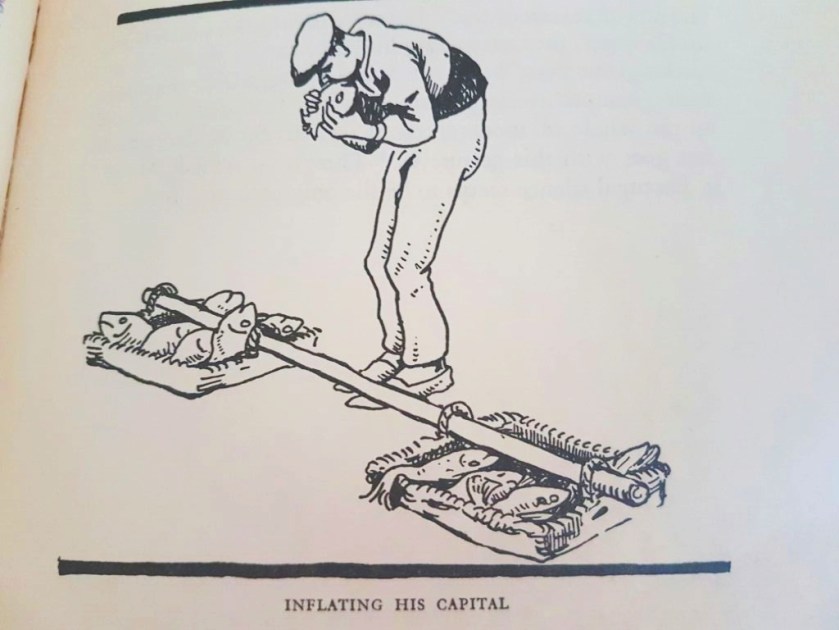
The book is actually two books, written in 1926 and 1933, detailing their travels in the country. They are reflective travellers who took the trouble to learn something of the language and to investigate their own preconceptions of the country. Along the way, they made sketches, and these are scattered throughout the chapters as illustrations. Here, for example, is a fish seller blowing into his fish to make them look bigger so he can get a better price. Cool eh?

I read it yonks ago and can’t actually remember a whole lot of it, to be honest. Maybe it’s due for a re-read. What I do know is that the “Somersault” of the title is a reference to the dramatic change in the country between the two visits. 1926 was the year of the coup that overthrew the Primeira República Portuguesa and established a dictatorship which, by 1933, when they returned, had become known as the Estado Novo (New State), led by António de Oliveira Salazar.
One small, dark detail stuck in my mind that gave me a little premonitory shudder: On page 75, they meet a Portuguese girl who had been separated from her parents during the Great War and left with relatives in Germany. Growing up, she believed herself to be German. When she was finally reunited with her parents, ten years later, she was pleased of course, but it came as a huge shock to her to find that she wasn’t a German at all. What a jolt that must have been to a girl who felt herself to have a “German Soul”. Now, at the age of seventeen, she would have less freedom than before. Worse, she would have to marry a Portuguese man who wouldn’t even understand her German love. Well, I think we can all see how this sort of cultural dislocation would be a shock to anyone. What I thought was telling, though, was when she describes her disappointment at finding out that she wasn’t who she thought she was:
“They want me to be a nice Portuguese girl but I can’t because, you see, I’ve been brought up as a German girl, and I was taught in the school that the Germans are the higher race, aren’t they? Do you see that?”
Jan and Cora note this as a minor personal tragedy but don’t comment on the idea that Germans are teaching children to feel themselves superior to everyone else. And this just ten years from German bombs falling on neighbouring Spain at the start of the Civil War, thirteen years from the start of the Second World War. The Salazar government was neutral in both, but gave military and logistical support to the Nationalist (and German) side in Spain and was broadly sympathetic to Hitler, only staying out of World War Two because of long-standing alliances with Britain.
Well, it’s easy for me, with the benefit of hindsight, to read more into this incident than the Gordons did. I certainly don’t mean to suggest that they should have seen the future in that one little tale, but I thought it was a fascinating little glimpse into what was happening under the surface of Europe in the inter-war years.
Birthday Swag
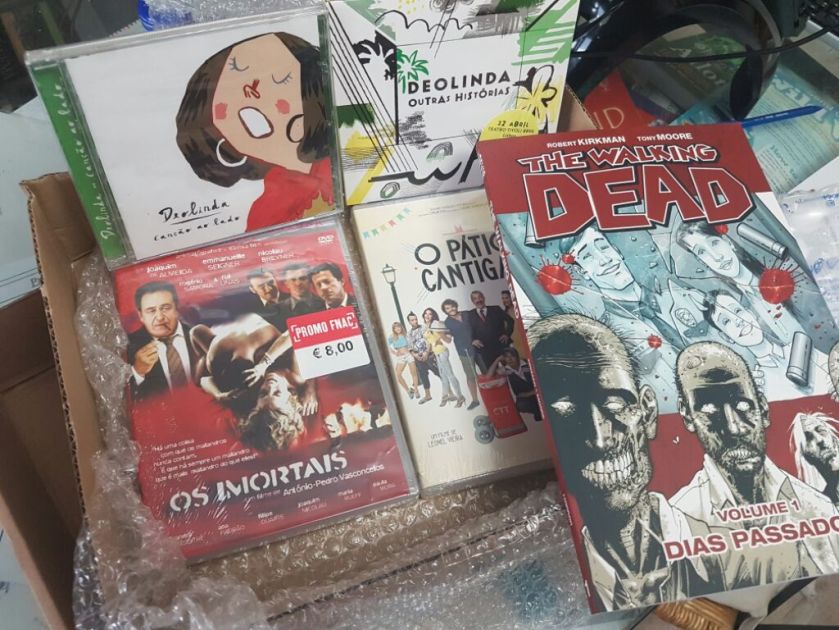
The bundle of Portuguese swag I ordered on my birthday has arrived after only five days, which is a lot better than Amazon can manage these days. Nice work FNAC!

The Postman brought me…
Dias Passados – Walking Dead Vol 1. I’ve never read any of these or seen the series so I guess I might as well use “it’s homework” as an excuse to start.
Os Imortais [Amazon link] by António-Pedro Vasconcelos and starring Nicolau Breyner (who is in just about every film ever made in Portugal) and Joaquim de Almeida (who also gets around, either within Portugal or playing evil Columbian drug barons in Hollywood movies). My cunhada (sister in law) recommended the director so I thought I would give this a try.
O Pátio das Cantigas by Leonel Vieira,which is a modern remake of an old classic. I probably should have bought the old classic, but I’m an idiot so I got this instead
Canção ao Lado and Outras Histórias by Deolinda [Amazon links here and here
respectively] because they are one of my favourite bands now and I can usually understand what they’re saying, more or less.
I Make Years
It’s my birthday today. Actually, unless I can finish writing this in the next minute and a half it was yesterday. Anyway… In Portuguese you can say this in two ways:
“Hoje é o meu aniversário” just means “Today is my birthday”
“Hoje faço anos” literally means “Today I make years”. I love this! It’s like my life is a machine for making time.
By the way, the Portuguese words to happy birthday are:
Parabéns a você
Nesta data querida
Muitas felicidades
Muitos anos de vida
Hoje é dia de festa
Cantam as nossas almas
Para o(a) menino(a) [Insert Your Name Here]
Uma salva de palmas
I can remember the first verse, but the second… never.
I ordered a big bag of Portuguese swag from Fnac.pt and I’ll blog about that when it arrives.
It’s Riry Funny
My First Actual, Proper Portuguese Joke
I had this idea for a joke in Portuguese yesterday while I was studying and I decided to turn it into a tweet. The verdict seems to be that it’s a bit crap.
One guy on iTalki liked it when I put it up for corrections but everyone else said “I can see what you’re driving at but I didn’t actually laugh”. And it got zero retweets on Twitter.
The english translation, though, got 54 (and counting!)
…which is more than any other tweet I’ve ever done with the exception of a photograph of a train cake I made for my daughter’s birthday party that was so bloody awful that it briefly catapulted me to Twitter-fame. I’m not really sure what this means. I mused on iTalki…
Fiz uma “tweet” com a piada em português e então fiz um outro com uma tradução em inglês (a piada corre bastante bem em inglês também: “Arctic”/”Article”). O tweet inglês retweetou-se cinquenta-e-dois vezes, e o português… nada! Talvez este facto mostra que a piada não é engraçada em português, mas provavelmente somente mostra que a maioria dos meus seguidores não falam português!
…but I wonder is it purely because so few lusophones saw it or is there something specific about the humour that gets lost in translation?
Tickling the Lusophones
Obviously, some things are never going to translate because the humour hinges on a pun that wouldn’t exist in the other language. Like these:
p: qual é o animal que tem mais que três olhos e menos que quatro? r: piolho
p: qual é o instrumento musical que tem mais que três e menos que quatro anos? r: piano
These jokes only work because the portuguese words pi+olho=piolho (π+eye=louse) and pi+ano=piano (π+year=piano). That’s a total dead-loss if you wanted to translate it.
In other cases, joke formats are specific to a time and place. The Portuguese don’t have lightbulb jokes, for example, so when I sent this to my teacher, she didn’t recognise it as a part of a wider tradition.
Quantos Brasileiros precise para mudar uma lâmpada? Nenhum. Lâmpada não mudou por causa do acordo ortográfico
To be honest, I think I’m a long way from understanding whether there is some impassable barrier to fully understanding what tickles another nation. I’d love to find out though!
Mnemonics
In the meantime, jokes and puns are a great way of brushing up your language skills and helping you remember stuff in a way that isn’t boring. Along the way, you get an insight into what makes people laugh in other countries. Here’s a guy getting his head around an old joke in English, for example. I happened to see it on iTalki today. They can be bilingual or just in the target language.
One of the simplest examples of puns as language-learning tools would be a mnemonic. Maybe you didn’t even realise that’s what you were doing when you came up with a mnemonic, but it’s all about the word play, baby, whether it’s acrostics, poems or puns. For example
You use a puxador when you want to push a door open
A puxador is a door handle and it is pronounced “pushadoor”. This is great until you find out that “puxar” actually means “pull”, not “push”. Push is “empurrar”, but even as you’re telling other people about this annoying fact, and tweeting “FML” about it, you are actually embedding all three new words in your mind in a single bad-luck anecdote, so it actually works better for being misleading.
One of my favourite apps, Memrise, encourages users to make “mems” – pictorial mnemonics – to help each other remember words. I have only done one because although I have ideas, who has that kind of time?

Here…
*points right*
…is my Mem for “As Cuecas”
Consoantes Perdidos
Another favourite joke format is the Lost Consonant. This is a format developed by Graham Rawle of the Guardian, back in the late eighties. He used to write a sentence that had one consonant omitted from one word, totally changing the meaning of the sentence. What I like about these is the challenge of making the grammar of the sentence work properly with or without the missing letter. That makes it a fun challenge for a person learning to write sentences in other languages, and to be honest, I suspect that I haven’t got it right every time when I have tried it. For example
which means
Increase the battery life of your mobile phone by not washing it in bleach
with the added c in “bateria” you get
Increase the life of the bacteria on your mobile phone by not washing it in bleach
But does the grammar actually make sense in either or both of these sentences? Christ knows, and I can’t even think how I would explain all this to a Portuguese person so they could judge. They’d think I was off my head.
There are some examples of original Graham Rawle Lost Consonants here.
Twitter Lost Consonants in English (#lostconsonants)
Twitter Lost Consonants in Portuguese (#consoantesperdidos)
Cartoons
I have already banged on at length about Astérix cartoons as the gateway to better vocabulary, but there are plenty of cartoons out there on the web if you know where to look and they can be quite instructive. Like this for example:

It works because “nada” means “nothing” but it’s also the second person singular imperative form of the Portuguese verb “nadar” – so it means, “hey, person I know reasonably well – you need to swim now!” And there’s no better way of remembering that fact than by laughing at this joke!
I found a new comic I like called Zorg & Borges recently. I think it’s on this page but the Publico website seems to be horrifically slow right now so apologies if this sends you to the wrong place. There’s a single example of it on here for sure though!
Dois Artigos
This iTaki notebook entry is pretty thin stuff as politics goes but it was a good way of challenging my vocabulary, so…
Hoje, dois artigos no jornal “Publico” chamaram a minha atenção. Nos dois o objecto é Portugal e a sua lugar em Europa. O primeiro artigo se publicou ontem, no aniversario do “revolução dos cravos”. Este artigo diz que um quinto da população do Portugal têm saudade do “Estado Novo” (o governo de Salazar e, depois dele, Marcelo Caetano, que dominaram o pais entre 1933 e 1974). Surpreendi-me. Não entendo como tanta gente num pais como Portugal podem sentir simpatia por um governo que tinha muitas características do fascismo! O artigo sugere que uma razão importante atrás desta simpatia de autoritarismo está a crise económica. E esta conclusão parece razoável: Nos tempos difíceis, as vezes, algumas pessoas voltam-se aos partidos que oferecem respostas fáceis, mensagens claros e uma imagem de força. Felizmente, a maioria dos Portugueses não concordam. Eles orgulham-se do seu pais e da sua revolução.
Entretanto, um outro pais de Europa, nomeadamente Polónia, já há um governo da direita. O partido Lei e Justiça ganhou as eleições de 2015, prometendo as medidas fortes contra a imigração. Eles afirmam que os migrantes muçulmanos do meio-oriente ameaçam o seu modo de viver. (Como se diz em Português “Pffff!”?) De qualquer maneira, alguns dias atrás, um estudante Português do programa “Erasmus*” foi atacado por um homem. Este homem (um militar) chamou-lhe “lixo” e lhe puxou pelo cabelo e pela roupa. O motivo, segundo o artigo, foi racismo. Pode ser que o homem não gostou do seu sotaque, sua pele… não sei.
Este artigo é o mais popular no website de Publico hoje. É um lembrete a todos para que as nações da Europa rejeitaram o fascismo muitos anos atrás. Somos melhores, mais fortes, quando trabalhamos juntos, ajudando uns aos outros.
Os Artigos
Crise leva um quinto dos portugueses a terem saudade dos tempos antes do 25 de Abril
Estudante português terá sido vítima de ataque racista na Polónia
*= Erasmus é um programa do UE para deixar as estudantes aprenderem nos outros países da união.
Thanks to Rubens for the corrections.
A Revolução
It’s quite rare that I actually understand tweets in Portuguese. Something about the condensed format, I suppose. I enjoyed these ones though.