Posted in Portuguese

Os Relógios

big-brother-is-watching-youBoa tarde e Força Benfica!*

O meu livro preferido é “1984” de George Orwell. A protagonista chama-se Winston Smith, e vive em Inglaterra no futuro. O livro foi escrito em mil novecentos e quarenta e oito. Naquele ano, Mil Novecentos e Oitenta e Quatro parecia o futuro, apesar de que só tinha quinze anos! É uma “utopia negra” que trata a manipulação da história e do idioma para controlar os cidadãos. Nas páginas dele há muitas frases bem conhecidos por exemplo “Big Brother is Watching You” (“O filho mais velho esta a olhar-te”)
Mas por quê digo-lhe isto? Boa questão.
Hoje, quando estava a falar com a minha professora, ela lembrou-me que os Portugueses usam o relógio de vinte e quatro horas. Por outras palavras, se forem três da tarde, é comum dizer “as quinze”. Agora, em Inglês, isso seria muito estranho. Além disso, é tão estranho que o Orwell utilizou a estranheza como um bom efeito. O livro começa assim:

“It was a bright cold day in April and the clocks were striking thirteen” (quer isto dizer “Estava um dia claro e frio em Abril, e os relógios estavam a tocar as treze”)

Quando um leitor inglês lê isto, os seus pensamentos correm como seguinte:
– Estava um dia claro e frio… [Mm-hm, O clima… bom. É normal. Que mais?]
– em Abril… [a primavera. Que bom. E o que mais?]
– e os relógios estavam [o tempo. O que pode ser mais normal do que o tempo?]
– a tocar as treze [O QUÊ????? Não é possível! Só há doze números num relógio. O que se passou?]

Neste ponto, o leitor deve pegar numa chávena de chá para acalmar-se.
Mas acho que em Portugal, esta frase não parece nada estranha…?
Mais tarde, o leitor descobre que no futuro, muito terá mudado, e uma destas coisas será a medida do tempo.

———————————————————

*=Para ser honesto, não me importa mas estou a tentar parecer como um português autêntico. Por outro lado, se fosse português estaria a ver o jogo, né? Hum.

Posted in English

Um… The… Um… Exam…

Just eight days now. It’s scary! I’ve been having extra lessons to raise my spoken language game from “horrifying” to merely “awful”. One of the things I’ve found helpful is Amolto Call Recorder for Skype. I’ve been using it to record my calls so I can listen to them later and get a second shot at my teacher’s wisdom (with her permission of course!)

Unfortunately, the results have been a little demoralising. I can’t believe how much time I spend just saying “Ummmm”.

So… there’s a long way to go.

Posted in English

Small-Talk Charades

Here at Luso HQ, we are big fans of a game called DipSticks. The game consists of a set of thin, cardboard strips with a question on each side. Contestants draw out a stick and have to perform a charade or some other task. Whoever answers correctly gets to keep the stick.

IMG_20160518_5667Now, there are only eight days left until the exam (*cue sound of screaming*) and I was trying to think of ways to cram in as much spoken Portuguese as I possibly can, so I hit on the idea of making my own DipSticks, but with Portuguese questions instead of charades. Each one has the same question each side, with one written in the “tu” form and one in the você form. My daughter is quite into the idea, which I like because, well, really anything that gets her learning about language is a plus in my book. The categories are loosely based on the “pontos de orientação” from the “Contatos Sociais” section of an old DEPLE paper published by TELC that I have somehow (how? I can’t remember) got hold of, so hopefully these are the kinds of questions that are likely to come up in the real exam.
The idea is that m’daughter will pick a card and read it out, possibly with some help, and I will try and give an answer at the drop of a hat. If I get a plausible answer with minimal umming and ahhing, and my pronunciation is close enough to at least not be misunderstood, then I win. If not, no stick for me.

You can download them as an excel file here if you’re interested. Just print them out on some nice thick printer paper (I used the same coated paper I use for printing photographs, but I’m sure some decent chunky CV paper would do the job just as well) , fold it in half along the centre line, glue the two sides together and cut them into sticks. They fit nicely into these funny little glasses somebody gave us, as you can see. A shot glass or even an egg cup would probably work just as well though.


Posted in English

Latest News From The Humour Lab

Following on from the last one

“An optimist is a person who, if he falls off the top of a building would wave through every window and say “doing all right so far!”

This is a bit of a cheat since it’s just a straight translation of an english joke but I like how it sounds anyway.

Posted in Portuguese

Uma Tradução Nova

Tentei de traduzir um outro canção de Deolinda. Olhe o video debaixo (O vestido dela é impressionante, né? A voz também, mas o vestido… diacho!)

Parece muito mais difícil do que o ultimo. As palavras são bastante simples mas há algumas frases que no pude entender no inteiro. Ainda o título é um osso duro a roer. Espero que o resultado não é tão longe do verdade!

Song at the Side

Forgive me, learned men, aesthetes,
Poetic spirits, gentle souls,
For the falsity of my genius and
My words
What is the scholarship that I sing,
What is life, wonder,
What is beauty, grace,
But I just aspire to the art
Of planting potatoes.
Forgive me for every little thing,
but there is nobody here who sings fado.
If you came to hear Deolinda,
You came to the wrong place.
We are in a house next door.
We all went to a house next door to us.
I know well that there are writerly trowels,
Literary plasterers and hard-working poets
And poets who are true masons
Of letters,
And they sing in genuine art, the humble fisherman
The modest seller of fish
And so the singer should devote herself to fishing.
Forgive me for every little thing,
But there is nobody here who sings fado.
If you came to hear Deolinda,
You came to the wrong place.
We are in a house next door.
We all went to a house next door to us.
Why not do what I like.
I sing with disgust the fact that
I am here
And somewhere I know someone unsuitable
Takes my place.
No one is happy with what he has
And there is always someone coming and they
Are as good as us;
But that someone is usually not
Who they should be.
Forgive me for every little thing,
but there is nobody here who sings fado.
If you came to hear Deolinda,
You came to the wrong place.
We are in a house next door.
We all went to a house next door to us.
And it is the change I propose;
It is not a fearful step
In dark utopias,
It is as simple as changing
a radio station…
I propose that they change with you and
Put their lives right.
Posted in English

Portuguese Somersault

Eastbourne doesn’t have much to recommend it but it has – or had when I lived there, anyway – an absolute jewel of a bookshop. It was a massive, sprawling affair with three floors and no recognisable system. Sometimes there was a parrot upstairs. And it was there that I first came across a book called “Portuguese Somersault” by Jan and Cora Gordon. I’d never heard of it before and I haven’t heard much of them since, either. To my surprise, though, they are still known today, and there’s a chap who has taken the time to curate a fan site, with biographical details and more about their various travel writings, which you can find at janandcoragordon.co.uk.

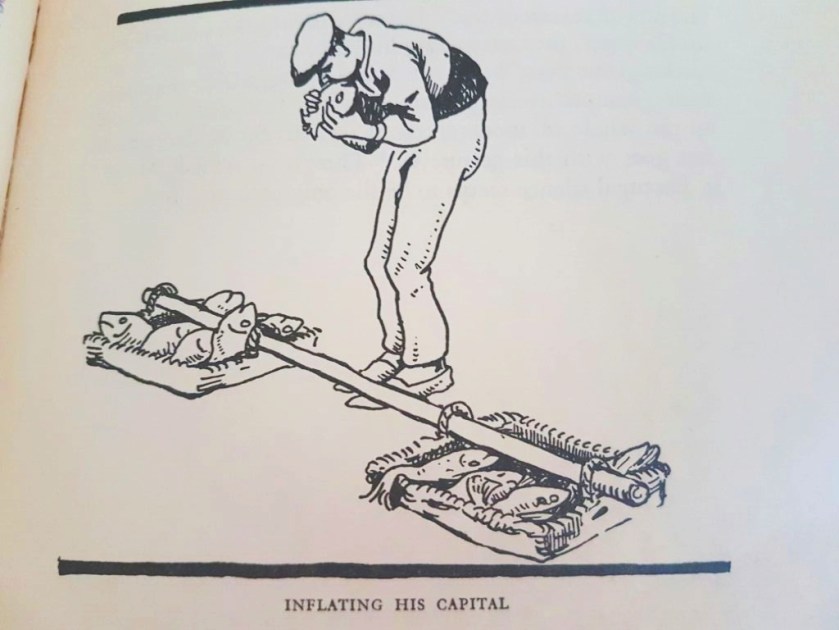
The book is actually two books, written in 1926 and 1933, detailing their travels in the country. They are reflective travellers who took the trouble to learn something of the language and to investigate their own preconceptions of the country. Along the way, they made sketches, and these are scattered throughout the chapters as illustrations. Here, for example, is a fish seller blowing into his fish to make them look bigger so he can get a better price. Cool eh?

IMG_20160510_21353

I read it yonks ago and can’t actually remember a whole lot of it, to be honest. Maybe it’s due for a re-read. What I do know is that the “Somersault” of the title is a reference to the dramatic change in the country between the two visits. 1926 was the year of the coup that overthrew the Primeira República Portuguesa and established a dictatorship which, by 1933, when they returned, had become known as the Estado Novo (New State), led by António de Oliveira Salazar.

One small, dark detail stuck in my mind that gave me a little premonitory shudder: On page 75, they meet a Portuguese girl who had been separated from her parents during the Great War and left with relatives in Germany. Growing up, she believed herself to be German. When she was finally reunited with her parents, ten years later, she was pleased of course, but it came as a huge shock to her to find that she wasn’t a German at all. What a jolt that must have been to a girl who felt herself to have a “German Soul”. Now, at the age of seventeen, she would have less freedom than before. Worse, she would have to marry a Portuguese man who wouldn’t even understand her German love. Well, I think we can all see how this sort of cultural dislocation would be a shock to anyone. What I thought was telling, though, was when she describes her disappointment at finding out that she wasn’t who she thought she was:

“They want me to be a nice Portuguese girl but I can’t because, you see, I’ve been brought up as a German girl, and I was taught in the school that the Germans are the higher race, aren’t they? Do you see that?”

Jan and Cora note this as a minor personal tragedy but don’t comment on the idea that Germans are teaching children to feel themselves superior to everyone else. And this just ten years from German bombs falling on neighbouring Spain at the start of the Civil War, thirteen years from the start of the Second World War. The Salazar government was neutral in both, but gave military and logistical support to the Nationalist (and German) side in Spain and was broadly sympathetic to Hitler, only staying out of World War Two because of long-standing alliances with Britain.

Well, it’s easy for me, with the benefit of hindsight, to read more into this incident than the Gordons did. I certainly don’t mean to suggest that they should have seen the future in that one little tale, but I thought it was a fascinating little glimpse into what was happening under the surface of Europe in the inter-war years.

Posted in Portuguese

Expressão Oral

Sample files working up phrases for use in the exam…

  1. Fale sobre o que gosta de fazer nos tempos livros

2. Fale sobre o seu trabalho

3. Fale sobre as vantagens e desvantagens de ter animais de estimação em casa

Posted in English

New Memrise Deck

I’m up to five Memrise decks now. The latest is called the “Heated Debate Toolkit” which has a lot of good “joining” words and phrases useful for having a discussion with another person, introducing arguments, pointing out errors and that sort of thing. It borrows quite heavily from a list put together by… someone… Benny Lewis? I think so… But it has translations attached (because that’s how Memrise works), some new phrases have been added, some left out (mostly because they were too obvious or else too obscure) and I have amended a couple to make them more Portugal-friendly, because a lot of them were written with the grammar of a large country in South America which shall remain nameless.

Posted in English

Birthday Swag

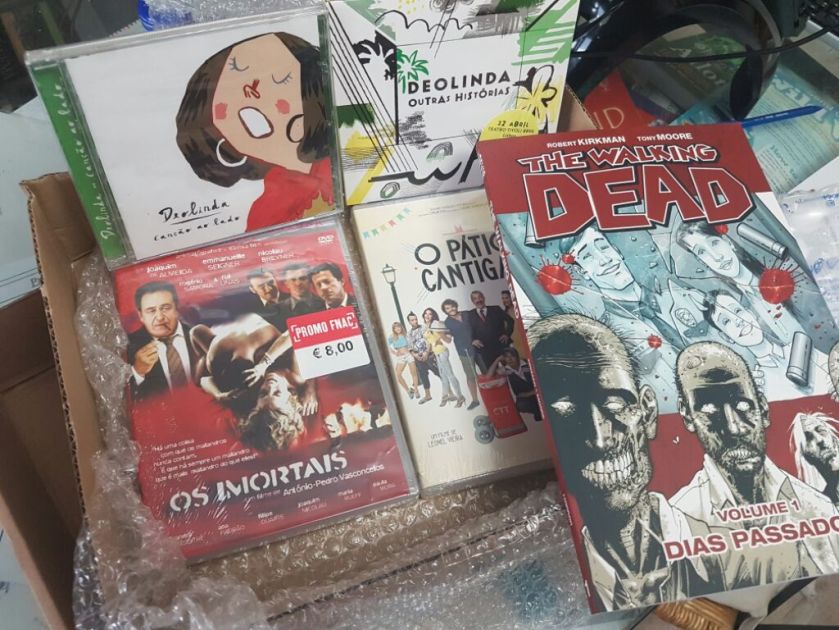
The bundle of Portuguese swag I ordered on my birthday has arrived after only five days, which is a lot better than Amazon can manage these days. Nice work FNAC!

IMG_20160510_22765

The Postman brought me…

Dias Passados – Walking Dead Vol 1. I’ve never read any of these or seen the series so I guess I might as well use “it’s homework” as an excuse to start.

Os Imortais [Amazon link] by António-Pedro Vasconcelos and starring Nicolau Breyner (who is in just about every film ever made in Portugal) and Joaquim de Almeida (who also gets around, either within Portugal or playing evil Columbian drug barons in Hollywood movies). My cunhada (sister in law) recommended the director so I thought I would give this a try.

O Pátio das Cantigas by Leonel Vieira,which is a modern remake of an old classic. I probably should have bought the old classic, but I’m an idiot so I got this instead

Canção ao Lado and Outras Histórias by Deolinda  [Amazon links here and here respectively] because they are one of my favourite bands now and I can usually understand what they’re saying, more or less.

Posted in English

I Make Years

It’s my birthday today. Actually, unless I can finish writing this in the next minute and a half it was yesterday. Anyway… In Portuguese you can say this in two ways:

“Hoje é o meu aniversário” just means “Today is my birthday”

“Hoje faço anos” literally means “Today I make years”. I love this! It’s like my life is a machine for making time.

By the way, the Portuguese words to happy birthday are:

Parabéns a você
Nesta data querida
Muitas felicidades
Muitos anos de vida

Hoje é dia de festa
Cantam as nossas almas
Para o(a) menino(a) [Insert Your Name Here]
Uma salva de palmas

I can remember the first verse, but the second… never.

I ordered a big bag of Portuguese swag from Fnac.pt and I’ll blog about that when it arrives.