Posted in Portuguese

A Invenção do Dia Claro

Li este livrinho inteiro, da capa até à contracapa num só dia mas não é assim tão impressionante porque tem menos de 40 páginas.

A Invenção Do Dia Claro

O escritor é José de Almada Negreiros (geralmente conhecido simplesmente por “Almada” se não me engano). Almada fazia parte do movimento modernista nas primeiras décadas do século passado e do grupo ao redor da Revista Orpheu, mas este livro é mais brando do que os anteriores. O editor da sua página de Wikipedia atribui esta mudança de estilo a uma atitude mais construtiva depois da Grande Guerra. Em resultado disso, quando o autor leu o primeiro texto da terceira parte (“a flor”) em palco, houve* quem risse em voz alta, achando que era algo satírico o humorístico, mas não era, era sincero.

O estilo da escrita é muito bonito e não me custou entender apesar da ortografia desconhecida, oriunda duma época antes do que nós pensamos como “velha ortografia” a(c)tualmente.

*Haver is one of those verbs that almost doesn’t seem to make sense in the perfect tense. The perfect tense is usually used for things that happen and then they’re over, as opposed to the imperfect which describes things that happen continuously over time. Haver usually means something like “to exist” or “to be present” and how can something exist as a one-off? Surely if you exist you exist continuously. In this sentence I’m describing this scene of someone reading something on the stage and the audience is there at the start of the performance and they remain in place throughout the performance. If that isn’t the criteria for imperfect tense I don’t know what is. But the translator suggests I describe the scene one of two ways

quando o autor leu (o texto) em palco, houve quem risse

Or

quando o autor lia (o texto) em palco, havia quem risse

So in the first example, he read it once (leu) and the audience were there on that one occasion (houve), and in the second example, he used to read it (lia) and they were there (havia).

What I don’t seem to be able to say is that he read it (leu) for an audience that was just there (havia).

OK useful exercise since it helps me. Understand when to use havia vs houve. I think I’m stuck in thinking about imperfect and perfect in a way that’s more like my o’level French and I need to just rid myself of that way of thinking.


Posted in English, Portuguese

Locuções Temporais

I’m struggling a bit with finding the right tenses for some of the sentence structures set out in the C1 course so decided to try and write a few for practice. Thanks to Dani Morgenstern for help with the corrections.

  • Quando acabei de ler ele já tinha escrito a sequela (when I finished reading he had already written the sequel)
  • Enquanto ele tocava bateria, eu preenchia os formulários de divórcio (while he was playing drums, I was filling in the divorce forms)
  • Quando chegares a casa, descasca as batatas (when you get home, peel the potatoes)
  • Ela disse-me que queria ser primeira ministra quando fosse grande (she told me she wanted to be prime minister when she was big)
  • Quando o vírus tivesse passado, ela voltava a treinar (when the vírus had passed she went back to training – I think the sense here is of something that happened repeatedly: she’d get ill every so often and go back to training after each occurrence, hence the imperfect tense)
  • Enquanto não leres o texto não estás capaz de responder às perguntas (since you won’t read the text you won’t be able to answer the questions)
  • Enquanto os negócios tivessem apoio financeiro não iriam à falência durante a pandemia. (as long as the businesses had financial support, they wouldn’t fail during the pandemic)
  • Enquanto o tio Rui não tivesse chegado a casa, a família não começava a jantar* (since Uncle Rui hadn’t arrived at the house the family weren’t starting their dinner)

*It’s probably worth pointing out here that this “a” is a preposition and “jantar” a verb. They hadn’t started to dine. But jantar can also be a noun so I could also have said “o jantar” instead of “a jantar” and the sentence would still work but it would mean “they hadn’t started the dinner”.

  • Logo que o comboio parta, telefona-me (as soon as the train leaves, call me)
  • Assim que receberes a carta do SNS, marca consulta. (as soon as you get a letter from the SNS, make an appointment)
  • No momento em que as cortinas se abrissem, a banda comecaria a tocar (as soon as the curtains opened the band would start to play)
  • Mal tivesse aberto a janela, o pisco entraria na sala (as soon as he had opened the window the robin would enter the room)
  • Logo que eu acordava tomava um café (as soon as he woke up, he used to have a cup of coffee)
  • Assim que enviou a carta, percebeu que se tinha esquecido do selo (Just as he posted the letter he realised he’d forgotten the stamp)
  • No momento em que o professor abriu a boca a campainha tocou (at the instant the teacher opened his mouth the bell rang)
  • Mal soube as noticias, começou a chorar (As soon as he heard the news he started to cry)
  • Antes que te esqueças, faz notas sobre a reunião (before you forget make some notes about the meeting)
  • Antes que ligasse ao meu pai, ele enviou-me uma mensagem (Before I called my dad, he sent me a message)
  • Antes de abrir a boca vou pensar duas vezes (before I open my mouth I’m going to think twice)
  • Depois de nos termos encontrado a minha vida era vazio e sem propósito (Before we met each other, my life was empty and without purpose)
Posted in English

The First Rule of Bruno Club

My daughter is currently obsessed with the new Disney Film, Encanto, so she’s listening to different language versions of the song “We Don’t Talk About Bruno”. There are a couple of Portuguese versions of it, but of course Brazilian Portuguese is usually more common. This is the European version (lyrics only, from the official accounts so as not to risk them dropping of YouTube before you see this)

And the Brazilian

You can have fun spotting the differences between them. Just a quick warning though, in case you haven’t seem the film, it’s about a Colombian family and even the English version has Spanish words in it. They probably blend in better in Portuguese, but “Mi Vida” is Spanish for example. The noun sounds like Portuguese but the possessive pronoun gives it away; and Abuela isn’t a name, it’s Spanish for Avó. Those are the only ones I can remember off the top of my head but I might be missing one of two, so keep your wits about you.

Posted in English

Tuga Yoga

No it isn’t a Massive Attack song, or a river in Cleveland, it’s a follow-up to my last post about yoga/ioga (both spellings seem to be used). Big thanks to Paul who replied directly. I asked some folks on reddit too and these seem to be the available options:

  • RTP Play’s #fitemcasa was Paul’s suggestion and I don’t know why I didn’t think of looking at this sooner, honestly! The sound quality isn’t as good as you’d expect from a national broadcaster, but I guess it was made in the early days of the acovolypse so it’s probably not that surprising that they hadn’t got their act together yet.
  • LiDL (yes, remember them?) have a few yoga workouts in their lockdown workout section, led by Filippa Barros, who I believe is a basketball player.

But those seem to be about the only free ones. Of course, a lot of instructors who used to do only in-person gym classes are now doing online classes, so if you don’t mind paying you could also try

The brazilian instructor I mentioned was a bit disappointing, I’m afraid. Hardly any effort. I felt like I’d barely got started when it ended.

Posted in English

New Year New… Você

I’m a bit run down at the moment. I exercised a lot last year but my knees are feeling the strain. I also have a sore back and, as is traditional at the start of January, I think I’ve gained a few pounds. I’m going to be doing a basic yoga class to work on mobility and core strength in a relatively non-taxing way. I’m mostly looking at a January 30-day workout that’s been recommended to me but I’d love to find a Portuguese instructor I can follow, just because I’d like to follow along and listen to how they describe the various stretches, muscles and so on. I’ve had a look at a Brazilian Yoga teacher called Pri Leite who has January course and seems down-to-earth in the way she presents. Her course doesn’t start till the tenth though (Whaaat? Who waits till the tenth to start their new year’s resolutions? Most of us are giving up by then!) but if anyone knows of a good Portuguese yoga teacher, I’d love to hear about them!

Posted in English

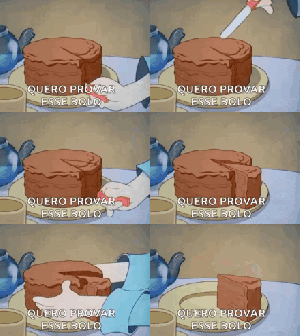
“Eu é Mais Bolos”

Eu é mais bolos

I keep seeing people write this on twitter. The context is usually a bit iffy, but I can tell its not just a random collection of words thrown together, despite the slightly confusing use of “é” after “eu”.

Apparently, it comes from an old sketch, done by veteran comedian Herman José in which he plays José Severino, a pastry chef who has accidentally been invited onto a talk show to discuss radiography. When it came out – exactly thirty years ago – it was immediately successful and people started saying it to each other, and even now, in 2022, it lives on on social media.

“eu é mais bolos”

Posted in English, Portuguese

To Tu or Not To Tu, That is the Desmond

I’m not sure whether making this pun in the week when the anti-apartheid hero died will be taken as offensive, but I needed to write about when to use “tu” in a sentence and the pun was just there waiting to be made and I’m not made of wood, people. I once almost walked into him in… Cambridge, I think, after a group of us made a pilgrimage from Norwich to attend his speech in about um… 1989? He was very good-natured about it.

Anyway, let’s get down to business. Here’s the question I asked yesterday.

Why (according to the C1 course I’m doing) is the word “tu” necessary in this sentence:

Tu vais ter mais experiência de vida. Nessa altura, vais compreender-me.

But absolutely wrong in this sentence, which is my attempt to rewrite the first using different tenses.

Quando tu tiveres mais experiência de vida, vais compreender-me

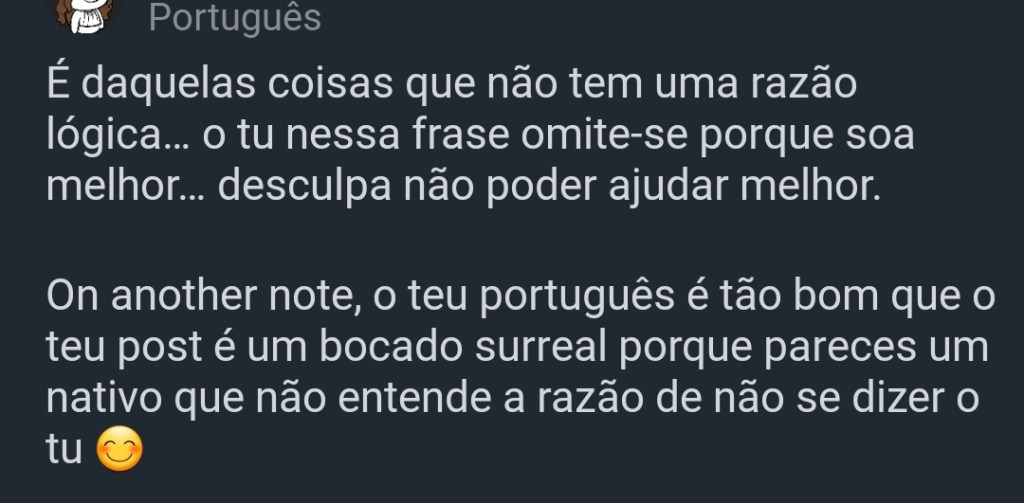
The gist of the answers I got was that the course’s model answer was wrong, or at least not unambiguously right. Although you don’t need it in the second sentence, you don’t need it in the first either, and since the exercise was to rewrite the sentence, it made sense to retain it if it was already there. The “tu” is superfluous because the conjugation of “vais” and of “tiveres” tells you you’re in the second person singular. If I had been changing “vai ter” into “tiver” then it would have been necessary to add a pronoun (ele or ela, probably) because “tiver” is ambiguous in a way that “vai ter” is not. Sometimes these things are just done on what sounds better so it might have been down to the personal sensibilities of the person setting the questions. It’s not very consistent though. Minor irritation.

Anyway, one of the respondents gave me some feedback that made me swell with pride:

So here is the question in the original Portuguese as a record of the most-praised Portuguese text I have ever written!

Uma das minhas dúvidas recorrentes é quando usar e quando não usar pronomes com verbos. Regra geral, não se usam tanto quanto em inglês mas por exemplo no meu curso, tenho de rescrever a seguinte frase começando com uma palavra específica e fazendo as alterações necessárias:

Q) Tu vais ter mais experiência de vida. Nessa altura, vais compreender-me.

R) Quando ____


Respondi assim:

Quando tu tiveres mais experiência de vida, vais compreender-me


Falhei. A resposta certa é exactamente igual mas tirando o "tu". OK tuga, mas... Porque? Porque é que o "tu" é necessário no modelo mas desnecessário - até errado - na resposta? Ambos exprimem a mesma ideia. Eu sei que a forma de "tiverES" assinala que estamos na segunda pessoa mas isso é igualmente verdade de "vaiS".

Desculpem o tom irritado. É ligeiramente frustrante fazer um curso que não explicam estas coisas. 🤷🏼‍♂️

Posted in Portuguese

Auscultadores

A amiga da minha filha utiliza auscultadores sem fio (airpods) mas está sempre a perdê-los. Ou seja perde sempre* um fone. Eu também desperdicei dois pares de auscultadores por perder um fone. O problema é o tamanho destes dispositivos. São minúsculos. Se deixares um fone cair ao** chão, não será fácil encontrá-lo.

A amiga dela fez exatamente isso: deixou um fone cair na rua, e logo depois um carro o atropelou e lá foram cem euros pelo cano abaixo.

Empresas de telemóveis, chega de Bluetooth. Fios! Queremos fios!

*=perde sempre, not sempre perde. Adverb after the verb.

**=ao, not no. It falls *to* the floor, not *on* the floor