It’s a pretty simple game that starts with the player being rescued from a car crash by Ventura and exchanging phone numbers. It then takes you through a series of days in which you can work to earn money, go to the shopping mall, or call your man to go on a date. At the mall, you can buy accessories for your Ventura, such as sunglasses and hats. On the dates, you can chat, question his choice of venues, and deal with various enemies who appear, such as gypsies and antifa members. You can play as yourself, although if you are a male it’ll send you away with “Bro, sai daqui. O André Ventura não gosta de paneleiros”. That sets the tone, really: the game is sending up his actual attitudes so it warns you right at the start to expect racist, sexist and homophobic language throughout.
Playing games is, of course, a bit silly, but we can’t study vocabulary all the time. Most of us have apps on our phone that we use to pass the time on lunch breaks or on public transport, so having a Portuguese game to play is good way to keep your brain in Portuguese mode without a huge commitment of energy. I doubt this one is going to be an addiction because the joke is bound to wear thin after a while but I’ll play it a few times and see where it takes me.
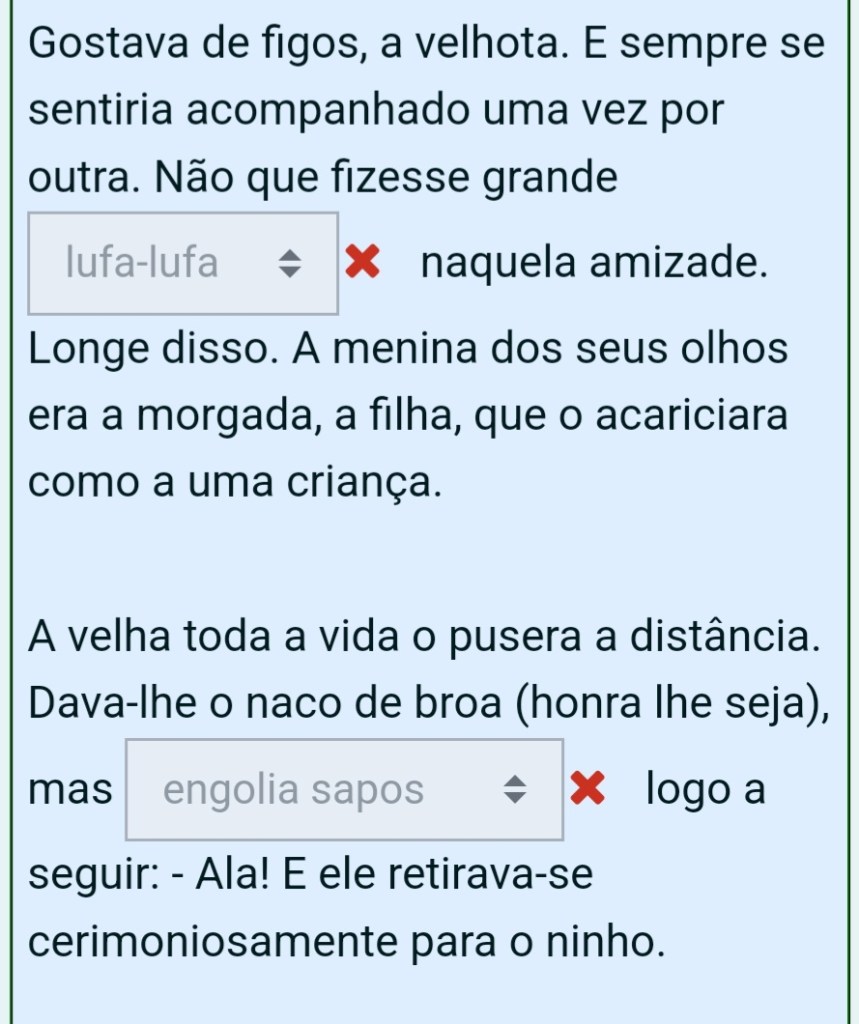
I found this exercise very, very hard. Even when I got the results back, I still couldn’t make sense of why the right answers were the right answers. I asked about it and got an answer but before I read it I’m going to write out a translation and try to sort it out in my own head… OK, what have we got?
She liked figs, the old woman. And he’d always feel himself accompanied from time to time. Not that she made a big ________ in that friendship. Far from it. The Apple of her eye was the only daughter, the child who had patted him when she was little.
And options for that space are “lufa-lufa” (being busy with lots of tasks), “finca-pé” (a firm stance) and bate-papo (chit-chat)
And then…
The old lady, all her life, had kept him at a distance. She gave him a loaf of bread (honor indeed!) but she _______ straight afterwards: – get away! And he took himself away cerimoniously to his bed.
And options for that one are “engolia sapos” (swallowed frogs – meaning did something she really didn’t want to do), “borrava a pintura” (smudged the painting) or… Something else, i can’t remember.
Uyth, in the Portuguese subreddit, explained that this is from a book called Bichos by Miguel Torga, which is embarrassing because I’ve read that and I still didn’t get it! It’s a very difficult book though, so it’s no wonder it was chosen for an advanced course like this. When I read it I felt all at sea and I only really managed to follow two or three stories.
Anyway, in the first case, finca-pé was the right answer because taking a firm stance on friendship means making an effort to keep it going. And in the second case, borrava a pintura – smudged the painting – means she undid the effects of something good she’d done. So after giving the animal (a donkey, if I remember rightly) the lump of bread, she chases him away.
OK, I can see that. Wow, so hard though! Some of the exercises were super-easy, so this one came as a real shock!
I spotted an expression I hadn’t seen before, out in the wild, on twitter
Um dos novos deputados do Chega, veterinário, acusou o jornalista Miguel Carvalho de fazer afirmações falsas. Miguel Carvalho segue atentamente o Chega há cerca de dois anos e não deixou passar a acusação.
It’s pretty hard to tell what’s going on in the video because they talk over each other a lot (which seems to be quite common in Portuguese TV), but apparently the guy speaking at the beginning is Miguel Carvalho, a journalist at Visão and the younger but slightly awkward looking fella is Pedro Frazão, a vet who was recently elected as a member of the Assembleia da República, representing the right-wing populist “party”, Chega. Frazão accuses Carvalho of making false statements and Carvalho comes back with “It isn’t me who will be judged tomorrow for spreading fake news, it’s you”.
Leaving aside whether “I know you are but what am I” is the killer move the tweeter seems to think it is*, the last sentence of the tweet is where the juicy goodness is:
O veterinário foi à lã e saiu tosquiado
The vet went for the wool and got sheered
This seems like a really good way of describing when someone’s cunning plan backfires and they end up looking stupid. I had a look around to see if it was something he’d just made up, but it’s a fairly common expression and there are a few versions of it online. The version Priberam gives is “Ir buscar lã e vir tosquiado“.
In case you’re tempted to feel sorry for Frazão for being talked over and taunted like this, it’s worth pointing out that he’s a loathsome little weasel who deserves no sympathy whatsoever. He made headlines a while back, having a pop at Joacine Katar Moreira, the annoyingly woke member of the Assembleia in a smallish party called Livre.
Pedro Frazão, showing his fearless conservative principles
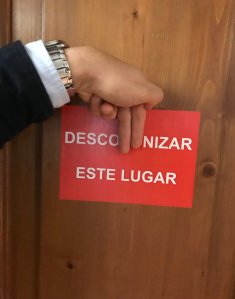
She had put up a sticker on a door of her office saying “descolonizar este lugar” (decolonize this place). That’s quite annoying, but his response was worse. Shortly before she was expected to leave the Assembleia, he took a picture of the door with his fingers over the LO, leaving it saying “desconizar este lugar” which can only be translated as “decuntify this place”. In case that wasn’t enough douchebaggery, he sealed the deal with an emoji of a plane taking off, which I read as implying she should not only leave the Assembleia but also leave the country and go back to Guinea Bissau, where she was born. She responded by reporting him to the police. The whole thing was a fairly squalid episode, with him definitely the villain of the piece.
So I’m not wildly in favour of debates where people talk over each other and accusé each other of lying, but if anyone is going to be verbally roughed up on TV, it might as well be him.
LOL. Or as Frazão might put it, 🤚L
And the line in the tweet about getting sheered is gold. I will definitely use that in future.
* UPDATE – I seem to have misunderstood. Carvalho wasn’t just talking about the court of public opinion: Frazão really did face an actual court judgement on the following day for having defamed a fellow politician. This puts it in a different light – friends, we are witnessing a murder here, live on camera
Today’s text is a bit grim I’m afraid. Sorry. Obviously feeling a bit fragile when I wrote it yesterday, so be warned! The book I’m describing is “More Than a Woman” by Caitlin Moran, if you’re interested. It’s very mixed, the full laughter-and-tears experience.
O livro que estou a ler é muito bom. Se tivesse de escolher uma só palavra para o descrever, a palavra seria “engraçado” porque faz me rir em voz alta muitas vezes mas há partes muito sérias, principalmente sobre a doença mental da filha da autora. O pesadelo começou com um distúrbio alimentar mas piorou até a coitadinha ficar* muito doente e ter de ir para o hospital várias vezes depois das suas tentativas de se suicidar.
Acabou por recuperar, graças a Deus, e conseguiu salvar-se depois de anos de sofrimento.
O que mais me marcou foi uma referência ao filme favorito dela: High School Musical. Durante um período mais difícil nonpercurso da sua doença a mãe dela sugere que elas se aconcheguem no sofá para verem o filme, que é também o favorito da minha filha. Senti um nó na garganta porque me lembrou que isto é algo que pode calhar a qualquer um de nós e as raparigas são ainda mais vulneráveis.
*= até + infinitive caught me off guard here! I wrote até… ficou… teve
I’ve quite nearly finished the C1 course, y’know. I wasn’t expecting to be ready for the C1 exam this spring, but I might just sign up in May because it’s going well: the advanced material is not so hard and I think I can pass with another 3 months to play with, despite still, still, making so many mistakes and never quite feeling ready, I have passed almost all the in-course tests first time.
This video from A Garota Não is giving me goosebumps today. The lyric is written by João Quadros, who is a comedy writer, twitter sage, irritant and sometime collaborator with Bruno Nogueira.
OK, OK, I don’t know an awful lot about Quadros to be honest, so apologies if that last sentence doesn’t do him justice. He seems to have been around for a while and to have written some classics of comedy. He also seems to be one of these people who some people absolutely adore and some people can’t stand. I must say, I didn’t know he’d written anything that could result in this loveliness. I mean, I know her voice and her guitar are doing the heavy lifting in this video, but you don’t write music like that and go to all that effort for any old drivel.
tudo começa numa estrada que termina no Alaska
há um sinal que tem escrito a letras vermelhas: deixe aqui os seus sonhos
desenhou o mapa de tudo o que não conseguiu
com coordenadas de objetivos falhados
o X afastava-o dos lugares onde seria feliz
um mapa de oportunidades desperdiçadas
de chances comprometidas
e de atalhos sem fim.
A Garota Não has an album on iTunes that has its share of bangers. I dunno though, I think I like her videos best: she has a few like this that are based on poems she’s read, or raps she’s heard and decided to interpret in her own way, sometimes singing in harmony with herself in a separate box.
One of them is based on a small fragment of this video by Classe Crua, which is probably the only rap ever written that mentions Theresa May. Weird.
Then there are some covers of songs in English (Wuthering Heights by Kate Bush and Ready or Not by the Fugees) and they’re good too, but we’re here to learn Portuguese, so let’s not get distracted.
Here’s a series of three Portuguese Writestreak texts about m’wife’s birthday treat, with notes at the bottom. (thanks to eqdif, gws-lthrowaway and Dani. Morgenstern for the tips)
Part 1 (Wednesday)
The Cake
A minha esposa faz anos hoje. Ela nasceu umas semanas antes de mim, por isso tenho uma oportunidade de brincar com ela por causa da sua grande idade a cada ano que passe, durante o intervalo entre o aniversário dela e o meu.
A nossa filha fez um bolo com morangos e recheio que foi mil vezes melhor do que qualquer bolo que eu já tenha feito. Amanhã, planeamos assistir a um concerto no centro da cidade.
Part 2 (Thursday)
Hoje à noite vamos assistir um concerto que vai ter lugar numa igreja. Numa igreja? Sim, a igreja de St Martin in the Fields fica na praça Trafalgar no centro de Londres e além de ser uma igreja tradicional, foi bem conhecida nos anos oitenta e noventa pelo seu apoio a pessoas sem abrigo que havia naquela zona e naquela altura.
Hoje em dia é mais famosa pelo programa de concertos apresentados no edifício e os seus arredores. A minha esposa quer ouvir As Quatro Estações de Vivaldi, recompostas por Max Richter. Confesso que não faço a mínima ideia como uma música composta por um italiano em meados do século XVIII* pode ser recomposta por um alemão qualquer no século atual. Ou é as Quatro Estações de Vivaldi ou é uma obra nova… Mas o que sei eu? Sou um gajo inculto que não sabe nada.
Part 3 (Friday)
Como já disse ontem, fomos juntos à igreja de St Martin in the Fields (cujo nome significa São Martinho nos Campos… Hum… Aqui vem uma digressão: a igreja é dedicada ao São Martinho de Tours na França. Quando a Igreja original foi construído naquele sítio na idade média, ficava fora do muro, e fora do que naquela altura era Londres, num campo, e ainda hoje retém o “in the fields” por causa disso, apesar de Londres ter crescido de tal modo que a igreja fica no centro da cidade atual, ao pé da coluna de Nelson e perto do palácio e do parlamento)
Hum… Onde é que eu estava? Pois, enfim** chegámos a horas e sentámo-nos na primeira fila ao pé (ou seja “ao cotovelo”) dos músicos. Estava tão perto dos violinistas que os podia ter lambido se me apetecesse, mas não os lambi porque teria sido uma asneira. A música era bonita e, lá dentro da igreja, o ambiente combinou-se com o som para produzir efeito mesmo arrebatador.
O homem na fila atrás da minha ficou entusiasmado e perdeu controlo da língua. Andava a dizer “Vibes” repetidamente. Não vou tentar traduzir, mas basta dizer que era um hipster chato***. Eu não liguei mas as senhoras estavam perto de o estrangular com uma máscara anti-covid.
Infelizmente eu e a minha filha estávamos cheios de sono mas não importou muito. Às vezes, estar com sono num espectáculo é agonia, mas a hora voou e em breve estávamos na rua e a caminho para casa.
Inside St Martin’s
* I think it was quite early in the century, actually, I just like “em meados de…” for some reason.
** This possibly isn’t a great choice. The corrector remarked that it sounded negative since ” ‘enfim’ está muito associado a suspiros” but it’s not grammatically incorrect so I’m leavin’ it!
*** I originally wrote “um hipster sem senso” intending to convey that he is utterly senseless, but when I did my usual thing of copying my Portuguese into gtranslate, it translated it as “a no-nonsense hipster”. Say what now? I usually use gtranslate as a way of checking my first drafts. If it comes up with a really surprising translation that’s a good indicator that I’ve picked the wrong word, or made a typo, or that predictive text has changed an “e” to an “é” yet a-bloody-gain, but it has its limits of course and I think this is just a flat-out mistake. These things are usually built by analysing real translations by real translators. If you look up “sem senso” in linguee, it only has one example of “sem senso” on its own (as opposed to something like “sem senso comum”), and I can’t see the wider context but I think the translator has made a poor choice.
This is probably what’s led to gtranslate translating it that way. But that’s OK, because I’ve learned something: the fact that there are so few examples tells me is that “sem senso” is obviously not used in Portuguese. What could I have said instead? Sem senso comum? Nah. Sem sentido? Maybe but it makes me think he has no sense of taste smell touch etc, rather than that he is just a moron, so I decided to describe him as “chato” (annoying) instead.
Just to show it’s not just me though, I can testify that my daughter, who has just started A Level French, and is a big fan of the Walking Dead video game series, has been getting just as much out of the French version of the Walking Dead graphic novel series as I got out of the Portuguese ones. She’s only a couple of volumes deep but she’s already better able to unravel complicated sentences, recognise new vocabulary that has come up before, and read out loud. I’ve been nagging her for ages to try the Astérix books but they’re not something that appeals to her and I’m glad she’s found her way to a series that suits her.
No ano passado, prestei muita atenção às notícias sobre as autárquicas mas, desta vez, a eleição passou me quase despercebida no meu sofá*. Estava desperto** para os acontecimentos, claro, mas só de modo ténue. Ouvi uns podcasts, vi uns tuites. Hoje, há um vídeo na Internet – provavelmente já viste – no qual um jornalista fala das legislativas e finge pedir uma explicação sobre o leque de partidos que fizeram parte.
É óbvio que os termos políticos, como “Liberal” e “socialista” têm significados (ou seja valores?) diferentes em países diferentes, e isso é bem ilustrado pelo contraste entre Portugal e os EUA.
* One of the problems of trying to reproduce my own writing style in Portuguese is that its not always easy to distinguish jokes or deliberately odd expressions from actual mistakes. I am really trying to say “It went almost unnoticed on my sofa” but of course that sounds weird in English so in Portuguese, I had suggestions like “passou quase despercebido enquanto estava no meu sofá” which is probably a more normal way of expressing it.
** I originally wrote that I was conscious (“consciente”) of the goings-on but that seems not to be the way Portuguese speakers use that word. Instead they are awake to it.
Oscar Wilde disse uma vez “Consigo resistir a tudo menos à tentação” e eu concordo. Não como porcarias* desde que não existem em casa, mas hoje a minha esposa fez montes de bolachas para a macaquinha e a amiga dela mas quando voltei para casa, ainda restavam montes e eu é que as comi.
Entretanto, instalei um novo jogo neste telemóvel e agora não consigo desistir de abrir a janela por cada dez minutos. Eu cá preciso de mais vontade para perder peso e ficar mais produtivo.
*=The word I originally used here was “petiscos”, which I usually think of as meaning snacks, but they’re only savoury snacks. The suggestions I was given, in addition to “porcarias” (actually means something like “filth” but can refer to any sort of junk food) were “guloseimas” (sweets) or “gordices” (fattening things)







 Luso
Luso 