Posted in Portuguese

This Lã Is Your Lã

I wrote a couple of knitting-related texts so here they are with corrections. To explain the puns: =Wool, Tricô is knitting, from the French Tricot. The verb form can be “tricotar” or “tricotear” or just “fazer tricot” and finally, Malha can mean knitwear (among other things; it’s generally any kind of mesh or netting), but confusingly the verb form “malhar” doesn’t mean “to knit”. If you look it up on Priberam it has heaps of different meanings but none of them is what you think it’s going to mean. Likewise if you Google “malhador” you’ll find it’s mainly personal trainers and people in the fitness industry. It’s confusing. There are corrections at the bottom of each. I’m out here trying to learn from my mistakes and I hope they’re helpful to others too. As usual, thanks go out to the correctors on r/Writestreakpt – in this case, Dani Morgenstern and Cataphract – for their patient explanations.

The Many-Coloured Lã

1 – Malhasculinidade Tóxica

Sou velho e por isso há muitos aspectos da cultura moderna que não entendo. Entre eles, há uma comunidade de tricotadeiros (e outros fãs de lãs) que é uma das comunidades mais “politicamente correctas” e condenatórias na Internet (Intermalha?). Há várias histórias de sites dedicados à malha nos quais os membros se juntam em várias fações rivais que acreditam serem mais santas do que as outras e entram em guerra civil*

O exemplo mais recente é uma polémica que tem a ver com um site chamado knitting.com. O site é assunto de uma série no YouTube porque uma empresa chamada “ecom crew” (basicamente “equipa de negócios online”) comprarou o domínio com o propósito de estabelecer uma loja Online. Boas notícias não é? Mais lojas significa que haverá mais opções. Mas há um problema: foi fundado por dois homens brancos. Para mim, isto é positivo. Tradicionalmente, o tricô era considerado uma atividade feminina; se houver homens que** querem tricotar, força, digo eu. Mas nem todos vão concordar comigo e não há problema. Afinal, se não gostares de um site, há um remédio fácil: não o visites.

Mas isso não chega. Membros da comunidade ficaram zangados. Apesar de o site ainda não ter aberto, havia já denúncias contra estes homens: iriam “homensplicar***” o tricô: iriam roubar padrões de outros sites; eram racistas contra chineses (por acaso, ambos os homens são casados com chinesas, mas ninguém quer saber). A empresa encara um grande desafio: já contratou muitas pessoas e investiu muito dinheiro em construir o site, mas, uma vez que tantos dos seus clientes estão a espalhar boatos de que os homens querem principalmente tricotar bandeiras nazis ou seja o que for, a sua estratégia de comercialização está à beira de ser frustrada antes da estreia do site!

*I think this is a pretty complicated sentence and my first attempt went so wrong that the correction ended up saying something other than what I was driving at. This is my second go and I hope it’s better. I’m talking about rival factions breaking out on message boards and denouncing each other for their lack of purity.

**There’s a whole show dedicated to men who knit in the Açores in this video from RTP. Their accents. Wooh, mama!

***This word actually does exist as an equivalent of “mansplain” although if you paste it back into gtranslate it translates it as “mensplicate” which is now my favourite word.

Mensplication Femsplicated

2 – Tricãô

Escrevi um texto ontem sobre os malucos na comunidade de tricô, mas no mesmo dia ouvi falar de um projecto que está em andamento aqui nesta ilha húmida que restaura a minha fé neste passatempo. A nossa rainha está quase a chegar ao sexagésimo aniversário do seu reinado. O instituto de mulheres hum… Como posso descrever o instituto de mulheres? É um clube de senhoras que tem* uma reputação de ser tradicional, antiquado, talvez conservador**. O instituto está a fazer um jogo. Vários membros tricotaram cãezinhos*** de lã. São corgis (a raça preferida de sua majestade). Irão esconder estes brinquedos em vários sítios na cidade. Quem encontrar um pode ficar com ele, claro, mas há um que contém um corgigo… hum… um código que dá acesso a uma festa para celebrar o aniversário da Rainha Isabel

Gosto muito disto. É a minha história preferida da semana que tem a ver com a malha.

*We have this dilemma in English too, but it’s not often that’s its as clear as this. The way the sentence is set up, the subject is a club (masculine singular) for women (feminine plural), so when we get into the verb, are we talking about the women – in which case we have to use têm – or the club – which would be tem. My thinking was that the Women’s Institute has a slightly old-school vibe and thats what some people like about it – so I’m talking about the club’s reputation. If you look at it the other way then we have to imagine that there are all these women who have a reputation for being a bit fuddy-duddy and one day someone takes them aside and says “Hey, Violet, nice twinset. The rest of us were chatting and we wondered if you had considered joining the WI with the rest of your kind?”

**Who knew one sentence could have so many pitfalls in it? OK, so we’ve established that we need “tem” and not “têm” but now we’ve got another noun in the mix. When I wrote the first draft, I was thinking in English and translating “a conservative reputation” – uma reputação conservadora. But is it really the reputation that’s Conservative? Don’t we mean that the club (or the women) has (or have) a reputation for being Conservative? So if I’m thinking of the club, my adjectives need to align with the gender of the club, surely? And for good measure, I needed to reword the sentence slightly.

So, taking those last two bullets into account, I changed “O Instituto de Mulheres (…) é um clube de senhoras que têm uma reputação tradicional, antiquada, talvez conservadora.” to “O Instituto de Mulheres (…) é um clube de senhoras que tem uma reputação de ser tradicional, antiquado, talvez conservador

***Cãozinho is one of those tricky words like Qualquer whose plural form changes in the middle. It’s not surprising though because it’s related to “Cão”.

Cão->Cães… so… Cãozinho ->Cãezinhos

Posted in English

O Acordo Ortográfico (no, not that one)

If you’ve been learning Portuguese for a while now, you’ve probably heard of the Acordo Ortográfico 1990 (AO) which was an agreement between the Portuguese speaking countries to standardise spellings, because it was confusing to have different words spelled different ways depending on the author’s nationality. It was a bit like the US and UK, except the difference is even wider. Standardising the spelling has helped somewhat in reducing the linguistic confusion but as you can imagine, it wasn’t hugely popular. Brazil is a bigger country and seems to have dominated the negotiations and had its spellings accepted as default in most cases. Portuguese people liked this as much as if Boris Johnson passed a law saying brits all had to write “color” and “aluminum”.

Aaaaanyway, that’s all well and good, the accord have been on force for quite a whole now so you probably won’t see the old spellings much since the law has succeeded in suppressing them in most printed and online materials. So most learners can just ignore them while being aware that they might occasionally come across a luddite still spelling “reaccionário com dois cês” or whatever.

But did you know that that wasn’t the only time in history the Portuguese have rearranged their written language? In fact, I think this is the fourth time! There was a move in 1971-73 to suppress unnecessary diacritical marks that were responsible for most of the differences between Brazil and the rest. Before that, there was a process in the early forties, resulting in a new orthographical agreement in 1945. That makes me laugh. The rest of the world is at war, but Portugal and Brasil have time and energy to expend agreeing the way to spell words.

But the granddaddy of them all was A Reforma Ortográfica de 1911, which was a pretty thorough revision of all aspects of the written language. I’ve got a book published in the lawless time of 1902 and… Well, I daren’t actually read the thing, but just leafing through it is a bit of a strange experience because although it’s largely familiar, quite a lot of the words just look like they’re refugees from some other language. Here’s the title page and a random chapter heading, for example.

Right from the start, what really surprises me is the name of the author: Camillo Castello Branco had double Ls in both his names back then, which he certainly doesn’t now. The AO has actually changed someone’s name! I mean… Your name is your name! If someone told me I had to start spelling my name differently I’d tell them to shove their extra letters up their bum. I asked around about this and was told that while people are alive they will usually keep their original names, regardless whatever linguistic regime-change that takes place around them. Still though, changing someone’s name after they’ve died? What?

But the weirdness doesn’t end there. “Principaes” for “principais”, “ella” and “elle” for the two subject pronouns, “ahi”, “sáem”, “corôa”, and half a dozen others. Even the nationality doesn’t escape – it’s written as “portuguez”. Modern printings of this same book would have standardised all these words of course.

English orthography is a right old mess of course, but we like it that way. OK, I joked about standardising the spelling with America, but that’s nothing: imagine a more thorough change that would standardise all spellings, or even make it into a phonetic language as various idiots have suggested over the years. Now imagine that change being imposed on all subsequent reprintings of Shakespeare, say, or Chaucer, or Dickens. How would you even understand the historical evolution in a language if you erase the past like that? How would you understand the Shakespeare had invented hundreds of new words if the plays had been printed in such a way that the spellings of those words had altered radically to something he wouldn’t even have recognised.

I dunno, Portugal, I see why you did it but I’m not sure I approve.

Posted in English

Oh No…

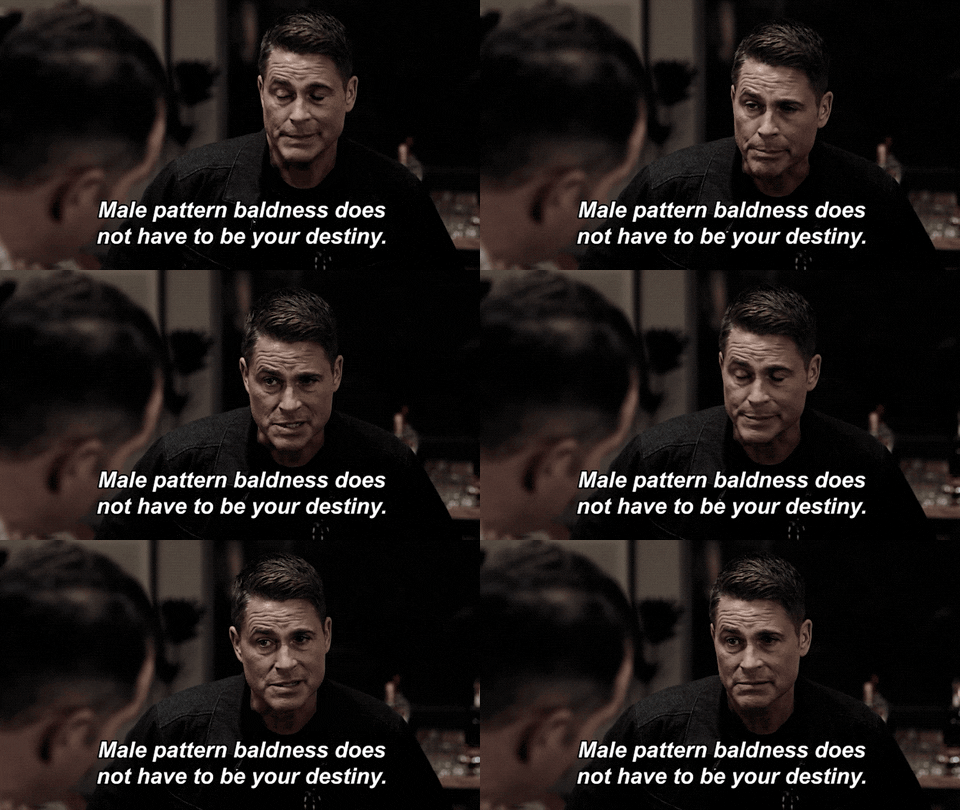
I just wondered how to say “male pattern baldness” in Portuguese so I googled it because it seemed like one of those things that would have a Wikipedia page and by looking across to the Portuguese version I could be sure that was the real term, not some shonky version from Google Translate. Now I’m going to be getting baldness cures pitched at me on every page I visit and every YouTube video I watch aren’t I. Damn you, technology.

Anyway, in case you’re wondering, it’s “alopécia androgenética de padrão masculino“. Pretty unwieldy, eh?

The Internet Be Like…
Posted in English

You Say Pow! Tautau. I say “Join NATO”

This must be my 400th title based on that song. I love it though. Anyway, the Social Media Find of the Day is this suggestion for ending the Russian invasion of Ukraine:

A mãe Putin vir com uma chinela dar taotao ao menino Vladimir.

Putin’s mother coming with a slipper to give her kid Vladimir tautau.

It’s not hard to guess from the context, is it, but my wife confirmed that yes, tautau means a smack – although she, and everyone else in the universe – spells it with a u, not an o. There’s a song called Vais Levar Tautau (you’re going to get a smack). Not my cup of tea, but if you’re interested it’s here

Posted in Portuguese

Trabalho de Casa

Eu e a minha filha ambos tínhamos bué* de trabalho para fazer hoje. Montes. Ela estava a entrar em pânico porque ainda não tinha escrito** dois ensaios sobre aspectos de filosofia. Eu sugeri que ela se sentasse à mesa comigo e que trabalhássemos juntos com uma vela perfumada e o álbum favorito dela.

A noite foi bem sucedida. Ela conseguiu escrever tudo. Entretanto, explicou-me a sua opinião sobre Berkeley (basicamente é a seguinte: “é um idiota e deve calar a boca”). Ela disse que “não é possível distinguir entre percepção subjectiva e entendimento veridico”, uma afirmação da qual não entendi patavina, e “Aristóteles era grego” (fiquei muito orgulhoso porque já sabia disso).

*I wrote this the other day after seeing that tweet I mentioned here

**Good illustration of the perils of directly translating the English that’s in your head. I wrote “feito” in place of “escrito” because in English we say “I haven’t done my essay” but think about it: you don’t DO an essay, your WRITE it.

Thanks to Dani Morgenstern for the corrections.

Posted in Portuguese

Um Livro Que Mudou O Modo Como Encaro A Vida

Today’s post is a writing challenge with the title “Books that changed how you look at the world”. For some reason, what came to mind was a book that I found very influential when I was a student but which I wouldn’t subscribe to now. And, as I’ve said in the text, even when I was a fan, I seem to have taken a very different life lesson from it than most of the writer’s other fans! Anyway, as usual I made mistakes and I’ll put the more interesting corrections at the bottom. Thanks to Dani Morgenstern for the help.

Esqueço-me sempre* de ler o tópico do dia. OK… Livros que mudaram a o meu ponto de vista. Há vários. Já li montes de livros ao longo da vida e confesso que 90 por cento passam pelo meu cérebro sem deixarem uma marca. Outros “esculpem”a minha perspetiva de uma maneira progressiva. Ou seja, não estou consciente de grandes efeitos mas, ano após ano, as minhas opiniões sobre vários tópicos ficam mais pormenorizadas e mais matizadas em resultado de ler livros (de ficção e de não-ficção) que alimentaram o meu pensamento.

Back to Freedom and Dignity by Francis Schaeffer

Mas livros que mudaram completamente a minha perspectiva? Há poucos. Provavelmente o que mais me marcou foi um livro que delineia um modo de agir e de pensar com o qual, hoje em dia, não concordo, mas que naquela altura, batia certo. O livro é o “Back to Freedom and Dignity” de Francis Schaeffer. O autor escreveu-o como resposta cristã às obras de psicologia, principalmente o behaviorismo** de BF Skinner. Que grande seca, né? Mas naquela altura, eu era*** um cristão que não entendia como sustentar a minha fé e simultaneamente participar na vida intelectual e política (esta frase soa pretenciosa, eu sei mas era um jovem). O livro abriu uma porta para uma determinada maneira de encarar a vida. Este processo durou 5 ou 6 anos e acabou por dar cabo da minha fé, mas cresci muito durante a tentativa de resolver o conflito. Ainda por cima, ouvi recentemente que o legado de Schaeffer foi o contrário do que seria suposto: milhares de cristãos evangélicos americanos leram os seus livros e ficaram inspirados a juntarem-se ao lado conservador da política no seu país (principalmente contra o aborto). Se fosse vivo hoje, acho que Scheaffer não apoiaria o que o partido republicano se tornou mas não há dúvida de que é um dos arquitectos principais a sua ideologia.

Entretanto, aqui estou eu, um centrista ateu!

*i originally wrote “Sempre me esqueço” because Sempre is one of those words that changes the position of the reflexive pronoun but of course the mistake I had made was to put sempre as the first word in the sentence like in English (“I always forget”) but in Portuguese it goes after the verb, so the reflexive verb can remain in its proper place.

**o found this word online and it does exist, but apparently there’s a more portuguesified version too: “comportamentalismo”

Posted in English

Abesbilico

One of my favourite things is trying to work out what the hell is going on in slang and social media lingo. Take this one for example…

“Abesbilico” is the “bué” of this generation.

So um… Eh?

First of all, bué. Bué is a word that entered Portuguese via Quimbundo, a language spoken in Angola. It can be used an adverb or a quantifier meaning “a lot”. “Leio bué” =I read a lot, and “Há bué gente” means “There are a lot of people” . This seems to be pretty well known. I first came across it as part of “bué fixe” – very cool.

And what about Abesbilico? I’d never heard of it before.

Tia Branca

Apparently it’s used a lot by Tia Branca who is a presenter on some kind of sex advice show on RTP. It seems to mean something like “gobsmacked”. Hunting around, I can find people asking about it in 2009 when it seems to have surfaced. Nobody seems to be quite sure about its origin. Possibly a splice of “Abismado” and… Something else. I definitely hadn’t seen it in the wild till I saw this but it might be a generational thing: if you search twitter for it, it seems to be getting used about ten times a day, so it’s out there, and I even came across memes of Tik Too teens lipsynching to Tia Branca saying “Este silêncio é propósitado, estou abesbílica”

Posted in Portuguese

Pássaros

Pisco de peito ruivo

Será que vocês se lembram do pisco-de-peito-ruivo que nos adoptou recentemente? Ficámos apaixonados pelo homenzinho. Visitou-nos todos os dias por várias semanas. Infelizmente, já nos abandonou. Havia um grupo de chapins reais que colonizou o alimentador fora da janela, e hoje em dia até os chapins não vêm porque o alimentador foi descoberto por dois pombos e um periquito que andam a lutar, um contra os outros, e os passarinhos pequenos não ousam visitar.