I’m going to be doing the London Nightrider event this weekend. I’ll be riding 100km, which is… what, about 65 miles? Something like that… to raise money for the Alzheimer’s society. It would mean a lot to me if you could sponsor me on my JustGiving page. I’ve got a temporary extra button over on the right-hand-side there 👉
It’s an overnight session, so I’ll be starting at 11PM and finishing at breakfast time. I’ve been cycling since I was tiny, but I’m not a sporty cyclist and I’ll be doing it on a very ordinary mountain bike, so I’m sure I can do it but it’s probably going to be pretty slow and painful!
It probably doesn’t look like much here but you should see the original, looming above you…
I was sorry to hear of the death of Paula Rego, an amazingly powerful and versatile portuguese artist who made her home here in Britain . She made it to 87, that’s a good long life so no tragedy, but still, a loss for the world.
I went to see some of her work at Europe house last summer and then later in the same year went to see the full exhibition at the Tate with my wife, who was always far more aware of Rego’s work than I was, of course. I went looking for the blog post I wrote about the Tate visit and was a bit surprised to find I hadn’t written one! I wasn’t as active on here back then, but stll, I don’t know why I didn’t write about that of all things.
Oh well, at least I know who I’ll be writing about on writestreakPT tomorrow!
It is with immense sadness that we announce the death of the Portuguese-born, British artist Dame Paula Rego at the age of 87. She died peacefully this morning, after a short illness, at home in North London, surrounded by her family. Our heartfelt thoughts are with them. pic.twitter.com/hFXdIZeTtb
I’ve just written a brief text in Portuguese about this which will probably end up being a blog post soon but I thought I’d expand on it in English in the meantime because it’s interesting!
So apparently there’s this joke that gets made a lot in Portuguese cafés. If you ask for a coffee by saying “queria um abatenado” (an abatenado is a kind of coffee) the waiter might reply “Queria? Já não quer?” if they are a bit of a smartarse. Why?
In English we don’t usually say “I want a cup of tea” because it sounds too blunt, so we go for something gentler like “I would like a cup of tea” instead. In the same way, the Portuguese have a fondness for tweaking the tense to sound more polite. They do this by saying “I was wanting a coffee”. And so, if you are a bored waiter you might decide to interpret this in the most literal way possible and reply with “Oh, you were wanting one, we’re you? So you don’t want one any more?” I know, hilarious, right?
I quite like it actually since it is both amusing and instructive for us learners but I think some people find it irritatingly pedantic, especially when it is repeated often. A recent article on Timeout Lisboa has taken waiters to task for this and for another literalism – namely when they reply to a request for a glass of water (“um copo de aqua”) by replying that they don’t have any glasses made of water, only glasses made of glass but if you want, they can give you a glass with water in (“um copo com água”). Marco Neves, in his blog, Certas Palavras, takes up the baton and gives a few other examples of nonstandard uses of verb tenses as well as some of his pet peeves. It’s a good read if you are at intermediate level or above.
Of course, as with most things, as soon as you noticed some weird feature of Portuguese, you realise English has exactly the same weirdness. I’ve already mentioned “I would like” as a politer version of “I want” but here are some other examples of verb tenses being used in weird ways in everyday English that are completely fine but would be confusing if you took them at face value.
Present tense for future events: I hope I don’t catch covid because I’m visiting my parents at the weekend.
Conditional tense for past events: When he was depressed he would spend his evenings drinking Drambuie and watching repeats of Peep Show with his cat.
Future perfect tense for things you assume to be true: Ah, Hamish, you’ll have had your tea
Present tense for historic events (the so called “historic present” or “narrative present” which was briefly both trendy and controversial a few years ago and basically dominates podcasting): “The Romans invade the Iberian Peninsula in the third century and are met with fierce resistance, not least from the Lusitanian tribes, led by Viriatus”
Studying another language has given me a new appreciation of my own.
Here’s a series of short texts written over the last few days when we were in holiday in Wales. Thanks to Patis12, Dani_morgenstern and Cataphract for the corrections
Quarta-Feira
Eu e a minha família vamos amanhã para o País de Gales para participar no festival literário. Por isso, os próximos textos irão ser curtinhos, acho eu, mas não quero abandonar o streak!
Quinta-feira
Hoje, pretendo ir buscar um carro (aluguei o durante 3 dias) e conduzir para o país de Gales com* a Minha mulher, a nossa filha e a amiga, dela. Não gosto de conduzir. De todo. É frustrante, portanto ando de carro com a menor* frequência possível. Além de ser o primeiro dia das miniférias, é o aniversário da minha filha. Faz 17 anos. Atingiu a idade na qual pode aprender a conduzir. Quem sabe, talvez ela vá lidar com tudo isso de volantes e travões e gasolina na próxima vez.
*This word originally had a typo and was written as “come” which is a bit unfortunate given that “comer” means eat (which would be bad) and also has a slang meaning which, if anything, is even worse in this context.
**as rarely as possible. I originally wrote “de menos frequência…” but that’s wrong.
Sexta-feira
Aqui estamos no oeste do Reino Unido. Assim que chegámos*, a minha mulher caiu ao descer uma escada. Torceu o tornozelo e bateu numa parede com a cabeça. Felizmente não tem concussão (sei isso porque ela ainda odeia o Boris Johnson), mas tem dores no tornozelo apesar de usar um curativo e um saco de ervilhas congeladas. Jantámos num restaurante. Hoje é dia de fazer compras nas livrarias e ouvir vários autores
*I wrote “logo que chegámos” which is fine but assim que is better
Sábado
Estou à espera para ouvir um discurso de uma autora chamada Bernardine* Evaristo. Li um livro dela há uns dias e gostei imenso. Sobretudo, adorei a maneira através da** qual ela estabeleceu ligações entre as várias gerações de personagens.
Ela conta a história de um jovem que encontra uma professora pouco simpática. O capítulo seguinte fala desta mesma professora e explica os motivos dela, mas ela também fica chateada com uma colega da geração anterior que se torna protagonista do capítulo seguinte. Acho que isso é uma boa lembrança de que cada um de nós tem a sua própria história que guia as suas ações
*Since this is quite an unusual name in English and quite a common one in Portuguese, the autocorrect feature changed it to Bernardino, which was quite embarrassing. Did the same in Instagram too. . I dashed the day’s text off in the last 5 minutes before she came on stage though so typos are to be expected!
**I wrote “a maneira na qual” – literally “the way in which” but it seems that the Portuguese say it as “a maneira através de qual” – “the way across which” or “a maneira como” – “the way how”
Domingo
Como Queiram
Ontem à noite, fomos ver uma peça de teatro – o As You Like It* de William Shakespeare – ao ar livre. Foi incrível. Logo depois da peça acabar, começou a chuva. Agradecemos aos deuses do tempo por terem adiado** a tempestade até à noite.
Choveu a cântaros. Ao chegarmos a casa, ouvimos a chuva a bater no telhado como se fosse uma bateria. As ovelhas lá fora, no campo estavam a balir***. Coitadinhos.
*There are various Portuguese translations. Older versions might be called “como vos aprouver” and more recent “como queiram”
**I originally wrote “terem-se travado” aiming for something like “having restrained themselves”. I’m not sure if this was actually wrong or if the marker just thought I was talking nonsense. I have a weird way of expressing myself in English and maybe it just sounds like mistakes in Portuguese….?
***balir os a good word. It means “to bleat”.
Epílogo: Segunda-Feira
As férias devem deixar-nos descansados mas voltamos para casa sempre exaustos* e cheios de sono. Queremos encher os dias todos com atividades, o que torna as férias mais ocupadas do que os dias de trabalho. Preciso de dois dias de descanso em casa depois de três dias de descanso num outro lugar.
*To my shame, I put sempre in the wrong place again.
I don’t really use Facebook much, but I have a couple of groups I follow lazily and one of them is called Portugal De Antigamente. I like to make sure I’m reading social media by Portuguese people, not just groups that are just dedicated to learning Portuguese. It broadens the horizons a bit and gives you more of a sense of the culture that the language is rooted in.
I like this one because people share old photos, memories and objects they have from their childhood or recent family history. Here’s one from Helga Schmidt-Glassner, for example. I’ve just found an article about her and will probably make her the subject of a future post in her own right.
I’ve mentioned before that there’s a Portuguese version of Wordle called Termo and I’ve been enjoying that in a daily basis. Well, there’s now a termo not on twitter, so this vice is on tap 24 hours a day!
To play, just tweet at this account and tell it a five letter word. It’ll reply straight away and you can keep going till you win. Or don’t.
It’s not as easy to follow as the website because you have to keep track of what letters you’ve used but that’s OK, it’s still fun and challenging and you can do it more than once a day!
Here’s a fun word i heard yesterday: commenting on something I wrote about my daughter’s birthday, someone wrote “Parabéns à tua pimpolha”. Sounds like a zit but isn’t. Pimpolho seems to be a sort of shoot of a germinating seed or, by extension, a child, with a female child being a pimpolha. There’s a brand of children’s shoes with the same name too.
Another word I’ve come across as a slang word for one’s offspring is “metralha”. Metralha is normally a volley of bullets (hence “metralhadora” for machine gun) or a hail of shrapnel but it seems to mean kids too. I can’t actually find any authority for this: it’s not in priberam or the dicionário informal or this thing I sometimes use. There’s a guy I follow on twitter who always uses it though. Presumably he isn’t the only one, but who knows.
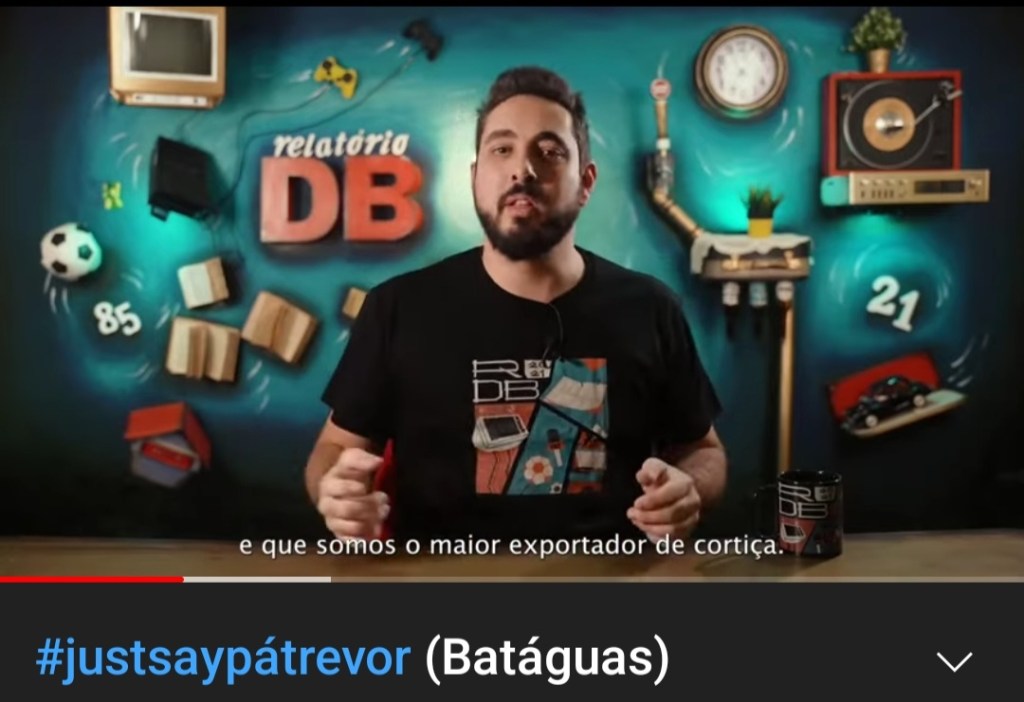
Expliquei a alguém o conceito da “pá” portuguesa hoje. Utilizei um vídeo do Diogo Badalada para ilustrar o meu discurso. Neste vídeo, o Diogo Batcave explica que além de cãezinhos* de água, o país produz a maioria da cortiça do mundo.
Pensando nisso, ocorreu-me que no futuro este produto pode ser útil porque, quando o ártico e o antártida descongelarem, e os mares surgirem por cima das costas dos continentes, Portugal flutuará na superfície da água. Afinal a profecia de José Saramago será concretizada… Quase… Porque será só Portugal e não a península ibérica que escapará o dilúvio**.
Diogo Badass
*gah, its so trixy that the plural of cãozinho os cãezinhos!
**This is a reference to the novel “A Jangada de Pedra” (“The Stone Raft”)
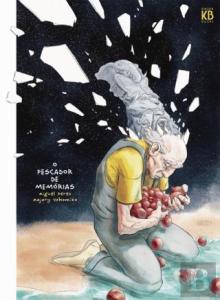
Este livro de Miguel Pires e Majory Yokomizo é uma banda desenhada que conta a história de um velho que vive numa ilha. Todos os dias, pesca no mar com romãs como isco e apanha pedaços de vidro que, ao ser montados (tipo puzzle), revelam as suas memórias. O leitor vem a entender que este homem tem demência e a sua ilha é uma alegoria – um exílio mental onde fica prisioneiro enquanto não se lembra da sua própria vida.
Acho que o escritor lida com este assunto desafiante de modo muito sensível. Os desenhos e o argumento funcionam bem juntos e o resultado é tocante.
While I was reading As Telefones Someone asked me if I was enjoying the book because the author “is pretty militant” which surprised me because I don’t really get that from the books at all. There’s one racist incident I remember from Marremoto, but I don’t really get strong militant vibes. Obviously, by writing about people in the margins of society like Boa Morte da Silva, I guess there’s an implied criticism of the system as a whole there, but I don’t think it’s any more than an author should feel for the subjects of her books. And what’s literature for if not to show us a different perspective on life?
I tried watching an interview with her to see if I could understand what he meant. Here she is on RTP2, drinking coffee with José Navarro de Andrade and talking about Maremoto. My first impression as that she just comes across as just a writer wanting to talk about her book. OK, she admits the dreadful crime of not having read O Ano Da Morte de Ricardo Reis by José Saramago, but she doesn’t say anything I’d describe as “militant”. Interestingly, (if I’m understanding correctly) the interviewer tries, at around the eleven minute mark, to get her to admit that the inconsistencies in the biography of the main character are because she is trying to make him a pastiche, representative of all African immigrants in Lisbon, to which she says, no, the protagonist is just writing his own story in the form of a letter to his daughter and he isn’t always a reliable or coherent narrator. QA lot of his personality comes from a real person she knows and yes, it’s messy, but that’s how life is sometimes.
I’m not sure where the idea that she is militant comes from. She seems very empathetic – to the point of avoiding any attempt to educate the reader because she feels like it gets in the way of the protagonist’s own voice.
She quotes Peter Geach, husband of Elizabeth Anscombe, in the closing minutes. I can’t find the quote online but it’s something like “It’s possible for a man to lose his one chance while he is still young, and live to be old, feeling happy and at ease in the world but in the eyes of God, be dead”. That’s heavy stuff, man, but it’s Christian ethics, not Marxism, feminism, CRT or whatever. So I’m at a loss to know where this “militant” thing has come from, unless she was more of a firebrand in her youth.





 Luso
Luso 