I’m a little surprised it even accepted the third one, really!

I’m a little surprised it even accepted the third one, really!
Here’s a joke you can use at parties if you want people to look at you with a baffled, pitying expression:

Hoje em dia, os cães são autocolantes mas antigamente, se quisesse prender um cão numa parede ou seja o que for, teria de usar Cola Cão
Cola = glue and Cão (with an accent) means dog so I’m reading this as dog glue, even though I know it’s a brand of hot chocolate powder and Cao is short for Cacau. The joke is just riffing off the idea of what you might use dog glue for.
It doesn’t work because Cao is pronounced differently from Cão. More like “Cáu”. Apparently it took a couple of reads to even see what I was driving at. Disappointing. I was quite proud of it.
A minha mulher usou esta palavra (de forma feminina, claro!) para descrever o seu estado depois de uns dias de tensão, à espera de um e-mail* de confirmação dum novo emprego (que já chegou!), e um tornozelo torcido.
A palavra vem do famoso “dialeto madeirense” do qual o Carlos Rodrigues nos tem informado. Quer dizer doente, cansado e pouco capaz de se movimentar.
*FLiP suggested I change this to “correio eletrónico” but I’ve never heard anyone actually use that so that’s a no!
This portuguese text was corrected by Patis12 (thanks!) and only had one error in it so apparently it is good Portuguese even if the biology leaves something to be desired. The theme of the day was “my favourite animal”
O meu animal preferido é a joaninha. É uma espécie de inseto híbrido, originário do cruzamento do besouro macho com um leopardo fêmea (uma conjugação pouco satisfatória para ambos os participantes).

Além de estar entre os insetos mais lindos*, as joaninhas têm um emprego muito importante no jardim que os tornam amigos do jardineiro: comem pulgões. São predadores selvagens que devoram os bichos que comem as plantas. Gosto muito deste facto porque gosto da ideia de ter um exército de besouros vermelhos com pontos pretos a lutar pela proteção dos meus feijões.
*alternatively “Além de ser dos animais mais lindos”. Good example of the distinction between ser and estar “as well as being one of the loveliest animals” uses ser because we’re defining it as a lovely animal but “as well as being among the loveliest animals” uses estar because it’s telling you about its location, albeit figuratively, within a hierarchy, not literally on a bush.

I did one of my occasional sweeps through the audiobook sites, on the lookout for new titles in european portuguese and I have managed to add about ten new ones to my audiobook page. The one I’m most excited about is this 👉 O Último Ano Em Luanda (The Last Year in Luanda) by Tiago Rebelo , but there are quite a few others, including a couple of new freebies.
I’ve rearranged the page slightly too: Bertrand is further down the page. I like the fact that they are a specifically portuguese outlet but the sad fact is that their collection hasn’t grown much. Neither has Audible’s. Why, Audible? Why must you torture us lusophiles? Kobo are smashing it though! They have added a few new ones, including some shiny, recent releases that have gone straight on my wish list. So I’ve moved Kobo right to the top of the page and I’m fully recommending that if you are serious about listening to european portuguese audiobooks, that’s the app you need!
Netflix announced another Portuguese series had gone into production a couple of weeks ago. That will bring the number of specifically European Portuguese offerings to a measly three, but it’s a good sign that they are following up the success of Glória and I’m hoping for more to come. The name of the show is “Rabo de Peixe” (Fishtail) and its set in the Açores. Here’s the teaser trailer below.
Returning to the subject of the recently departed Paula Rego, this time in Portuguese. Thanks to Cataphract for the corrections

Faleceu anteontem em Londres a artista Paula Rego. A artista morreu em casa, junto dos filhos.
Paula Rego nasceu em Lisboa em 1935 (completou 87 anos no início deste ano) mas mudou de país para Inglaterra com 17 anos para estudar na escola Slade de arte, com o incentivo dos seus pais anglófilos. Ao longo da sua vida, a obra desta pintora abordou questões políticas tais como o abuso de poder e os direitos das mulheres (acima de tudo na luta pela disponibilidade do aborto) mas não se limitou a isso. Também pintou cenas da vida quotidiana, e contos de fada. As vezes, falou da sua arte “dar uma face ao medo”. Até pintou o retrato oficial do então Presidente da República, Jorge Sampaio.
Tornou-se* cidadão do Reino Unido, casou-se com um inglês, e até recebeu a ordem do império britânico, que lhe permitiu ser tratada por “Dame Paula Rego” (mas se alguma vez usou este modo de se referir a si própria, não sei!)
Foi galardoada por institutos de arte de vários países, incluindo o Turner Prize aqui no Reino Unido. Eu e a minha esposa fomos ver a exibição na Galeria Tate no ano passado. Foi a exibição mais abrangente de sempre das obras dela e o que mais me espantou foi a diversidade de estilos e de temas que ela conquistou. Experimentou muitos e atingiu sempre um efeito incrível em qualquer género da pintura.
*I wrote this originally so I’ve left it in but I’m not sure it’s accurate. I thought she’d acquired British citizenship while here but someone suggested she’d always had dual citizenship. I can’t confirm one way or the other so I’ve left it as it is but don’t quote me, okay.
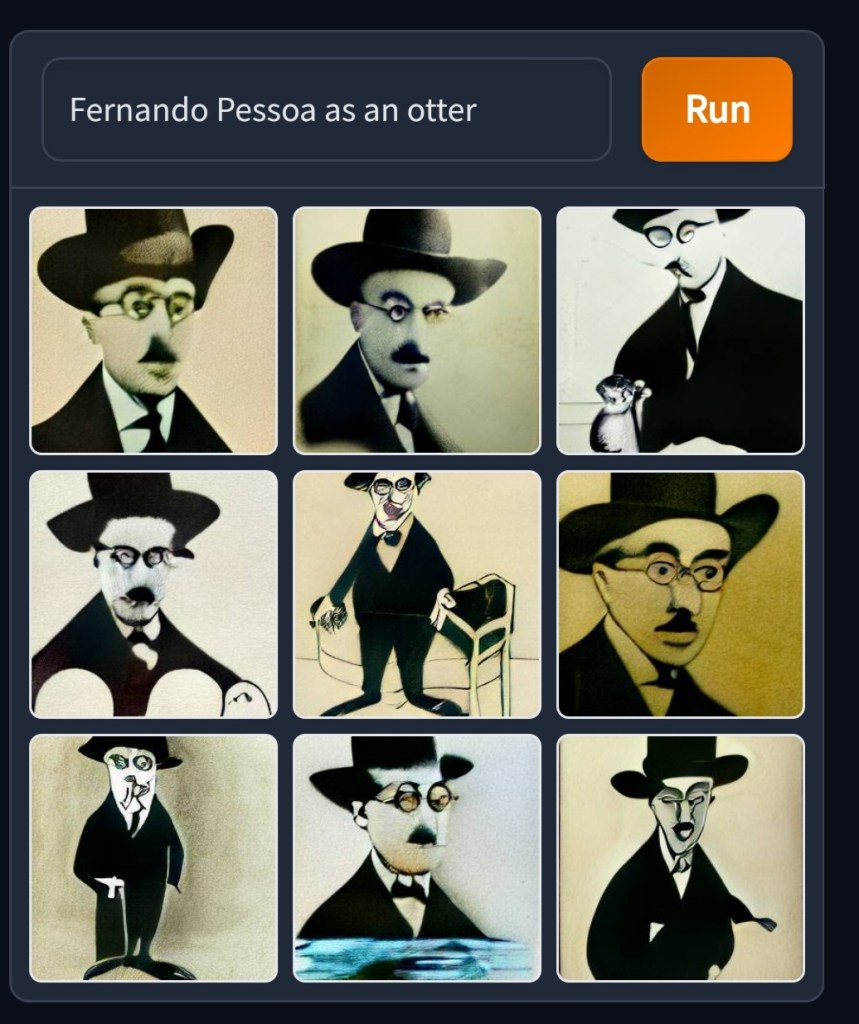
Like a lot of people, i have been playing with Dall-E. This one surprised me. I was a bit worried it wouldn’t know who Fernando Pessoa was but it turned out it didn’t know what an otter was
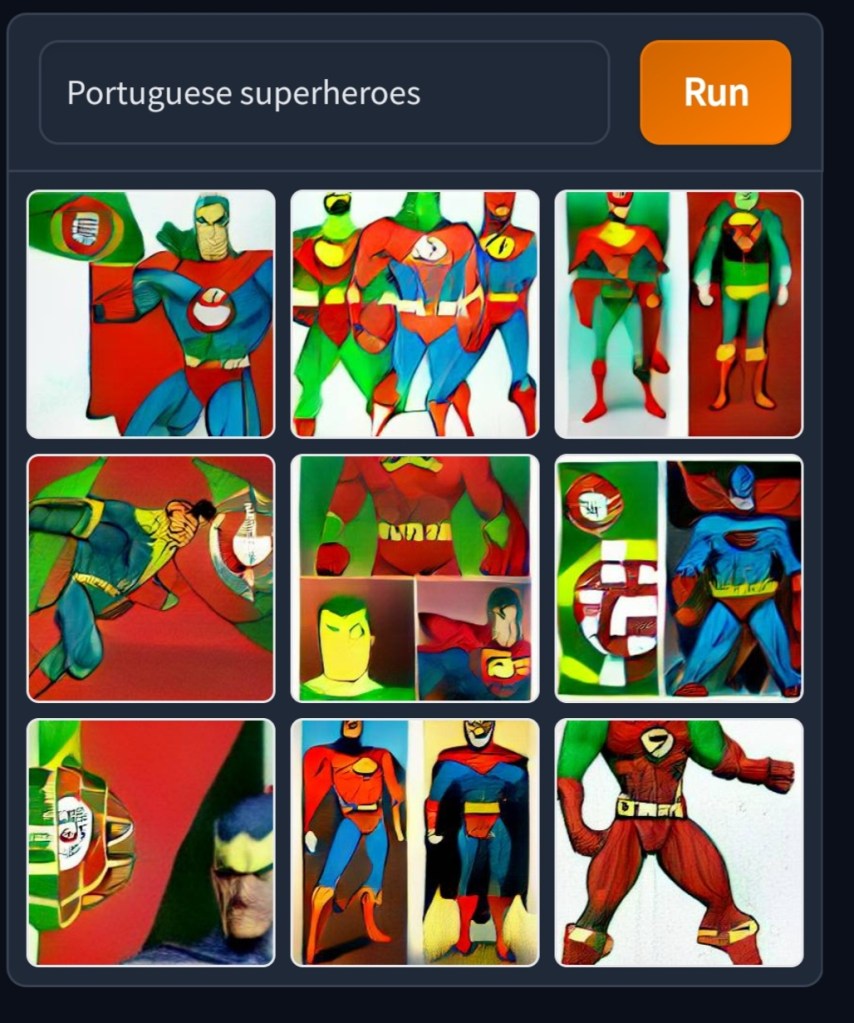
And here’s one where the Justice League all have the same super-power and it’s just knowing the colours of the Portuguese flag.
Here’s the Portuguese version of yesterday’s text. Thanks to Cataphract for the pointers.
Ouvi falar desta piadola há algum tempo. Por acaso, recentemente, li dois textos sobre o mesmo assunto. O primeiro no blog de Marco Neves e o segundo no site da Timeout Lisboa. Ambos tomaram a mesma posição, mas o do Neves é mais pormenorizado: o humor é baseado num literalismo exagerado. Ou seja, quando o cliente quer pedir um café com delicadeza, usa-se o pretérito imperfeito – “queria um café” – porque soa mais suave do que “quero”. Um empregado chico esperto, ouvindo este tempo verbal pode fingir não entender e daí a resposta “queria? Já não quer?”
Pessoalmente, acho esta tendência por parte dos empregados de Portugal muito engraçada e educativa mas tanto quanto entendo, o que mais irrita os cafeínodependentes* é a repetição. Ouvem sempre a mesma pergunta.
*cafeínodependentes not cafeínadependentes even though caffeine is spelled cafeína.

 Luso
Luso 