
Made this for Instagram but it seemed to fit here too.
Made this for Instagram but it seemed to fit here too.
Então, ainda não falei da rainha, Cesária Évora? Tive a sorte de assistir a* um espetáculo dela em… hum… 2001, se não me engano. Naquela altura, não falava nem uma palavra de português mas mesmo se falasse não me teria ajudado porque a maior parte da obra dela está em Crioulo Cabo-Verdiano. Fomos com a tia da minha esposa. A minha esposa nasceu no Cabo Verde e viviu lá durante os seus primeiros anos, antes da família dela ter voltado para a Madeira. A cantora tinha uma maneira muito relaxada de se apresentar na sala de concertos. Não parecia ser muito animada. Só cantou de pés descalços**. Havia uma mesa no centro do palco e, durante o seu intervalo, a banda continuou a tocar enquanto ela sentou-se numa poltrona, acendeu um cigarro, deitou um pouco de vinho num copo*** e ficou tranquila, nem sequer olhando o público durante 3 ou 4 minutos até à abertura da próxima música.
Queria fazer uma tradução da sua canção “Angola”, que é empolgante, mas claro que preciso da ajuda de um português que entenda o crioulo. Roubei as letras deste site, mas acho que o homem que fez esta tradução parafraseou um pouco. Por exemplo, aquela primeira linha tem uma conjugação do verbo “viver”, sem dúvida. Acho que ela diz “Essa vida boa que os senhores estão a viver”. Existem vários sites online onde se explicam estas línguas parecidas com o português padrão – por exemplo, aqui está a descrição de “nhôs” no Infopedia . E tenho as minhas dúvidas sobre a interpretação de “Ami nhos ca ta matá-me” porque parece-me tão descabido no contexto… mas tenho de confiar no tradutor porque ele afirma que é fluente!
A música é linda. Eu não sei nada de teoria da música e se calhar, estou completamente errado, mas parece-me influenciado pela música do Brasil, com um ritmo sincopado que me lembra o**** Samba, mas é mais do que só uma cópia: muito mais. Tem um som único, e a voz dela é… Ouso dizer “ouro sobre azul”? O efeito da voz e da música é esmagador!
*I need to smack myself in the head with a frying pan a few times till I remember to put the “a” after “assistir”
**I’m only talking about the concert but I could easily have said the same about her career.
***I really screwed this sentence up – I tried to use the verb “derramar”, which isn’t even the right verb (it means spill) but then I managed to get it even wronger and wrote “derrubar”. I think deitar is the right verb even though it sounds weird – I usually associate it with laying something down or chucking it away. I also wanted to express the idea that she poured out a few sips worth, but that didn’t go any better. Hopefully this works. the easy way would be to say “encheu um copo” because why wouldn’t you want to fill it all the way up? But I was trying to be more specific than that. Sigh. This seems like a very basic thing to be confused about when I’m meant to be at C1 level.
****Not “do Samba”: “it reminds me of” doesn’t have de, whereas “i remember” does – so the preposition use is pretty much the opposite of english, really!
| Crioula | Português | Inglês |
|---|---|---|
| Ess vida sabe qu’nhôs ta vivê Parodia dia e note manché Sem maca ma cu sabura Angola angola Oi qu’povo sabe Ami nhos ca ta matá-me ‘M bem cu hora pa’me ba nha caminho Ess convivência dess nhôs vivência Paciência dum consequência Resistência dum estravagância | Essa vida boa que vocês têm Paródia dia e noite até de manhã Sem mágoas, com alegria Angola, Angola Oh que povo alegre A mim não me matam Venho com hora para partir A convivência na vossa vivência Paciência duma consequência Resistência duma extravagância | That good life you’re living Parodies, day and night, until morning Without pain, but with happiness Angola, Angola Oh what a happy people They don’t kill me I come when it’s time to be on the way The way living together is a way of life Patience of consequence Resistance of extravagance |
Thanks to Cristina of Say it in Portuguese for correcting the text description above the video.
I was bowled over by Jéssica Cipriano’s version of Madredeus’s O Pastor when I watched it the other day, shortly after hearing her version of Olá Solidão. It’s so, so good. When she really cuts loose at around 4.20, my eyes were filling up and my soul left my body. I think the pianist, David Antunes, was right there with me too. Holy shit! How is this woman not a million times more famous? How do I not even see an album of hers on Spotify? How is she not smashing Eurovision? It’s some sort of conspiracy to hide her from the ears of foreigners, I reckon.
Here’s the original from the 1990 album, Existir. You can see it’s got a richer musical arrangement, and the singer’s voice is beautiful in an ethereal way. but it’s too ethereal for me, and the band has never really grabbed me for that reason, even though they were the first portuguese band I ever listened to. They remind me of bands like Clannad, the Cocteau Twins and Enya. I feel like the voice is being used as a musical instrument; there’s not much emotion there and the words don’t really matter so much so it’s hard to get into.
| Português | Inglês |
|---|---|
| Ai que ninguém volta Ao que já deixou Ninguém larga a grande roda Ninguém sabe onde é que andou | Oh, nobody goes back To what they left Nobody lets go of the big wheel Nobody knows where they’ve been |
| Ai que ninguém lembra Nem o que sonhou Aquele menino canta A cantiga do pastor | Oh nobody remembers Not even what they dreamed That child sings The song of the shepherd |
| Ao largo Ainda arde A barca Da fantasia O meu sonho acaba tarde Deixa a alma de vigia Ao largo Ainda arde A barca Da fantasia O meu sonho acaba tarde Acordar é que eu não queria | In the distance It’s still burning The boat Of fantasy My dream ends late Leave your soul on guard In the distance It’s still burning The boat Of fantasy My dream ends late Waking up is what I didn’t want |
A minha filha está a estudar numa faculdade na Escócia. Começou recentemente a namorar com um jovem que está a estudar no mesmo curso. Está muito feliz. Ainda bem porque isso significa que não tenho de o assassinar. Ah ah, estou a brincar. Ou estou*?

Os dois vão passar uns dias connosco durante os feriados. De vez em quando, ela envia-me uma mensagem a dizer algo como “Vais gostar dele pai. Ele está ansioso por te conhecer.”
Acho que ela está ligeiramente preocupada caso eu não o aceitar. E é verdade que os pais das raparigas exibem uma certa hostilidade para com** os namorados delas. Porque são preciosas e ninguém é digno das nossas princesas. Muitas vezes, quando ela era nova, perguntei-me: “E se ela levar um javardola qualquer para casa?”
Mas ela não é parva. Escolheu um rapaz inteligente, respeituoso e com um bom sentido de humor, que gosta muito dela. Não me admira, porque confio nela e sei bem que ela não aceitaria um homem que não a apreciasse. Mas entendo o constrangimento por parte deles. Ela também vai conhecer os pais (e o cão) dele. Pais de namoradas podem ser intimidantes e cães são… são cães, basicamente. Quando era pequena um cão bateu nas costas dela com as patas*** anteriores que a derrubou, e desde então, está de pé**** atrás.
Mas tenho toda a certeza que vamos ter umas boas festas: eu, ela, o namorado e até o cãozinho.
*”Or am I?” makes me laugh, but it is of course not really a portuguese expression.
**Para com seems to be one of those things that exists in portuguese that doesn’t really have a close analogy in english, but here’s a Ciberdúvidas page that explains how it’s used.
***I wrote pés because I am a silly man
****I originally wrote that she had “uma pulga atrás da orelha” but I think that’s a different kind of distrust, but let’s look on the bright side, at least I managed to recycle the word “pé” from the previous clause.
Thanks again to Cristina of Say It In Portuguese for correcting the text – although I might have messed a couple of them up through my own lack of understanding and you can blame me if I have!
Passei umas horas no hospital esta manhã. A minha esposa trabalha lá como assistente de cuidados de saúde. Saiu da casa para o seu emprego às 7 horas, mas às 9, ligou-me para dizer que se sentia fraca e com tonturas, portanto o médico tinha-a enviado para às urgências onde vários funcionários mediram a sua pressão arterial, fizeram-lhe um teste de gravidez (que seria uma surpresa, e muito inconveniente, mas a menos, desde que a macaquinha se foi embora, já temos um quarto a mais onde podemos colocar um berço …. ah ah ah) e geralmente inspecionaram a saúde geral. Cheguei uma hora depois com uma garrafa de água e toda a empatia que tenho.
Os enfermeiros e médicos foram muito simpáticos mas havia um jovem funcionário à porta do cubículo onde se encontrava a minha esposa que estava a explicar várias teorias de conspiração parvas ao seu amigo (que entretanto estava a tentar fazer o seu trabalho) e eu fiquei cheio de vontade de lhe dar um par de bofetadas* para restaurar um sentido de realidade.
Depois de algum tempo um médico chegou ao pé da cama e informou-a de que tinha de ficar no hospital durante 3 dias. Nós dois começamos a gaguejar, ultrajados, mas o homem estava a brincar – o seu problema de saúde não passou de uma ligeira desidratação. Eh pá… não nos faças isso!
Regressámos para casa e ela está a fazer uma soneca no sofá.
*Originally “bofetadas na cara” but bofetadas can only be in the face, apparently – cf Priberam
I published this one in a hurry because I needed to rant a bit, but thanks again to Cristina of Say It In Portuguese for correcting the text by email within a few minutes of my uploading it!
Today’s translation is from Os Quatro e Meio. Why are they called that? You’d think, wouldn’t you, that maybe there were 5 of them but one was a dog so they only count him as half because he can’t play the mandolin. But no, there are six of them. So… what, are three of them dogs? How many mandolins do they need in one band? I’ve googled it but I’ve no idea how to account for the numerical disparity* Anyway, they hail from Coimbra and they are alumni of the student music scene down there but they branched out and found themselves a following in the country as a whole. They seem very earnest young men and you can see how they’d appeal to people who like easnest young men, preferably with eyebrows and suits, and it’s a good pop song: simple, catchy and with plenty of scope to let loose on the vocals In fact, here’s Jéssica Cipriano absolutely singing the hell out of it with a very minimal musical accompaniment and it’s even better than the original. I’d never heard of her before but she has an absolutely phenomenal voice.
The translation is mostly pretty easy, although I struggled a bit with “Fiz bandeira de um velho ditado / Melhor só que mal acompanhado”. Nothing hard about it, but when I translate it the two lines didn’t seem to fit together which made me think I’d missed something and I tried experimenting with alternative meanings of “acompanhar”. For example, it’s the verb Google Mail uses when it asks if you want to follow up an email that you’ve sent and not had a reply. So I was thinking maybe “it’s only better than barely following things up….” Desparate stuff. Anyway, the punctuation makes the difference because of course “Melhor só que mal acompanhado” is the ditado mentioned in the first line. He decided to live by the idea that it’s better to go alone than in bad company
| Português | Inglês |
|---|---|
| Eu já fui assim Tão focado em mim Sem querer conselhos De ninguém Fiz das nuvens lar Saltei sem olhar Crendo que no fim sairia tudo bem | I used to be like that** So focused on myself Without wanting advice From anyone I made a home in the clouds I jumped without looking Believing in the end it would be fine |
| Fiz bandeira de um velho ditado: “Melhor só que mal acompanhado” Nem pensava em apoiar os pés no chão Olá, solidão Olá, solidão | I made a flag of an old saying: “Better alone than in bad company” I never thought of keeping my feet on the ground Hello solitude Hello solitude |
| Eu tinha um lugar Com vista pra o mar Que ninguém chegou a conhecer Voei rente ao céu Tudo era só meu E o que ainda não era Iria ser | I had a place With a sea view That nobody ever got to know I flew close to the sky Everything was all mine And whatever wasn’t yet Was going to be |
| Olho em volta, agora estou sozinho Não liguei às placas do caminho Nem parei pra perguntar a direção Olá, solidão Olá, solidão | I look around, now I’m alone I didn’t pay attention to the road signs I didn’t stop to ask directions Hello Solitude Hello Solitude |
| Fiz bandeira de um velho ditado: “Melhor só que mal acompanhado” Nem pensava em apoiar os pés no chão | I made a flag of an old saying: “Better alone than in bad company” I never thought of keeping my feet on |
| Olho em volta, agora estou sozinho Não liguei às placas do caminho Nem parei pra perguntar a direção Olá, solidão Olá, solidão | I look around, now I’m alone I didn’t pay attention to the road signs I didn’t stop to ask directions Hello Solitude Hello Solitude |
| Eu já fui assim Tão focado em mim Sem querer conselhos De ninguém | I was always like this So focused on myself Without wanting advice From anyone |
* EDIT: A helpful reader has suggested this web page as the source of the name: “Começámos por ser só cinco. Salvo seja, já que o Rui [Marques, contrabaixista] não tem dimensão para isso. Não é que o valor dele ano seja igual ao dos outros mas a estatura dele deixa um pouco a desejar” – I assume that “ano” is a typo for “não” or possibly “anão” heh heh
** Thanks to Liliana for suggesting I tweak the tense here (see comments below 👇)
Now that I’ve finished Qual É A Dúvida I’ve returned to the bloody awful, boring “Português Outra Vez“, aimed at C1/C2 level students. On the face of it, there’s no reason it should be so dull: both books are just page after page of exercícios lacunares (missing word problems), but they’ve ordered it into three sections and within each section they’re all the same *kind* of missing words. I’m currently part way through 60 pages of verb+preposition. I have a copy of the Guia Prático de Verbos com Preposições for any that I don’t already know. Helena Ventura is co-author of both books, so the examples are often quite similar.
Now, that much repetition could be useful if it was drilling the variations of dar+preposition or passar+preposition but there’s surprisingly little repetition of those. Dar appears just twice, I think, and ser, passar, ficar seem only to be there once. Instead we’re doing easy things like gostar de, precisar de, plus some fairly obscure ferns that only ever take one preposition anyway. It’s not ideal and I am finding it much harder to stay motivated. I’ll see how it goes but I might just open a window and fling it at the pigeons outside.
The other two sections are expressões idiomáticas and vocabulário. I feel like this is all good meat-and-potatoes stuff, necessary for building core competencies for the advanced exam, so I hope the pigeons enjoy it.
More practically, I suppose I should hope between sections to break up the monotony or something.
Aaaaanyway, enough moaning. I’m writing out some that I got wrong, hoping they’ll stick in my mind better:
Não Conseguimos convencê-lo; ele torce pelo Benfica e não muda de ideias. I got torcer por, but failed to realise that Benfica needed a definite article. Torcer por =Ser adepto de = to be a supporter of
Todas as pessoas devem ser compassiva e solidárias, olhando a quem está em situação de pobreza e depende da ajuda dos outros. Again, i got the right formula – olhar a – but I used the imperativo. That probably would have worked if there were a full stop after “solidárias” but it doesn’t make sense as it is and I should have rethought it. Olhar a =ter em consideração =to look out for
Quantas costeletas tocam a cada pessoa? Parecem-me poucas para tanta gente. I had no clue here and just guessed badly. Tocar a = calhar a =to… Hm, it’s a difficult one to translate neatly but the whole sentence is like “How many cutlets are there for each person”. It can also mean “to have to do with” or “to compete for”
O António foi falar com o chefe e foi pedir-lhe pela colega da receção, para que o chefe a promovesse, pois ela merecia. I got the wrong end of the stick with this one. I didn’t realise Antonio was a worker in the same firm. I thought he was a customer who was recommending the receptionist for promotion. Conseqiently I messed it up. Pedir por =interceder a favor de= to ask on behalf of, to act as an intermediary.
Há pessoas tão ambiciosas que não olham a meios para atingir os fins. I missed the relevance of this. And used “ser contra” instead. Olhar a =atender a = care about. So in this case they don’t care what means they have to use to achieve their ends. We’ve all met people like that, eh? Some people are so ambitious to be a good portuguese students they will even stoop to doing the actual exercises diligently.
Não compares um Ferrari com um Toyota! São completamente diferentes! I used a in place of com. Classic overliteral translation from English. Compare x WITH y, not x TO y. Comparar com = colocar em igualdade com =Make a comparison. The way this is phrased implies that the comparison will always be of equality, but priberam is much closer to the English notion of comparing. Ie, you can make an unfavourable comparison, but even though “this is a million times better than that” is a comparison, people will often be opposed to you comparing Shakespeare to Dan Brown or whatever, feeling that Shakespeare is somehow demeaned by being spoken of in the same breath as such a terrible writer, and I assume that’s what’s going in in the example.

I read this banda desenhada back in 2018 but I found it heavy going at the time and I decided to go back to it. At the time, what I said was
Hum… O livro tem 60 páginas e contém 10 contos. Obviamente, estamos na presença dum autor que usa um estilo bem lacónico. As histórias são esquisitas, escuras, perturbantes – mais parecidas com os contos de Franz Kafka do que uma BD tradicional. Na verdade, apenas dois contos têm a marca duma BD: balões de texto. Os outros são, antes, pequenos trechos de ficção, alguns pouco maiores do que um tweet, ilustrados com desenhos escuros ou arrepiantes. Fico contente por ter lido mas não tenho a certeza se apreciei. Vou colocá-lo numa prateleira longe da minha cama para não ter pesadelos.
But here’s what I came up with in 2023, with more fluency of reading (not having to hit the dictionary every 30 seconds)
Ah ah, a opinião do eu de há 5 anos não está assim tão longe da verdade, apesar do seu fraco domínio do idioma, mas aquele rapaz com 48 anos não tinha noção da paixão que fundamenta a maior parte do livro. No primeiro conto, o narrador tem um amor escondido. Está esboçado na forma dum monstro ou um demónio que brama fora do apartamento da amada. Noutros, encontramos outras formas de amor: amor de filhos pelos seus pais, netos pelos avós, e de uma barata gigante pelo dono da casa onde vive. Coisas quotidianas, estás a ver? Cada história tem o seu próprio estilo artístico, mas há uma sensação arrepiante que se difunde pelo livro todo. Trata-se de um amor assombrado por uma angústia existencial.
Once again I’m indebted to Cristina of “Say it in Portuguese” for correcting the errors in the original draft.
Her’s another translation – this time “Eu e o Meu País” (me and my country) by Oquestrada. It has a weird bit of anglo-french wittering at the start and I’ll just pretend that doesn’t happen. I wish I had a video of them doing it live but every one I’ve found has been shonky fan footage.
The song itself isn’t that deep either. The bit I really like is the very beginning. Freguesia is one of my favourite words for some reason, and that second line is great, plus the sense you have of her dashing around everywhere trying to hug the whole country. So that’s the only reason for the translation. If you want an objectively better video of them playing an objectively more stompy song, check this out.
| Portuguese | English |
|---|---|
| De distrito em distrito de freguesia em freguesia e quando os teus braços chegam aos meus nós somos só um, somos um só nós somos um só, somos só um eu e o meu país | District by district Parish by parish And when your arms reach mine We are one, we are one We are one, we are one Me and my country |
| Ouvi dizer que me amavas, adoravas, entendias ouvi dizer que me querias, me estimavas, percebias e se à noite me sorris de dia pouco me falas mas se à noite me sorris de dia pouco me falas de dia pouco me falas | I heard you loved me, adored me, understood me I heard you wanted me, esteemed me, noticed me And if at night you smile at me By day you hardly talk to me And if at night you smile at me By day you hardly talk to me By day you hardly talk to me |
| I wanna dancing with myself I wanna dancing with myself e é tanta a rotunda que já nem sei chegar a ti neste silêncio, neste pantanal sou turista acidental neste anúncio, neste postal sou turista acidental mas e tu, tu oh tu meu país mas e tu, tu oh tu meu país diz-me diz-me onde ficas tu neste postal | I wanna dancing with myself I wanna dancing with myself And there are so many roundabouts I don’t even know how to get to you In this silence, in this swamp I’m an accidental tourist In this advertisement, in this postcard I’m an accidental tourist But you, you, oh you, my country But you, you, oh you, my country Tell me where you are on this postcard |
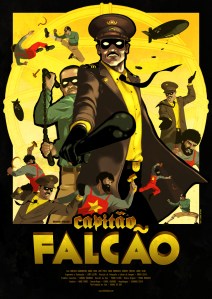
I’ve been trying to find a copy of Capitão Falcão on DVD for a while now but I’ve just found a free copy for download on the Internet Archive*. That’s a pretty respectable site, not a nest of pirates, so it appears to be legit. Anyway, can’t get it anywhere else, so I downloaded it. I couldn’t quite believe my luck. I’d have happily paid a hefty pile of cash for this but nobody wanted my money, apparently.
Anyway, here’s my review:
Este filme é incrível. Ouvi dizer que é um dos filmes portugueses mais engraçados de sempre e não mentiram. O protagonista é um militar (protagonizado por Gonçalo Waddington da série Odisseia) que é selecionado pelo General Gaivota para um novo cargo de super-herói e defensor do estado. O seu nome é Capitão Falcão e o seu auxiliar chinês é conhecido por Puto Perdiz. Os dois usam máscaras à moda antigo: ou seja, são máscaras que escondem a parte superior do rosto, não dessas máscaras cirúrgicas que cobrem a fuça.
Mas porque é que os protagonistas têm nomes de aves? Suponho que é uma referência aos super-heróis do passado. Quanto ao Puto Perdiz, a sua alcunha é parecido com a do Robin (o “Boy wonder”), da série Homem-Morcego. Mas existem ainda mais paralelos porque sem dúvida este filme trata-se de uma sátira daquele género de super-heróis. Os vilões riem-se em voz alta de modo exagerado, como o Doutor Evil do “Austin Powers”, por exemplo, e os métodos de interrogação gozam com as séries policiais duras.
Mas acima de tudo, acho que há duas personagens nas quais este filme é baseado: Primeira: O Besouro Verde** uma personagem americana que também usava mascara e também tinha um ajudante chinês (protagonizado pelo lendário Bruce Lee!). É óbvio que o seu “vibe” (como dizem os jovens) é cem por cento o do Besouro Verde. Mas mencionei a série no Insta e a minha amiga Olga respondeu com uma segunda personagem: “Major Alvega!”
“Hum, o quê? Diz lá, quem é esse Major?”
Major Alvega, também conhecido por “Battler Britton” era um piloto da RAF (Força Aérea Britânico) que estreou na revista Sun*** em 1956 e depois mudou-se para Portugal mas naquela altura a ditadura nacionalista exigiu todos os heróis terem nomes portugueses, e foi assim que nasceu o Major Alvega****. Este vídeo dá mais informações. É evidente que o escritor do diálogo é consciente do legado do Major Alvega porque há uma cena numa prisão onde Capitão Falcão perguntou a um homem como se chamava. O homem respondeu que antes de ser preso tinha sido um major. “Major Al…. ah ah ah… Major Alberto”
Enquanto o Major Alvego assumiu um nome Salazarista, Capitão Falcão é um servidor do próprio Salazar, porque o filme tem lugar nos anos sessenta e os criminosos são liberais, ateus e comunistas. Pior ainda, “São comunistas e ninjas…. Comuninjas”
*If you also need subtitles, try these
**Green Hornet in english, but Besouro means beetle, not hornet
***Yes, a now defunct magazine, not the still existing paper
****Confusingly it seems that when Major Alvega was turned into a TV series it was sold back to anglophone audiences with a totally different name: Ace London!
Once again I’m indebted to Cristina of “Say it in Portuguese” for correcting the errors in the original draft
 Luso
Luso 