Posted in English

Lyrics Training

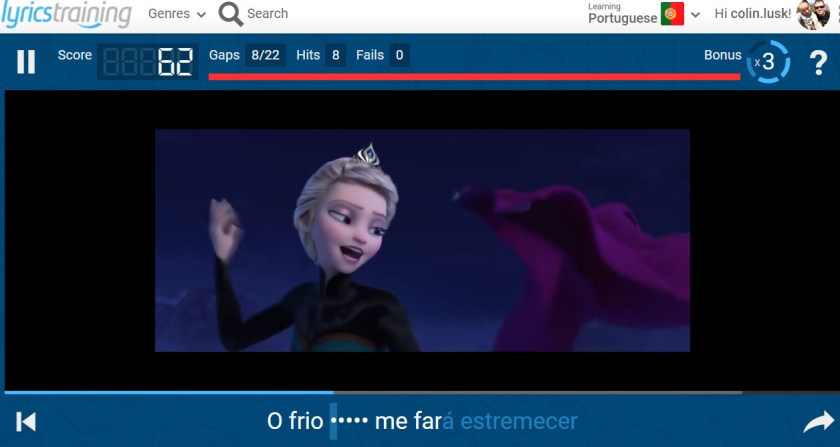
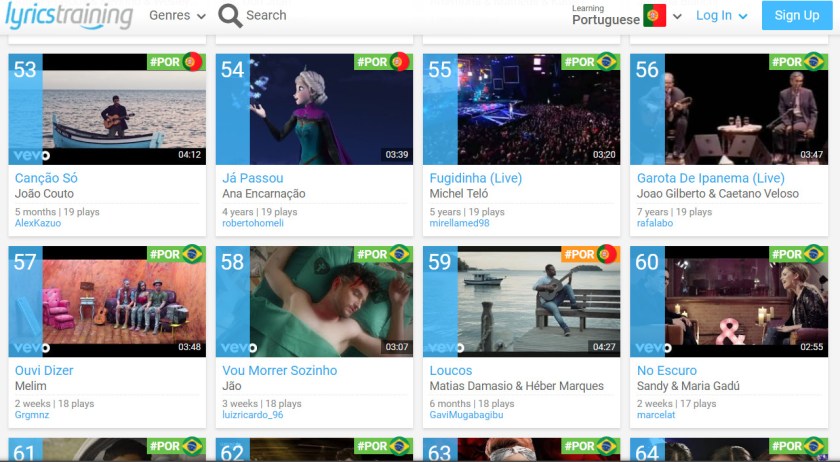
I heard about a site called Lyrics Training from a Brazilian guy I’ve been doing language exchanges with for a while now. It seems opretty useful. The idea is to improve your listening skills by filling in random missing words from a song that plays in a video window. You can select different levels of difficulty and if you can’t get it fast enough it pauses and rewinds to give you a little more time. There are ots of different languages, including both brazilian and portuguese portuguese, but the two are clearly marked with a flag in the corner of each video thumbnail.

Untitled

Untitled


Posted in English

A Pimenta

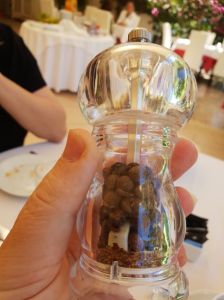
IMG_20180731_35755I asked about this on iTalki but didn’t get any useful answers. The hotel we stayed at earlier this summer had pepper grinders on the table, but instead of having normal black peppercorns in them, they had allspice (aka Jamaican pepper). I wondered if this was common in Portugal or if someone had just got confused in the hotel kitchen.

I still don’t know, but if anyone else does, I’d be interested to hear about it.

Posted in English

It’s All Too Much

More jottings from Ciberdúvidas, this time about different ways of saying too many/much. There does seem to be an overlap between the uses, so I’ll just spread them out and see what’s what.

Demais

Can be:

  1. An adverb meaning “a heck of a lot”. Ele fuma demais seems to be “he’s a heavy smoker” and not “he smokes too much”
  2. An intensifier where it does the same job as the adverb but it underscores other adverbs or adjectives – A jarra é frágil demais; vai partir-se
  3. A kind of indefinite nouny-pronouny thing along the lines of “the surplus” or “the others”: Daquelas senhoras, uma comeu peixe, as demais comeram carne 
  4. A way of saying “além disso”: Esse trabalho é muito difícil; demais, é mal pago [also spelled “ademais” in this case]

De Mais

Ciberdúvidas says it’s an adverb but it’s behaving like an adjective, expressing that the amount is excessive. It’s equivalent to “a mais”. It’s always referring to quantity, not degree. Comprei livros de mais

Demasiado

Can be

  1. An adjective and fulfills the same function as de mais. Note that, like other adjectives, the ending changes. It’s more commonly used in Portugal than in Brazil. Goes before the word it’s qualifying. Passam demasiados carros. 
  2. An adverb, where it fulfills the same function as demais. Comi demasiado.
Posted in English

Don’t Even Think About It, Se Não Way

More jottings from Ciberdúvidas, this time relating to the difference between “se não” and “senão”.

Senão (just one word) can be:

  1. A noun meaning “drawback” or “defect” – the example given in the article, “Não há bela sem senão” menas “there’s no beauty without a drawback” or if you’re feeling poetic, “every rose has it’s thorn”
  2. As a linking element meaning one of several things in english, which all have the common theme of expressing an alternative case:
      • “or else” – Fala mais alto senão não te oiço means “Speak up, or else I won’t hear you”
      • “but (on the contrary)” – Não dá quem tem, senão quem quer bem means “It isn’t those who have that give but to those who really want to”
      • “if not” – O que é a vida senão uma luta? means “What is life if not a struggle? [NB – it only means “if not” in this kind of context though – where it’s essentially doing the same job as “except” – contrast with the meaning of “se não” below]
      • “except” Ninguém falou senão o meu irmão means “Nobody spoke except my brother
  3. Paired with another “nao”, this alternative case can morph into “only” or “nothing but”. For example Ele não tinha senão uma atitude a tomar: proteger a mãe.” means “He has nothing but this one attitude: to protect his mother”
  4. Paired with “Quando” it means “suddenly”. Eu estava quase na escola senão quando um carro atropelou um aluno means “I was almost at school when suddenly a car knocked over a student

Se Não (two words) is a lot less awkward. It means what it looks like it means: “If not” in most contexts we would normally use them. For example the Primo Levi book called “If Not Now, When” in english is called “Se Não Agora, Quando?” in Portuguese.

Some more examples:

  1. Se não fosse um homem, gostaria de ser um sapo” – If I weren’t a man, I’d like to be a frog”
  2. “Tenho cem livros de PG Wodehouse se não mais.” I have a hundred books by PG Wodehouse, if not more

This second one is the sort of situation I would make a mistake in since it looks like one of the examples for senão, but it’s subtly different.

The article gives this helpful tip: Uma regra simples para se verificar esta situação: neste caso é possível introduzir a expressão “é que” entre o “se” e o “não”. So…

  • Tenho sem livros de PG Wodehouse se é que não tinha mais.

According to the rule, that should break in cases where we would want to use senão:

  • Fala mais alto se é que não [???] não te oiço
  • Não dá quem tem, se é que não [dá] quem quer bem
  • O que é a vida se é que não é uma luta?

Hm… I’m not sure. The first and second are definitely wrong, but the third means. “What is life if it is not a struggle”. Has that broken the sentence…? Not completely. It’s subtly different, but… Bit shady, that one.

“Se não” occasionally comes up in an even more separate way where you have a negative statement with a reflexive, passive or pronomial verb (cf this post)

  • Quem se não sente de agravos, não é honrado.

Here the verb is “sentir-se” but the se has gone ahead of everything else. Seems like a tedious and annoying way of writing a sentence to me, but hi ho.

Posted in English

Menos At Work

I sometimes get confused between “pelo menos” and “ao menos” so here are some jottings about different expressions with preposition+menos. They can just occur randomly. For example “A simplificação traduzir-se-á, no entanto, por menos exigências administrativas” just means it’ll result in fewer administrative overheads, but this is about where they’re used together with more co-ordination. The bulk of it comes from Ciberdúvidas and from Gramática Aplicada Níveis B2, C1.

Pelo menos

Pelo menos means “at least” and can be used anywhere you’d use “at least” in english including seemingly idiomatic things like “At least tell me your name, even if you won’t tell me anything else”

Ao menos

Is essentially the same as pelo menios but with the important difference that you can’t use it for quantity – so if you’re saying “I need at least ten chickens” it’s “preciso de pelo menos dez frangos” and not “ao menos”.

A menos que

This means “unless” and since it introduces something that only might happen, it needs a subjunctive:

“Eu estarei lá a menos que chuva” (“I’ll be there unless it rains”)

Por menos …. que

There’s a set of phrases in Gramática Aplicada that correspond to english phrases like “No matter how much money you have, you can’t buy happines”. There aren’t any examples that use “menos” but on the same principle I assume you can do this sort of thing:

“Por menos roupas que eu use, estou sempre som suor” (“no matter how little I’m wearing, I’m always sweaty”)

Posted in English

Já & Ainda

Jottings from Ciberdvidas, with some side-notes pulled from other places:

General Meanings of Ainda

Most simply, it’s just “still” e.g. “Ainda estás a adormecer?”

It can mean “one day” as in the example “Tu ainda hás-de ser muito feliz” (“you’ll be happy one day”)

It can be a reinforcer – like mesmo – but applied to a specific time as in the example “Ainda ontem o vi” (“I saw him only yesterday”)

It can work like “além disso” as in the example “Fui jantar. Comi muito bem e ainda me diverti com a conversa de Miguel” (but cf the note to this text where I used the phrase “ainda por cima” which has more of a sense that the thing being added to the situation is making ot even worse, rather than even better!)

It can mean “at least “Ainda se ele marcasse um golo, o dinheiro era bem gasto, mas assim…”

Interesting that you can imagine english sentences that would meet all these cases and would all use “still”, because it’s one of those words that can be used in places where it doesn’t have a real meaning but subtly tweaks the existing meaning of the sentence.

General Meanings of Já

Under normal circs, it means “already”, but like the use of that word in jewish slang, it can also mean “right now”. “Vou-me já embora” means “I’m going right now”

Já in questions/answers

If a question contains the word “já” and you want toanswer affirmatively you’d normally use “já”. Otherwise,”Ainda nao”

“Já comeste?” / “Já sim”

“Já leste o artigo?” / “Ainda não”

Ainda in questions/answers

Likewise, if the question contains ainda then the answer would normally contain ainda in the positive and já in the negative

“Ainda estudas português?” / “Sim, ainda estudo”

“Ainda estuda japonês?”/ “já não”

With “que”

“Ainda que” is “Although” and it’s followed by a subjunctive

“Ainda que eu esteja de regime, às vezes como gelado”

Já que is “since ” and doesn’t

“Não tenho tempo para estudar já que comecei o meu novo projecto”

Other Locutions

Ainda bem = “It’s just as well”

Ainda assim = “Even so”

Ainda mais = “Even more”

Desde já = “As of this moment”
Posted in English

Two Become One

Here’s an interesting thing I noticed yesterday: it’s pretty commonplace in portuguese to use collective nouns like “a gente” and “a família” as purely singular and not really acknowledge that the unit is made up of several people. This happens in english too but the portuguese are more strict. For example, we’d usually say “my family is coming to dinner” but not “the people is angry” because people is plural, whereas gente isnt. Yesterday I came across this sentence

Tanto nós como o casal nosso amigo, não estamos interessados em viagens muitas horas”

The highlighted bit means “our friend the couple”. In other words, the married couples is treated as a unit to the extent that it is “our friend” rather than the two individuals being “our friends”.

Posted in English

More About Consulates

I thought I’d add a quick blog post in english to follow up the text I’ve just written in portuguese, for the benefit of anyone who might be going to the portuguese consulate to conduct any sort of business, but especially for anyone who needs to register their marriage and change the name on their ID Card, maybe in preparation for applying for citizenship or applying for a passport. I guess in the age of Brexit there will be a lot of people having to brave the bureaucracy. Sigh.

portuguese-passport-big

First of all, you can only make bookings online on the consulate website and they come available at stupid o’clock at night, so you’ll need to plan this well in advance.

Second, the list of necessary documents the consulate supplies isn’t entirely complete, as I’ve mentioned in my test. For a start, if you’re like us, wanting to register a marriage, you’ll need your other half. In other words, a portuguese woman can’t go along, prove she is married and get her name change processed, she has to bring her estrangeiro husband along and have him sign some stuff at the same time. On top of that, the husband’s birth certificate and the marriage certificate both have to have been issued within the last 6 months. If you have the originals, sorry, but those won’t do, you have to have them reissued. You can do this online without too much effort and at a reasonable cost, and it only takes a few days to arrive, although if, like me, you need to ask for three extra copies because the appointment keeps being rescheduled, you might come under suspicion of identity fraud!

And third, prepare for a slightly tedious day. Although both parents need to be there, it’s best not to bring a child if you can avoid it. In our case, the funcionario got a bit arsey when our thirteen-year-old came, and there aren’t many children with the patience to stick it out for three or four hours in a mouldy building with an all-pervading air of bureaucratic intransigence. What I said in the text is not an exaggeration: we were talking to the manager of the office and staff did keep ambling in without knocking and asking her basically the same question. Their system was down and nobody quite knew what to do about it. They wanted to cancel our appointment and make us come back again but m’wife wasn’t going to put up with that nonsense. There really was a 2014 calendar on the wall and she actually discussed the cases & personal situations of 4 other cases just as chit-chat while we were sitting right in front of her. There were boxes everywhere and the general atmosphere was of complete chaos. It’s no wonder the consulate in London has such a terrible reputation among portuguese emigrants.

I’m not one of nature’s managers, but I could definitely imagine a few changes someone could make to make the whole thing easier for everyone. For a start, just fixing the website to show the correct details of what to bring would save hours a week dealing with wasted appointments of people who don’t have the right things with them. That would make life easier both for the staff and for the vistors. A few signposts, a bit of training in procedures, some customer focus, a few hours spent putting the boxes away in a cupboard… it honestly wouldn’t take much to turn things around and make it work better for everyone.

Posted in English

Cash

Words and phrases related to money

Estar teso / Ficar liso = to be skint

Bagatela = a bargain

Puxar os cordões à bolsa = control spending [“pull the purse strings”]

Abrir os cordões à bolsa = foot the bill

Massa/nota/pastel/guito = money

Cheio de nota = loaded with cash

Pipa de massa = a moneybags

Caloteiro = deadbeat – someone who doesn’t pay what they owe

Ao preço de a chuva = very cheap [“at the price of rain”]

Custar os olhos na cara = cost an arm and a leg [“cost the eyes in your head”]

Levar fiado = buy on credit


Posted in English

Transatlantic Witterings

images

I’m going to use this post as a notepad for brazilian language notes.

Abbreviations

I’ve been having skype language exchanges with a brazilian PE teacher who lives in Portugal, and that’s not too bad because he knows the euopean dialect, but I’ve also joined a sort of online gaming board made up of some brazilian dudes who talk in abbreviations, and that’s like being buffeted about inside a washing-machine full of abbreviations.

vdd=verdade
tva=estava
cmg=comigo
vlw=valeu (“thanks”)
ñ=não

One that flummoxed me was “blz” which, from the context I thought was a borrowed “please” (they use borrowed americanisms like “man” a lot so this is not as mad as it sounds) but it’s actually “beleza” which is a regional way of saying “ok” or “understand?” You reply with “beleza” if you get it and “não entendi” if not.

Galera

Galera seems to be used in more or less the same way as the portuguese “malta” in my group but I think it’s more like “team”

PQP

Means “Puta que pariu” literally ‘bitch that gave birth’ but less literally just a general all-purpose swear. Linguee translates it as “fucking hell”