I’ve been thinking about the evolution of this blog. I originally started it as a sort of homework notepad where I would re-type texts that had been corrected, as a way of helping the lessons would stick in what I call my memory, but that’s less relevant these days, and the point of the blog was getting lost, especially since I have been learning other languages like Scots Gaelic which has been a bit confusing, I think.
So from now on I’m going to make it a bit more outward-facing, try and include more reviews of Portuguese resources and when I do include whole texts written in portuguese, try and explain what’s going on a bit more. I’ll be adding more and more resource pages listing useful Portuguese learning resources on the menu on the right hand side of the page too. Obviously I’m not a teacher, not even a native speaker, I’m just a student. If you’re reading this, I guess you are too. I think we students can probably help each other find good teachers, good videos, point out each other’s mistakes and generally motivate each other to be better at our chosen language.
An Invitation
So here’s an invitation: I write a lot of stuff on here but I’m curious to know who is reading it and what they like. I’d love to hear from you. I’d love it if you dropped a note in the comment section below 👇, saying what kind of thing you’d like to see on here. Or maybe go and find something you like on another page of the site and tell me about it. Is it the sort of thing you’d like to see more of? Less of? Have I made any egregious screw-ups? Should I convert the site to a knitting blog?
My favourite bookshop Bertrand, runs online classes as a sideline, covering history, philosophy, creative writing and other topics of general interest. These are obviously aimed at native speakers, not learners, but I can understand Portuguese pretty well, so I thought I’d give it a go and hope not to embarrass myself by doing anything too stupid. I selected “Portuguese Para Todos” (Portuguese For All) which is given by Marco Neves, a blogger and author of books about the Portuguese Language such as “Doze Segredos Da Língua Portuguesa” which I read a couple of years ago and summarised in a series of posts at the time. He knows his stuff and expresses himself very clearly. The course tries to help people level up their language game so that they can be more persuasive, interesting writers. He points out that this is especially important in the age of the internet when a lot of us are communicating in written format without an editor as a matter of routine. The format is a series of videos, with a new section released each weekday for students to view on demand and there are a few short quizzes to check your understanding (I am embarrassed at how low my scores were, I’m afraid!)
I’m going to use this post as a summary of the course, partly as a memory aid for myself and also as a review for the benefit of anyone who might be intereted in doing the same kind of course. We’re all on this language-learning jounrney together so we might as well help each other out and learn from each other’s experiences. I’ll try and avoid giving too much detail here though of course, since I don’t want to give away any spoilers on a commercially available product. If you think you’d benefit from the course, it’s only about forty quid, so get on it next time it’s presented! (Just to reiterate though, this is emphatically NOT a course aimed at new learners. Although he speaks very clearly, the material is such that you won’t even know what he’s talking about unless you’re at intermediate level or above)
Part 1 – Grammar, Errors and Myths of Portuguese
What is grammar? Grammar is the collection of habits of native speakers. Everyone has one in their heads, and even if we encounter an unknown word, so long as the basic grammar is intact we can still recognise it as a valid sentence and usually make a reasonable stab at the meaning of the word as a result. If the grammar vreaks down, on the other hand, we might struggle to even recognise the text as an example of the language.
Common annoying errors. I won’t list them all. I did a review summary of a book called 101 Erros de Português que Acabam Com a Sua Credibilidade a while ago, which covered a lot of the same ground, and I listed the main topics of interest to non-native speakers, but it’s like “Eats, Shoots and Leaves”, A lot of the mistakes are just errors of laziness or over-familiarity that are more likely to be made by a native speaker (think “they’re” and “their” in english, for example) than by someone who is coming to the language as a foreigner, learning the rules from a book. The most surprising example to an english reader is a false error: he says a lot of people will correct the phrase “Não há nada” (literally “there isn’t nothing”) because it’s a double negative. Now, in english this would definitely be an error and it would cause most educated british people to downgrade their estimation of the speaker’s intelligence by about 50% automatically but it is perfectly legitimate in portuguese. In fact, it’s correct. You can’t even say “Há nada” because you need both words to construct the negative statement. From what little Spanish I know, I think they are even more extreme and the rule seems to be that the more negatives you can squeeze into a sentence the more emphatically negative it becomes but Portuguese is a little less painful to english ears!
Part 1 (Extra)
In an extra session at the end, he lists some problems with autocorrect in MS Word. I don’t actually use MS Word in Portuguese, so I skimmed it, but I think we know Word isn’t perfect and has a lot of blind spots. Essentially, the problems with it in PT-PT are the same as the problems with it in EN-GB with the added complication that in addition to selecting the right dialect, you also have the option of configuring it to use or to ignore the Acordo Ortográfico, or some mixture of both forms. He gives quite a lot of detail here, and shows screen recordings of how to change settings to make Word more helpful.
If you use Word a lot for your Portuguese writing, this section alone might justify the price of the course!
Part 2 – How Does the Portuguese Language Work?
Poor Hades
More examples of annoying errors. These ones are mainly related to verbs, and especially uses and misuses of the verb haver. I made a joke I was very proud of about “há-des” and posted it on Instagram like a big dufus. So far nobody has told me what a comic genius I am so either it is embarrassingly ungrammatical or else nobody shares my sense of humour.
Words as building-blocks of language. He breaks down words into fixed types (numbers, conjunctions etc that don’t change their endings) and variable types like verbs and nouns that do. He then shows how the “sentence construction mechanism” turns these words into whole sentences. He does this at a pretty high level that a native speaker would understand, and it’s interesting for a relatively advanced leaerner to see how he describes it in a way that is far removed from how we foreigners might learn it from books.
There are examples of long, complex sentences from the classic novel “Os Maias” by Eça de Queirós where the conjugation of the verb can trip up a writer, simply because there are many words between the subject and the verb, so when you get there you’ve lost track of what form it should have “Os Casas onde [long, rambling clause stretching over multiple lines]… mantém-se na minha memoria”. You occasionally see people make this kind of error in english too, when the noun and verb get separated. For example, I’ve just been listening to a podcast about the Jersey fishing kerfuffle and the presenter said “There has to be somemethod of resolving these disputes that don’t involve gunboats“. The verb refers to the singular “method” but because the word “disputes comes right before it he has used “don’t” instead of “doesn’t”. Tut tut, low standards at the Spectator!
There’s quite a good section on very complicated gradations in past tense. For example the difference between “O jogo tinha acabado de terminar” (the game had just finished) and “O jogo tinha acabado” (the game had finished). The first one can sometimes seem like an error since “acabar” and “terminar” both mean finish. So if you say “tinha acabado de terminar” it sounds like you’re saying “The game had finished finishing” but it’s perfectly correct. In contrast, my wife tells me that when she used to say “Vou ir ao cinema” (I am going to go to the cinema) her mother would cut her off by saying Se vais, não precisas de ir (If you are going you don’t need to go). In other words, you don’t need to use ir as an auxiliary verb if the main verb is also ir. You would just say “vou ao cinema”
When to use the infinitivo pessoal. It’s good to know portuguese people struggle with this since it baffles the hell out of us. Dudes, surely the whole point of an infinitive is that it isn’t personal an doesn’t change…? He says that sometimes it’s more of a stylistic chocie than a grammatical one. “O mais certo é tu seres o último a saber” (What is most likely is you will be the last to know) has a personal infinitive whereas “Toca a ler” doesn’t. It is definitely wrong if it’s the main verb, used with an auxiliary (Os meus pais acabaram de mudar a casa, not Os meus pais acabaram de mudarem a casa, for example) but the auxiliary verb itself *can* be a personal infinitive (Achei bem de terem mudado a casa, not Achei bem de ter mudado a casa)
Part 3 – Punctuation – Full Stops and Dashes
I think the fact that the AO is quite prescriptive about punctuation maybe means that it gets talked about more in Portugal than in the UK. It’s pretty unusual to see anyone pedantically mocking someone for adding full stops after each letter of U.S.A. for example. The rules are basically the same as in english with a few exceptions
Dot after the number when writing abbreviations of ordinal numbers (first, second etc) 1.o, 2.o, 3.a
Colons are known as “dois pontos”
The dash — or “travessão” — is mosty used as in english. In other words, bung it in anywhere you suspect you might need a colon or a set of brackets or whatever, but you can’t really be bothered to think about it. Unlike in english, it can also be used at the start of a line of dialogue instead of putting the whole line in quotation marks — also known as “aspas”. If using a dash in this way, you would end the paragraph before with a full stop or colon, then put the dash followed by dialogue. If the dialogue ends and, narration is separated off with more dashes:
— It works like this, you see — said Jeeves — but it takes some getting used to!
There are then some points about spacing of words in Word documents, how to use Word formats and so on.
Portuguese uses commas in place of decimal points 5,5 (cinco virgula cinco)
Sometimes but not always, the opposite happens: a dot in place of a comma in thousands: 1.000
You need a space between numbers and units
5 km
5 oC, and even…
5 %
The word “numero” can be abbreviated to n.o
You abbreviate “antes de Cristo” (Portugugese equivalent to BC/Before Christ) as “a. C.” – small a, large C, dots after each and a space between
Part 4: Punctuation – Commas and Other Problems
I don’t think there’s anything here that will surprise an english speaker: the rules are all the same, and they’ll probably get broken at roughly the same rate as we break them in english due to our own prejudices and where we, personally, pause in our own speech, or just through force of habit. He even mentions “virgula de Oxford” and says that the use of commas before and in english is “muito polémica”. Not arf, mate.
In the extra section there are some interesting tidbits that are rules in portuguese but nobody cares about at all in english such as
If you have a phrase in brackets and you need another bracketed phrase inside it you use square brackets inside curved brackets (for example in this phrase [which I have put in brackets] there is another expression nested inside it where I have used square brackets)
Random additions like [sic] also belong in square brackets
Quotation marks (or “aspas”) come in two forms: “aspas altas” (high quotation marks) are what we would normally think of as quotation marks, but «aspas em linha» (in-line quotation marks) are also a thing. The basic uses are similar except that, as discussed above, you can use dashes to indicate speech, which you really, really can’t in english.
Apostrophes are blissfully rare in portuguese. he dispatches the whole subject in less than one minute. You’d be hard-pushed to do it in under an hour if this were a course in english! It would be illustrated with many examples of horrible misuse. People would boo and hiss and throw things at the screen. As in english, they are used for omitted letters, for example in quoted speech where someone has an accent: “meu qu’ido”. You don’t normally need it for merging prepositions into articles de+os=dos, for example, but you very occasionally need to, if the article is part of a book title, for example. If you’re a fan of Eça de Queirós you might want to say “I like Os Maias”, but “Os” is part of the title and you don’t want to cause confusion, so it would go “Gosto d’Os Maias” and that’s really about the only time you need to do that.
Note that in posrtuguese, apóstrofo is the name of the punctuation mark. The word apostrofe exists too but it’s a figure of speech. Specifically, it’s an emphatic invocation, for example “My God, my God, why have you forsaken me?” (Me Deus, meu Deus, por que me abandonaste?”)
Part 5: Abbreviations,
This just touches on some points raised in earlier days. In fact, it’s a wierdly short unit, this, and I can’t understand why he didn’t distribute the content more evenly between the sections. Anyway, as in english, an acronym (acrónimo) is like an abbreviation (sigla) but it can be pronounced like a word, such as “OTAN” (what we would call NATO), or “UNICEF”. This is really the entirety of the lessons I learned from section 5!
Part 6: Portuguese in the Office
Here we’re getting into the realms of style. He talks about how to avoid long convoluted sentences, and vagueness. For the most part, this is something, as a learner, that I am less able to control, since I don;t have the grammatical chops to write a long-convoluted sentence even if I wanted to and, on the other hand, don’t have a good ear for what constitutes clear, beautiful portuguese prose. This is probably one for the people at C2 level. I found the third point really interesting and helpful though
Read the sentence out loud to see if it sounds good and conveys the message clearly
Think about the division between setences and the internal structure because you’re not James Joyce, author of Ulysses, so that epic snot green 60-page sentence you wrote explaning the company’s internet usage policy could probably be broken up a bit to make its meaning clearer, say into two thirty-page sentences and all the readers thanking you, the sky opening, the music ringing, as I walk through Dublin out past the villages as the text gets easier and this seems like I good idea yes I said yes I will Yes
Avoid repetition. This seems obvious and we try to avoid it in english too of course but in the example he uses, it isn’t an obvious repetition. He shows a sentence taking place in the past, having “tinha” as an auxiliary verb twice and “que” three times. These kinds of things are quite hard to avoid, given the structure of the grammar, so this seems like a really useful thing to take away from the course. He suggests a way of breaking the sentence up. Unlike in the previous case, this isn’t to avoid lengthy sentences but to avoid overuse of little joining words like que. He also switches up the tenses a little to get rid of the double tinha. Obviously if the repetition is intentional, as in the abovementioned passage from Ulysses, that’s different, but unintentional repetition is often ugly and distracting.
Avoid repetition. This seems obvious and we try to avoid it in english too of course but in the example he uses, it isn’t an obvious repetition. He shows a sentence taking place in the past, having “tinha” as an auxiliary verb twice and “que” three times. These kinds of things are quite hard to avoid, given the structure of the grammar, so this seems like a really useful thing to take away from the course. He suggests a way of breaking the sentence up. Unlike in the previous case, this isn’t to avoid lengthy sentences but to avoid overuse of little joining words like que. He also switches up the tenses a little to get rid of the double tinha. Obviously if the repetition is intentional, as in the abovementioned passage from Ulysses, that’s different, but unintentional repetition is often ugly and distracting. Sorry, this is a silly joke isn’t it
Finally, there’s a shorter section on how to create a good piece of writing: drafting it, editing it and rewriting it. The bulk of the material here is in written format, with the writing serving as an example of good text as well as a piece of instruction.
Part 7: Questions and Traps in the Language #1
This was just a Q&A where people had submitted examples for the teacher to use as models and suggest optimal use of punctuation. I noticed a couple of the people asking the questions had very non-Portuguese names – “Jenny” and “Georgette” – so maybe I wasn’t the only estrangeiro lurking in the audience after all!
For the most part, the questions were to do with when it was OK to bend the rules relating to commas in order to make the meaning clearer, but it was all relating to parts 3, 4 and 5 of the series.
Part 8: Questions and Traps in the Language #2
Miscellaneous questions about orthography. I won’t list them all, but some of the ones I thought were most interesting were:
Use of articles with place names (“topónimos”). Coincidentally, I had been planning to do a post about this anyway, following on from a conversation I had with a former teacher but since I’m here, I’ll just embed it in this post instead
Countries generally take an article when they appear in a sentence – A Russia, O Reino Unido and so on. So it’s “Vivo na Rússia”. I live in the Russia, not I live in Russia
A few countries don’t need one though. He gives two examples but my teacher gives six, which I believe she regards as the complete list: Portugal, Marrocos, Angola, Moçambique, Cuba, Israel. Ele vive em Portugal
And there’s an even smaller list where the article is optional. You can use or omit the article in the following cases Espanha, Itália, França, Inglaterra “Elas vivem em/na França”. Both the course and my teacher give the same list, which is reassuring
Cities don’t take articles at all except in a few cases, usually where the city takes its name from some other geographical feature – so “O Porto” is “The Port”, O Rio de Janeiro is “The River of January”, and so on; so they take articles where they appear in a sentence but Londres, Paris, Lisboa, Preston etc don’t.
He gives one exception for the above, and it’s recognisable to an english speaker. We might say “I have fond memories of the Preston of my youth”, and likewise in portuguese that would be “O Preston da minha adolescencia”
Contractions of prepositions and articles, such as ao, pelo and do. I feel like these are something we pick up quite early as new learners so guess if you are reading this you either know them or know where to find them in your grammar book. He gives some examples of when not to use them – mainly in sentences where the article or pronoun pertains to an infinitive, either on its own or as part of a clause. Um. That’s not very clear is it? Um… let’s see if I can write some examples without copying the ones from the course because it’ll be more of a challenge. The italic phrases don’t get contracted because they refer to an infitive, or a phrase containing an infinitive (highlighted in red) which is sneakily doing the job of an object.
Enterrou o seu pai antes de ele (not “dele”) falecer = “he buried his father before his dying”, which isn’t the traditional way of doing things, I know, but maybe he’s just not very patient
Não gosto de um (not “dum”) livro de segunda mão ter uns cantos dobrados = “I don’t like a second hand book having dog-eared pages”. True dat.
Hm… that’s all he said about this subject. I had a feeling he might be missing some. (Not that I doubt his knowledge, obviously, but there might be some things that are too obvious to say to an audience of native speakers…?) I was sure there was a rule that said you leave the two separate if the number was important – for example in a sentence like “I managed to move all my stuff to the new house in one journey instead of two” seems like it should be “em um” to stress the fact of the number. I can’t find any evidence of such a rule online though so maybe I dreamed it. See this ciberduvidas answer for example
He talks about some less common contractions too, like
Comigo, contigo, convosco and all those contractions of “com” with a personal pronoun
lhas, mo, and other splicings of a direct and an indirect object. If you haven’t come across this sort of abomination yet, wait till you get to B2. Basically, when you say “I gave it to him” the “it” (o) and the “to him” (lhe) get splunged together into “lho”, and there are a few other combinations along the same lines. He thinks these are a bit ugly. He also warns of the danger of confusing things like “mostramos” (we show) with “mostra-mos” (show them to me). Well quite! *reaches for gin and tonic*
Difference between “à-vontade” with a hyphen and “à vontade” without. I’d never heard of the hyphenated version, and when I checked online the first result was someone saying it was invalidated by the Acordo Ortografico but it’s in priberam and that’s good enough for me. With the hyphen it is a noun which means something like “alacrity” or “eagerness”. Without the hyphen it works as an adjective and means something like “at ease” or “in one’s element”, as in the phrase “esteja a vontade” which is roughly equivalent to ” make yourself at home” or “feel free to…”
Cabo-Verdiana not Cabo-Verdeana: important in my house because Mrs L was born there.
Enquanto sometimes appears in the wild as “enquanto que” and it’s not wrong but it’s never obligatory so the takeaway for a non-native speaker is probably just “don’t bother”
Part 9: Questions and Traps in the Language #3
Again , dealing with questions native speakers often get wrong. Some of them won’t be much use but
Modes of address were discussed, and these are often quite confusing because on the whole we are much less formal in the UK and certainly don’t have mjultiple ways of saying “you” depending on who we’re talking to. He sets them out in decreasing order of formality from “Vossa Excelencia” (which is how the consulate usually addresses me!), down through “O senhor doutor”, “O Colin”, “Você” and finally “Tu” as the most informal. The last two pronouns are often omitted entirely and the listener just has to understand that when a person says “estás” they mean “you are” and when they say “está” they probably mean “you are” but could also mean “he is” or “she is” or “it is”, and you just have to get it from the context. What’s confusing about that? :^) In the plural, it’s similar except that tu doesn’t exist and vós appears instead as slightly more formal than vocês but is only used in certain regions of the coutry, not including Lisbon. See, it’s perfectly simple… ha ha ha *weeps*. Anyway, he talks about these at some length, highlighting the different usages in different social situations and regions. In Brazil, of course, all bets are off!
Use of the verb haver seems relevant. Again, I’ll make my own examples rather than copying because it’ll help me remember, but bear in mind I might introduce my own errors, so if you want it from the horse’s mouth, sign up for the course.
Generally, haver does the job of “there are” or “there were” or “there will be”. Há dois gatos na sala de estar” = there are two cats in the living room. In this sense it is roughly synonymous with “existir” except that existir behaves like a normal verb (Existem dois gatos) but haver is always and only third person singular. So: há, havia, podia haver, houve, haverá and so on but never havem, hei, hás, houverem.
Also works in situations where in english we would use “ago”. Há três anos = three years ago. Also in place of “for” when talking about time. Há muito tempo
Haver de (with no hyphen) means “to be obliged to”: Hei de ir a consulta = I have to go the the appointment
Haver-de (with hyphen) is a vaguer way of signaling an intention: “Hei-de visitar os meus pais” is like “I should really visit my parents (at some point)”
It can also be a substitute auxiliary verb instead of ter. “Eu havia gastado todo o meu dinheiro”. Some conjugation websites include this sort of construction, but most don’t.
Verb agreements. Mostly pretty standard stuff but
I did not know that the verb ser can agree with the object instead of the subject in some cases. “The problem is the people who votes for the other candidate” can be “O problema é as pessoas que votaram para o outro candidato” or “O problema são as pessoas que votaram para o outro candidato” . This is because those two things – the problem and the people – are identical to each other: the problem is the people, the people are the problem. Since this is (a) optional and (b) confusing as feck, I suggest you just be aware it exists but not try to use it
Sometimes it’s not always obvious that a singular subject is singular when you are talking about “the majority of people” or “all the people” (toda a gente), so watch out for situations where you refer to a group of people as a collective. This relates back to the point made in part 2.
Where does the pronoun go when it’s the object of the verb?
Usually after the verb, with a hyphen: “diga-me“, “dei-lhe o biscoito” and so on. This position is called ênclise and it is the default way of doing it in european portuguese.
If there is an auxiliary verb, the default method still applies but the pronoun can go after either part of the verb, according to choice: “eu ia-lhe oferecer um lapiz”, or “eu ia oferecer-lhe um lapiz”
In the future or conditional tense, you have to put it in the middle of the verb, directly after the main stem and before the ending, making what is sometimes called a pronoun sandwich. “cantar-lo-ei em voz alta” (I will sing it out loud), “nunca dar-lhe-ia a joia” ( I would never give her the jewel). This is called mesóclise and it is one of the top three most horrifying aspects of european portuguese, and that’s why most people prefer using compound future tenses like “vou-lhe dar um beijinho”
Finally, the pronoun goes in front of the verb in certain very specific contexts. This is called próclise. I can’t explain the uses as well as he can, obviously, so I’ll do it in a simplified way
After “que”: Ele disse que ele te deu um biscoito”
In negative contexts: “Eu nãote prometeu nada”
In co-ordenated phrases like nem… nem… or quer… quer…. To be honest, I don’t even know what you would call this kind of grammatical structure in english but anyway it looks like this: Vou casar-me com Pedro querme permitas quer nao
When the verb appears after certain adverbs such as “talvez”, “apenas” or “só”, for example: “apenasme deu dois biscoitos”
When it appears after prepositions like “para” or “até” or “de”, for example: “antes deo comer, lava os mãos”
When the subject of the verb is a quantifier like “ambos” or “poucos”, for example: “ambosme ignoraram“
When the subject of the verb is “alguém” or “algo”, for example: “alguémme disse que há mais um biscoito no armário” (there’s a bit of a theme here isn’t there?)
The last section in Day 9’s lesson is a run-through of similar words with confusing meanings such as oficial and oficioso, trás and traz. The biggest headache-inducer out of these is the difference between porque and por que, which has come up a few times on this blog, including in the 101 Transgressions post I mentioned earlier
Part 10: How to Write Unforgettable Sentences
The final lesson in the series starts with some examples of “fake news about portuguese”, i.e. situations where wannabe pedants have insisted that certain portuguese phrases should in fact be written in some other way. My favourite was Bicho Carpinteiro (woodworm) which someone had insisted should be “bicho pelo corpo inteiro”, which is pretty good as a description of, say, lice but unless you were Pinnocchio, you couldn’t really get an infestation of bicho carpinteiro pelo corpo inteiro. I was a bit confused by his description since he seemed to be saying children could have woodworm, but it seems to relate to an idiomatic expression “ter bicho carpinteiro” or “estar com bicho carpinteiro” means to be fidgety or hyperctive (in Priberam, “Estar irrequieto; não parar quieto no mesmo lugar.”)
Then he dives into the video “How to Write Unforgettable Sentences” itself. All I can say is it must be easy to be a writer in portuguese because he manages to cover the entire subject in three minutes and thirty one seconds! He does this by examining a paragraph from Civilisation, a short story by Eça de Queirós, looking at the choice of adverbs, differing lengths of sentences, contrasting imagery and explaning how this demonstrates his total mastery of the language. This stuff is all pretty advanced. I’m not sure I could analyse a text in my own language at this level of detail, and obviously I am in no way close to being able to do it in portuguese. This is some proper C2-level content
Conclusion
The conclusion is used to wrap up any remaining participant questions about capitalisation, about the awkward spelling, and about a whole raft of things really. He explains them really well, giving reasons for the choice, getting people to think more about why they do it in a certain way, rather than simply giving the rule. Some of the items I found interesting were:
A question about how to write dialogue that spans multiple paragraphs. I hadn’t really thought about this. As I mentioned in Part 3, sometimes dialogue in portuguese is written using a hyphen at the beginning of the line instead of using speech marks at the beginning and end. So what do you do if the protagonist witters on for ages and his diaogue goes over into a new paragraph? How does the writer know that this is the same character talking and not a reply from someone else, say? The course’s solution for this is to start the speech with a hyphen and then start the next paragraph with a closing quotation mark
— So you start with a dash like this
» And then when you start the new paragraph you continue with the closing part of one of these inline quotes. This looks very odd to my british eyes, I’m afraid, but that’s how it works so I’ll just have to get used to it!
A question about compound verbs – phrases made of a verb and a preposition like “dar para” or “passar por” – that completely change the meaning of the verb. In this video he touches on them briefly, discussing when it is ok to use them in written portuguese, but doesn’t, obviously, go into detail about the meanings of all possible versions because it would take ages. He does advise students (and remember, these are native speakers!) to check a dictionary of the meanings of these compound verbs (here’s a link to the one I use, if you’re interested), because they don’t usually appear in normal dictionaries, simply because they are made up of lmultiple words.
A summary (in text form, not video) of the Acordo Ortográfico. If you don’t know about this, it’s an agreement that came into effect recently to standardise the spelling of the language between its european and brazilian variants. There’s a description of it in english on wikipedia, and even an online translator here that you can use to rid your own texts of any heretical words. Weirdly, there is a disclaimer under the title that says that the explanation doesn’t actually follow the rules of the AO itself! And sure enough, right there in the first paragraph: “O Acordo Ortográfico é um acordo entre oito países de língua oficial portuguesa, com o objectivo de uniformizar a ortografia da língua portuguesa e simplificar algumas das suas regras.” there’s a word that should have lost its C under the new rules.
General thoughts (from me) about the whole course
All in all, I really enjoyed the course and found myself looking forward to each new video dropping. It’s very clear. I didn’t find myself needing to rewind and listen again as I sometimes have to on Youtube, for example. He obviously really likes the language and cares about it being used well, but he isn’t pedantic, he just likes clarity.
The distribution of videos was a bit strange and didn’t seem well thought-through. Firtly on duration: why are there only three minutes and twenty seconds on day 3 but about an hour on day 1? Could it not have been evened out a bit so that we get – say – twenty to thirty minutes a day? Then there’s the way topics were grouped together. Things that seemed to belong together were widely spaced in time. OK, I know in some cases that was because he was allowing student questions to dictate some of the lessons, but that’s not true in every case. For example, having discussed some misconceptions about the language in part 1, why save the last three examples for part 10? Why not just group all that material into one day’s lessons, probably in the “Questions and Traps” sections in days 7, 8 and 9? That would have freed up Section 10 to expand on how to write beautiful prose.
But these are minor annoyances. The general content of the course was very good, and well worth the price of admission. I would recommend it to anyone with a good level of portuguese who wants to appear more polished in their written language.
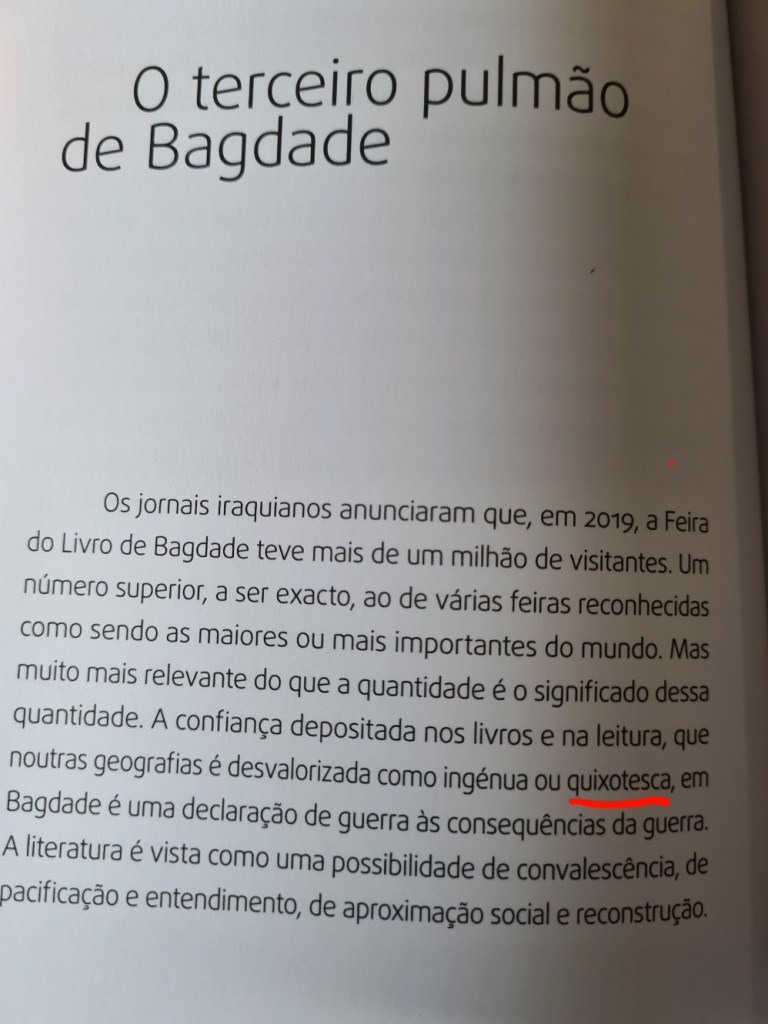
Reading a book this morning I came across an example of a word in the wild that I had never seen before
Quixitesco/a – meaning Quixotic. I believe the correct pronunciation is “key shot-esco”, based on hearing Booktubers pronounce the name Don Quixote and the only pronunciation quide I can find backs that up, although it’s Brazilian so there’s still a small shadow of doubt, but I’m fairly confident.
Anyway, it’s not exactly uncommon for me to spot new words in the wild, but I enjoyed this one so I thought I’d share!
By the way, the book is “O Vício Dos Livros” (addiction to books) by Afonso Cruz, one of my favourite Portuguese writers. His work is incredibly diverse, covering everything from children’s books to massive chunky tomes, but this one is very compact, neatly illustrated with short, digestible texts. The grammar is not too taxing, thank god, but the vocabulary is a bit harder so it’s a decent stretch read for a B1 or B2 student who doesn’t mind checking the dictionary from time to time. It’s also new, and very popular at the moment, showing up all over Portuguese bookstagram, and I am always, always on trend. 😉
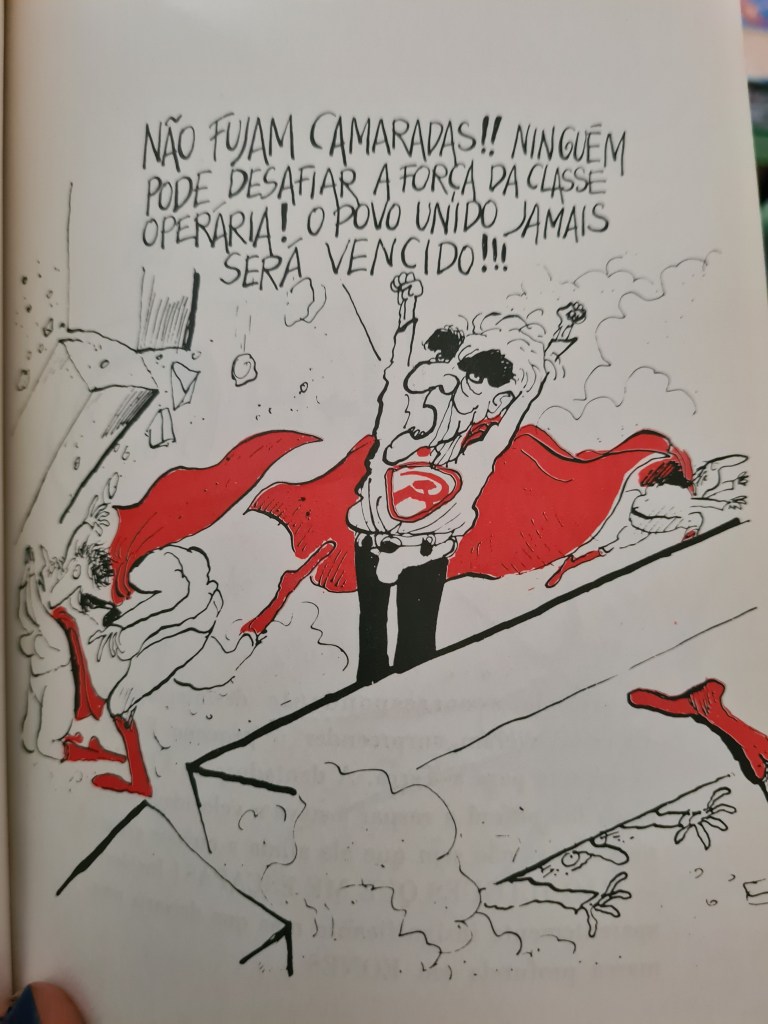
I’ve just written about O Superman, the satire on the career of António Ramalho Eanes. One of the things the book mentions is his visit to London where he does a typically Portuguese (?) thing: rearranging the cushion before sitting next to the Queen. I didn’t think much of this but you can actually see it happen in this video of the state visit.
Of course, the Queen is not scandalised by this and it doesn’t seem to be much of an issue. I don’t know why the satirist thinks it’s such a big deal but I guess it’s all grist to his mill, showing how uncultured and yokelish the president is that he’s never taken a ride in a royal carriage before!
The video is interesting (to me, anyway), since the announcer conveys the palace’s statement, putting forward Britain’s official stance towards the nascent democracy, which in a few short years had veered from fascism to a vanguardist, near communist junta, via a counter-revolution to a broadly left-wing government, ruling under a democratic constitution. So I’m glad to see they are recognising that process and trying to help it along.
I’m not sure, but I think we british play a larger role in the book. Early on, Cropcon, Superman’s home planet, is destroyed by a rival planet, which the author calls Brybton. Well, I don’t know what Brybton is meant to represent, but it sounds like “Britain” and “Bribe” might be contributing ingredients – in other words, the author reckons the military junta that acted as midwife to the democracy was unable to withstand the corrupting effect of international capital, as represented by England! I might be reading too much into that but it’s a fun historical factoid so I’ll enjoy it at least until someone tells me it’s wrong!
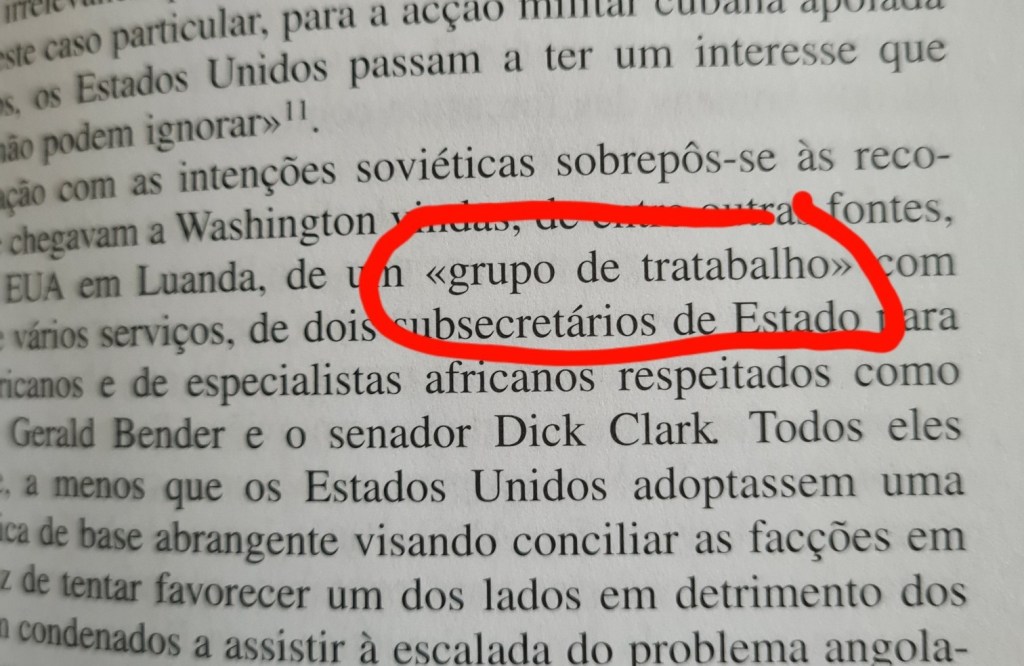
The quotation marks make it look like it’s a deliberate change so I was theorising it might be a combination of “trabalho” and another word like “tratamento”. I was curious because I thought the author was being sarcastic or implying something about their motives.
It’s not though. After a lot of hoo-ha, I finally found a copy of the English version in Google Books and it just says “Task Force”, so it must just be a simple typo. Annoying!
If you enjoyed the audiobook post a couple of weeks ago you might also enjoy this new YouTube channel started by Booktuber Silent Wanderer. It’s called Em Voz Alta and it’s looking to release two chapters per week of short stories read by Portuguese readers, many of whom I already know from their own channels. So far, they’ve finished O Principezinho (everyone’s favourite!) and they’re well into The Canterville Ghost.
Don’t forget, you can use the videos as audiobooks even if the screen is off by following the suggestions in my most recent post, Story Hour
One of the things that struck me after posting my list of audiobooks is that there aren’t many that are aimed at younger children, and if you’re a new reader that might be exactly what you need. I did check all the Portuguese children’s stories on Audible but with the exception of O Principezinho they were all Brazilian.
It seems like the best way to listen to stories for children is through videos. There are some on YouTube and some on the RTP Estudo em Casa site under “Hora da Leitura” (Reading Hour).
Here are a few lists you can tap into. If you want to listen to them as audiobooks, with the screen off and your phone in your pocket, there are a couple of settings you need to change on your phone, and I’ll put a video about that down at the bottom if you need it.
This one isn’t a playlist, but you can see the RTP Hora da Leitura videos here. Obviously, these are for home-schooling during pandemic lockdown so there’s a bit of discussion around each. If you’re reading this during a lockdown, consider watching them outside of school hours so as not to add to network traffic.
Obviously, you might be happy just to follow along with the video, especially since some of them show the actual text, or animations that can be good visual clues, but if you want to treat them like normal audiobooks, here’s a video that will explain how to set your phone up to play the audio only, even when the phone screen is off.
As regular readers (hey, stop laughing – I have regular readers! I do!) will know, I am obsessed with audiobooks, so I have been trying for a while now to compile a definitive list of all the european portuguese audiobooks available, so I have been through every single audiobook in Audible and listened to the accent and I’ve wrestled with Kobo’s completely useless search function to bring a few golden nuggets from among the grit. You can find them all here. I’ll add to the list as new ones become available. If you know of any I’ve missed, please let me know. I feel like I’ve been pretty thorough but I’m just one person and it’s a big internet.
There are affiliate links on the page, by the way: I’m hoping my obsession will pay for itself one day.
It seems like there’s a lot going on at Practice Portuguese, everyone’s go-to European Portuguese resource. The lads are now both full-time on the project as paid work, freeing up time for their non-paid work: dadding.
But even better, they’ve got a new app out that makes it easier to use their content on a phone. This could be a real game changer for a lot of people. At the moment it’s only in beta but I’ve downloaded it and it looks good.