I heard about this channel, Portuguese Dips the other day. There are some really good little snippets in there: little useful bits of language to pick up and spice up your spoken language, mostly. This for example isn’t really something I see often in traditional lessons but it definitely seems plunderable. A good one to add to your YouTube follows.
Category: English
Expressões da Natureza
Doing homework from the new book. Here we go with idiomatic expressions that have to do with nature. I’ll skip all the obvious ones. Tirar o cavalo da chuva is in there for example. It’s an old favourite but I’ve mentioned it about a hundred times already.
- Frio de rachar – splitting cold. Very, very cold.
- Arranjar lenha para se queimar – to gather wood to burn oneself. Basically to create difficulties for yourself
- Chamar-lhe um figo – To call something a fig. To eat /serve something you really like. Can also mean that you covet something.
- Mandar à fava – to send someone to the bean. To send someone away or make it obvious you want them to get lost
- Com a cabeça na lua – with one s head in the moon. Equivalent to “with one’s head in the clouds” in English
- Mandar às urtigas to send someone to the nettles. To treat something as unimportant
- Sol de pouca dura – Sun that doesn’t last long. Something good but transitory
- Ter névoa nos olhos – To have fog in one’s eyes. To have blurred vision. This can be used both for the literal blurry vision but also figuratively when you don’t understand something
- Aos quatro ventos – To the four winds. In all directions – just like in English, if you scatter something to the four winds.
- Estar com um grão na asa – To have a grain in the wing. A state of mild euphoria or tipsiness
Burn, Lion-Tamer, Burn.
I came across this just now on Priberam and I love it. Apparently if you are enjoying a bust-up of some kind you’re “letting the circus catch fire”.

An Unlesson
I’ve just had a meeting with a Portuguese teacher who I thought was doing something interesting. Her name is Catarina and she runs The Language Unschool.
If you hang around the various online forums where Portuguese learners congregate, you’ve probably come across a lot of teachers looking for new students among the pool of curious, interested, potential learners who are trying to figure out where to start. The teachers usually have YouTube channels with a range of topics new learners are interested in: how to watch subtitled TV, how to use Ser and Estar, how to say the days of the week and so on, and they use that to draw in paying punters.
Catarina was fishing in darker waters though. She contacted me via Reddit after I’d already been writing in WritestreakPT every day for a few weeks and invited me for a free consultation. I liked the sound of the school. The package has a few components: a smartphone app, grammar videos, group sessions activities that aim to draw out people’s Portuguese voice and getting them talking. She seemed very switched on and presented the options well.
She’d really made an effort to demonstrate her personal touch too, because she’d looked at some of my recent posts, where I’ve talked about my January yoga binge and she’d actually teamed up with a local yoga teacher and made a video about yoga in Portuguese, released on the day she contacted me 👇
As a piece of entrepreneurship, it was impressive. I felt like she was making an effort to win me over as a customer: where most teachers aim for broad appeal, she seemed to be aiming for a specific niche. That’s how it felt anyway: the approach, the description, even the pricing structure, all seemed to be tailored to suit people who had already made up their mind to stick at it long term.
Anyway, I tried out the yoga video yesterday morning . I had to turn the subtitles on because I couldn’t hear very well but the inbuilt YouTube subtitles have a black background. That created some unexpected humour, because at one point the teacher got down on the floor and… And then I couldn’t see her any more! It looked like she’d had a sudden attack of shyness and decided to hide behind the subtitles, which made me laugh out loud. Anyway, if you fancy giving it a go, maybe play with the video settings and see if you can change the subtitles so they don’t have a background.
As I’ve said in some previous posts, doing workouts in Portuguese is a good way of learning some of the more niche body vocabulary and you’ll get a decent stretch out of it too, so what’s not to like?
I’m still pondering whether to go for the course. I’ll sleep on it. I definitely like the idea, and I need something to boost me towards spoken fluency, but I’m not sure how it fits into the rest of my life. Also, with the third world war around the corner, maybe nothing matters any more.
Hm, got a bit dark there at the end, didn’t it? I caught a glance at the news. Sorry.
A2 Exam Help

Cheating in an exam isn’t something I’d ever encourage, but if you’re going to cheat, you need at least to be sure that the person whose answers you’re copying knows more than you. So we can only envy any would-be cheater who was lucky enough to be sat next to Liz Sharma in the A2 exam and managed to peep over her shoulder when she wasn’t looking. Liz is the host of Talk The Streets, the popular YouTube series and she recently took the exam as part of a citizenship application and vlogged about it. Anyway, I know one of the most frequent questions I get is about where to find exam resources so I am officially designating this video as pretty flipping useful. A lot of what she says backs up what I said in my previous posts about the form of the exams but she’s obviously much more advanced than I am now, let alone how I was when I did my first exam. That means she’s got a bit more detachment from the stress-factor, which allows her to be cool and calm about the advice she gives, whereas I think my blog posts probably read like someone who has just escaped from being held hostage!
Feliz Dia Dos Namorados
On reflection, I wish I’d saved that Andre Ventura Dating Simulator post for today. Anyway, if you’re planning on whispering sweet nothings into someone’s ear today, make sure you do it in Portuguese.
Course Review – Portuguese for Foreigners, Level C1
Here’s my review of the Portuguese for Foreigners Online Self Study course for level C1, also known as DAPLE, offered by Camões Instituto da Cooperação e da Língua. I finished the course on Saturday so it seems like a good idea to get it out of my head and onto a blog post while it’s still fresh.

The Instituto offers courses at all levels of the CAPLE framework from A1 (beginner) to C2 (God-mode). It also caters for different kinds of packages: this review is just the self study option, but for a further €140, I could have gone the de luxe route and added some tutor interaction. See here for more details about the options. I haven’t done any of the other courses so I don’t know whether or not my opinion of this one applies equally to the whole range. I mean I guess so, but who knows?
The obvious attraction of doing a course created by the organisation that designed the exam curriculum, is that you’re getting it “straight from the horse’s mouth”. You know that they will be teaching subjects the exam board think are important at this level so there’s a good chance they will come up in the exam. That’s great, and I think it’s undoubtedly one of the strongest selling points of the course: it gives you a road map of what you need to know. And it doesn’t just teach you about grammar and vocabulary, it tries to weave those together with the major themes you need to know about. The topics for each of the twelve units are
- Ourselves and others – interpersonal interactions
- Carpe Diem – enjoying free time
- A healthy mind in a healthy body
- From the field to the city – different ways of life
- Thinking about the future – training and professional development
- Giving new worlds to the world – immigration and emigration
- Science and religion – allies or enemies?
- New information technologies – solitary closeness and collective isolation
- Portugal and my country – festivals and traditions
- Portugal and the arts
- Portugal today
- Portugal and the world
I think the course is definitely worth doing for this reason alone: insofar as learning a new language entails learning about the culture, the place and the people, it’s useful to have someone walk you through how Portugal sees itself and its place on the world. Whenever I see lessons about Portuguese culture it tends to be Fado, recipes for cod, o Galo de Barcelos, and all that tourist-friendly stuff. Interesting, no doubt, but this course gets down into how trust works in neighbourhoods where shopkeepers know their neighbours and extend credit where it’s needed, and what is it that makes such trust possible; the migrant experience and the role of Portugal and its former colonies in the wider world. In other words, it goes deeper. It also gives you tools to be able to describe challenges that all countries face, like the rise of social media, the decline of religion and the challenges of international cooperation.
How does this map onto the exam itself? Well, the cultural knowledge will come in handy in the fourth (spoken) part, which seems to be where you’re most likely to describe your knowledge of some cultural or social trend. Even though you’re not speaking in the course, you’re getting used to thinking about the ideas and making use of the vocabulary.
As for the other three sections*, there are audio/video components that are going to be useful in developing your listening skills for the aural comprehension. It’s far, far easier than the aural comprehension section of the exam because of the time available and the relatively simple questions you’re asked, so don’t get lulled into a false sense of security. Likewise, the written comprehension is quite a bit easier than in the exam. OK, the way I’m talking, I expect it sounds like I got full marks and I definitely didn’t, but I feel like I lost more marks through carelessness than because I was unable to interpret an ambiguous or tricky question.
When it comes to the written work, there are some exercises based on grammar but they’re quite minimal. Each new structure it introduces is covered in a very basic way and the students is only really expected to do one question for each, which isn’t really enough to push it into your long term memory.
So summing up: It was €180 well spent, but it’s not a perfect course. But I could have guessed that. No one learning tool is ever going to tick all the boxes and we always need to look at multiple sources. This one has no speaking component, but I could have got that by signing up for the premium course. Or I could use an online tutor on a site like italki or Polytripper or even just ask around on one of the many Facebook groups for Portuguese learners like this one (European only but heavily moderated) or this one (freer and easier but includes Brazilian Portuguese). It’s a little weak on grammar, but that’s what exercise books are for, and a book won’t mark you down if you accidentally make a typo or if spellchecker changes your right answer to a wrong answer. The book I’m about to start using (Português Outra Vez) doesn’t have any audio component but it’s very text-heavy so I’m expecting it to be able to boost my grammar levels up a notch or two using it.
So if you’re considering going in for one of the exams, definitely consider one of these courses as a sort of route map, but don’t make it the whole of your learning plan: be prepared to take notes for further study afterwards. You’ll probably need it.
Oh and one more thing: if you do it, do it in your browser. Don’t bother with the app.
*=If you haven’t already taken an exam, have a look at one of my descriptions of the exam process for more background on what is in each section. Here’s the B1 exam, for example.
Panic Over
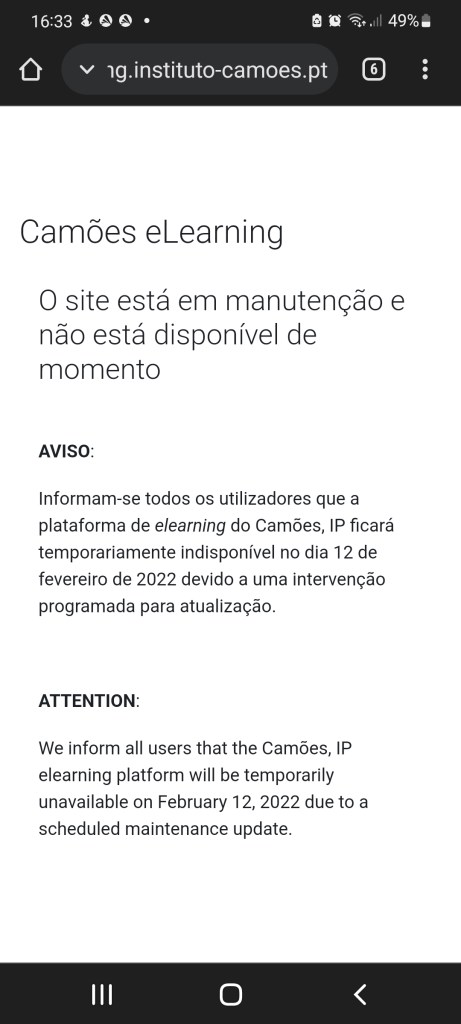
The site came back online and I’ve finished the course now.

Nãoooooooooooo!
I WAS PLANNING TO FINISH IT TODAY!!!!
My Dinner With André
I’ve been having a whirlwind romance with Andre Ventura, the Nigel Farage of Portugal. It’s taken my breath away.
It’s all thanks to a game called André Ventura Dating Simulator.

It’s a pretty simple game that starts with the player being rescued from a car crash by Ventura and exchanging phone numbers. It then takes you through a series of days in which you can work to earn money, go to the shopping mall, or call your man to go on a date. At the mall, you can buy accessories for your Ventura, such as sunglasses and hats. On the dates, you can chat, question his choice of venues, and deal with various enemies who appear, such as gypsies and antifa members. You can play as yourself, although if you are a male it’ll send you away with “Bro, sai daqui. O André Ventura não gosta de paneleiros”. That sets the tone, really: the game is sending up his actual attitudes so it warns you right at the start to expect racist, sexist and homophobic language throughout.

Playing games is, of course, a bit silly, but we can’t study vocabulary all the time. Most of us have apps on our phone that we use to pass the time on lunch breaks or on public transport, so having a Portuguese game to play is good way to keep your brain in Portuguese mode without a huge commitment of energy. I doubt this one is going to be an addiction because the joke is bound to wear thin after a while but I’ll play it a few times and see where it takes me.
 Luso
Luso 