Some examples from the book I’m using, with idiomatic expressions relating to clothing. (Roupa). Example sentences are difficult if you’re working on your own because of course there is no model answer to check so I am just shamelessly posting them as my daily text on writestreakpt
Diz-se que o ex-ministro dos Negócios Estrangeiros recebeu luvas com origem na Rússia. (Receber luvas = take a bribe)
A crise financeira provocou desemprego no Sul da Europa portanto os cidadãos tiveram de apertar os cintos. (apertar o cinto = tighten one’s belt)
A Rebeca é uma verdadeira mexeriqueira que corta sempre na casaca de alguém de que não gosta. (cortar o casaco = talk smack about someone)
Os meus amigos trabalham na Televisão Estatal e quanto à realização de programas, sabem as linhas com que se cosem. (saber as linhas com que se cose = to be expert in some skill)
À beira do Douro, em Vila Nova de Gaia, estão localizadas as famosas caves do vinho do Porto onde se encontram garrafas de se lhes tirar o chapéu. (ser de se lhe tirar o chapeu = to be worthy of taking one’s hat off to)
Estou num beco sem saída. Preciso de descalçar esta bota (mistura de metáforas!) (descalcar a bota = resolve a problem)
O bisavô dela foi fazendeiro em Minas Gerais. Era trabalhador e gastava pouco pelo que conseguiu juntar um belo pé-de-meia. (juntar um pé de meia = save)
Não gosto de amigas com língua-de-trapos. (língua de trapas – a malicious gossip – someone who might cortar o casaco de alguém, in fact!)
Another translation post. I’m in a translatey mood, I guess. This one is by Orelha Negra with A Garota Não (again!) on guest vocals. Like yesterday’s, it has a strong feminist theme, but whereas that was just calmly wishing for more representation, this one is about domestic violence so it’s pretty raw: far moreso than I would have guessed from the general vibe of the music. Batida can mean beat in the musical sense as well as “beaten” or “beating” in the violent sense, so I think I had an idea that it was jsut a song about making music until I started trying to translate it line by line.
To be honest, it comes across as pretty bleak, but I don’t think it’s *just * that: there seems to be sense of wanting to move beyond the situation and reassert dignity. For a start, you have the dialogue at the beginning and the end of the song in english, talking about being ready for something. Then there’s the woman who does the live painting in the video (below). She’s called Mázinha and she’s obviously got a positive sense of the song being about forgiveness and redemption (quote here) so she’s painted a really upbeat image, indicative of a new start – presumably after leaving the dude. There isn’t much of that in the song lyrics though, as far as I can see!
E tu tás pronto, honey? / And you – are you ready honey? Estarás pronto para ver / You’ll be ready to see Como é que a cor da batida fica na mulher / How the colour of a bruise looks on your woman Ela não é santa / She isn’t holy Só um santo para o ser / Only a saint for being it Como é que esses argumentos servem pra bater / How these arguments lead to beating
Cala esses demónios / Silence those demons Já te podes perdoar / You could forgive yourself Não levantes essa mão se não for pra lutar / Don’t raise that hand unless it’s to fight Por um dia mais claro / For a brighter day Por um tempo mais doce / For a sweeter time Não trocava um abraço p’la jóia que fosse / She didn’t exchange an embrace for any jewel
O tamanho da mini saia / The size of a mini skirt É inverso a essa cobardia / Is the inverse of that cowardice Se não aguentas a mulher que tens / If you can’t stand the woman you have É porque te fica em demasia / It’s because she’s too much for you
O tamanho do sorriso dela / The size of her smile Não precisa de autorização / Doesn’t need permission A liberdade é um barco à vеla / Freedom is a sailboat E o amor não é uma prisão / And love is not a prison
Liberta logo esse ciúmе amargo / Just let go of that bitter jealousy Porque o ciúme deixa o Homem bruto / Because jealousy makes a man brutal Já nem sequer vês o mundo direito / You don’t even see the world clearly Mas tu és o teu próprio instituto / But you’re your own boss
Quantos deuses / How many gods É que o medo cria / Does fear create Semear a morte / To sow seeds of death Sangue à terra fria / Blood in the cold ground Desce mais um corpo / Another body falls A história é igual / The story is the same Quando os cintos dançam / When the belts dance Chora a catedral / The cathedral cries
Quantos deuses / How many gods É que o medo cria / Does fear create Semear a morte / To sow seeds of death Sangue à terra fria / Blood in the cold ground Desce mais um corpo / Another body falls A história é igual / The story is the same Quando os cintos dançam / When the belts dance Chora a catedral / The cathedral cries
Here’s a translation of “Que Mulher é Essa” by A Garota Não, because why not? I think it literally comes out as “What woman is that” but I’ll translate it as “Who’s that woman” because it sounds better in English.
Que Mulher é Essa
Que mulher é essa /Who’s that woman Que eu vejo na telenovela /That I see in the soap opera? As mulheres à minha volta /The women around me Não se parecem nada com ela /Don’t look anything like her.
É só mulher sexy /It’s only a sexy woman Que desliza quando passa /Who glides by A coxa* não entra /No lame woman appears E se entra é pra dar graça /And if she does its only as comic relief.
Que mulher é essa /Who’s that woman Que eu vejo na publicidade /That I see in the ads Será que as feias /Do the ugly women Vivem todas na minha cidade /All live in my town?
Só mulher bonita /Only a beautiful woman Todas altas e esguias /All tall and slender E só entra a gorda /And the fat woman only shows up Para perder calorias /To go on a diet
A preta não entra /The black woman doesn’t appear A baixa não entra, não /The short woman doesn’t, no A velha não entra /The old woman doesn’t appear A torta não entra, não /The disabled** woman doesn’t appear, no Quanto talento gasto em vão /How much talent is wasted?
Que mulher é essa /Who’s that woman Que desfila lá na passarela /That parades up there on the catwalk Nunca há-de entrar na moda / It will never be fashionable O pé descalço da Gabriela /To have bare feet like Gabriela
Só mulher com estilo /Only a woman with style Com glamour e muito brilho /With glamour and lots of polish Toda a roupa assenta /Whose clothes all fit Só à gente é um sarilho /We’re the only ones with problems
Que mulher é essa /Who’s that woman Que aparece tanto na revista /Who’s in the magazines so often Três folhas só de fotos /Three pages of nothing but photos E um cantinho de entrevista /And a tiny corner for the interview
E o que é que importa..? /And what does it matter? Quem quer saber do que fala? /Who wants to know what she talks about? Muito mais importa /It’s much more important Que vestido leva à gala… /What dress she wears to the gala.
A preta não entra /The black woman doesn’t appear A baixa não entra, não /The short woman doesn’t, no A velha não entra /The old woman doesn’t appear A torta não entra, não /The disabled** woman doesn’t appear, no Quanto talento gasto em vão /How much talent is wasted?
*Coxa usually means thigh but I think the sense here is the feminine form of “coxo”, which is defined as “pessoa que coxeia” – a person who limps. So I have opted for “a lame woman” which I hope is what she meant!
**Torta, in this context, is a bit confusing. It means twisted or bent, and priberam gives a few informal meanings including rowdy, cross-eyed, disloyal. I’ve also seen twisted in the sense of having a crooked face after local anaesthetic at the dentist, so possibly someone with an asymmetrical or disfigured face…? I originally published this with the translation as “twisted” but I’ve edited it subsequently because some people I spoke to on reddit indicated that we’re supposed to picture someone whose bones are deformed in some way and who essentially has some form of physical disability or impairment.
I wrote a short text about speaking. Thanks to csc_3 for the help with this one.
A minha cunhada visitou a irmã dela ontem, o que me deu oportunidade de falar português. A minha mulher costuma* falar inglês em casa, mas quando a família se junta, a conversa passa para português. Falei bem (na minha opinião!), mas estou consciente de ter feito** alguns erros de concordância e tal. Preciso de falar mais.
*dammit, I seem to have some sort of weird mental block about whether to write “costuma” or “customa”
** Hm, when I originally wrote this, I was trying to say “I was conscious of making errors” while I was speaking but by the time the corrector finished straightening out the grammar it said “I am conscious of having made errors” which is also true but I was trying to describe my feeling of self-consciousness in the moment so the meaning has changed slightly.
Portuguese people be like…
I think this lack of speaking practice is a problem I really need to get hold of. As I said a while ago, when I was feeling gloomy, speaking another language is a challenge when you’re an introvert who doesn’t really live for conversation in any language. But I need to make the effort to find a place to get some serious speaking time.
Here’s a joke you can use at parties if you want people to look at you with a baffled, pitying expression:
Hoje em dia, os cães são autocolantes mas antigamente, se quisesse prender um cão numa parede ou seja o que for, teria de usar Cola Cão
Cola = glue and Cão (with an accent) means dog so I’m reading this as dog glue, even though I know it’s a brand of hot chocolate powder and Cao is short for Cacau. The joke is just riffing off the idea of what you might use dog glue for.
It doesn’t work because Cao is pronounced differently from Cão. More like “Cáu”. Apparently it took a couple of reads to even see what I was driving at. Disappointing. I was quite proud of it.
I did one of my occasional sweeps through the audiobook sites, on the lookout for new titles in european portuguese and I have managed to add about ten new ones to my audiobook page. The one I’m most excited about is this 👉 O Último Ano Em Luanda (The Last Year in Luanda) by Tiago Rebelo , but there are quite a few others, including a couple of new freebies.
I’ve rearranged the page slightly too: Bertrand is further down the page. I like the fact that they are a specifically portuguese outlet but the sad fact is that their collection hasn’t grown much. Neither has Audible’s. Why, Audible? Why must you torture us lusophiles? Kobo are smashing it though! They have added a few new ones, including some shiny, recent releases that have gone straight on my wish list. So I’ve moved Kobo right to the top of the page and I’m fully recommending that if you are serious about listening to european portuguese audiobooks, that’s the app you need!
Netflix announced another Portuguese series had gone into production a couple of weeks ago. That will bring the number of specifically European Portuguese offerings to a measly three, but it’s a good sign that they are following up the success of Glória and I’m hoping for more to come. The name of the show is “Rabo de Peixe” (Fishtail) and its set in the Açores. Here’s the teaser trailer below.
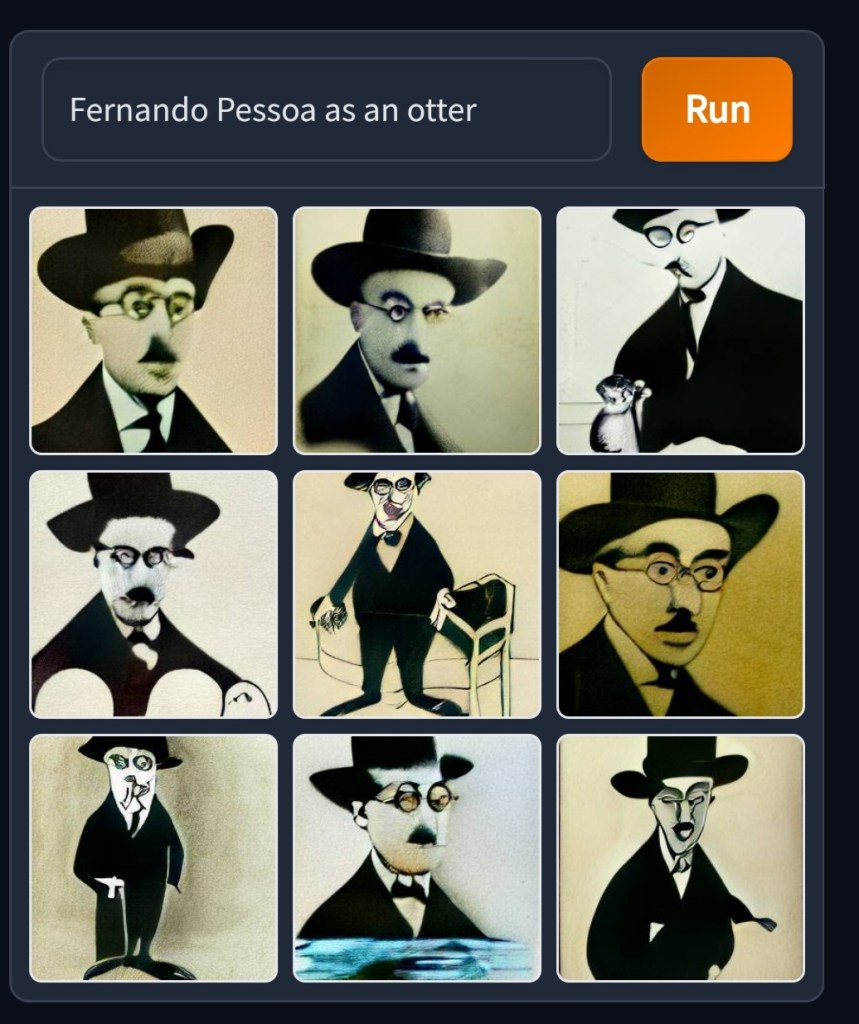
Like a lot of people, i have been playing with Dall-E. This one surprised me. I was a bit worried it wouldn’t know who Fernando Pessoa was but it turned out it didn’t know what an otter was
Fernando Pessoa as an Otter
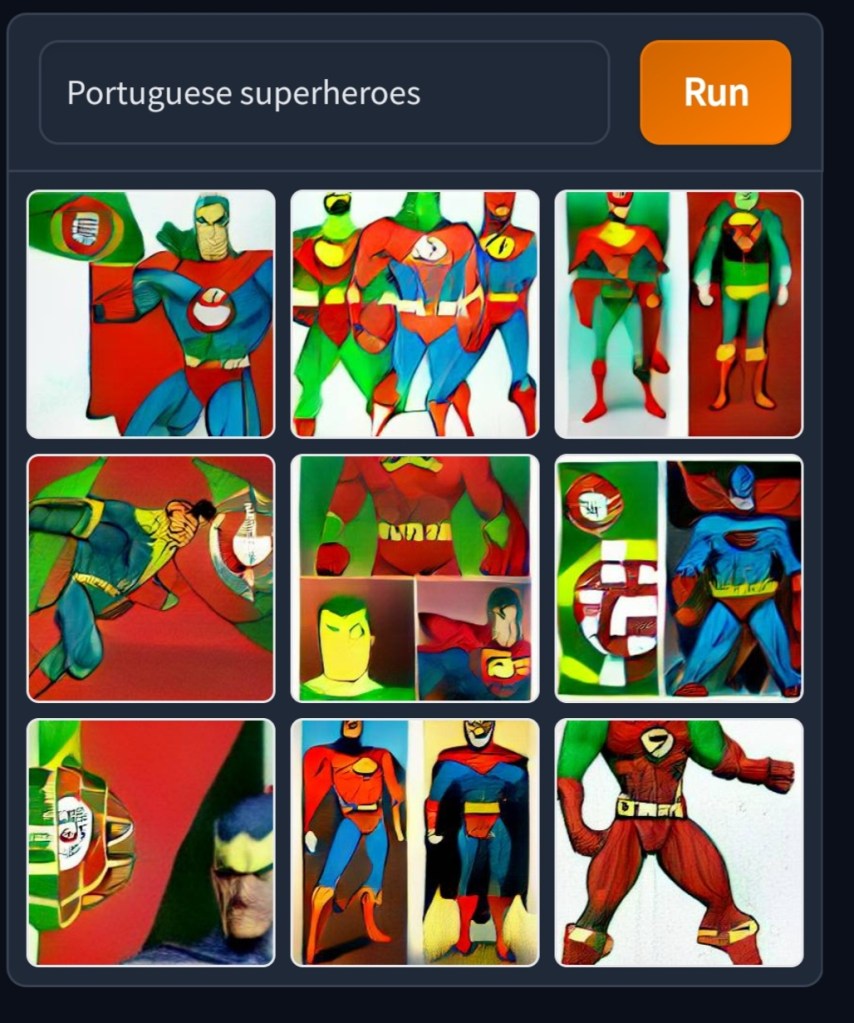
And here’s one where the Justice League all have the same super-power and it’s just knowing the colours of the Portuguese flag.





 Luso
Luso 