Hey, I didn’t tell you about my trip to Islington to see Manuel Cardoso’s gig, did I? I should do it in Portuguese, really, but my brain is still broken and I’m still feeling pretty terrible with the… cold or the sinus infection or whatever it is, so I’m going to take the coward’s way out and write in english instead.
The venue is called The Bill Murray and it’s near The Angel, one of my favourite parts of town, behind the Union Chapel. You have to get off Essex Road and go down a few very boring roads to get to the actual spot though. It’s like a small pub with the back room converted into a venue that holds maybe a hundred people on small chairs around a low square stage about five feet by five. I got there quite early and sat down at the side of the room, but it started to fill up and I moved to allow a couple to sit together. That left me in one of the only remaining empty chairs: right at the edge of the stage where I could reach out and touch the mic stand if I wanted to. I could hear people talking english, including the announcer. I started thinking, well, I guess the show’s going to be in english. Disappointing.
It wasn’t though! As soon as he came on, he started in portuguese, but he read the room and asked “por palmas” , (by round of applause) how many portuguese people were in. Then he asked had anyone brought a non-portuguese friend with them who didn’t speak the language. A few boyfriends were pointed at and raised their hands sheepishly. There might have been a few who had come on their own and didn’t even understand the question but we’ll never know. Anyway, he told them they were in for a rough ride and gave them a joke in english – an off-colour gag about Ronaldo – and then went back to his routine. I was really, really close to where he was standing and I felt a bit self conscious. If I looked completely baffled I was going to stand out like a sore thumb at that range, so I made sure not to let my expression go slack at any point.
I actually understood most of it though, thank god. Obviously, he was talking fast, using a lot of slang, and talking about things that would only make sense if you were steeped in the culture, so there were definitely gaps, but I laughed extra-loudly at the jokes I actually got, partly because they were funny, and partly because I was so happy to have understood them. I was especially glad to get the ones that made reference to pop culture memes: “My sex life is like Leiria. It exists, but it’s not that amazing” for example. Or politics “João Galamba was found to have weed in his house… well, at last we have a politician ‘sem filtro'”.
Sometimes, I got the words but not why it was funny. Like there was a stretch where he was pretending to be a lovestruck man talking to his girlfriend on the phone and I laughed at alost every protestation of love he made, but one of the compliments he gave her was that her breasts were like chips ahoy cookies. Er… OK…
Other times, I totally missed the reference. Like, at one point everyone in the room did that sort of wincing laughter, you know, when someone makes a really near-the-knuckle joke. He was already doing a routine about kidnapping children, which I wasn’t really vibing with, but people seemed to be enjoying, but he said something about you can’t just walk into the Hotel da Luz and steal a baby. “Now, the Praia de Luz, on the other hand…” I didn’t get it straight away but obviously should have guessed it was a Madeleine McCann reference. That’s an example where you’d probably laugh from the shock value if the timing was right, but if you’re on a slight delay while your brain processes it, the effect is lost.
The whole thing was over pretty quickly: started at 6.30 and finished by 7.30. I really enjoyed it though, and I definitely want to do this again. I must follow more comedians on instagram so I can see when their tours are coming up.
I mentioned a while ago that I was starting the Say it in Portuguese CAPLE Exam Prep course. I thought it would be worth taking a really focussed course to try and get myself match fit instead of winging it. In case anyone is in the same boat, thinking of taking it for a future exam, here’s what it’s like:
The course took place over 4 weeks because that’s how long I had from enquiring to the date of the exam. Following an introductory meeting, Cristina offered a range of three options, based on what I said my weak points were. There were different levels/prices, depending how much support I wanted and I went with the middle one. I won’t say what the prices were in case it’s a trade secret, but I’d definitely call it very good value.
As you might already know, there are four sections in the exam*, and I felt reasonably comfortable with the reading comprehension but decidedly iffy about some of the others, so the really important stuff for me was in the form of four weekly drops of one sample paper from the written part of the exam and a recording and set of multiple choice questions from the aural comprehension section. I completed them in my own time and emailed them back. Very detailed feedback would then arrive the following day for me to work through.
On Fridays we had an online meeting where we’d go through some of the homework feedback and also did a simulated parts 1 and 2 of the “produção e interação orais” exam format. Mistakes made in the meeting would prompt more feedback via email, including actually recording the lesson and doing a step-by-step feedback recording that I could listen to and hear my mistakes.
Cristina does other courses and she’s also host of one of the earliest portuguese podcasts, so she’s an experienced teacher, but I think I was one of the early adopters on this specific DAPLE course, and there were a couple of teething troubles – a few typos in the questions – which I fed back and will no doubt have been corrected by the time the next person takes the course. In the post-exam debrief, I also suggested she might change the order the aural papers were given in, since I think the first one was a real past paper and the later ones were close simulacra. They were very good recordings and sounded almost exactly like real exam questions, but the questions were a tiny bit less ambiguous and tricksy, so I thought maybe it would be better to start with those and finish on the real past paper.
The course definitely boosted my confidence and helped me approach the exercises in a more controlled, less panicky way. Yeah, the exam could have gone better, but it could have gone worse too, and it definitely would have if I hadn’t done the course! I would definitely recommend it to anyone planning on taking a CAPLE exam, especially if you’ve never taken one before and are not familiar with the format.
Yesterday was the day of the DAPLE (C1) exam. Usually when I do one of these exams I write it up straight away, but I’ve left it till the next day because I was feeling a bit miserable. It all went a bit piriform, I’m afraid. Let’s take it step by step:
I arrived at the embassy half an hour early. Better than half an hour late, I suppose, but they don’t open the gates till nine. No exceptions. Even when their own staff arrived the secrity guy wouldn’t answer the buzzer till nine sharp. I was in need of a wee, and I had a congested nose, so being out in the cold did not help at all. And then a brazilian and a…. venezuelan(?) guy arrived and started speaking spanish. I tried to ignore them. I don’t need to hear spanish today, lads!
When we were let in, she showed my to a nice reception room – much nicer than the noisy, echoey office the exams have been held in previously. I was the only student there, so I was just sat at a table, with the invigilator about fifteen feet away at a different table. My face was bunged up, I had to breathe through my mouth a lot of the time, and I had to keep blowing my nose noisily.
The Compreensão da Leitura went well. 90 minutes, 60 marks. There were some extracts from articles about modern life: an overview of the work of António Damásio and a missing paragraph exercise based on a story about how portuguese kids coped with remote learning during lockdown. The missing paragraph thing is quite annoying: it soaks up a lot of time for only 5 marks. I was worried that I was behind schedule but of course it was fine: The last 40 marks are fill-in-the-blank questions, which are much quicker than the ones where you have to read the text, so you don’t have to be strict about hitting one mark every minute and a half. It was definitely challenging, but I had done the preparation and I reckon I got most of the marks.
Break. Water, toilet, blow nose, eat a square of chocolate, suck a menthol sweetie.
Next came the Produção e Interação Escrita. 90 minutes, 3 exercies. I found myself getting writer’s block at first, suddenly doubting my spelling of almost every word. I wrote a formal letter to the local council, telling them they shouldn’t close the library, recycling as much from the question itself as I possibly could.
Next up was a discussion stemming from this article from the Expresso (the section beginning “O problema não é a ansiedade dos jovens quanto o futuro…”). I decided to branch off in the middle and talk about George Bernard Shaw’s novel “Back to Methuseleh” which takes as its premise that if you could only extend the human lifespan to hundreds of years then everyone would suddenly be incentivised to really work at dealing with entrenched, long-term social problems. This seemed like quite a fun diversion: the trouble with always having to write about environmental issues is that it can feel a bit preachy, so I was glad I made it more interesting. Generally, if you bore the marker they are less likely to give you the benefit of the doubt. With hindsight, I think I might have confused some of the plot points with “The Trouble with Lichen” by John Wyndham, which is also about extending human life, but never mind; I doubt the marker will have read both, so I think I’m pretty safe.
The third of the three exercises was the usual mechanical rewriting of sentences into different forms: passing direct to indirect speech, switching in and out of subjunctive and using gerunds. I’ve done a shit-ton of fiddly grammar exercises lately in Qual é a Dúvida: about a hundred pages of them, in fact, so I felt really confident about my answers. Done, dusted, 5 minutes left over, so I skimmed the first and second texts, strafing the errors. Some really stupid ones! Probably saved myself about ten lost marks there.
Break. Water, toilet, blow nose, eat a square of chocolate, suck a menthol sweetie.
Hey, well, it’s all going well so far right, as the optimist said as he fell past the thirteenth floor.
Next up was squeaky bum time: the Compreensão do Oral, which is always everyone’s least favourite. It’s 40 minutes and 25 points. I have done six of these for practice recently and was starting to feel quite confident, so I just tried to stick to my new system and keep a cool head. I couldn’t though – I felt like I was swimming around in a sort of soup of words. And the questions were really ambiguous too, For example, there was a passage about the rehabilitation of the Iberian Lynx (I can’t find the exact recording but here’s a podcast that deals with the same situation). At one point he talks about a kind of rabbit called the Coelho Bravo which he said was essential to the Lynx because it was so specialised that the Coelho Bravo was “almost its only food” but he didn’t say what else it ate. The answers included one that just said it was “essential” and one that said it was essential because it was the lynx’s “only food”. I didn’t like the first because it’s not specific enough about why the rabbit is essential, but the second seemed to be overstepping the mark so I played it safe and stuck with the first.
Then there was one about wolves in portugal (I’ve listened to an audiobook about them, but it didn’t help much I’m afraid), a section from this interview with the author of a book called “Adeus Futuro”. The invigilator told me afterwards that even she couldn’t answer the questions for this section (cool cool cool cool cooooool).
And finally an interview with friend of the blog Marco Neves. I’ve read one of his books, actually had another of his books on order at the time, and I once did a course he taught so I have a pretty good idea of the way he thinks. And Ainda bem, because the fourth question in the section was about a specific word – I can’t remember what it was but it began with “des” and the question was about whether the des- was there to reinforce the root word or contradict it. I didn’t catch it the first time around so I listened out for it really carefully the second time and I swear, dead ass, as the young folk say, that he didn’t bloody say it. I mean, I know he must have, but I didn’t hear. I made an educated guess, but I dunno. I was gutted. I’ve been scoring 17-20/25 lately and I’d be surprised if I got 15 in this. Horrifying.
Break. Water, toilet, blow nose, eat a square of chocolate, suck a menthol sweetie, say, when asked how I am, that I just want to die.
The final part of the exam is the shortest, but it’s quite nerve-wracking because it’s recorded on video: Produção e Interação Orais. 25 minutes, and you’d think it would feel like hours, but it doesn’t, it feels like about twelve seconds. With hindsight, I wish I’d written some reminders to myself on a card about controlling the rate at which I speak, and slipped it into my backpack. so I could have read it before that part of the exam and refocus my thoughts before the real thing.
Again, I’d spent quite a bit of time preparing for this and I had developed an apresentação which I hadn’t memorised but reckoned I could use all or part of in talking about myself. Weirdly, though, she didn’t really give me much room to expand on my answers. It was just Where were you born, where do you live now, how long have you lived here, how long have you been learning portuguese and a few other things. I even got cut off if I said too much. Gutted! I’d been prepared to give my silly discussion of running in the park, talk about the books I’ve read and maybe even get into talking about the comedian I’d seen on the previous evening, but I didn’t get a chance. My answers were fine, but I thought this would be my chance to shine and it wasn’t.
Me trying to finish my Apresentação before embrassy security throws me out in the gutter
The next part of the interaction is a visual prompt and I was handed most boring picture in the world, with two men and a woman sitting at a desk and almost no other objects visible in the shot. I talked about meetings and how a lot of work meetings were happening online now, and how I quite liked that as an introvert. I did some light-hearted banter about what it’s like when you’re trying to write an email and someone says your name but you have no idea what they are asking you because you weren’t listening. Not exactly comedy gold but it was reasonably grammatically correct. I suspect there were a lot of Umms in there though. I hadn’t quite filled the time, so she gave me a follow-up question: did I think there was a gender pay gap in the workplace. Oh shit, I thought, was that what I was supposed to talk about? Women in the workplace? Oh well, I started saying it depended on the specific company and that in my industry, social services, women were really well represented in senior positions, but that was as far as I got because we hit the time limit again. Probably just as well, really, I don’t normally want to give pat answers so I think I would have got into lifetime earnings after that and come a cropper on the vocabulary.
Lastly, we had to do an interaction about starting an export business. Normally, you’d do this with another student but since there weren’t any, it was me and the invigilator, with a third person taking notes. Why did they need to take notes when it was all on camera? I dunno.
The scenario was that I wanted to export olive oil and she had to persuade me to export cork instead. Wha’? What do I know about the relative profitability of those things? I didn’t really follow the sequence properly and kept fighting my corner even though the script said I was supposed to agree with her in the end. I finally took the hint but I was in the middle of saying that my wife has lots of bags but she doesn’t have one made of cork, so I turned on a dime and said that, now I thought about it, maybe I’d but her a nice cork bag. Except I started a clause with “talvez”, and the subjunctive circuits of my brain creaked into action, creaked to a halt again and I remember really clearly hearing myself entone in slow motion… “de…ver….ia…” and knowing it was wrong but just feeling so out of control at this point that I didn’t even try and correct myself. Feck.
They stopped the tape and asked me if I felt it had gone well and I said no, definitely not and I stood up. They asked me some more things while I was gathering my pens, stuffing menthol sweeties into my mouth, nose and ears and wriggling my coat on. I coudn’t even string a sentence together. At one point, I turned to them both and said “Juro que falo melhor do que…” and then couldn’t even think how to finish the sentence. Oh well, the recording had stopped so whatever.
I had lunch in Comptoir Libonais, then home, where I watched a movie and had some more nice food. First booze in months, too, but I’d earned it. Nose still streaming. Finished the rest of the menthol sweeties. Oh and there was a parcel. It was that Marco Neves book I’d ordered. God is mocking me.
Well, I guess it could be worse. There were some real low points but it could be a lacklustre pass. I’m not even pausing, I’m going to set my sights on DUPLE in May and start work now. I know I’ve said this many times before, but I absolutely have to talk more. I’ll never get there if I can’t talk naturally.
I think I’ve mentioned this girl before, and she’s well worth watching. This story in particular struck me because I’d never heard of the bloke but he really seems to be something of a national phenomenon.
Translation time! This song is fantastic and I love it. I first heard it as a small segment, used as the theme for a podcast called Assim se faz Portugal, hosted by Maria Rueff. the singer, Fausto Bordalo Dias, known simply as Fausto, is a well-regarded artist who has been making music for decades and is still going. He released his first album 5 years before the end of the dictatorship and soon after was drafted into the colonial war in Guinea, but he was a conscientious objector, and he went on to be active politically. And it really shows in this song, from a 1977 album called Madrugada dos Trapeiros (Dawn of the ragpickers).
The song is structured using the idea of a folk dance called a Roda or “Baile Mandado” (guided dance – you can see an example here, which gives you a better idea of what the song is building on), where everyone has their place and they’re being given instructions, but instead of dance steps, what’s happening is the usual round of the poor being oppressed because they are ruled by people from a different class who don’t share their values, but “o baile vai terminar” and I guess there’s a parallel between mandador (The person who calls the intructions at the dance) and the boss, going on in the first verse especially
Portuguese
English
Senhoras e meus senhores, façam roda por favor Senhoras e meus senhores, façam roda por favor, cada um com o seu par Aqui não há desamores, se é tudo trabalhador o baile vai começar. Senhoras e meus senhores, batam certos os pézinhos, como bate este tambor Não queremos cá opressores, se estivermos bem juntinhos, vai-se embora o mandador Vai-se embora o mandador
Ladies and gentlemen, Form a circle please Ladies and gentlemen, Form a circle please Each one with their partner There are no heartbreaks here If everything is working The dance will begin Ladies and gentlemen Stamp your feet right in time to this drum We don’t want oppressors here If we’re getting on well together The boss can leave The boss can leave
Faz lá como tu quiseres, faz lá como tu quiseres, faz lá como tu quiseres Folha seca cai ao chão, folha seca cai ao chão Eu não quero o que tu queres, eu não quero o que tu queres, eu não quero o que tu queres, Que eu sou doutra condição, que eu sou doutra condição
Do what you like Do what you like Do what you like The dead leaf falls to the ground The dead leaf falls to the ground I don’t want what you want I don’t want what you want I don’t want what you want Because I’m from a different class Because I’m from a different class
De velhas casas vazias, palácios abandonados, os pobres fizeram lares Mas agora todos os dias, os polícias bem armados desocupam os andares Para que servem essas casas, a não ser para o senhorio viver da especulação Quem governa faz tábua rasa, mas lamenta com fastio a crise da habitação E assim se faz Portugal, uns vão bem e outros mal
From old empty houses, abandoned palaces The poor make homes But now every day The well-armed police Clear the floors What are those houses good for If not for the gentry To live off speculation Whoever governs makes a blank slate But deeply regrets the housing crisis And thats how it goes in Portugal Some do well and others badly
Faz lá como tu quiseres, faz lá como tu quiseres, faz lá como tu quiseres Folha seca cai ao chão, folha seca cai ao chão Eu não quero o que tu queres, eu não quero o que tu queres, eu não quero o que tu queres, Que eu sou doutra condição, que eu sou doutra condição
Do what you like Do what you like Do what you like The dead leaf falls to the ground The dead leaf falls to the ground I don’t want what you want I don’t want what you want I don’t want what you want Because I’m from a different class Because I’m from a different class
Tanta gente sem trabalho, não tem pão nem tem sardinha e nem tem onde morar Do frio faz agasalho, que a gente está tão magrinha da fome que anda a rapar O governo dá solução, manda os pobres emigrar, e os emigrantes que regressaram Mas com tanto desemprego, os ricos podem voltar porque nunca trabalharam E assim se faz Portugal, uns vão bem e outros mal
So many people without work They don’t have bread or sardines And they don’t even have a place to live They wrap up against the cold Because people ate so thin Raging with hunger The government gives a solution It tells the poor to emigrate And the emigrantes that returned But with so much unemployment The rich can return because they never work And thats how it goes in Portugal Some do well and others badly
Faz lá como tu quiseres, faz lá como tu quiseres, faz lá como tu quiseres Folha seca cai ao chão, folha seca cai ao chão Eu não quero o que tu queres, eu não quero o que tu queres, eu não quero o que tu queres, Que eu sou doutra condição, que eu sou doutra condição
Do what you like Do what you like Do what you like The dead leaf falls to the ground The dead leaf falls to the ground I don’t want what you want I don’t want what you want I don’t want what you want Because I’m from a different class Because I’m from a different class
E como pode outro alguém, tendo interesses tão diferentes, governar trabalhadores Se aquele que vive bem, vivendo dos seus serventes, tem diferentes valores Não nos venham com cantigas, não cantamos para esquecer, nós cantamos para lembrar Que só muda esta vida, quando tiver o poder o que vive a trabalhar Segura bem o teu par, que o baile vai terminar
And how could anyone else, having such different interests, Govern the workers? If that guy who lives well Living off his servants has different values They don’t come to us with songs, We don’t sing to forget We sing to remember That this life only changes When power is held by Those who live to work Hold your partner tight Because the dance is about to end
Faz lá como tu quiseres, faz lá como tu quiseres, faz lá como tu quiseres Folha seca cai ao chão, folha seca cai ao chão Eu não quero o que tu queres, eu não quero o que tu queres, eu não quero o que tu queres, Que eu sou doutra condição, que eu sou doutra condição
Do what you like Do what you like Do what you like The dead leaf falls to the ground The dead leaf falls to the ground I don’t want what you want I don’t want what you want I don’t want what you want Because I’m from a different class Because I’m from a different class
Here’s another song translation. This one’s a real old-school fado from Lucília do Carmo, mother of Carlos do Carmo and friend of Alfredo Marceneiro, who I’ve mentioned on here before because he sang the original Casa da Mariquinhas. I don’t know what the story of this song is but it’s from the Salazar era and it’s giving me strong Fado, Fátima, Futbol vibes.
Portuguese
English
Lisboa, Casta* Princesa Que o manto da realeza Abres com pejo Num casto beijo Lisboa tão linda és Que tens de rastos aos pés A majestade do Tejo Lisboa das Descobertas De tantas terras desertas Que deram brado No teu passado De beleza tens a coroa Velha Lisboa Da Madragoa Quantos heróis tens criado!
Lisboa, Chaste Princess Whose royal robe You open shyly In a chaste kiss. Lisboa, you’re so lovely That you have trailing at your feet The majesty of the Tejo. Lisboa of the discoveries of so many deserted** lands That made you famous*** In your past You have the crown of beauty Old Lisbon From Madragoa So many heroes you’ve created!
Sete colinas São teu colo de cetim Onde as casas são boninas Espalhadas num jardim**** E no teu seio Certo dia foi gerado E cantado Pelo povo sonhador O nosso fado
Seven hills Are your satin skirts***** Where the houses are beautiful Spread out in the garden And on your breast Some day was brought into being And sung By the people who dream Our Fado
Lisboa, tardes doiradas Dos domingos, das toiradas Em que luzia A fidalguia E em que esse sangue valente Mostrava que havia gente A quem a morte sorria Lisboa, terra de fama Tens a tristeza de Alfama E a poesia Da Mouraria E nos teus velhos recantos Eu sei lá quantos Tu tens encantos Dos tempos da valentia!
Lisboa, golden afternoons Of Sundays, of bullfights In which shone The nobility And in which that brave blood Showed that there were people Who smiled at death Lisboa, famous land You have the sadness of the Alfama And the poetry Of the Mouraria And in your old corners I don’t know how many You have enchantments Of the times of bravery
* Casta can mean “caste” is it’s a noun, but I think this is an adjective: the feminine form of “casto”
** 🤔
***Brado can also mean “a shout” but I don’t think that makes sense, given teh following line, so assume this is what she means.
****This is the lyric I found for this song but I’m pretty sure she says “espalhado em jardins”
*****It’s weird that this one word, colo can mean two completely different parts of the body, but hey ho. I’ve taken it as meaning the skirts arranged on a lap, because we don’t really have a word for the top part of a woman’s chest, above the breast, and I’m not writing “breast”. Anyway, a breast is mentioned a few lines later – how many breasts do you need, people? Her son is always singing about them too!
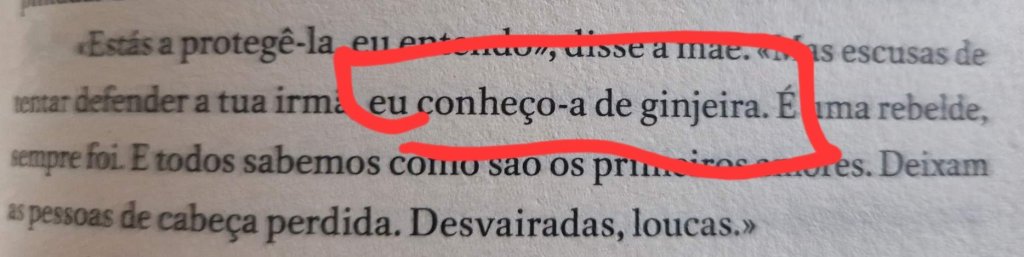
Well, this is a bit worrying. I’ve just written a blog post about the expression “Conhecer de Ginjeira”. When I went to tag it, my WordPress site seemed to recognise the expression, so I looked it up and found I’d already written the same explanation just a few months ago, in July. I often feel like my memory is declining in my late middle age, which is a cause for concern in a lot of ways, and definitely makes learning a language an uphill struggle. But to have researched and written a blog post just 15 weeks ago and to have zero recollection of having done so… Oh lord, my braincells are an endangered species. Anyway, for what it’s worth, here’s the November version of July’s article.
I came across an expression I didn’t recognise today: Conhecer de ginjeira.
It seems like not very much is known about the origins. An answer on the always-reliable Ciberduvidas says that it’s usually mildly negative, maybe implying you know their tricks and won’t be taken in by the. It goes on to suggest it is probably a rural expression meaning you’ve known them since you were young enough to pick ginjas (sour cherries) together. Like a lot of -eira words – pereira, maceira, nogueira, bananeira – a ginjeira is the tree on which the fruit grows.
The origin doesn’t quite fit this case because the speaker is the mother of the person under discussion, but that’s fine, expressions often take on a life of their own.
I’ve just finished Qual É A Dúvida and I was really impressed. I’d spent a lot of time bogged down in a really tedious, repetitive exercise book beforehand and I could never motivate myself to open it, so switching to this was a real breath of fresh air. It’s got 25-35 questions in every 2 page section. Its purpose is to focus on some of the trickier aspects of grammar that you might have found hard when you learned about them. As such, it isn’t a textbook and doesn’t give very detailed explanation of each topic because it assumes you’ve already learned it and just need to practice some examples to get the hang of the. So you get a super-basic summary of the rule or difference it’s trying to highlight and then it leaves you to fill in the spaces. It covers relatively basic stuff from B1 up into some really twisty grammar for C2 level.
I found it challenging in places, but even in the easy pages, I never really felt like I was wasting my time.
It’s really one of my favourite books so far, and I have marked some of the harder pages to review again later.
I’ll put the first contents page below so you can see what it’s hitting at the intermediate level, but the whole thing spans three pages.
Strong recommendation if you’re intermediate/advanced. And if you’re looking to load up on textbooks, remember I have a special page for that and it’s here.
It looks like Manuel Cardoso isn’t the only Comedian coming to London this month – Hugo Sousa is too. That’s two portuguese comedy shows in the next week! Get in!
I’ve had the audiobook of Lisbon by Neill Lochery on my listening list for a while now and finally got around to it simply because I had started Enquanto Salazar Dormia by Domingos Amaral And wanted a little more background about wartime Lisbon to give me the context.
I learned a lot! I’d always known Portugal had a slightly odd place In World War 2 History: Salazar, as a fascist, was probably more inclined towards Hitler’s world view, but Portugal and Britain have been allies since way back. I also knew we hadn’t always been good allies (see this post about the portuguese national anthem starting life as a diss track about the treacherous land-stealing British empire).
What I hadn’t realised was how many different schemes and counter-schemes were swirling around the capital, or how delicate was the balance that kept the Iberian peninsula out of the war.
Nor had I any idea that part of Portugal’s reason for distrusting Britain was that Neville Chamberlain had offered Angola to Hitler as part of his appeasement negotiations. Or about the delicate situation regarding Wolfram (Tungsten) mining that was necessary for both sides’ war effirts. At one point, a network of SOE agents had recruiters portuguese sub-agents and poised then to blow up mining infrastructure and assassinate some key people in the event that Portugal was invaded by Spain at the behest of the nazis and there wasn’t a padeira around to hold them back.





 Luso
Luso 