…Over my old posts and thinking I’ve made some pretty good points over the years. I just wished I remembered them after writing them down. Instead, when I stumble upon a post from 4 years ago about prepositions I think “Oh that’s very clever. Did I write this?”
Some of it’s pretty good. I need to take a weekend out and read the whole lot to see what I could learn from it. It might be depressing though. The other day I wrote a blog post and then realised I’d already done one on the same topic (here). Then the other day, when I was looking for something, I came across a post from 2021 about “assim ou assado” and realised I’d forgotten that and duplicated it too, following on from the Raquel Sem Interesse book I read in the summer.
Hugh Laurie said that at his age reading was like filling a bath with the plug out, and I feel the same with portuguese. I’m only retaining about 10% of what I learn, I think. I’m on a slippery slope that ends with someone asking me if I know who the prime minister is.
Her’s another translation – this time “Eu e o Meu País” (me and my country) by Oquestrada. It has a weird bit of anglo-french wittering at the start and I’ll just pretend that doesn’t happen. I wish I had a video of them doing it live but every one I’ve found has been shonky fan footage.
The song itself isn’t that deep either. The bit I really like is the very beginning. Freguesia is one of my favourite words for some reason, and that second line is great, plus the sense you have of her dashing around everywhere trying to hug the whole country. So that’s the only reason for the translation. If you want an objectively better video of them playing an objectively more stompy song, check this out.
Portuguese
English
De distrito em distrito de freguesia em freguesia e quando os teus braços chegam aos meus nós somos só um, somos um só nós somos um só, somos só um eu e o meu país
District by district Parish by parish And when your arms reach mine We are one, we are one We are one, we are one Me and my country
Ouvi dizer que me amavas, adoravas, entendias ouvi dizer que me querias, me estimavas, percebias e se à noite me sorris de dia pouco me falas mas se à noite me sorris de dia pouco me falas de dia pouco me falas
I heard you loved me, adored me, understood me I heard you wanted me, esteemed me, noticed me And if at night you smile at me By day you hardly talk to me And if at night you smile at me By day you hardly talk to me By day you hardly talk to me
I wanna dancing with myself I wanna dancing with myself e é tanta a rotunda que já nem sei chegar a ti neste silêncio, neste pantanal sou turista acidental neste anúncio, neste postal sou turista acidental mas e tu, tu oh tu meu país mas e tu, tu oh tu meu país diz-me diz-me onde ficas tu neste postal
I wanna dancing with myself I wanna dancing with myself And there are so many roundabouts I don’t even know how to get to you In this silence, in this swamp I’m an accidental tourist In this advertisement, in this postcard I’m an accidental tourist But you, you, oh you, my country But you, you, oh you, my country Tell me where you are on this postcard
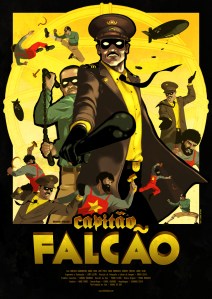
I’ve been trying to find a copy of Capitão Falcão on DVD for a while now but I’ve just found a free copy for download on the Internet Archive*. That’s a pretty respectable site, not a nest of pirates, so it appears to be legit. Anyway, can’t get it anywhere else, so I downloaded it. I couldn’t quite believe my luck. I’d have happily paid a hefty pile of cash for this but nobody wanted my money, apparently.
Anyway, here’s my review:
Este filme é incrível. Ouvi dizer que é um dos filmes portugueses mais engraçados de sempre e não mentiram. O protagonista é um militar (protagonizado por Gonçalo Waddington da série Odisseia) que é selecionado pelo General Gaivota para um novo cargo de super-herói e defensor do estado. O seu nome é Capitão Falcão e o seu auxiliar chinês é conhecido por Puto Perdiz. Os dois usam máscaras à moda antigo: ou seja, são máscaras que escondem a parte superior do rosto, não dessas máscaras cirúrgicas que cobrem a fuça.
Mas porque é que os protagonistas têm nomes de aves? Suponho que é uma referência aos super-heróis do passado. Quanto ao Puto Perdiz, a sua alcunha é parecido com a do Robin (o “Boy wonder”), da série Homem-Morcego. Mas existem ainda mais paralelos porque sem dúvida este filme trata-se de uma sátira daquele género de super-heróis. Os vilões riem-se em voz alta de modo exagerado, como o Doutor Evil do “Austin Powers”, por exemplo, e os métodos de interrogação gozam com as séries policiais duras.
Mas acima de tudo, acho que há duas personagens nas quais este filme é baseado: Primeira: O Besouro Verde** uma personagem americana que também usava mascara e também tinha um ajudante chinês (protagonizado pelo lendário Bruce Lee!). É óbvio que o seu “vibe” (como dizem os jovens) é cem por cento o do Besouro Verde. Mas mencionei a série no Insta e a minha amiga Olga respondeu com uma segunda personagem: “Major Alvega!”
“Hum, o quê? Diz lá, quem é esse Major?”
Major Alvega, também conhecido por “Battler Britton” era um piloto da RAF (Força Aérea Britânico) que estreou na revista Sun*** em 1956 e depois mudou-se para Portugal mas naquela altura a ditadura nacionalista exigiu todos os heróis terem nomes portugueses, e foi assim que nasceu o Major Alvega****. Este vídeo dá mais informações. É evidente que o escritor do diálogo é consciente do legado do Major Alvega porque há uma cena numa prisão onde Capitão Falcão perguntou a um homem como se chamava. O homem respondeu que antes de ser preso tinha sido um major. “Major Al…. ah ah ah… Major Alberto”
Enquanto o Major Alvego assumiu um nome Salazarista, Capitão Falcão é um servidor do próprio Salazar, porque o filme tem lugar nos anos sessenta e os criminosos são liberais, ateus e comunistas. Pior ainda, “São comunistas e ninjas…. Comuninjas”
This should give you a pretty good flavour of it! (Don’t worry though, that blaring music doesn’t play all the way through – it’s much easier to understand than this!)
**Green Hornet in english, but Besouro means beetle, not hornet
***Yes, a now defunct magazine, not the still existing paper
****Confusingly it seems that when Major Alvega was turned into a TV series it was sold back to anglophone audiences with a totally different name: Ace London!
Once again I’m indebted to Cristina of “Say it in Portuguese” for correcting the errors in the original draft
Sérgio Godinho, singer, writer and all-round renaissance man, has been working for 50 years now and Radio Comercial produced this really nice video of other musicians covering one of his best known songs. Of course, this sort of ensemble cast has been besmirched by that Imagine song in 2020, but they go a long way toward redeeming it.
I don’t recognise all the participants but I’ve definitely mentioned A Garota Não, António Zambujo, Miguel Araújo, Tiago Bettencourt, Ana Bacalhau, Claudia Pascoal, Tim from Xutos e Pontapés. I’m a little surprised I’ve never mentioned Camané apart from a couple of passing references. His eyebrows alone deserve their own blog post. And I’d been thinking of doing something about Os Quatro e Meia, but hadn’t got around to it yet
Aside from playing spot the celebrity, there’s a lot to look at in the video: there are shots taken in front of A Ponte D Luís in Porto, the Padrão dos Descobrimentos, and a mural by Vhils. You should also be able to spot where they’ve tried to mock up some of his album covers too. Compare this discography – I can see a couple (Samuel Úria and David Fonseca), but I feel like I’m probably missing some because a few of the scenes look so staged that they seem like the director is trying to set up the shot – like at 2.02 Diogo Piçarra is sitting on a park bench and as he sings the line he puts his elbow up on the backrest, then 7 seconds later at 2.09 João Só does the exact same thing but on the other side. That’s not a coincidence! Likewise the weird quantum superposition of Rita Redshoes on the same bench at 1:56 looks like it’s not just random.
A lot of them I’d never heard of before, or heard of but never sat down and listened to, so I picked on a few who took my interest:
Capicua is quite interesting – she’s one of the first on screen. She’d broken the dress code by just turning up in normal clothes instead of being in her finery. I am not a rap aficianado, so I wasn’t really moved by her stuff, but her videos are quite interesting and worth a look. My favourite actual song is “Maria Capaz“, which is obviously a wordplay on Maria Rapaz, and I like that she’s turned it around and made it a good thing like that. Very good!
I feel like there’s split in the genders of the singers: Most of the guys are showbiz veterans like Palma, Abrunhosa and Ribeirinho, all grizzled and weatherbeaten. Then there are people like Zambujo and Araújo in the next generation down, younger than me but not exactly spring chickens; and there is a fair sprinkling of young dudes in there too. The women, on the other hand, are almost all young, hot and immaculately groomed. I don’t really see any female fadistas of that older generation, coming out of retirement. I wonder if they were asked. The only woman I noticed who looks like she had done the hard miles and approaching his level of seniority was Mafalda Veiga, who is straight after Capicua. She seems to have done quite a lot of duets with the other musicians in the video (here) and I liked that there was someone there representing for us grown-ups.
Buba Espinho is the least rock star-looking person I’ve ever seen and I checked out a video of his and it’s charming because he acts like a big ol’ doofus as well. His music’s Ok though and I don’t hold it against him that he isn’t trying to be super-cool in the american style. There are videos of him doing more straightforward Fado too and he looks more at home there.
Carolina Deslandes is also fine but I didn’t feel the need to buy all her music. That’s a shame because she has an amazing voice.
Rui Ribeirinho seems like an interesting guy. He’s from a band called GNR – not to be confused either with Guns ‘n’ Roses or with the Banda da Guarda Nacional Repúblicana. They’ve been around since the eighties and they’re still rockin’. HOLD THE PHONE – My wife’s just told me she met him at a party once! What the actual fuck?
Rita Redshoes is someone I’d heard of but never paid much attention to. I quite liked this video where she is surrounded by Caretos… wait, why don’t I have any posts about Caretos? I could have sworn I’d written about them a few months back but I can’t find it now. Oh well, add it to the to-do list. Rita Redshoes has a very diverse back catalogue. There are some in english, this children’s show and even some relaxing white noise to send you to sleep!
Pedro Abrunhosa is another name I know but I’ve never listened to. I can’t say I was that interested to be honest. Sorry, Pedro. He’s been around a long time though. I might put him on my Spotify for a while and see if I can find something I like. Listen to the crowd on this video – they love him!
Sara Correia has a cracking set of pipes – she really belts it out, sailing that line between fado and more commercial pop, a bit like Ana Moura. She and Abrunhosa have collaborated before in the past on a fundraiser for Ukraine and it’s really powerful. Better when she’s singing than him, it must be said, but powerful all the same. Oh and she’s singing at Cadogan Hall in February – right, get that one in the diary!
Let’s do the lyrics, shall we? Lots of passive voice here: it’s going to be difficult to render it into english without sounding affected but I’ll do my best.
Portuguese
English
A principio é simples, anda-se sozinho Passa-se na rua bem devagarinho Está-se bem no silêncio e no borburinho Bebe-se as certezas num copo de vinho E vem-nos à memória uma frase batida Hoje é o primeiro dia do resto da tua vida Hoje é o primeiro dia do resto da tua vida
At first it’s simple, walk alone It happens in the road, nice and slowly It’s OK in the silence and the noise Certainties are drunk in a glass of wine And a well-worn phrase comes to mind Today is the first day of the rest of your life Today is the first day of the rest of your life
Pouco a pouco o passo faz-se vagabundo Dá-se a volta ao medo, dá-se a volta ao mundo Diz-se do passado, que está moribundo Bebe-se o alento num copo sem fundo E vem-nos à memória uma frase batida Hoje é o primeiro dia do resto da tua vida Hoje é o primeiro dia do resto da tua vida
Little by little, the step becomes slow One takes a turn to fear, a turn to the world It’s said that the past is dying Breath is drunk in a bottomless cup And a well-worn phrase comes to mind Today is the first day of the rest of your life Today is the first day of the rest of your life
E é então que amigos nos oferecem leito Entra-se cansado e sai-se refeito Luta-se por tudo o que se leva a peito Bebe-se, come-se e alguém nos diz bom proveito E vem-nos à memória uma frase batida Hoje é o primeiro dia do resto da tua vida Hoje é o primeiro dia do resto da tua vida
And then friends offer a place to sleep One enters tured and leaves refreshed And fights for everything that’s taken to heart Drinks, eats, and someone says “Enjoy!” And a well-worn phrase comes to mind Today is the first day of the rest of your life Today is the first day of the rest of your life
Depois vêm cansaços e o corpo fraqueja Olha-se para dentro e já pouco sobeja Pede-se o descanso, por curto que seja Apagam-se dúvidas num mar de cerveja E vem-nos à memória uma frase batida Hoje é o primeiro dia do resto da tua vida Hoje é o primeiro dia do resto da tua vida
Afterwards comes tiredness and the body weakens One looks inside, little remains Asks for rest, no matter how short Doubts are washed away in a sea of beer And a well-worn phrase comes to mind Today is the first day of the rest of your life Today is the first day of the rest of your life
E enfim de uma escolha faz-se um desafio Enfrenta-se a vida de fio a pavio Navega-se sem mar, sem vela ou navio Bebe-se a coragem até dum copo vazio E vem-nos à memória uma frase batida Hoje é o primeiro dia do resto da tua vida Hoje é o primeiro dia do resto da tua vida
And in the end, a choice becomes a challenge Life is confronted in its entirety Navigating without a sea, without a sail or a ship Courage is drunk from an empty cup And a well-worn phrase comes to mind Today is the first day of the rest of your life Today is the first day of the rest of your life
E entretanto o tempo fez cinza da brasa E outra maré cheia virá da maré vaza Nasce um novo dia e no braço outra asa Brinda-se aos amores com o vinho da casa E vem-nos à memória uma frase batida Hoje é o primeiro dia do resto da tua vida Hoje é o primeiro dia do resto da tua vida
And meanwhile time turns the coal to ash And another high tide follows a low tide A new day is born, on the arm another wing Loves are toasted with house wine And a well-worn phrase comes to mind Today is the first day of the rest of your life Today is the first day of the rest of your life
My run of bad luck… or rather my non-run of bad luck continues. I was due to do the Meia Maratona dos Descobrimentos in a week and a half but I’ve had a weird infection that’s blocked my nose for weeks and left me unable to train or to sleep, and it’s not shifting, so I have had to drop out. Probably just as well because I also can’t afford it, but that’s another story!
Being an optimist (most of the time) I subscribed for the EDP Lisbon Half Marathon in March and I’ll probably try and do one closer to home later in December if I can get well again in the next week or so. I’m on antibiotics and steroid sprays and saline rinses. It’s weird, not like a cold, not like a flu or covid, just like someone has filled my nostrils with plaster of paris. I just want it to stop.
Super-optimist me wants to go for the Lisbon Marathon in December if the March run goes well. I’ve done 2 marathons before but mever managed to finish one runnning all 26 miles. In the Brighton one I hit a wall at 20 miles and just stopped for no reason and ended up walking about 3 miles before I could get running again. Disappointing. And as for the South Downs Marathon… well, I was just hopelessly out of my depth there! Hot day, savage hills, not enough training, not enough water. Took me about 6 hours!
I;ve heard Portugal has a strong running culture. I am not quite sure where it is. I mean obviously there are super-stars like Rosa Mota (who is still going strong) and my early influence, Jessica Agosto (hey, not bad, seven-years-ago-me, I can see you’ve made a couple of mistakes there but you were doing Ok for a newbie!), but I think there’s only one park run venue, I haven’t seen many runners around parks, and when I went running in Madeira earlier this year people looked at me like I was a lunatic. You’ve only to check the relative availability of the Lisbon Marathon (just sign up) vs the London one (join a lottery months in advance and hope the gods of running smile upon you).
I’ve always wanted to do a run in Portugal though: it’s a bucket list goal, just to see what the vibe is like. This is my third attempt now. Third time lucky right? Right?
Fazendo os exercícios lacunares no livro “Qual É a Dúvida”, deparei com uma palavra desconhecida que me atrapalhou. O objetivo desta questão especifica era decidir se o substantivo precisa, ou não, de um artigo indefinido (um, uma):
“Tenho ______ Malhoa e…. (blábláblá)”
Acabei por deixar vazio o espaço porque achava que “Malhoa” era uma doença qualquer. Confundi-o com maleita, apesar da letra maiúscula. Mas a resposta certa é “um” porque Malhoa era um artista, portanto “um Malhoa” é um quadro pintado por aquele artista. Igualmente em inglês, os ricos dizem “I have a Picasso on my yacht” ou não sei o que é, não sou Jeff Bezos, mas o importante é que “🇬🇧 a Picasso” e “🇵🇹 um Malhoa” têm a mesma forma portanto não é nada difícil!
Mas quem é este gajo, Malhoa?
Segundo a Wikipedia, o artista nasceu em 1855 e começou a sua formação com 12 anos. Fez parte de uma tertúlia de artistas portugueses chamada “O Grupo do Leão”. Apesar de ser pioneiro do movimento naturalista, a sua obra era reconhecida como sendo muito parecida com a corrente artística impressionista que estava muito a moda naquela altura.
Faleceu em 1933 e foi sepultado no Cemitério dos Prazeres. Existe um museu dedicado à sua memória.
Once again I’m indebted to Cristina of “Say it in Portuguese” for correcting the errors in the original draft
I’ve been browsing Lidel for C2 textbooks to work through. They have quite a lot of good options, including some ebooks and interactive content, and I was surprised to find myself spoiled for choice. Unfortuantely, for UK users, even if you only pick downloadable products that don’t need to be posted, when you try to check out this happens!
So I wrote to them and explained that this surely couldn’t apply to virtual products, and even for paper books, Brexit had turned out to be a bit of a “tudo-nada”… Hm, is that the right expression? It was closest I could get to “damp squib”. And that most other book dealers had sussed out by now that their packages wouldn’t be shot down by spitfires on their way across the channel. Looking forward to hearing from them…
Li o segundo livro desta autora há 4 meses e tal, e gostei. Este parece-me um livro mais fraco. Admito que não tenho a idade, nem sou do país nem do género, sobre qual ela está a escrever, portanto provavelmente não me devo queixar (!) mas o álbum consistem em BDs curtinhas mas não há nada novo: algumas não têm graça, são apenas “aconteceu isto”… E concordo: Acontece, sim. Há outros que não entendi. O que se passou? O que é esta coisinha no canto do desenho? Mas também há algumas que bateram certo.
Lembra-me a Sarah Anderson, mas também não gosto da Sarah Anderson. Ai, que desmancha-prazeres sou!
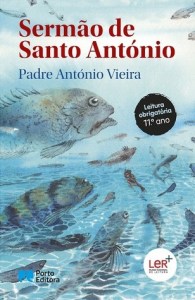
Uma portuguesa que leu este livrinho na escola avisou-me para não ler, mas sou teimoso, e ainda bem porque gostei. Já li muitos livros religiosos em Inglês durante a minha juventude desperdiçada, portanto o estilo não me assustou, ainda que seja ateu.
A história é uma alegoria que acrescenta pormenores à bem conhecida história de São António, que pregou aos peixes uma vez que os moradores da cidade taparam os ouvidos.
O sermão, que o autor coloca na boca do santo, foi muito relevante à situação social em vigor naquela altura e criticou o papel dos colonizadores e missionários no Brasil (contexto que teria perdido se a minha esposa não me tivesse explicado). Em resumo, gostei bastante mas fiquei contente por terminar depois de 60 páginas. Não preciso de mais!