Posted in English, Portuguese

The Red Hot Silli Preppersitions

More corrected exercises from Português Outra Vez

Grammar, we love you

Quando elas vierem a casa, lembra-lhes para regarem as flores no rés do chão.

Eu faltei aos ensaios e, por isso, não vou em digressão pelo Canadá. (I actually feel like my wrong answer wasn’t totally wrong: dedicar-se was an option so I put “dedico-me aos”. I feel like that works but the book says no No, apparently not, because the ensaios are rehearsals for the tour. Duh!)

O pai do nosso amigo Charles valeu-se do cargo que ocupa para lhe arranjar trabalho no Ministério dos Negócios Estrangeiros.

O presidente faltou à palavra e adotou essa lei discriminatória

Levantei-me as cinco de manhã; faltou pouco para amanhecer.


Thanks to Cristina for spotting the typos & the misunderstanding in the first version.

Posted in English, Portuguese

Exercícios Lacunares

Now that I’ve finished Qual É A Dúvida I’ve returned to the bloody awful, boring “Português Outra Vez“, aimed at C1/C2 level students. On the face of it, there’s no reason it should be so dull: both books are just page after page of exercícios lacunares (missing word problems), but they’ve ordered it into three sections and within each section they’re all the same *kind* of missing words. I’m currently part way through 60 pages of verb+preposition. I have a copy of the Guia Prático de Verbos com Preposições for any that I don’t already know. Helena Ventura is co-author of both books, so the examples are often quite similar.

Now, that much repetition could be useful if it was drilling the variations of dar+preposition or passar+preposition but there’s surprisingly little repetition of those. Dar appears just twice, I think, and ser, passar, ficar seem only to be there once. Instead we’re doing easy things like gostar de, precisar de, plus some fairly obscure ferns that only ever take one preposition anyway. It’s not ideal and I am finding it much harder to stay motivated. I’ll see how it goes but I might just open a window and fling it at the pigeons outside.

The other two sections are expressões idiomáticas and vocabulário. I feel like this is all good meat-and-potatoes stuff, necessary for building core competencies for the advanced exam, so I hope the pigeons enjoy it.

More practically, I suppose I should hope between sections to break up the monotony or something.

Aaaaanyway, enough moaning. I’m writing out some that I got wrong, hoping they’ll stick in my mind better:

Não Conseguimos convencê-lo; ele torce pelo Benfica e não muda de ideias. I got torcer por, but failed to realise that Benfica needed a definite article. Torcer por =Ser adepto de = to be a supporter of

Todas as pessoas devem ser compassiva e solidárias, olhando a quem está em situação de pobreza e depende da ajuda dos outros. Again, i got the right formula – olhar a – but I used the imperativo. That probably would have worked if there were a full stop after “solidárias” but it doesn’t make sense as it is and I should have rethought it. Olhar a =ter em consideração =to look out for

Quantas costeletas tocam a cada pessoa? Parecem-me poucas para tanta gente. I had no clue here and just guessed badly. Tocar a = calhar a =to… Hm, it’s a difficult one to translate neatly but the whole sentence is like “How many cutlets are there for each person”. It can also mean “to have to do with” or “to compete for”

O António foi falar com o chefe e foi pedir-lhe pela colega da receção, para que o chefe a promovesse, pois ela merecia. I got the wrong end of the stick with this one. I didn’t realise Antonio was a worker in the same firm. I thought he was a customer who was recommending the receptionist for promotion. Conseqiently I messed it up. Pedir por =interceder a favor de= to ask on behalf of, to act as an intermediary.

Há pessoas tão ambiciosas que não olham a meios para atingir os fins. I missed the relevance of this. And used “ser contra” instead. Olhar a =atender a = care about. So in this case they don’t care what means they have to use to achieve their ends. We’ve all met people like that, eh? Some people are so ambitious to be a good portuguese students they will even stoop to doing the actual exercises diligently.

Não compares um Ferrari com um Toyota! São completamente diferentes! I used a in place of com. Classic overliteral translation from English. Compare x WITH y, not x TO y. Comparar com = colocar em igualdade com =Make a comparison. The way this is phrased implies that the comparison will always be of equality, but priberam is much closer to the English notion of comparing. Ie, you can make an unfavourable comparison, but even though “this is a million times better than that” is a comparison, people will often be opposed to you comparing Shakespeare to Dan Brown or whatever, feeling that Shakespeare is somehow demeaned by being spoken of in the same breath as such a terrible writer, and I assume that’s what’s going in in the example.

Posted in English, Portuguese

Exercises (p60)

Trying the same as yesterday but this time I’m going to list all the verb/preposition combinations out before I start.

(While I was doing this, my sister-in-law, who is madeiran, came over and tried to do one of the questions in the opposite page. She couldn’t do them either, so I don’t feel so bad now)

The verbs to choose from today are

Agir

  • Agir contra = to act against
  • Agir por = to be motivated by
  • Agir segundo = to act in accordance with
  • Agir sobre = to act on something, produce an effect

Falar

  • Falar com =to speak with
  • Falar de = to make criticisms about
  • Falar sobre = to talk about, express opinions about
  • Falar em = to mention, refer to
  • Falar para = to speak on the telephone to someone in another location, to direct your speech toward
  • Falar perante = to speak on front of an audience
  • Falar por = to speak for someone, as a representative

Meter

  • Meter em = to put inside

Meter-se

  • Meter-se a = to dedicate oneself to, to roll up one’s sleeves and start doing something
  • Meter-se com = to direct one’s words at, to provoke, to challenge
  • Meter-se em = to dedicate oneself to something, to shut oneself in somewhere, to interfere in
  • Meter-se por = to go somewhere

Pensar

  • Pensar de = to have an opinion about
  • Pensar em = to reflect on something, to have an intention of
  • Pensar por = to do someone’s thinking for them
  • Pensar sobre = to think about, to have an opinion about

Saber

  • Saber a = to taste of
  • Saber de = to know about

Telefonar

  • Telefonar a = to phone someone
  • Telefonar de = to phone from somewhere
  • Telefonar para = to phone a place

Ter

  • Ter com = to have some relation with
  • (ir) Ter com = to meet with someone
  • Ter alguma coisa contra = to have something against
  • Ter de = to have to do something
  • Ter alguém por = to consider something (tenho-o por boa pessoa means you believe someone is a good person)
Grammar batman
Holy prepositions, Batman

This feels much easier than yesterday’s. The expressions aren’t so similar. Anyway, here we go with the questions.

  • A Isabel é de ideias fixas: há nove meses meteu-se a aprender russo e já fala muito bem ✔️
  • Estamos a pensar em fazer uma viagem à Índia, talvez em Setembro ✔️
  • Na cerimónia académica, o estudante mais velho falou pelos colegas de turma ✔️
  • O José queria ajudar o neto, mas não podia porque não sabia nada de informática ✔️
  • Vais ter com a Ulrike ao Chiado? É um sitio muito bom para passear ✔️
  • O professor de História é “um livro aberto”: consegue falar sobre todos os assuntos com facilidade. ✔️
  • Os meus vizinhos são escandalosos, andam sempre a se metem em complicações ✖️ meter-se em (meh, right verb, wrong tense)
  • A família do homem-bomba declarou que ele agia pelas suas convicções religiosas ✖️ agiu segundo
  • O que é que pensas deste primeiro ministro? Eu acho-o um competente.✔️
  • Tenho a Fernanda por uma pessoa leal e honesta. ✔️
  • A mãe telefonou para o consultório do médico, mas não conseguiu falar com ele. ✔️
  • As alunas chinesas queixam-se e dizem que os portugueses se metem constantemente com elas. Elas acham-nos muito atrevidos*. ✔️
  • O réu, acusado de homicídio, argumentou que agiu por legítima defesa e agiu sobre os interesses da família. ✖️ Agiu em/ agiu pelos
  • Pedro, tens de pensar seriamente no seu futuro, não podes continuar nessa indolência. ✔️
  • Mete o dinheiro no bolso porque podes perdê-lo ✔️
  • Tens de acabar o trabalho quanto antes, já estamos atrasados na entrega. ✔️ (the answer actually gives “temos” but I think this works if you imagine one person’s work holding up an entire project team..?)
  • Detestava ouvir falar de outros pessoas, sobretudo quando era crítica gratuita. ✔️
  • A que é que te sabem essas batatas fritas? Acho-as horríveis. ✔️
  • A nossa filha, no seu doutoramento, teve de falar perante uma audiência de mais de cem pessoas. ✔️
  • Tens de dar a tua opinião, não posso pensar por ti ✖️ falar por
  • É difícil provar que ele não agiu por má-fé. ✖️ Tenha agido de

*nice word: cheeky

Well, that was much better but still left a lot to be desired…

Posted in English, Portuguese

Exercises (p59)

I’ve been stalled in my textbook for quite a while. It’s quite hard to get through because the exercises are so samey. For example, at the moment I am working through a section in which you have to fill in blanks with verb/preposition combos. The section is 58 pages long with about 20 per page so I era thousand questions of the same type. This would be OK if they gave examples or pointers to teach you something before you embark on the exercise, but it really expects you to go and find the answers from some other source (in my case, the Guia Prático de Verbos com Preposições, which I definitely recommend even if I don’t recommend the textbook!)

It’s pretty exhausting and doesn’t make me feel motivated at all. I think I probably need to switch because ploughing through this isn’t yielding results.

Anyway, let’s have a go – I’m just going to straight up do my homework on here and mark it in real time.

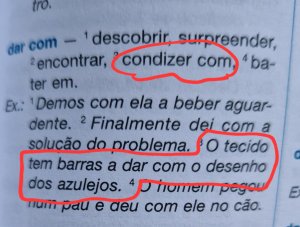
Condizer com = dar com
  • Chegamos no Porto, de manhã, fomos do comboio das sete e regressamos ao fim da tarde ✖️ Vamos ao/Vamos no = We are going to Porto. In the morning, we’re going by train at 7.0p and return at the end of the afternoon. This is a bad fail. The tenses are all wrong, even. I think if I’d gone back and checked this one I’d have spotted it but I didn’t.
  • A cor das cortinas dá-se com as tonalidades usadas na decoração da sala ✖️ dá com =The colour of the curtains matches the tones used in the decoration of the room. I guessed “dar-se com”, which usually means “to get in with” would also mean match, but “dar com” is the right answer. It has a few different meanings but “condizer com” (to match) is one.
  • O autocarro 31 vai para a cidade universitária? ✖️ Passa pela = Bus number 31 goes through the University town?
  • O Pedro deu-se pela janela do comboio para admirar a paisagem. ✖️ Chegou-se à = Pedro went close to the train window to admire the countryside.
  • A Maria andava completamente obcecada por uma colega: lançou-se em si, constantemente, a pensar nele e não conseguia concentrar-se no trabalho. ✖️ Dava por =Maria was completely obsessed with a colleague: she was aware of him at all times, thinking about him and she couldn’t concentrate on work.
  • Emagrecia de dia para dia: os médicos passaram a pensar que fosse cancro. ✖️ Chegaram a = she was getting thinner day by day: the doctors had reached the point of thinking it was cancer.
  • A mãe quando o viu partir, de tão comovida, pôs-se a chorar. ✔️ Good lord, I’m on question (g) and this is my first right answer???
  • Como a Laura quase nunca sorri, muitas vezes passa por antipática. ✔️
  • Depois de muitos desgostos e desilusões, a Marta, deprimida, deu em alcoólica ✔️
  • Todas as cenas do filme não passaram dum manicómio ✖️ se passam num = All the scenes take place in a madhouse. This is a really good example of me getting it wrong because I got the wrong idea about what they were trying to say. I thought it was a bad film and every scene was like a madhouse.

Oh god, I’m so lost…

  • Esse aparelho tão esquisito dá para quê? ✔️
  • Acho que há pouco comida, as sardinhas não chegam para tanta gente ✔️
  • Não posso ir a um café a meio de manhã ✖️ passar sem = I can’t do without a café at midmorning.
  • A Helena dá-se bem com todos os seus colegas de trabalho. Assim o ambiente é ótimo. ✔️
  • O cão-polícia lançou-se sobre ladrão e conseguiu dominá-lo ✔️

OK at this point I had some wine. Let’s see how my success rate changes

  • O Rui vai a frequentar concertos, desde que namora com aquela pianista ✖️ passou a = Rui started going to concerts ever since he started dating that pianist
  • Estamos fartos de tentar modos diferentes de resolver a equação matemática mas não conseguimos chegar à solução. ✖️ Dar com = We’re exhausted from trying different ways to resolve the maths equation but we can’t find a solution
  • A empregada pôs os pratos e os talheres sobre a mesa para o jantar dos patrões. ✔️
  • O deputado do partido “Os Verdes” foi ontem a Dublin, onde esteve dois dias e deu uma conferência. ✖️ Chegou de = The MP from the Green Party arrived yesterday from Dublin where he was for two days and gave a conference.
  • O António foi para Bruxelas com um contrato de trabalho de três anos. ✔️
  • Abriu a porta de repente e deu com o filho mais novo a fumar às escondidas. ✔️

Oof, pretty terrible. Maybe I need to keep ploughing on because I’m really not doing well with these! That’s what? 11/21? Even with a reference book to hand. Terrible!

Posted in English

Divided by a Common Language

I wrote something the other day that included the word “ficámos” as a past tense of ficar, meaning “we stayed”, and a Brazilian guy has told me it should be ‘ficamos”. I’ve told him that I am pretty sure this is one of those differnces between PT-PT and PT-BR: Portugal uses an -ámos ending in the past perfect, but in Brazil -amos is used for both present and perfect (lol, no scope for confusion there!) but he’s insisting that no, his way is correct. I feel a little arrogant contradicting someone whose native language is portuguese but I’m pretty sure I’m right on this one so I’m just ignoring the bloke and carrying on regardless.

Priberam (portuguese) on the left vs conjugação.com (brazilian) on the right

As I mentioned a few months ago in my comparison of the two types of Portuguese, Brazil has a larger media and a more powerful cultural impact in the world so they don’t always notice the smaller group of people speaking the European variant across the atlantic. The same is true of the US media hegemony co-opting English. There’s no use complaining (*pauses to wipe away bitter British tears*), it just is what it is. So if you’re asking someone for advice or corrections, it’s best to say what variant you’re learning to avoid misunderstandings, but if someone tries to help and gets it wrong (like this bloke is doing, I think) you have to be sensitive in how you reply. Anyone who honestly tries to help someone online is a good person. If they get it wrong from time to time, that doesn’t make them bad: a gentle reminder should sort things out with no hurt feelings. I used to have a portuguese friend who would absolutely lay into Brazilian teachers who corrected European portuguese learners but I think she was being unreasonable and I’d always try to calm her down because it made me cringe to think that someone had tried to help me and was getting a verbal battering for their troubles. I definitely don’t want to do that, but I’m going to politely suggest that I think he’s mistaken!

Posted in English

Queria? Já Não Quer?

I’ve just written a brief text in Portuguese about this which will probably end up being a blog post soon but I thought I’d expand on it in English in the meantime because it’s interesting!

So apparently there’s this joke that gets made a lot in Portuguese cafés. If you ask for a coffee by saying “queria um abatenado” (an abatenado is a kind of coffee) the waiter might reply “Queria? Já não quer?” if they are a bit of a smartarse. Why?

In English we don’t usually say “I want a cup of tea” because it sounds too blunt, so we go for something gentler like “I would like a cup of tea” instead. In the same way, the Portuguese have a fondness for tweaking the tense to sound more polite. They do this by saying “I was wanting a coffee”. And so, if you are a bored waiter you might decide to interpret this in the most literal way possible and reply with “Oh, you were wanting one, we’re you? So you don’t want one any more?” I know, hilarious, right?

I quite like it actually since it is both amusing and instructive for us learners but I think some people find it irritatingly pedantic, especially when it is repeated often. A recent article on Timeout Lisboa has taken waiters to task for this and for another literalism – namely when they reply to a request for a glass of water (“um copo de aqua”) by replying that they don’t have any glasses made of water, only glasses made of glass but if you want, they can give you a glass with water in (“um copo com água”). Marco Neves, in his blog, Certas Palavras, takes up the baton and gives a few other examples of nonstandard uses of verb tenses as well as some of his pet peeves. It’s a good read if you are at intermediate level or above.

Of course, as with most things, as soon as you noticed some weird feature of Portuguese, you realise English has exactly the same weirdness. I’ve already mentioned “I would like” as a politer version of “I want” but here are some other examples of verb tenses being used in weird ways in everyday English that are completely fine but would be confusing if you took them at face value.

Present tense for future events: I hope I don’t catch covid because I’m visiting my parents at the weekend.

Conditional tense for past events: When he was depressed he would spend his evenings drinking Drambuie and watching repeats of Peep Show with his cat.

Future perfect tense for things you assume to be true: Ah, Hamish, you’ll have had your tea

Present tense for historic events (the so called “historic present” or “narrative present” which was briefly both trendy and controversial a few years ago and basically dominates podcasting): “The Romans invade the Iberian Peninsula in the third century and are met with fierce resistance, not least from the Lusitanian tribes, led by Viriatus”

Studying another language has given me a new appreciation of my own.

Posted in English, Portuguese

Locuções Temporais

I’m struggling a bit with finding the right tenses for some of the sentence structures set out in the C1 course so decided to try and write a few for practice. Thanks to Dani Morgenstern for help with the corrections.

  • Quando acabei de ler ele já tinha escrito a sequela (when I finished reading he had already written the sequel)
  • Enquanto ele tocava bateria, eu preenchia os formulários de divórcio (while he was playing drums, I was filling in the divorce forms)
  • Quando chegares a casa, descasca as batatas (when you get home, peel the potatoes)
  • Ela disse-me que queria ser primeira ministra quando fosse grande (she told me she wanted to be prime minister when she was big)
  • Quando o vírus tivesse passado, ela voltava a treinar (when the vírus had passed she went back to training – I think the sense here is of something that happened repeatedly: she’d get ill every so often and go back to training after each occurrence, hence the imperfect tense)
  • Enquanto não leres o texto não estás capaz de responder às perguntas (since you won’t read the text you won’t be able to answer the questions)
  • Enquanto os negócios tivessem apoio financeiro não iriam à falência durante a pandemia. (as long as the businesses had financial support, they wouldn’t fail during the pandemic)
  • Enquanto o tio Rui não tivesse chegado a casa, a família não começava a jantar* (since Uncle Rui hadn’t arrived at the house the family weren’t starting their dinner)

*It’s probably worth pointing out here that this “a” is a preposition and “jantar” a verb. They hadn’t started to dine. But jantar can also be a noun so I could also have said “o jantar” instead of “a jantar” and the sentence would still work but it would mean “they hadn’t started the dinner”.

  • Logo que o comboio parta, telefona-me (as soon as the train leaves, call me)
  • Assim que receberes a carta do SNS, marca consulta. (as soon as you get a letter from the SNS, make an appointment)
  • No momento em que as cortinas se abrissem, a banda comecaria a tocar (as soon as the curtains opened the band would start to play)
  • Mal tivesse aberto a janela, o pisco entraria na sala (as soon as he had opened the window the robin would enter the room)
  • Logo que eu acordava tomava um café (as soon as he woke up, he used to have a cup of coffee)
  • Assim que enviou a carta, percebeu que se tinha esquecido do selo (Just as he posted the letter he realised he’d forgotten the stamp)
  • No momento em que o professor abriu a boca a campainha tocou (at the instant the teacher opened his mouth the bell rang)
  • Mal soube as noticias, começou a chorar (As soon as he heard the news he started to cry)
  • Antes que te esqueças, faz notas sobre a reunião (before you forget make some notes about the meeting)
  • Antes que ligasse ao meu pai, ele enviou-me uma mensagem (Before I called my dad, he sent me a message)
  • Antes de abrir a boca vou pensar duas vezes (before I open my mouth I’m going to think twice)
  • Depois de nos termos encontrado a minha vida era vazio e sem propósito (Before we met each other, my life was empty and without purpose)
Posted in Portuguese

Tense, Nervous Headache

Examples of high-octane verb usage based on a C1 exercise that I really screwed up.

Se ela não chegar, depois telefono-lhe.

Lamento que o seu filho não tenha ido à escola a horas na semana passada.

Não acho que a minha filha queira ir à escola hoje.

Caso ela venha tarde, a mãe dela preocupa-se.

Se ela vier tarde, a mãe dela preocupar-se-ás.

Quando for para a universidade ela terá passado os exames escolares todos.

Oxalá ele veja o filme francês que o professor deu como tpc mas acho que não está nada interessado.

Vou perguntar-lhe como se diz “LOL” em português

Se dissesses aos jovens de hoje que vivias num caixote sem água nem comida em* criança eles nunca acreditariam.

Se me disseres que estás a pensar em estudar apicultura, é garantido que faço um trocadilho qualquer sobre “exames de enxames”.

Há quem traga uma bandeira do UE para o concerto..

Ainda não sei se eles touxeram a amiga da filha com eles.

Apesar de ele já ter feito muitos pudins o de ontem não foi um êxito.

Será melhor se vocês beberem um copo de vinho e se esquecerem de tudo.

Diga eu ou que disser**, não me desatem deste mastro.

Ainda que ela ouça mal, está sempre ao pé de mim de cada vez que abro um saco de ração***.

Lamentamos que o senhor não tivesse pedido ajuda quando a cobra entrou no quarto.

Não repitas o que o pai disse na sala de aula.

Falas tão baixo. Podes repetir?

Ainda não faço ideia de quando ela parte para Edimburgo.

A picture that has nothing to do with Portuguese verb conjugations.
Tense nervous headache? Try conjugatin

*=em, not como. In child, not as a child.

**=I managed to get this doubly-wrong. I wrote “diga ou que eu dizer”

***=I wrote “lata de ração” but ração is dried food. Tinned cat/dog food is “comida de gato/cão”

Posted in English, Portuguese

Fazer’s On Stun

Another C1 Exercise: uses of Fazer with a preposition

Não te faças de sonso. Diz-me! Passaste ou não passaste? (Fazer-se de = to our on an act – so this first sentence is like “don’t act all coy”)

Não estudei e isso fez com que chumbasse no exame. (fazer com que = to have a consequence. Note the use of the subjunctive after it)

Os meus pais queriam ir de férias durante o período letivo, por isso mandaram um email que a fazer de conta que eu estava doente (fazer de conta = to pretend)

Eu também, fiz por aprender mas não consegui reter nada do assunto. (fazer por = to make an effort)

Precisas de trabalhar e fazer pela vida (Fazer pela vida = to make a living)

Tens febre. Queres uma tigela de canja? O que é que posso fazer por ti? (this Fazer por isn’t really a comound verb. He’s just offering to do something for the person)

Farei um grande esforço para ajudar* o meu vizinho que quer pintar o quarto da filha mas não consegue mover os móveis. (Also not a comound verb. He’s just making an effort to help. This sentence and the one above are good examples of the subtle differences between por and para, I think. You’d translate both as “for” in English but in this case, the person is making an effort in order to help, so you use para, whereas in the previous paragraph you’re doing something as a result of their need, so it’s por)

Quando era sócio do clube de drama, fiz de príncipe da Dinamarca numa peça chamada… Hum… Hamster ou algo do género. (Fazer de = to act like, to represent)

Fiz o relatório da câmara municipal (This fazer de isn’t a compound verb – I just made the report about the local government)

Este texto faz parte da minha aprendizagem de português. (Fazer parte de =to be a part of something)

I feel you, Scotty (image: Swear Trek)