Her’s another translation – this time “Eu e o Meu País” (me and my country) by Oquestrada. It has a weird bit of anglo-french wittering at the start and I’ll just pretend that doesn’t happen. I wish I had a video of them doing it live but every one I’ve found has been shonky fan footage.
The song itself isn’t that deep either. The bit I really like is the very beginning. Freguesia is one of my favourite words for some reason, and that second line is great, plus the sense you have of her dashing around everywhere trying to hug the whole country. So that’s the only reason for the translation. If you want an objectively better video of them playing an objectively more stompy song, check this out.
Portuguese
English
De distrito em distrito de freguesia em freguesia e quando os teus braços chegam aos meus nós somos só um, somos um só nós somos um só, somos só um eu e o meu país
District by district Parish by parish And when your arms reach mine We are one, we are one We are one, we are one Me and my country
Ouvi dizer que me amavas, adoravas, entendias ouvi dizer que me querias, me estimavas, percebias e se à noite me sorris de dia pouco me falas mas se à noite me sorris de dia pouco me falas de dia pouco me falas
I heard you loved me, adored me, understood me I heard you wanted me, esteemed me, noticed me And if at night you smile at me By day you hardly talk to me And if at night you smile at me By day you hardly talk to me By day you hardly talk to me
I wanna dancing with myself I wanna dancing with myself e é tanta a rotunda que já nem sei chegar a ti neste silêncio, neste pantanal sou turista acidental neste anúncio, neste postal sou turista acidental mas e tu, tu oh tu meu país mas e tu, tu oh tu meu país diz-me diz-me onde ficas tu neste postal
I wanna dancing with myself I wanna dancing with myself And there are so many roundabouts I don’t even know how to get to you In this silence, in this swamp I’m an accidental tourist In this advertisement, in this postcard I’m an accidental tourist But you, you, oh you, my country But you, you, oh you, my country Tell me where you are on this postcard
Translation time! This song is fantastic and I love it. I first heard it as a small segment, used as the theme for a podcast called Assim se faz Portugal, hosted by Maria Rueff. the singer, Fausto Bordalo Dias, known simply as Fausto, is a well-regarded artist who has been making music for decades and is still going. He released his first album 5 years before the end of the dictatorship and soon after was drafted into the colonial war in Guinea, but he was a conscientious objector, and he went on to be active politically. And it really shows in this song, from a 1977 album called Madrugada dos Trapeiros (Dawn of the ragpickers).
The song is structured using the idea of a folk dance called a Roda or “Baile Mandado” (guided dance – you can see an example here, which gives you a better idea of what the song is building on), where everyone has their place and they’re being given instructions, but instead of dance steps, what’s happening is the usual round of the poor being oppressed because they are ruled by people from a different class who don’t share their values, but “o baile vai terminar” and I guess there’s a parallel between mandador (The person who calls the intructions at the dance) and the boss, going on in the first verse especially
Portuguese
English
Senhoras e meus senhores, façam roda por favor Senhoras e meus senhores, façam roda por favor, cada um com o seu par Aqui não há desamores, se é tudo trabalhador o baile vai começar. Senhoras e meus senhores, batam certos os pézinhos, como bate este tambor Não queremos cá opressores, se estivermos bem juntinhos, vai-se embora o mandador Vai-se embora o mandador
Ladies and gentlemen, Form a circle please Ladies and gentlemen, Form a circle please Each one with their partner There are no heartbreaks here If everything is working The dance will begin Ladies and gentlemen Stamp your feet right in time to this drum We don’t want oppressors here If we’re getting on well together The boss can leave The boss can leave
Faz lá como tu quiseres, faz lá como tu quiseres, faz lá como tu quiseres Folha seca cai ao chão, folha seca cai ao chão Eu não quero o que tu queres, eu não quero o que tu queres, eu não quero o que tu queres, Que eu sou doutra condição, que eu sou doutra condição
Do what you like Do what you like Do what you like The dead leaf falls to the ground The dead leaf falls to the ground I don’t want what you want I don’t want what you want I don’t want what you want Because I’m from a different class Because I’m from a different class
De velhas casas vazias, palácios abandonados, os pobres fizeram lares Mas agora todos os dias, os polícias bem armados desocupam os andares Para que servem essas casas, a não ser para o senhorio viver da especulação Quem governa faz tábua rasa, mas lamenta com fastio a crise da habitação E assim se faz Portugal, uns vão bem e outros mal
From old empty houses, abandoned palaces The poor make homes But now every day The well-armed police Clear the floors What are those houses good for If not for the gentry To live off speculation Whoever governs makes a blank slate But deeply regrets the housing crisis And thats how it goes in Portugal Some do well and others badly
Faz lá como tu quiseres, faz lá como tu quiseres, faz lá como tu quiseres Folha seca cai ao chão, folha seca cai ao chão Eu não quero o que tu queres, eu não quero o que tu queres, eu não quero o que tu queres, Que eu sou doutra condição, que eu sou doutra condição
Do what you like Do what you like Do what you like The dead leaf falls to the ground The dead leaf falls to the ground I don’t want what you want I don’t want what you want I don’t want what you want Because I’m from a different class Because I’m from a different class
Tanta gente sem trabalho, não tem pão nem tem sardinha e nem tem onde morar Do frio faz agasalho, que a gente está tão magrinha da fome que anda a rapar O governo dá solução, manda os pobres emigrar, e os emigrantes que regressaram Mas com tanto desemprego, os ricos podem voltar porque nunca trabalharam E assim se faz Portugal, uns vão bem e outros mal
So many people without work They don’t have bread or sardines And they don’t even have a place to live They wrap up against the cold Because people ate so thin Raging with hunger The government gives a solution It tells the poor to emigrate And the emigrantes that returned But with so much unemployment The rich can return because they never work And thats how it goes in Portugal Some do well and others badly
Faz lá como tu quiseres, faz lá como tu quiseres, faz lá como tu quiseres Folha seca cai ao chão, folha seca cai ao chão Eu não quero o que tu queres, eu não quero o que tu queres, eu não quero o que tu queres, Que eu sou doutra condição, que eu sou doutra condição
Do what you like Do what you like Do what you like The dead leaf falls to the ground The dead leaf falls to the ground I don’t want what you want I don’t want what you want I don’t want what you want Because I’m from a different class Because I’m from a different class
E como pode outro alguém, tendo interesses tão diferentes, governar trabalhadores Se aquele que vive bem, vivendo dos seus serventes, tem diferentes valores Não nos venham com cantigas, não cantamos para esquecer, nós cantamos para lembrar Que só muda esta vida, quando tiver o poder o que vive a trabalhar Segura bem o teu par, que o baile vai terminar
And how could anyone else, having such different interests, Govern the workers? If that guy who lives well Living off his servants has different values They don’t come to us with songs, We don’t sing to forget We sing to remember That this life only changes When power is held by Those who live to work Hold your partner tight Because the dance is about to end
Faz lá como tu quiseres, faz lá como tu quiseres, faz lá como tu quiseres Folha seca cai ao chão, folha seca cai ao chão Eu não quero o que tu queres, eu não quero o que tu queres, eu não quero o que tu queres, Que eu sou doutra condição, que eu sou doutra condição
Do what you like Do what you like Do what you like The dead leaf falls to the ground The dead leaf falls to the ground I don’t want what you want I don’t want what you want I don’t want what you want Because I’m from a different class Because I’m from a different class
Translation time! This one is a classic fado, which is mentioned in the book I reviewed the day before yesterday. It also gives us some insight into the Portuguese language’s radical commitment to singular verb endings for collective nouns. The video is majestic and well worth watching, even with the sound off, for the glances between the guitarist and the guy on the guitarra portuguesa. I’d love to know what was going on between them. The song itself is written by Amália but it is really more of an adaptation of a longer poem called “Povo” by Pedro Homem de Mello.
First of all, I think we’re meant to envision people washing their clothes in the river, rather than skinnydipping, in case that’s not obvious! But let’s focus in on how she refers to the noun “povo” here. I’ve highlighted the relevant words in the first verse. As you can se, she’s addressing the “povo” (the people – especially the simple, common people) as “Tu”. In other words, she’s addressing them all, collectively, using the form normally reserved for one singular person who’s familiar to the speaker.
This was really jarring to me. Of course, it’s not that hard to find people referring to “a gente” using third person singular pronouns – I wrote about this a couple of months back – and the portuguese generally take a firmer line on treating the collective as one singular entity (as opposed to using words like eles/them) than we would in english. But to see her speaking directly to the people like this and just address the whoel population like it was her little sister is quite a cultural leap, at least for me.
Povo que lavas no rio
People who wash in the river
Povo que lavas no rio Que talhas com teu machado As tábuas do meu caixão Povo que lavas no rio Que talhas com teu machado As tábuas do meu caixão
Pode** haver quem te defenda Que compre o teu chão sagrado Mas a tua vida não
People who wash in the river Who cut with your axe The boards for my coffin* People who wash in the river Who cut with your axe The boards for my coffin
There might be people who defend you Who buy your sacred land But not your life
Fui ter à mesa redonda Beber em malga que esconda Um beijo de mão em mão Fui ter à mesa redonda Beber em malga que esconda Um beijo de mão em mão
Era o vinho que me deste Água pura, fruto agreste Mas a tua vida não
I ended up at the round table*** To drink from a bowl that hides A kiss from hand to hand I ended up at the round table To drink from a bowl that hides A kiss from hand to hand
It was the wine you gave me Pure water, wild fruit But not your life
Aromas de urze e de lama Dormi com eles na cama Tive a mesma condição Aromas de urze e de lama Dormi com eles na cama Tive a mesma condição
Povo, povo eu te pertenço Deste-me alturas de incenso Mas a tua vida não
Scents of heather and dirt I slept with them in the bed I was in the same condition. Scents of heather and dirt I slept with them in the bed I was in the same condition.
People, people, I belong to you You gave me moments of incense**** But not your life
Ai, povo que lavas no rio Que talhas com teu machado As tábuas do meu caixão Povo que lavas no rio Que talhas com teu machado As tábuas do meu caixão
Há-de haver quem te defenda Quem compre o teu chão sagrado Mas a tua vida não
People who wash in the river Who cut with your axe The boards for my coffin People who wash in the river Who cut with your axe The boards for my coffin
There might be people who defend you Who buy your sacred land But not your life
*=Could this be more emo?
**=Some versionf oe the lyrics use “ha-de” in place of “pode” but this seems to be teh version she’s singing in the video above. I’m pretty sure the há-de version is taken from Dulce Pontes’ rendition.
***=What’s the word “ter” doing here? According to priberam “ir ter a” is a compound verb meaning the same as “ir dar a” or “ir parar a” – um… OK, I’m none the wiser… but according to the Guia Prático de Verbos Com Preposições, that means “terminar em” or “desembocar”. So basically, to lead to something, to end up at something. Hence “ended up at”
****=I must admit, I got confused about this since the incense reference seemed a bit random, and I was trying to make sense of it by looking at alternative meanings of that word. Figuratively, it can mean praise or subservience, but I think I was overthinking it because it looks like she’s just referring to the smells at the top of the verse. OK, right, that makes sense!
Today’s post is definitely Not Safe For Work. It’s filthy, in fact. Yesterday’s was a translation of a Quim Barreiros song but it wasn’t a very typical one, because it had been commissioned by someone else, so I thought I’d try something more mainstream. There are so many to choose from. “A Garagem da Vizinha” and “A Cabritinha” are big favourites, but I’ve always been intrigued by “Mestre de Culinária” because I can see there’s a double entendre going on but I can’t quite work out what he’s driving at, so here I go, deep-diving into it, trying to work out what he’s actually saying. Hopefully the experience will be educational, but if not, who cares, it’ll still be fun.
I’ll use a live version. Well… “live” in a manner of speaking. I think it’s overdubbed with the original track, but I like the vibe of the video because it looks like he’s singing at a student graduation ceremony and they’re all having such an amazing time and dancing like nobody’s watching in their capa e batina (aka “traje acedémico” – student robes). This just feels like the right way to enjoy music.
First of all, here’s a straight-up translation. I’ll get to the insinuação (innuendo) at the end.
Mestre de Culinária
Master of Cookery
Sou solteiro e bom rapaz Vivo num apartamento Ainda sou muito novo P’ra pensar em casamento
I’m single and a good lad I live in a flat I’m still pretty young To think about marrying
Convido minhas amigas P’ra comer e p’ra dançar Mas demoro muito tempo A preparar o jantar
I invite my girl friends over To eat and dance But I take a long time To prepare the dinner
Eu sou o mestre de culinária E sei enfeitar a travessa Vou comprar uma panela de pressão Para ver se eu cozinho mais depressa
I am the master of cookery I know how to garnish the platter I’m going to buy a pressure cooker To see if I cook quicker
Sei que sou bom cozinheiro Aprendi com a Isabelinha Mas confesso que me faltam Utensílios de cozinha
I know I’m a good cook I learned from Isabelinha But I admit I don’t have Cooking utensils
Todas me dizem o mesmo Que jantar delicioso Quem tem fome desespera Pois sou muito vagaroso
They all say the same thing to me That the dinner was delicious But anyone who’s hungry despairs Because I’m so slow
Eu sou o mestre de culinária E sei enfeitar a travessa Vou comprar uma panela de pressão Para ver se eu cozinho mais depressa
I am the master of cookery I know how to garnish the platter I’m going to buy a pressure cooker To see if I cook quicker
Of course, a literal translation is easy enough, but reading between the lines to see the nudge-nudge-wink-wink meaning he’s trying to convey is much harder. For example, I’m pretty sure this page was written by an AI, judging by the structure of the text, and it seems to be taking it very much at face value. My first assumption, before I started writing this, was that the innuendo would turn out to be something about him really being a mestre de cunilíngua, but I’m not sure how taking a long time over that would be a bad thing.
Wait… Mestre de Cu… But doesn’t that mean…?
No, the clue probably should have been in the first syllable of cu-linária. He’s the mestre de cu.
And sure enough, the pay-off line “Para ver se eu cozinho mais depressa” sounds like “Para ver seu cuzinho mais depressa”. He wants to see his guest’s arse as soon as possible. So it seems his aim is to but a pressure cooker so he can cook quickly, get dinner over and done with and move on to… other things.
I can see a few other lines of possible innuendo: panela can mean bum/buttocks (4th definition here), but I don’t think he’s planning to buy pressure-buttocks, so I think that might be a red herring.
Travessa is an interesting one because it has quite a lot of meanings, both as a noun and an adjective. The ostensible meaning here is a long dish or platter, but it can also mean an act of crossing (travessar = atravessar) and that can – according to at least one online source – mean an act of penetration. I don’t see much evidence for that though. It’s a little difficult to tell though becaue if you start googling words like that the results you get look like the kinds of things you don’t want to click on. I think like the guy might have been overthinking it, but I could be wrong.
A more plausible line of enquiry with travessa is as the feminine form of travesso, which means bad, naughty, wicked. So it would mean something like “bad girl”. Enfeitar a travessa? Decorate the bad girl? In tauromaquia (bullfighting), enfeitar means to stick a farpa ( a decorated spear thingy) in a bull (some of the pictures on this page for example) so… Well, that certainly sounds like it might have some sort of double meaning. I don’t see any solid evidence for that either but it feels a little more likely than the previous suggestion.
That’s the chorus, but what about the rest? Is cooking a metaphor for something else? Well, the word “comer” (to eat) isn’t mentioned, but it is a slang word for having sex, so all this cooking imagery might be leaning in that direction. Is the theme of taking a long time implying he’s old and in need of viagra? Nah, that seems unlikely because he says right at the outset that he’s young. Obviously given the “eating” motif, oral sex has been suggested but I don’t really see it – I can’t put my finger on why, but I think the innuendo would be more obvious if it were that.
The whole thing has a general smutty air to it, but I think trying to spell out exactly how the smut works just feels like clutching at straws. Maybe the wider narrative is just a frame for the chorus and that’s where all the double-entendre lies.
Here’s the question I asked about this on Reddit
Coloqiei-me o* desafio hoje de traduzir uma canção de Quim Barreiros para inglês. O título é Mestre de Culinária.
Claro que já sabia que existem várias insinuações na letra, mas não percebi o que o poeta dizia. Depois do exercício, compreendo mais, mas acho que ainda não entendo cem por cento.
Hum… O trocadilho mais óbvio é “para ver se eu (seu) cozinho (cuzinho) mais depressa”, que ecoa a primeira sílaba de cu-linaria. Acho que “travessa” (um prato elongado) também tem duplo significado (manhosa”?), mas além disso, não tenho certeza. Quanto mais pensei, mais imaginei que havia insinuações em quase todas as palavras. Eu estava num corredor de espelhos sem saída.
Acabei por desistir antes de enlouquecer. O que me passou ao lado**
*”Coloqiei-me o desafio” strikes me as a really odd locution but that’s the correction. I wrote “fiz um desafio”
**I wrote “perdi o quê” for “what did I miss” but that’s not very idiomatic.
I fancied doing another translation, and there’s a song I saw a while ago and mentally filed under “What the hell did I just see?” so here I am, coming back to give it a more thorough treatment.
I’ve definitely mentioned Joaquim de Magalhães Fernandes Barreiros before and I think described him as Portugal’s Benny Hill. He does smutty, innuendo-laden songs and he’s well-liked by many and perhaps a source of embarrassment to others. He’s well-known enough that Netflix chose him to promote its series Sex Education in Portugal – and here’s the result.
OK, well this is going to be fun. *Cracks Knuckles*
The first thing to point out is that a few times in the lyrics he addresses the listeners directly and he does this using the vós form of the imperative tense. This is pretty uncommon. In fact, the first time I saw it I almost had an aneurism becaue I thought it was a new tense that I’d never seen before. I’ll highlight it in the portuguese text for anyone who doesn’t recognise it.
Educação Sexual
Sex Education
Rapazes e raparigas Ligai o computador Vamos todos aprender Como é que se faz amor
Boys and girls Turn on the computer We’re all going to learn How to make love
É hora de despertar Para a vida sexual Uns vão gostar de banana Os outros de bacalhau
It’s time to wake up To sexual life Some people like banana The others, cod
Seja homem ou mulher Não importa a orientação A realidade é sempre Melhor que a fricção
Whether man or woman It doesn’t matter the orientation The reality is always Better than friction*
Falai abertamente De sexo sem timidez Está na hora de começar Aguentas oito de uma vez?
Speak openly About sex, without shyness It’s time to start Can you handle eight at once?
Para cima, para baixo Está no ir, está no quente Enfiai devagarinho E gozai suavemente
Up and down It’s on the go**, it’s in the warm Put it in slowly And have fun***, gently
Para cima, para baixo Está no ir, está no quente Enfiai devagarinho E gozai suavemente
Aguentas oito de uma vez? Aguentas oito de uma vez? Aguentas oito de uma vez?
Up and down It’s on the go, it’s in the warm Put it in slowly And have fun, gently
Can you handle eight at once? Can you handle eight at once? Can you handle eight at once?
* Reality is better than f(r)iction is obviosuly a pun. There are a few ways of expressing the equivalent of “truth is stranger than fiction” in portuguese, but this is legitimately one of them – see this TSF Rádio Notícias article, for example.
**Not sure about the translation here. “Está no ir” isn’t a phrase that comes up a lot if you google it, but it does seem to mean what you’d think if you translated it literally “It’s on the go”
***Gozar usually means to enjoy something in european portuguese – “gozar de férias” (enjoy the holidays) is an example given on priberam, so I’ve just translated it like that. However, the fact that in brazilian portuguese it also means “have an orgasm” is pretty obviously going to be relevant, given what he’s singing about!
Another translation today: it’s a rap, but it’s surprisingly easy to translate. Or rather, I didn’t have any impossible slang to deal with. I daresay a professional translator would laugh at it, but that’s OK.
Dialectos de Ternura
Dialects of Tenderness
Yoo Ela diz que me adora quando a noite vai a meio Eu sinto-me melhor pessoa, menos fraco, feio Passa o dedo na rasta com a mão bem suave Encosta o lábio no ouvido e diz-me: Queres que a lave? Vamos para o chuveiro e ela flui com a água Lava-me a cabeça, a alma e qualquer resto de mágoa Diz que o meu amor lhe dá um certo calor na barriga É aí que eu sei que quero ser para sempre aquele nigga Que lhe mete a rir, rir, quando eu lhe faço vir Da terra até à lua mano, é sempre a subir E somos grandes, gigantes com dez metros de altura Falamos vinte línguas, dialectos da Ternura Tipo
Uhh, uhh! Yeah, yeah! Faz, faz! Dá, dá
Yo! She tells me she adores me in the middle of the night I feel like a better person, less weak, ugly She runs her finger over my dreadlock* with her soft hand Puts her lips to my ear and says “Do you want me to wash it?” We go to the shower and she flows with the water She washes my head, my soul and any remaining pain She says my love makes her warm in her belly It’s then that I know that I want to be that nigga That makes her laugh, laugh when I make her come From earth to the moon, man, she’s always rising And we’re big, giant, ten metres tall We speak twenty languages, dialects of tenderness. Like
Uhh, uhh! Yeah, yeah! Do it! Do it! Give it! Give it!
Água morna em pele quente poro aberto não perfura A minha alma já tá nua e eu faço-lhe uma jura, jura Para sempre teu depois da noite volvida Um segundo ao teu lado já preenche uma vida O conceito de tempo não entra na sensação Aquilo que vivemos tá gravado no coração Segura na minha mão e continua a canção É a melhor que já ouvi reinventaste a paixão Ela diz que me adora quando o dia vai a meio O copo passa de meio vazio para meio cheio A palavra ganha vida e fala à minha frente Sigo calmo atrás dela deixo crescer a semente
E Diz-me Uhh, uhh! Yeah, yeah! Faz, faz! Dá, dá
Warm water on hot skin, open pore, doesn’t pierce My soul is already naked and I swear to her, I swear Forever yours, after the night has passed One second by your side is a full lifetime The concept of time doesn’t enter the senses What we’re living is carved on our hearts Hold my hand and continue the song It’s the best I’ve ever heard, you’ve reinvented passion She tells me she adores me in the middle of the night The cup grows from being half empty to half full The word comes to life and speaks in front of me I follow her calmly and let the seed grow
Uhh, uhh! Yeah, yeah! Do it! Do it! Give it! Give it!
Em cada beijo há uma frase, em cada frase há um verso Em cada verso há um lado do lado inverso De uma história que assombra a memória Da leveza irrisória de uma conquista notória Faço V de vitória, porque hoje eu sou rei Ao lado da rainha com que sempre sempre sonhei Foi por isto que esperei, em cada noite que amei Ou pensei que amei porque é agora que eu sei A razão da palavra consagrada Que tanta gente dá à toa em troca de quase nada Ela não tá espantada, pelo contrário, relaxada Revê-se na expressão da expressão enamorar
E diz-me Uhh, uhh! Yeah, yeah! Faz, faz! Dá, dá
In each kiss, in each sentence there’s a verse In each verse there’s another page on the opposite side Of a story that overshadows the memory Of the ridiculous lightness of a notorious conquest I make the V for victory because today I’m the king By the side of the queen I’ve always, always dreamed of It was this I was hoping for, every night I loved Or thought it loved, because now I know The reason for the sacred word That so many people give thoughtlessly in exchange for almost nothing She’s not shocked, on the contrary, relaxed It shows in the expression, the loving expression
Uhh, uhh! Yeah, yeah! Do it! Do it! Give it! Give it!
According to Priberam, Rasta can be a rastafarian and by extension can also refer to dreadlocks as worn by rastafarians.
I’ve already done a translation of an Antonio Zambujo song – Flagrante – but it was in the context of a grammar lesson so I thought I’d come back and have a go at one of his others – Pica do Sete. I mainly chose it because it always bothers me. I think he’s singing about a woman who’s punching his ticket but in the video the woman is a passenger and he’s… well, stalking her, really. And at the end there’s a male conductor, so maybe she’s supposed to be narrating? I dunno, maybe spending some time really getting into the lyrics will straighten it out in my mind.
First of all, the title. As far as I understand it, “o Sete” is the number 7 tram. Pica is a bit trickier and I suggest being careful how you use it because it can mean lots of different things including a spliff (in portugal) or a penis (in brazil) so you know… handle the word with care! Anyway, in this context, it’s the ticket inspector. I think it comes from the verb picar which means to puncture something. You can read more about the life of a “pica” on Lisbon trams in this really good blog post written at around the time the song was released.
Portuguese
English
De manhã cedinho Eu salto do ninho e vou pra paragem De bandolete à espera do sete Mas não pela viagem Eu bem que não queria Mas um certo dia vi-o passar E o meu peito cético Por um pica de elétrico voltou a sonhar
Early in the morning I jump out of my nest and go to the tram stop Wearing an Alice band, waiting for the number 7 But not for the journey I didn’t really want it But one day I saw him pass by And my skeptical heart* Went back to dreaming about a tram conductor
A cada repique Que soa do clique daquele alicate Num modo frenético O peito cético toca a rebate Se o trem descarrila o povo refila e eu fico num sino Pois um mero trajeto no meu caso concreto é já o destino
Every time the bell rings When that clipper makes its clicking sound In a frenetic way The skeptic heart sounds the alarm If the tram derails, the people complain and I’m quite happy** Because, in my case, the route is the destination.
Ninguém acredita no estado em que fica o meu coração Quando o sete me apanha Até acho que a senha me salta da mão Pois na carreira Desta vida vão Mais nada me dá a pica que o pica do sete me dá Que triste fadário e que itinerário tão infeliz Cruzar meu horário com o de um funcionário de um trem da carris
Nobody believes the state my heart gets into When the number seven picks me up Until I think the ticket will jump out of my hand Because in the path That this life takes Nothing pierces me like the conductor on the number 7 What a sad fate, what an unfortunate timetable To cross my schedule with that of a tram employee
Se eu lhe perguntasse Se tem livre passe pró peito de alguém Vá-se lá saber talvez eu lhe oblitere o peito também Ninguém acredita no estado em que fica o meu coração Quando o sete me apanha Até acho que a senha me salta da mão Pois na carreira desta vida vão Mais nada me dá a pica que o pica do sete me dá
If I asked him If he had a free pass for someone’s heart Who knows, maybe I’ll invalidate*** his heart too Nobody believes the state my heart gets into When the number seven picks me up Until I think the ticket will jump out of my hand Because in the path That this life takes Nothing pierces me like the conductor on the number 7
Ninguém acredita no estado em que fica o meu coração Quando o sete me apanha Até acho que a senha me salta da mão Pois na carreira desta vida vão Mas nada me dá a pica que o pica do sete me dá Mas nada me dá a pica que o pica do sete me dá
Nobody believes the state my heart gets into When the number seven picks me up Until I think the ticket will jump out of my hand Because in the path That this life takes Nothing pierces me like the conductor on the number 7 Nothing pierces me like the conductor on the number 7
* The actual word is “chest” (peito) but “skeptic btreast” sounds weird
** Refilar and Sino both have multiple meanings. I originally thought the passengers are leaving the tram and queuing for the next one, but she is staying in, ignoring everything (metaphorically under a glass bell jar) because she wants to stay where she is. That doesn’t seem to case. Refilar usually means to grumble and complain and that’s what it means here. “Estar num sino” just means to be well-disposed and calm, according to this page. It doesn’t seem to be a very well-known expression though, judging by people’s reactions when I asked.
***Obliterar obviously sounds like obliterate and usually means the same but one of the meanings Priberam gives is to invalidate something by means of a stamp or a mark or by piercing it – so basically what a tram conductor does to a ticket then!
OK, well I think we can be pretty sure that the narrator of the song is the female passenger and she’s got the hots for the male conductor. The singer is just voicing her interior monologue, not stalking her. I’ve highlighted the two words that give the clue: she says she’s wearing a bandolete – an alice band or hairband. Well, men can wear those but it’s unusual, and the woman in the video has one but Zambujo doesn’t. Then fuurther down he says “um pica” not uma pica, so it’s a male conductor.
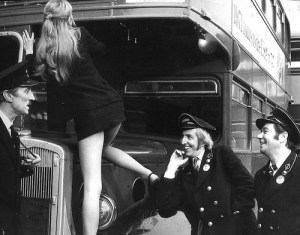
If I were portuguese and wanted to study the equivalent male phenomenon, I guess I’d have to analyse the old sitcome “On the Buses”. Coincidentally, I’ve recently watched my first episode of that. My daughter is obsessed with Reece Shearsmith at the moment and apparently they are planning to do an On the Buses parody in the current series of Inside Number 9. I’m old but even I’m not old enough to remember it when it was first broadcast.
Further musings about the expression “estar num sino”
I gently pointed out in reddit that it was surprising that quite a well-known song had an expression in it that hardly anyone understood and people seemed to be fine with not knowing what he was in about. Obviously there are plenty of songs in English that are the same (try listening to the lyrics of “Whiter Shade of Pale” sometime for example) so it’s not really surprising, but I thought it was fun to ask if people were actually listening to the lyrics.
Fiz uma pergunta ontem sobre a letra de uma música do António Zambujo. Há uma expressão na canção que diz “Fico num sino” que mal entendi*. O que mais me marcou foi o facto de os** respondentes também não saberem o significado da frase. Mas… É uma canção bem conhecida não é? Será que grande parte das pessoas ouviram a música e pensaram “Pois é, está presa*** numa campainha. Faz todo o sentido”
* mal entendi meaning I barely understood it. Maybe should have written “entendi mal” (i misunderstood it) or não entendi (i didn’t understand it) to be more accurate.
**de and os are separate here because “o facto de” is a sort of standalone expression.
*** apesar do cantor ser masculino a narradora da canção não é.
I haven’t done a song translation for while and I fancied having a go at “Cancao de Engate” by António Variações. There aren’t many decent videos of it and anyway he’s a bit hard to follow because of his distinctive singing style so if you don’t know it, try this orchestral acoustic version by Tiago Bettencourt
Cancão de Engate
My sense, going into it, is that it uses a lot of slightly oblique language so this is going to be a tricky one, but here goes…
Tu estás livre e eu estou livre E há uma noite p’ra passar Porque não vamos unidos Porque não vamos ficar Na aventura dos sentidos
You’re free and I’m free* And there’s a night to get through Why don’t we get together Why don’t we get Into the adventure of the senses
Tu estás só e eu mais só estou E tu tens o meu olhar Tens a minha mão aberta À espera de se fechar Nessa tua mão deserta
You’re alone and I’m alone too And you have caught my eye You have my open hand Ready to close On your lonely hand
Vem que o amor não é o tempo Nem é o tempo que o faz Vem que o amor é o momento Em que eu me dou Em que te dás
Come, because love is not time Nor is it time that makes it Come, because time is the moment In which I give myself And you give yourself
Tu que buscas companhia E eu que busco quem quiser Ser o fim desta energia Ser um corpo de prazer Ser o fim de mais um dia
You who are looking for company And me who is looking for whoever wants To be the end of this energy To be a body for pleasure To be the end of another day
Tu continuas à espera Do melhor que já não vem Que a esperança foi encontrada Antes de ti por alguém E eu sou melhor que nada
You keep waiting For something better that isn’t coming Because what you hope for has already been found By someone before you And I am better than nothing
Vem que o amor não é o tempo Nem é o tempo que o faz Vem que o amor é o momento Em que eu me dou Em que te dás
x3
Come, because love is not time Nor is it time that makes it Come, because time is the moment In which I give myself And you give yourself
x3
* I’m sorry, but I am a man of a certain age but I am already reading this in a Mr Humphries voice
Hey, well that wasn’t as bad as I thought it would be. One of the easier ones I’ve done, in fact!
Carrying on the translation tradition, I thought I’d have a go at this rap by Gandim because I can understand most of it but not quite all and I thought it would be fun to do the research and really understand it from top to bottom. Gandim means something like “workshy person”. He isn’t a real rapper, he’s a character invented by Guilherme Duarte. Duarte originally trained as a computer scientist (that’s relevant context for the song, believe it or not!) but he’s famous as a comedian who has been involved in a few different podcasts and media projects such as “Por Falar Noutras Coisas” (“Speaking of Other Things”). Here, he’s having a rap battle with himself in his “real” persona. It’s quite funny and has lots of good slang. It’s ABSOLUTELY FILTHY though. Seriously – this is definitely the rudest thing I’ve ever translated on here, so if you’re of a sensitive disposition you might want to skip this one!
It’s also interesting how they’re using some english words and expresions in ways that are close to but not quite identical to the way we use them ourselves: even in the title, “ego-trip”, seems just to mean a boastful rap and “feat” is obviously just “featuring” but later in the lyrics they seem to be using it as a noun, roughly equivalent to “collaboration”
Ya, Gandim feat Guilherme Duarte / Yeah, Gandim, feat Guilherme Duarte Juntos no mesmo som mesmo / Together in the same track Ninguém estava à espera / Nobody was expecting it Não sei se a tuga está preparada para isto / I don’t know if the Tuga was ready for this Vamos mostrar como é que se faz / Let’s show them how it’s done
Isto nunca foi visto / This has never been seen Porque nunca foi feito / Because it’s never been done Parece que viste o anti-cristo, boy / It looks like you’ve seen the anti-christ, boy Até te cai o queixo / Even your jaw is drooping Vai deixar mazela / It’s going to leave a wound Ainda nos vão pedir sequela / They’re going to ask us for a sequel As rimas são como as cricas / The rhymes are like pussies Aparecem tipo dicas / They appear like tips De todos os lados / From all sides Eu e o Guilherme (Olá Olá) os mais pesados / Me and Guilherme (Hello, Hello) the heaviest Espera lá… isto é uma egotrip? / Wait… is this an ego-trip? Ya, faz sentido pelo beat / Yeah, that makes sense from the beat Devia ter visto a tua parte antes de gravarmos o feat / I should have watched your part before we recorded the “feat“ Mas obrigado por me fazeres o convite / But thanks for the invitation Mas é melhor falares por ti / But it’s best to speak for yourself Eu nem sou bem rapper / I’m not really a rapper Há muitos melhores do que eu por aí / There are a lot better than me round here Não vale a pena essa humildade / This humility is no good Nu sta* rebenta sociedade / We are blowing up society O game vai mudar, a gente veio para ficar / The game is going to change – we came to stay Este som é bomba atómica, vai incinerar / This track is a nuclear bomb. It’s going to incinerate Calma, man / Calm down, man Não é preciso exagerar / There’s no need to exagerate Tipo exibicionistas / Like exhibitionists Não vamos estar aqui a criar / We didn’t come here to create Sei lá, expectativas irrealistas / I dunno… unrealistic expectations É um som razoável / It’s a reasonable track Um flow confortável / A comfortable flow Não vai ser nada memorável / It isn’t going to be memorable at all Nem raro de outro mundo tipo marte / Not rare, from another world like Mars Falo, claro, da minha parte / I’m speaking of course, from my own perspective As damas até ficam loucas, desvairadas, malucas / The women go crazy, frenzied, insane Desapertam as blusas e abanam as bundas / They loosen their blouses and shake their asses** Ficam com água nas bocas / Their mouths water Quando vêem as nossas bazucas / When they see our bazookas Vocês fazem cara de mau a pensar que têm pila grande / You make like a badass, thinking what big dicks you have Mole já mete respeito mas olha ainda expande / Soft, they give respect, but then they expand O que vocês têm de pau a gente tem só de glande / Our glans alone is the size of your whole dick*** Pah, o meu é médio, não vou mentir / Mate, mine is pretty average, not gonna lie Não é grande nem vale a pena medir / It’s not big but I’m not going to measure it Nem grosso nem fino, é banal quando estou contente / It’s not thick or thin, it’s OK when I’m happy E quando está murcho até é bastante deprimente / And when it’s soft, it’s pretty depressing Mas dizem que o tamanho não importa / But they say size doesn’t matter E mesmo que seja um bocado torta / Even if it’s a little bent Desde que não esteja morta / As long as I’m not dead O que conta é o que se faz com o membro peniano / What matters is what you do with your penile member E nisso, confesso, sou mais que mediano / And with that I am above average Aguento tipo 7 ou 8 minutos / I can last like 7 or 8 minutes Parece pouco, mas 5 é a média / It doesn’t seem like much but the average is 5 Não estou a gozar, li na Wikipédia / I’m not kidding, I read it on Wikipedia Cus e mamas, everywhere / Tits and ass everywhere Comemos com as mãos, sem talher / We eat with our hands, no cutlery Lambemos o prato todo da tua mulher / We lick your wife’s plate clean Até cai pó lado como Feher / Until she falls over like Fehér**** Ela quer mais diz que tu só reclamas / She wants more and says you only complain Nem é preciso férias nas Bahamas / A holiday in the Bahamas isn’t necessary É mesmo aí nas vossas camas / It’s right here in your beds Que vamos comer as vossas damas / that we eat***** your women Vamos? os dois ao mesmo tempo / “We”? Both at the same time? É um bocado estranho (caga nisso bro) / That’s a little bit weird (fuck this, bro) Tenho alguns complexos com o meu corpo / I have a few body issues E nem é pelo tamanho / And it’s not about the size Estar assim nu ao pé de outro homem / To be right there next to another man É demasiada nudez / That’s too much nakedness Não sei, dá para ir à vez / I dunno, maybe we could take turns Não quero ser mau companheiro / I don’t want to be a bad companion Mas se é para ir, vou em primeiro / But if I’m going, I’m going first A gente derrapa, drift fast and furious style / We slide in, Fast and Furious style Elas ficam molhadas com o nosso flow 8 mile / And they get wet with our 8 Mile flow Quer boleia a tua hoe / Does your ho want a ride? E não é só no meu lambo / And not just in my lambo****** Tem mudanças automáticas, 7 / It has seven automatic gears Mas ela tem a mão na manete / But she has her hand on my gearstick Não tenho guita para lambos / I don’t have the money for lambos E até acho que é muito show off / And I find them a bit showy Não curto dar nas vistas / I don’t enjoy showing off O meu bote é um clio de 99 / My ride is a 99 Clio Patina quando chove, faz barulhos da panela / It skids when it rains, makes a noise from the oil pan Tem pelos de cadela, rádio só à capella / It has dog-hairs everywhere and the radio is only a capella Não liga à primeira quando a noite gela / It doesn’t start first time on cold nights Deve ser problema de velas / It must be some problem with the spark plugs Aqui é faroeste, a lei é nossa / Here in the wild west******* the law is ours Tu estás a leste, baza ou levas coça / You are from the east, get the hell out of here or get spanked O que tu cospes cai no meu spam / What you spit******** falls into my spam folder Mas quem não cospe é a tua irmã / But your sister doesn’t spit Aqui é conflito, não é meninos da mamã / This is war, not mummy’s kids À noite é delito, dormir de manhã / the night is sin, sleep in the morning Vens dar para gangster com o teu clã / You’re coming like a gangster with your posse Ainda deixas a tua filha orfã / You’ll just leave your daughter an orphan Gandim, não sei se te consigo acompanhar assim / Gandim, I don’t know if I can carry on like this Eu não sou gangster nem g / I’m not a gangster or a G Só houve aquela vez que roubei uns cromos da panini / The only thing I have ever stolen is some Panini stickers Sempre fui bom aluno, calminho / I was always a good student, calm Eu sou bué humilde, mano / I’m really humble, man Já na autoavaliação pedia baixinho / In the self-evaluation I asked for a lower mark Menos do que achava que merecia no ano / Less than they thought I deserved that year Manda vir a tua crew / tell your crew to come E ainda sais daqui todo nu / And you’ll leave here naked Andas aí armado em clown / There you go, acting like a clown A tua tropa sai daqui tipo black hawk down / Your soldiers will leave here like Black Hawk Down Eu e o Guilherme a gente arrebenta / Me and Guilherme, we destroy Venham todos que a gente enfrenta / No matter who we face Tag team ninguém aguenta / Tag team nobody can withstand Humilhação tipo shot à panenka / Humiliation like a Panenka********* penalty kick Depende, quantos é que são / It depends how many there are São muito grandes ou um deles é anão / Are they very big or is one of them a dawrf? Se for malta da pesada ainda ficamos em maus lençóis / If these guys are heavy, we could be in a tight spot Consigo andar à porrada, mas não há cá heróis / I can fight but there are no heroes here Prefiro resolver de forma sensata / I prefer to resolve this sensibly Ser diplomata, sou franco / To be diplomatic, I am frank Mas se tem de ser, siga / But if it has to happen, go ahead Eu cubro-te o flanco / I’ll cover your back Fiz jiu jitsu, sou cinturão branco / I did ju-jitsu, I’m a white belt Invejas o don perignon / You envy the Dom Perignon O chamon, os diamonds e o rolex / The weed, the diamonds and the rolex Desculpa lá o flex / Pardon the flex Mas por isso é que a dama que me dá sex é a tua ex / But it’s because of this that the woman who gives me sex is your ex Tanto money no corpo uso o pulso como expositor / So much money on my body, I use my wrist like a showoff E tu honey, só lhe dás uso em frente ao computador / And you, honey, you only use it in front of your computer Eu nem tenho relógio / I don’t have a watch Vejo as horas no telefone / I check the time on my phone Que não é topo de gama / that isn’t top of the line Nem é sequer é um iphone / I don’t even have an iphone Não curto gastar assim / I don’t like splashing out like that Em booze, drugs e ostentação / on booze and drugs and ostentation Prefiro poupar e chegar / I prefer to save up and reach Aos setenta são / my seventies Os cães ladram e passa a caravana********** / The dogs bark and the caravan passes by E nós aqui a chillar com a marijoana / and we’re here chilling with marijuana Somos demasiado fat para ser fit / We’re too fat to be fit All day smoking weed, we don’t give a shit / All day smoking weed, we don’t give a shit Mais ou menos / More or less Não fumo há bué anos, mas não condeno quem fuma / I haven’t smoked in years, but I don’t judge those who do Só acho que há malta muito nova a fumar / I think it’s mostly young people smoking Não quero influenciar / I don’t want to influence them Porque depois o pessoal abusa / because then people abuse it Man, dá lá aí uma passa ya, fuma aí / Man, take a hit on this, smoke up É mesmo assim, Guilherme ya, somos os maiores deste a tuga até pequim / That’s how it is, Guilherme, we’re the greatest from Portugal to Peking é mesmo assim, os mais pesados / that’s how it is, we’re the heaviest Não curto gabar-me assim / I don’t enjoy boasting like this Não dá para fazer uma ego trip humilde / It’s no good making a humble ego-trip E deixar de parte ego / and leave out the ego part às vezes acordo tão negativo / Sometimes I wake up so negative Que me sinto abaixo de zero / That i feel less than zero Tenho as minhas inseguranças / I have my insecurities Acho que me está a bater a ganza / I think that weed is kicking in Dias depressivos, sem vaidade / Depressive days, without vanity Dias que não me acho capaz de fazer nada com qualidade / Days when I don’t feel able to do anything well O meu ego tem síndrome de Estocolmo / My ego has Stockholm syndrome Estou a ficar meio zonzo / I’m getting a little dizzy Estou a ficar meio zonzo / I’m getting a little dizzy Complexo deus aplaude o meu complexo de fraude / My god complex applauds my imposter syndrome Bué deep / Really deep Sou mil folhas / I am a thousand layers Flow bue quick / Real quick flow Beep beep / Beep beep Tenho bué camadas / I’ve got so many levels No sleep, horas acordadas / No sleep, awake for hours Porque na cama tenho sempre muitas queridas bué dadas / Because in bed I always have many well-endowed babes Sabia que tinha isso dentro de ti / I knew you had this in you Estava a ver que não / I was thinking you didn’t E se é para me gabar feito patrão / And if I have to boast, it’s done, boss Sou ganda boss da programação / I’m the big boss of computer-programming Tua cabeça não aguentavas a pressão, meu / You can’t stand the pressure, man Ainda te dava uma como a Maria João, Abreu / I even gave you one with Maria Joao Abreu***********
Ai, olha aí, há limites, mano / Hey look, there are limits, bro Acho bué falta de respeito dizeres uma cena dessas / I think it shows a lack of respect to say something like that É uma egotrip, tudo bem, mas calma lá / It’s an ego trip, OK, but calm down Não é preciso atirar com essa da programação à cara do pessoal / It’s not necessary to throw this computer-programming thing in people’s faces Nem toda a gente tem o mesmo acesso à educação / Not everyone has the same access to education Vou bazar, não curto estar aqui com gabarolas / I’m going to get out of here. I don’t want to be here with showoffs
*= Not sure what’s going on here – short for “nos esta(mos)” I think…?
**=I’ve gone against my principles and written this the american way because british spelling and rap do not mix
***=Look, I’m sorry, I’m just the translator, don’t blame me
****=I think this must mean the hungarian footballer who died of a heart attack on the pitch – hence the reaction!
*****=Comer a tua dama means “eat your lady” but comer is also a slang word for “have sex”, so I probably could have translated it less literally than this. The other relevant piece of information here is that the game we call drafts is called Damas in portuguese, and when you take the opponents piece, the word for taking can be “capturar” or “comer” so he could be talking about playing draughts. but in this context, probaby not!
******I guess he means Lamborghini here but the fact it’s so close to “lamber” is setting my double entendre radar pinging)
*******faroeste = far west? I’ve never heard this before, but I googled faroeste and it does indeed bring up a load of wild west films dubbed into portuguese!
********=-I assume this is the same as the slang use of spit in english – spitting lyrics, spitting facts. He’s dissing your rap lyrics, basically
*********= Panenka… he’s a footballer apparently. Good at penalties. Google him, I can’t explain
**********=This is an expression that comes up sometimes in exercise books – it just means something like – “we just carry on as normal, no matter what happens or who complains”
***********= Maria Joao Abreu was an actress who had died a few months before the video was released, so you’re meant to think that the shocked reaction that follows is as a result of the extreme bad taste of what he’s just said.

 Luso
Luso 