Posted in English

A Brief, and Not Very Coherent Rant About Language and Racism

Sorry, it’s in English today.

A man waving a Portuguese flag and awkwardly balancing a Brazilian one. For some reason est understood by AI, his head is in backwards.
I hope the boffins can sort out AI soon. I don’t want to be in my sixties, going in for a hip replacement and the robot doctor decides I am in urgent need of a head reversal procedure at the same time.

After writing yesterday’s blog, I looked at some more posts by the same Instagram account. The guy’s missus, who is Brazilian, has a video here in which she talks about a shitty, racist flyer that was being handed out in downtown Lisboa. She makes a lot of good points, but she seems to have caught some negative attention from social media bottom-feeders, as you can see from the follow-up post here.

In some cases, the critics have dressed up their nonsense as a complaint about non-standard Portuguese, but obviously, the underlying problem here is just straight-up xenophobia. There are racists in every country, of course. This is as true in Portugal as it is anywhere else, and weirdly Portuguese racism even extends to Brazilians, which is surprising when you consider that Brazilians are not natives of a former colonised country, they are largely the descendents of Portuguese settlers (and their slaves). Brazil, as a state, only exists because the territory now known as Brazil was colonised by the Portuguese. In short, they are you, lads! They’ve been away longer than your sobrinha who moved to Luxembourg last year, but it’s the same principle, just with a bigger time lag.

Now, I’m not saying there shouldn’t be an immigration policy that works for the country as a whole, but it has to be one that treats people as people. The minute people get into this kind of hatred, they’re on the road to a very, very bad place.

This is all by way of getting to my main point, which is that I’ve made cracks about Brazilian Portuguese on here a few times and I’ve even shared the odd meme (here for example). But I hope it’s clear that it’s not meant to be hostile. As you know, I mostly try to stick to European Portuguese as much as possible so as not to get confused, so some of the gags are about that desire to keep the other dialect at bay. But there’s also some friendly intercontinental rivalry between Europe and America, which is, at root, born of the inferiority complex of smaller less powerful countries seeing their former colonies doing more business and having more fun than us. Taking the piss out of our erstwhile cousins’ spelling and accent helps us cope with the shame of being efete and irrelevant on the world stage.

Anyway, I thought I’d better get that clear in case anyone thought I was like these pamphlet yahoos. This is a European Portuguese blog, but we love our transatlantic friends too, despite the occasional bit of teasing.

Posted in Portuguese

Racismo Em Português

Racismo Em Português de Joana Gorjão Henriques
Racismo Em Português

Racismo em Português” é um livro e uma série televisiva criados por Joana Gorjão Henriques, uma jornalista que trabalha no jornal Público. Comprei-o pensando que fosse um documentário sobre o racismo em Portugal mas não é. A jornalista entrevistou várias pessoas – jornalistas, músicos, ativistas – em cada um dos cinco países africanos de língua oficial portuguesa (“PALOP”). O objetivo do documentário é confrontar o racismo do Império português e os efeitos que permanecem nos países ex-coloniais nos dias de hoje. Estou ligeiramente desiludido porque queria saber mais sobre a realidade em Portugal em si, mas não importa muito porque este assunto é fascinante também. Não há narração durante o documentário. A jornalista deixou os entrevistados falarem sem os interromper. Foi interessante ouvir as opiniões deles sobre o seu ambiente, onde tantos edifícios ficam com o estilo do antigo poder colonial, e sobre as atitudes mentais que persistem ainda na vida cultural do povo.

Quanto ao livro, a narrativa é mais estruturada: a jornalista encaixa as palavras transcritas dos entrevistados num contexto que (segundo a sua própria introdução) retira muita inspiração do pós-modernismo que está muito na moda em círculos académicos nos Estados Unidos, que tem uma visão muito simplificada do percurso da história, e uma visão de racismo para com pessoas negras como o pecado original que explica todos os males dos nossos tempos. Isso ressoa em várias entrevistas também, mas parece-me que a jornalista amplifica-o ainda mais. Uma entrevistada fala de “micro-agressões” que faz pouco sentido em geral mas faz ainda menos numa sociedade onde brancos e mestiços de pele clara constituem uma minoria da população. No capítulo sobre a situação em Angola, ela fala de “privilégio branco” ainda que haja poucos brancos para serem privilegiados. Um mestiço (ou seja “produto da miscigenação” 😬) pergunta-se “Será que eu preferiria não existir, será que isso teria tirado algum peso, o não ter havido colonização [….] Então não dá para responder porque eu não estaria cá para responder e não há como comparar porque não há como voltar atrás”. Esta conversa marcou-me muito, tanto no livro quanto no documentário, porque a vida daquele homem é emblemática do estado em que nos encontramos no século XXI. Devemos escolher: ou nós focamos no passado ou no futuro. Ou responsabilizamos as pessoas claras por existirem e por serem ‘privilegiadas’ ou afastamo-nos da ideia de raça e trabalhamos para criar um mundo em que nos tratamos como se fôssemos iguais porque somos iguais mesmo, digam o que os racistas disserem.

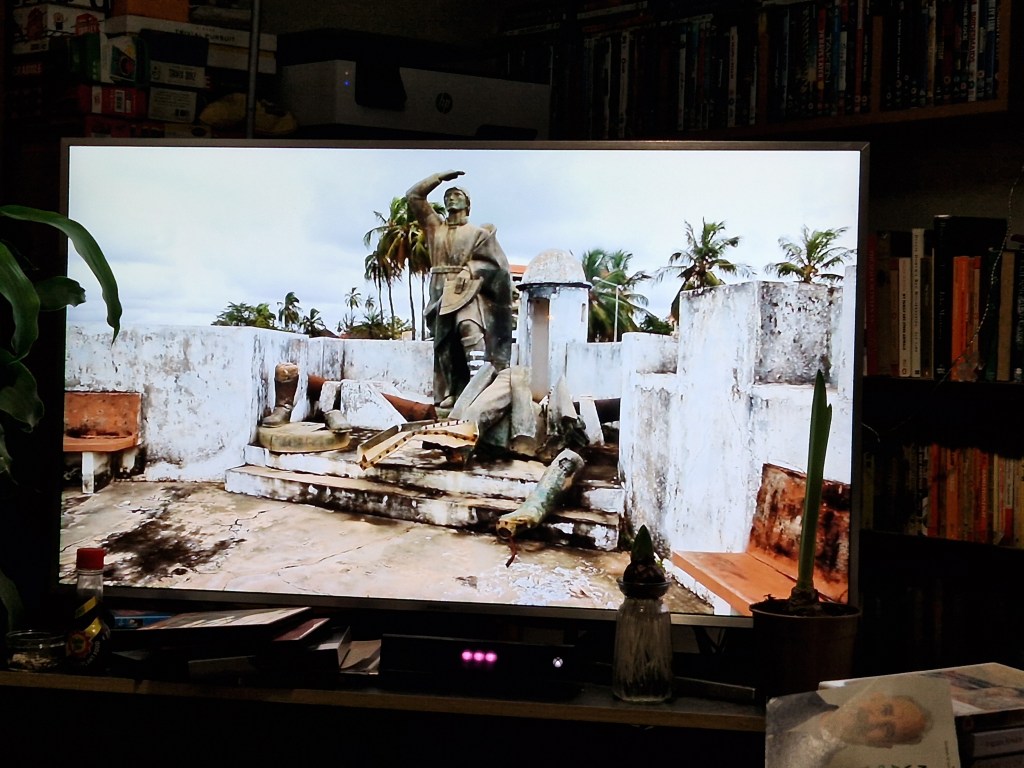
The ruins of empire… And whether I’m referring to the image on the TV or the mess that surrounds it, I’ll leave it to you to decide.
Posted in English

TFW you’re being Microaggressioned

As a result of a recent conversation about racism (following on from a book I read – there’ll be a review here in a day or two) a Brazilian guy on reddit pointed me to an account on Instagram called brasileirasNaoSeCalam. It’s basically one of these accounts that seeks to ginger people up for a particular cause by telling you how absolutely terrible everything is. In this case, quite a lot of the posts are just quotations from Brazilians in other countries recounting times they were victims of racism. The vast majority of them are in Portugal.

It’s quite interesting from a sociological point of view because of course there are racists in every country and knowing what kinds of stereotypes people have about each other tells you something interesting about the country. There is definitely racism against Brazilians in Portugal. I’ve seen videos and I have spoken to people who have some really unpleasant views about them all being thieves and whores, but I’m a bit unclear about the extent of that racism and I’m curious to know more.

But just as there is racism in every country, microaggressions (ie perceived slights which are held to be evidence of a deep seated hostility) are everywhere too, mainly thanks to the steady creep of absolutely terrible ideas from the USA. And my sense is that a lot of these posts fall under that heading. And in a way, that’s interesting in itself because learning what people see as a microaggression can tell you something about the shape of paranoia in a particular demographic. Take this for example:

(I’m doing an online course and my teacher always turns up with two video options for us to watch: one in Brazilian and one in English “for anyone who doesn’t like Brazilian”

From the comments, the reason for the complaint is that some people find the use of “brasileiro” in place of “português de Brasil” to be evidence of hatred, and the fact that she thinks some people might prefer to hear a foreign language rather than a São Paulo accent just adds insult to injury. This seems a little over-sensitive, but more importantly, I think it’s pretty obvious that there are plenty of alternative explanations for why English is being offered alongside Brazilian. For example, Portugal has a pretty good record of welcoming refugees and asylum seekers from Syria, Venezuela and Ukraine, among others. It must be a hard transition for those people to make given how much harder it is to learn portuguese than English. Of course it’s not practical to have videos in every language, but English is practically a universal esperanto these days, and it seems very likely that someone who is still struggling to learn portuguese might find it easier to follow an English language video than one that is in a strong, unfamiliar accent.

The irony is I think the teacher is being unfairly accused of racism just because they are making the course more accessible for all immigrants, and not exclusively catering to the needs of oversensitive Brazilians. Quite a lot of the quotes on the site are in the same vein: they’re minor or open to more charitable interpretation or just frankly unlikely-sounding.

Don’t get me wrong, there are definitely some real racist incidents on there, but I get the impression it’s one of those accounts where all the followers want to tell their victimhood story and the net effect is that it becomes a huge echo chamber and everyone inside is in a state of constant fear and rage, way out of proportion to the real situation. I’d love to find some good journalism on the subject though. When I say good journalism I mean (a) uses data competently and thoughtfully and (b) doesn’t pepper their narrative with the word ‘privilege’.

Posted in English

An Incident

I was interested in this passage from Maremoto, the book I finished the other day. In the passage, the protagonist, Boa Morte, is standing around near a bus stop when a guy he’s never met comes up and starts accusing him of stealing and generally giving him a hard time. Xingar is a good word here: to verbally abuse someone. O homem está a xingá-lo

Djaimilia Pereira de Almeida

“Chamou-me preto de Guinea, farrusco vai para a tua terra, escarumba eu sei lá que mais, aqui na rua há quem diga que pareço realeza, não sei se é verdade, o povo Cuanhama é conhecido pela sua majestade”

Maremoto – Djaimilia Pereira de Almeida

It’s obviously got a strong racial angle: preto being a word for black that is not exactly polite (“negro” is the more acceptable word). I’ve heard it described in a news program as the Portuguese equivalent of the N word, but it certainly doesn’t seem to be that, judging from the contexts I’ve seen it in. It definitely has a charge to it though. Likewise, Farrusco is related to skin colour, but its literal meaning is more like “sooty”. “Vai para a tua terra” means go back to your own country and Escarumba is just a general, derogatory term for a black person.

I was initially confused as to why he then goes on, in the second part of the sentence, to talk about royalty, but I was probably being stupid: he’s just turning the situation around. The guy haranguing him can only see his colour and is making all kinds of assumptions about him, but he says among people who know him better, he is considered to have a regal bearing. It seems quite a good way of dismissing the idiot as an irrelevant know-nothing.

When I asked about this online, quite a few people said it wasn’t necessarily a racist incident. Say what now? It’s true that the book doesn’t say for sure that the aggressor in the situation is white, but everything about the terms he’s using – three words in quick succession that make specific reference to Boa Morte’s skin colour – just make me think that the speaker doesn’t share that skin colour. I pointed this out, but the Portuguese peeps replied that there were rivalries and snobberies between black Portuguese people and Africans and then within the African community between different nationalities and tribal groupings and that it’s not unheard of for different groups to say ostensibly racist things to each other as a result. Nobody from within Portugal contradicted this point of view; nobody said it sounded like a racist incident. Every Portuguese person who expressed an opinion said it seemed ambiguous to them.

Mmweellll, I’m from outside the culture so I’m reluctant to flat out contradict them but I must say that gets a big 🤔 from me. If anyone else reading this knows the book, I’d love to hear how you read it and whether or not you agree.

Anyway, it all sounds a bit grim, doesn’t it, but Djaimilia Pereira de Almeida is a good enough writer that she can handle a pretty heavy subject with a lightness of touch. It’s quite a funny scene, believe it or not!