I thought I’d give this post from last year a brush-up since it’s a bit out of date
It’s always a good idea to have some tricks up your sleeve for learning languages when you don’t feel like it, when you want to increase the density of your target language in your life, or when you just want a change of pace. Here are a few of my favourite techniques with a European Portuguese flavour:
Podcasts
If you’ve got some mindless task to perform, such as hoovering, ironing or writing a speech for Donald Trump, don’t listen to the new Katy Perry album, listen to someone speaking your chosen language instead. Portuguese (as opposed to Brazilian) podcasts are hard to come by but you can find them if you look hard enough. There are three specific language-learning podcasts for european portuguese that I know about. They all have their own websites but you can find them on itunes too. I’ve put them in order of difficulty with the easiest first
- Portuguese with Carla is really focused. Carla and her husband Marlon take a short piece of dialogue and break it down in minute detail, encouraging listeners to follow and repeat the words. It is definitely a good place to start if you have no Portuguese at all or if you want to work on your pronunciation. They have a few weird theories about how smelling herbs helps you learn but no worries, I’ve tried it without performance-enhancing oregano and it has been very helpful.
- Practice Portuguese is everyone’s go-to podcast for European Portuguese, and if you speak to other portuguese learners they’ll usually mention it within the first ten minutes. It’s produced by a native Portuguese guy called Rui, who does most of the talking and Joel, who is Canadian and adds a learner’s perspective to some of the dialogues. The podcasts started out aiming to develop listening skills, but more recently, they have developed a more coherent feel and branched out into videos and an online learning system for newbies. Pro-tip: don’t listen to the podcast in order because the earliest ones are some of the more challenging. You’re better off looking on the website, where they have a filter system that lets you choose your difficulty level.
- Say it in Portuguese is the most advanced of all, I think. Each episode deals with an idiomatic expression and explains its use and meaning. It’s great if you are working at the B1/B2 level but it takes no prisoners, and I definitely wouldn’t recommend it if you’re starting out.
In addition, you can probably find Portuguese podcasts on subjects that interest you. Obviously these are harder, because they’re aimed at a home audience, not at learners, but it’s a great way of developing listening skills if you don’t mind a challenge!
One strategy for finding them is to search itunes’ podcast directory for portuguese words that interest you (futebol, livros, telemóveis etc), but you’ll probably find a lot of Brazilian or even spanish results come back. Another is to look for specific portuguese broadcaster like “rádio comercial”, RTP or TSF and see what they have to offer. Here are a few I like:
- Caderneta De Cromos A series on Rádio Comercial about eighties pop culture, covering Star Trek, Pat Benatar, Ghostbusters, Space 1999, Rocky, Pac Man… All the good stuff.
- O Homem Que Mordeu o Cão Another Rádio Comercial offering, featuring the same presenter as the last one, namely Nuno Markl. It deals with weird news from the week.
- Grande Reportagem Long-form audio reporting in a radio 4 stylee.
- O Inimigo Público One of the easier-to-follow news podcasts. It’s the audio version of an irreverent comment section in the print newspaper Público.
- Pessoal e Transmissível Interviews with people from all walks of life. The podcast isn’t being made any more but there are hundreds of old ones still available on iTunes.
- Sbroing Children’s audiobooks. They did a whole recording of “O Principezinho” (The Little Prince) that has expired from iTunes but you can still download it from the site.
Taking a left-turn at the traffic lights, there are some good, inspirational podcasts for language-learners in general. Have a look at “Actual Fluency” or “Creative Language Learning” in iTunes, for example. Personally, I can only take this kind of thing in small doses, but a little of it now and again is good. It reminds you that you’re not alone and it gives you some ideas from the hardcore language-ninjas.
Audiobooks
Librivox has a few books in Portuguese but they’re mainly recorded by Brazilians, I think, including the collections of European Portuguese poetry. There’s a very good version of Amor de Perdição by Camilo Castelo Branco in proper Portuguese, though, and you can probably find a few others if you dig around a bit.
Online Videos
If you have Netflix, try looking for Salvador Martinha’s “Tip of the Tongue”. He’s a comedian, and as far as I know, his show is the only legit European Portuguese offering on UK Netflix at the moment. There’s a series called 3% which is in Portuguese and meant to be very good but it’s Brazilian so probably not helpful if you’re studying European Portuguese.
There’s a portal website linking to Portuguese TV Live and you can also look up the individual stations on Google, of course, and check their stock of archived shows.
There’s quite a bit on Youtube though. Leaving aside whole films, Youtube is a great source for things like documentaries and vlogs. If you can find a channel that broadcasts regular updates on a subject you like, it’s a huge incentive to listen regularly, and you’ll find Youtube helps you along by suggesting similar things to try. I am a huge fan of books, so I started out googling “livros” and various other likely-sounding portuguese words until I managed to find the portuguese booktube community. Criteria to use when picking a channel might be:
- Does the subject matter interest me? (obviously!)
- Is the presenter engaging,
- Do they share my tastes in books/ motorbikes/ fashion/ antique silver cowcreamers/ whatever? A lot of Youtube videos are made by younger people, so you if you’re an old fart like me you might have to hunt around for people who have interests outside the young adult mainstream.
- Do they speak clearly?
Here are a few booktube channels I’ve found, in case you are also a bookworm and want to save yourself a lot of digging and just piggy-back onto my research.
I could actually add about half a dozen others that I could mention but I probably don’t need to because if you watch a few of these, Youtube will start suggesting other related accounts, so you’ll find them soon enough. It’s quite a close-knit online community.
Music
If podcasts aren’t your thing, there’s always music. I’m a bit ambivalent about music as a learning method. A lot of people recommend it, including my wife, but I often find it’s like watching as a stream of syllables rushes by at speed. I think unless you’ve taken trouble to read the lyrics written down beforehand and compare with a translation, it’s difficult to pick the words out and appreciate them. Of course, you can still enjoy the music, but understanding the lyrics adds a whole other dimension. Most songs can be found on sites like lyricstranslate, and if you put some time into getting familiar with the meanings, it’ll pay off, I promise!
If there’s one thing Portugal has lots of, it’s music. Here are a few bands to try:
- Deolinda (by far my favourite Portuguese band)
- Ana Bacalhau (solo material by the singer from Deolinda)
- Amália Rodrigues
- Miguel Araújo
- Os Azeitonas
- António Zambujo
- Orquestrada
- Ana Moura
- Mariza
- Salvador Sobral
- Carlos Do Carmo
- DAMA (everyone tells me how they like this band. I can’t be doing with them myself but maybe I just have bad taste)
Here’s my Spotify playlist if Spotify is your thing
DVDs
 If you’re clever enough to understand films made in Portuguese, that’s a great way to learn more but it’s pretty challenging. You’re not helped by the fact that the Portuguese film industry is not particularly strong compared to Brazil, even, let alone Hollywood. Some of the old classics are excellent (but beware modern remakes of classics like O Pátio das Cantigas for example). I liked Capitaes de Abril very much and the films of António-Pedro Vasconcelos seem to be worth a look, like Os Imortais for example, or Call Girl, which looks a bit dodgy but I’ve heard is good. Some portuguese movies can be a bit grim though. Ossos, for example, is slow and turgid and has barely any dialogue in it so what’s the point? I have one called O Vale de Abraão which I’ve heard good things about but it looks pretty bleak too, and the bloody thing is three and a half hours long, so I’m putting it off…
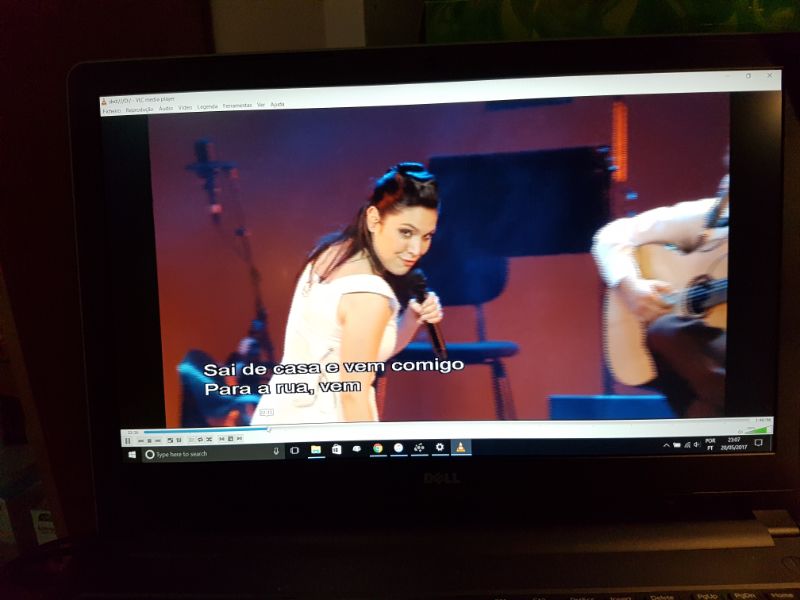
Easier fare would be an English-Language film you’ve seen before, dubbed into your target language. That usually means children’s animated films, since nobody ever dubs live-action movies. Try and check that the actors doing the voice-overs aren’t Brazilian. The last thing you want is all that Eejy Beejy Beejy thing that Brazilians do. We have three dubbed films in the house (*points* at the picture at the top of this section) and it’s good because my daughter likes watching them too. Turn on English subtitles if you are very new to the language, or Portuguese subtitles if you just want written clues to help you disentangle the words. Or neither if you’re a total badass.
Change the Way You Use The Web.
If you spend a lot of time online (ha ha ha, sorry, I’m kidding – obviously you do! It’s the twenty-first century and you probably haven’t left the house in weeks!) you can massively increase the amount of language in your life by tweaking the settings on your most-used websites. The obvious one for me is my Google Account settings, which affects all my search results, plus the menus in Google Chrome, names of folders etc in Gmail, spellcheck in Google Docs, names of days and months in Google Calendar and half a dozen other things.
I’ve also changed twitter, but that doesn’t do much except teach you some stupid pretend words like “tweetar” (shouldn’t that be “pipiar”???). I daresay if you use Facebook you could get some mileage out of changing the language settings in that. You can change the settings of Windows itself if you have Windows 10 but it’s a bit harder on earlier versions. This might be the ONLY advatntage of Windows 10.
Put Your Existing Apps To Work
 I found it pretty hard to find good apps for learning European Portuguese, but it’s relatively easy to find good quiz apps and many of them have other language settings. I have a copy of Trivia Crack which I’ve set on Portuguese so I can enjoy farting about playing games and still be learning new words, phrases and pop culture references and (crucially) facts about Brazilian football. It has its drawbacks of course: most of the questions are written by Brazilians so you get quite a lot of Brazilian grammar in there, but still, it’s more educational than Angry Birds.
If you’re feeling feisty, there’s even a “translate questions” feature that lets you translate Portuguese (or whatever) questions into English.
You can change the language settings on quite a lot of apps, in fact, but I’ve found quiz apps are more useful than most since you have to think quickly and really engage with what you’re being asked.
Going a step further, try changing the language settings on Android or iOS. It’s quite a big step because from then on just about anything you do using it will require a bit more concentration, but if you’re up for it, it’s a great way of getting familiar with vocabulary related to gadgets.
Language Apps
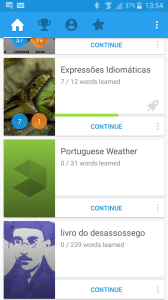 Memrise is really the only dedicated language-learning app worth having. What makes it different from other apps is that it keeps track of the words you’ve learned and returns to them a short time later, to jog your memory so that they really stick. There’s some science behind it apparently. I dunno. It works pretty well though.
The decks are made by users, so they vary in quality. Some are mildly irritating. For example, they will count something as wrong because you used a lower case letter instead of a capital, then in the next slide you’ll use a capital and it’ll mark it as wrong because now it wants a lower case. That doesn’t stop it being a kick-ass language-learning tool though, and of course you can easily make your own decks with words you want to learn. I usually have a go on it while I’m brushing my teeth at night and while I’m eating my breakfast in the morning. As with most things, make sure you specify European Portuguese, not Brazilian.
There are lots of other vocabulary apps but I don’t really rate them highly. If you want to take a look, you could try this blog post by Marlon Sabala.
iTalki and Hellotalk are useful apps that can help you find formal or informal tuition, language exchanges and so on.
Most of the newspapers and broadcasters have their own apps too, and you can set them up to bombard you with portuguese destaques (headlines) throughout the day, and some of the language translation sites like Google Translate and Linguee have apps too.
Websites
I’ve come across a few useful websites that you might want to check if you don’t already know them:
- Conjuga-me (excellent website that summarises all the verb tenses for a given verb. Definitely one to bookmark!)
- Priberam (online dictionary)
- Linguee (it took me ages to see the usefulness of this, but if you search for a word, either in english or portuguese, it’ll give you actual human-created translations in real books or official publications so that you can get a feel for the way it’s translated in context)
- Readlang (directory of native speakers reading texts)
- Nós Falamos Portugues (learning esources, including short interactive exercises, sorted by level)
- Badumtish (flashcard game – very basic)
- Ciberdúvidas (Q&A about the portuguese language)
- Learncafe (I’m saving this one for later: it has courses in various subjects, taught in Portuguese. It could be a bit challenging. I also suspect it of latent Brazilianness, so handle with care)
Label Your House
I mentioned, last year, posting post-it notes all over my house with the names of things on them. That’s quite a clever way of bumping up your vocabulary a bit without really trying, although with hindsight I wish I’d written the words in larger letters with a big fat marker, as I find myself peering at the post-its instead of having the words thrust in my face.
Lindsay Does Languages has a brilliant variant on this theme. I came across it earlier today and decided to incorporate it in my life as soon as I get a free minute (2019, I think). While you’re at it, have a look at some of the other articles on her site. They’re pretty good fun.
 Hoje, fui até ao Barbican Centre para ver um concerto de música lusófona de Portugal e do Brasil. A fadista Carminho está quase ao fim dum série de concertos nos quais ela canta as obras de Tom Jobim. Lamento que não tenho um grande conhecimento de musica brasileira, mas conheço o nome de Jobim, e dois membros da banda tinham o mesmo nome porque são os netos dele (ou.. Um neto e um filho…? Não sei…) além duma baterista e do violoncelista Jaques Morelenbaum.
 Também cantou dois fados dedicados ao Jobim e um outro escrito por uma poeta brasileiro, Vinicius de Moraes.
 esta semana! Na quarta, fomos (ou seja, a senhora 18ck e 18ckinha foram, porque tive que trabalhar) até ao Hammersmith Apollo para ver The National, e no sábado vamos ver Nick Cave num gigante estádio e vamos precisar dum telescópio. Mas o ponto alto da semana foi ontem à noite, quando fomos ao Barbican Centre para assistirmos a um concerto do Miguel Araújo.