Posted in English, Portuguese

O Tyler Joseph E Eu

I wrote a narrative version of our adventures at Reading Festival on iTalki because it seemed to have more potential than just the bitty account I published yesterday. My daughter wanted an English version so I’m going to do alternate sentences, Portuguese, English, Portuguese, English.

Hi lovely. I hope you like it. It’s quite hard to be funny and interesting in a language I don’t speak well, but I tried!

So here we go…


14026710_1101393793249229_1209082872_n
One of these people is old enough to know better

Fomos ontem a um festival de musica.

Yesterday we went to a music festival

Tweetei “ao vivo” durante o dia inteiro em Português para praticar.

I tweeted live in portuguese all day for practice

O festival se chama Reading Festival porque fica numa cidade que se chama Reading, mas “Reading” significa “a ler” ou “leitura” e por isso usei o hashtag #festivalDaLeitura apesar do facto de que não tem nada a ver com livros.

The festival is called Reading Festival because it’s in a town called Reading, but “Reading” is the English equivalent of the portuguese words “lendo” or “leitura” (Portuguese words for reading!) so I used the hashtag #festivalDaLeitura even though it has nothing to do with books!

A minha esposa ficou confusa por isso.

My wife was confused by that

Porque é que um homem de 47 anos foi a uma festival para jovens de quinze a vinte-e cinco anos?

So why is it that a 47-year old man went to a festival for 15 to 25-year-old youngsters?

Fui com a minha filha.

Well, I went with my daughter

Ela tem onze anos – mais nova do que a média da idade duma pessoa no festival, mas é uma fã da banda Twentyøne Piløts (vinte-e-um piløtøs).

She is eleven – younger than the average age of someone at the festival but she is a fan of the band Twentyøne Piløts

Esta banda estava programada para às vinte-e-um menos dez.

This band was scheduled to play at 8.50PM

Conduzimos até ao festival na manhã e passamos o dia a explorar a arena.

We drove to the festival in the morning and spent the day exploring the arena

O Sol brilhava e o dia estava quente.

The sun shone and the day was warm.

Ouvimos várias bandas novas: Creeper, Lower Than Atlantis, Citizen, Neighbourhood, Dinosaur Pile-up.

We saw some new bands: Creeper, Lower Than Atlantis, Citizen, Neighbourhood, Dinosaur Pile-up

A experiência foi muito divertida.

The experience was really fun

Quando o relógio aproximou-se da hora de jantar, fomos para a tenda do NME onde os 21 Pilots iam tocar.

When the clock was nearing dinner time, we went to the NME tent where 21 Pilots were going to play

Chegamos muito cedo para tentar encontrar um bom sítio para ver o palco.

We arrived very early to try and find a good place to see the stage

Foi difícil, porque existiam muitos idiotas altos que empurraram em frente de nós, mas no afinal achamos um lugar perfeito.

It was difficult because there were a lot of tall idiots who pushed in front of us but finally we found the perfect place.

13687330_1896735653887220_101347283_n
O Tyler Joseph está lá dentro!

Sabes os Twentyøne Piløts?

Do you know Twentyøne Piløts (Yes, I know my one English reader does!)

São bué fixe!

They’re so cool!

Quando chegaram ao palco todas as fãs gritaram e fizeram um grande barulho.

When they arrived on stage all the fans screamed and made a big noise

A música começou e dançamos, saltamos, e cantamos muito fortemente.

The music started and we danced and jumped and sang really loudly

Eles tocaram as músicas mais conhecidas, e enquanto que tocaram, fizeram muitas acrobacias loucas.

They played their best-known songs and while they were playing they did loads of crazy stunts (I don’t know how to say “hamster-ball” in Portuguese)

Depois do concerto, regressamos a casa.

After the concert we went home.

Ouvimos mais tarde que durante uma acrobacia o cantador, o Tyler Joseph, foi vitima dum assalto, mas achamos que a historia foi exagerada.

We heard later that during one of the stunts, the singer, Tyler Joseph had been the victim of an assault but we think the story was exaggerated

Caiu sobre um grupo de fãs, perdeu um sapato e a sua t-shirt. foi rasgada.

He fell on top of a group of fans, lost a shoe and his t-shirt was ripped (I don’t know how to say “ski mask” in Portuguese)

Alguns fãs ficaram bêbados mas não havia uma atmosfera nada má.

Some fans were drunk but there wasn’t a bad atmosphere.


IMG-20160827-WA0000
America Reacts

Actually, that last sentence understates it – the atmosphere was amazing and the weird backlash from fans online has been a bit surreal to watch. I had someone ALLCAPS ME because I had been near the moshpit so he thought I was one of the villains who had done the deed.

Anyway, that’s my story. If two blog posts weren’t enough and you want to know more about these smol beans there’s another eyewitness account of the crime here written by my daughter, who has employed much higher journalistic standards in her account and is able to supply far more detail.
Posted in Portuguese

Oxford

Este fim de semana, a minha família e eu fomos a Oxford*.

Ficamos hospedados num hotel e visitamos vários lugares turísticos – a biblioteca “Bodleian” (onde foram filmadas as cenas dos filmes** “Harry Potter”) e uma escola da universidade famosa. Infelizmente, Oxford fica no Reino Unido e por isso o tempo estava húmido e frio, mas a cidade é linda, e gostamos muito dela. Mais importante, comprámos muitos livros. Adoramos os livros.
No domingo (hoje!), remei em Oxford City Regatta (Regata da Cidade de Oxford) com o meu amigo japonês. Perdemos ambas as corridas. Os nossos oponentes eram homens grandes e fortes com muita experiência e muito treino, mas não faz mal. O dia estava bom. Enquanto que eu remava, a minha mulher e filha caminharam ao longo do rio e foram ao cinema para ver o filme “Swallows and Amazons”

*=No Google Mapas Oxford se chama Oxónia mas acho que não é comum em Portugal. Pode ser é um nome Brasileiro para a cidade…?
In fact, Sophia informs me:

Na verdade é um nome aportuguesado, mas creio que não é muito comum em Portugal. Tens aqui a explicação: https://ciberduvidas.iscte-iul.pt/consultorio/perguntas/oxonia-ou-oxford/2019

**=I wrote “a serie Harry Potter” as a literal translation of “The Harry Potter Series” (of films) but although “serie” is used in Portuguese it seems only apply to actual TV series.

Posted in Portuguese

A Linguagem Gestual

2016-08-12_17.58.19
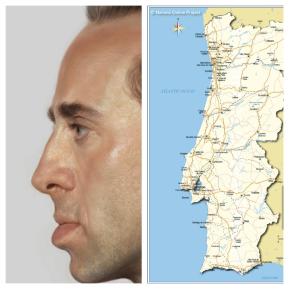
Mapa do Portugal (à esquerda) e imagem de uma cara (à direita)

Fiz hoje uma aula de Linguagem Gestual Britânica. Foi interessante. O professor ensinou-me a dizer (ou se calhar “como fazer gestos por”) “Olá”, “Chamo-me Colin”, e muitas frases úteis.

O meu gesto preferido foi “Portugal”. Olhe o mapa de Portugal. Parece uma cara em perfil, não é? Por isso, o gesto Portugal é um dedo colocado na testa e trazido sobre a nariz até o queixo do locutor.

Acho que não é o mesmo sinal em línguas de sinais em outros países.

Posted in English

Two Become One

CpR1xmZXgAE54XYSo the other day, my wife was reading the Observer to maintain our impeccable middle-class credentials, when she showed me a full-page graphic in which the headline “Why two languages are better than one” is written in several different languages, including Portuguese.

“Do you see a problem?” she asked, and I’m happy to say that, yes, it jumped out at me straight away. It turned out to be quite educational. Stay awhile and read the next few paragraphs and I will lift the lid on the whole sorry affair.

To further burnish those impeccable middle-class credentials I mentioned, I decided to take a picture of the page and tweet about it in a slightly smarmy way.  I also mentioned it to a couple of other people – a Portuguese friend on Hellotalk and an online tutor. To my surprise, both of them thought the sentence was absolutely fine and error-free. Well, what was I to do? How could I break the news to Mrs L that she had been outvoted? I asked a different tutor and she initially joined the “No, it’s fine” crowd, but then after thinking about it agreed that it was a mistake. Two all. Mrs Lusk then started pinging it out to people she was at school with – people in their forties who went to school before the Acordo Ortográfico when it all got a bit slack. At last the balance of opinion shifted decisively in favour of it being a mistake and her faith in humanity was restored.

So what was the problem? Well, my Portuguese is pretty feeble, but let me have a stab at describing what I think is going on and why it wasn’t obvious whether or not there was an error. Basically, the problem is the mismatch between

são + melhor

in the middle there. “São” is third person plural but “melhor” is singular. There are two languages so it looks like it ought to be “melhores”.

That’s as far as I had got when I was smarmily tweeting at the Observer, but I’m not even sure “sao melhores” is right either. What does the adjective describe? Not the languages themselves surely? That would be like hearing the sentence

Why two languages are better than one

and parsing it as

Why two languages are both better than this other language

That makes a sort of sense but what we’re really interested in is not the languages themselves but a person’s ability to speak the two languages. There’s a word missing:

Why speaking two languages is better than speaking one

Now it makes more sense because here “speaking” is a gerund – a present participle used as a noun. If you add the gerund back in it’s obvious what we’re actually talking about here. The adjective and the verb now refer to “speaking” so they can go back to being singular again and we can make another version of the sentence.

OK, here goes – I’m really putting my neck on the line here. If I muck this up after this much build-up I’m going to look a right tit:

Porque falar duas línguas é melhor do que falar uma

If this were Brazilian portuguese we would use a portuguese gerund (“falando”) but European Portuguese seems to prefer infinitivos (“falar”) in these kinds of situation. Apart from that… I think this is better, but if it’s not you can have a good laugh at me in the comments box below this post.

This kind of thing isn’t just a portuguese problem of course. We’ve all heard English-speakers mangling sentences because they haven’t really thought about what the words mean. Me, I always get muddled up with collective nouns. Do you say “a small group of bankers are destroying the economy” because there are multiple bankers, or “a small group of bankers is destroying the country” because there’s only one group. So it doesn’t really surprise me that there are sentences like this that can trip up perfectly intelligent portuguese people. I’ll just note it down as an interesting artefact I’ve come across on the road to fluency.

Posted in English

Key Learnings 5 – Gender Rannygazoo

I haven’t blug for a while. Blug is the past tense of blog, right? Anyway, while I have been in silent mode, I’ve been involved in a group discussion on Hellotalk run by a Portuguese friend. There are a few Portuguese-learners in there and it’s interesting to see how the conversation evolves.

Now, normally, I mention my own failings in conversation, but in this case, someone else made a mistake that I thought was really interesting and I definitely would have made it too if I’d been trying to say the same thing, so I’m writing about it to help cement the knowledge in my brain. What he said was

Eu tenho dupla nacionalidade, Americano e Português

The correction came back as

Eu tenho dupla nacionalidade, Americana e Portuguesa

Weird. He’s a bloke, so why is it “Americana” and not “Americano”? Well, the answer is that nacionalidade is a noun in its own right and the way the sentence is structured, it’s his nationality that is described as American, not him. Since nacionalidade is feminine, it becomes “Americana”. If he had said

Eu tenho dupla nacionalidade. Sou Americano e Português

that would have been OK, because in that sentence the adjective is applied to him directly. I was taken aback at first, because we anglophones are so used to not having to think about this stuff, but when you think about it, it makes sense, and opens up a little window into how the language works.

Posted in Portuguese

A Regata

No sábado*, fui à cidade de Staines para fazer parte duma regata, a minha primeira regata desde que comecei neste desporto. As equipas de remo vieram de muitos clubes do sudeste de Inglaterra. Cada equipa estava vestida com o uniforme do seu clube. O sol brilhava e o rio Tamisa parecia lindo, cintilante na luz de uma tarde de verão.

A minha primeira corrida foi o “double sculls” (barcos duplos com dois atletas e quatro remos). O meu parceiro chamava-se Kenji, um homem japonês que mora aqui em Londres. Ele é um remador um pouco melhor do que eu, mas somos bastante similares. Ganhamos a corrida facilmente.
A segunda corrida foi um conteste entre barcos individuais. Neste desafio, o meu rival era… o mesmo Kenji da corrida passada! IMG_5841Enquanto eu remava a linha de partida, tive uma experiência assustadora. Um barco quádruplo saí da sua pista e veio directamente a mim. Gritei “dê uma olhada!**” mas os dois barcos colidiram. Parece que como um milagre ninguém foi ferido. Enfim, cheguei à linha da partida. Comecei bem, e fiquei contente de estar em frente durante a maior parte da corrida mas infelizmente, fiz um erro com o meu remo esquerdo e o meu barco quase parou. Se não tivesse feito este erro, podia ser que eu ganhasse, mas não posso resmungar: a habilidade superior do meu amigo ganhou o prémio.

Finalmente, Kenji e eu entramos no nosso barco duplo outra vez para a corrida final do dia. No caminho para a linha, estava a pensar “que mais me iria acontecer?” porque lembrei-me do barco quádruplo. Mas o pior estava para vir: Senti algumas cocegas no meu joelho. Olhei para baixo. Os meus deuses***! Uma aranha gigante estava a subir o meu joelho! Comecei a chorar imediatamente e bati os meus joelhos até não sentir mais nada.

Desta vez não conseguimos ganhar. A outra equipa terminou a corrida três pés a nossa frente. Mas não faz mal. O dia foi incrível! Tão bom!


*=Days of the week in lower case… Jesus chorou!

**=”Atenção” makes more sense here but this is a literal translation of “take a look” which is what I actually said

***=Everyone corrected this to “Oh meu Deus” but I was feeling pantheistic, so…


Thanks Sophia, Rubens, Celso and Marcos for their correcções.

Posted in English

Music and Toilets

Listening today:

Ana Moura, because she’s coming to the Barbican Centre in September and I’m going with Mrs Lusk. I think a Ana’s possibly a bit uncool, like a Portuguese Mariah Carey, but I’m not bothered and I’m calling it homework

Luisa Sobral, because she seems like fun. I think she does songs in English as well as Portuguese, and for children as well as adults. I would dearly love to know what this is about, for example. Is it educational in some way? Just a fun thing to sing? What? I actually have a podcast of her talking about it so I’ll try and decipher that rather than take the coward’s way out and ask Mrs L.

Beatriz Gosta, because I was told it would be good to mix it up a bit with the podcasts. I listen to a lot of news and serious programming from Antena 1, but of course it’s all in one tone of voice and a narrow vocabulary, so I tried Antena 3 which is a hotbed of filth and depravity and shrieking yoof presenters. Well, it’s broadened my vocabulary, even if none of the words are usable in most conversations I’m likely to have in the queue to see Ana Moura.

Posted in Portuguese

Uma Nova Língua

Well, my Arabic lesson was interesting, and here’s a report (in corrected portuguese) of my daughter’s Japanese lesson:

Estou a fazer o “iTalki Olympic Language Challenge” (o desafio Olímpico de línguas). Quando estava a falar com a minha filha sobre este assunto, ela disse que queria estudar uma língua também.
– Que bom! Filho de peixe peixinho é! E qual é a língua é que queres aprender, fofinha? Português?
– Não, Japonês!
Fiquei surpreso mas ela disse que tem um grande interesse pela língua e a cultura japonesa. Por isso, hoje de manhã, teve a sua primeira aula com uma professora japonesa. Ela gostou muito dela e aprendeu muitas palavras. Marcamos cinco aulas para as semanas seguintes.
É possível que ela se farte de japonês após* cinco aulas. Não sei, mas estou muito contente de vê-la encontrar novos interesses.


*=I keep writing “após de” and it keeps getting corrected but I keep doing it.

Thanks to Sophia, Lilian and Bruna for their corrections

Posted in Portuguese

Comentários Sobre Um Filme: Os Imortais

No sábado*, vi um filme de António-Pedro Vasconcelos que se chama “Os Imortais”. Gostei muito dele. O argumento concerne quatro soldados da guerra em Moçambique. Após a guerra, voltaram a Portugal mas acharam difícil voltar à vida quotidiana. Para lutar contra o aborrecimento,  eles discutem, jogam a poker e passam o tempo com mulheres que maltratam. Afinal, tornaram-se ladrões. Roubaram um banco usando armas militares e um deles matou um segurança.

A protagonista é um “chui” – um policia velho protagonizado*** por Nicolau Breyner, um gordo, velho, e que sempre fuma um cigarro como um detective clássico! Não se importa pelo roubo, ou até mesmo dos assassinatos (de um soldado e uma mulher francesa) que seguem. Apenas quer resolver a mistério antes da sua aposentadoria, e antes do seu colega – um polícia jovem, que tem muitos certificados, e usa computadores em vez do trabalho tradicional da policia.

*=according to Rita, who kindly corrected this, “Segundo o Novo Acordo Ortográfico, os dias da semana deverão ser escritos com letra minúscula”. Good God! No wonder the Portuguese are so cross about it!

**=lit. “A security”. I originally wrote “um guarda de segurança” because that’s what wee would say in English but… nope.

***=I wrote “jogado” which was stupid because “playing” a game isn’t necessarily the same as “playing” a part in a film in every language. A Brazilian user corrected it to “interpretado” which looks more natural to me but Rita is Portuguese so I’m trusting that the weird-looking “protagonizado” is right.


Posted in English

Key Learnings 4 – Um Falso Amigo

Today’s lesson included the word “admirar” in an article about all the different types of coffee on offer in Portugal. I can’t remember the exact wording but it was something like

Não admira que as turistas preciso de um dicionário quando pedem um café!

The meaning seems to be “I’m not surprised the tourists need a dictionary when they order a coffee”. So “admirar”, which is obviously cognate with “admire” has obviously diverged in meaning somewhat from its English cousin.

In the same lesson, we also came across “vasculhar” which looks like it has something to do with “vascular” but if you’re expecting it to mean “to pump blood” or something then you’ve been had by another false friend. It actually means to search – not specifically searching for something but having a good old look round in general, in the way a thief might if he got into your house and was looking around to see what there might be to steal. A related word is “remexer” which means “rummage”.

Finally, “Rever” which is obviously cognate with “review” means “look again at”. It must be related to “revista” but “revista seems only to mean “magazine” now and has lost its connection tio what we think of as a review as in a book review – they use “comentário” instead.