Tag: humour


You have to laugh or you’d cry…

Piadas Secas

I tried to make a joke in a discussion about a previous post and it didn’t work so here’s a very laboured discussion of when and whether “In Soviet Russia” jokes can work in portuguese. It was always going to be a challenging text and, sure enough, I made lots of errors. For me, the tricky part if how to emphasise the reversal at the end. I want it to land hard on the “you” at the end. I’m sure I’ve seen this done in portuguese by doubling up in the pronoun – like “Parece-me a mim…” but I don’t think I really stuck the landing on any of these attempts.
Este texto é uma tentativa de recriar uma piada antiga. Tentei copiar o formato duma resposta a um comentário da Dani, mas acho que não funciona.
Em inglês, o modelo é assim (imaginem que o falante é um russo num programa americano). “Here in America, is very good, everyone watch television. In old country, television watch you!”(1)
Muitos destas piadas não funcionam se forem traduzidas literalmente: “Nos Estados Unidos podes sempre encontrar uma festa. Na Rússia, o partido encontra-te sempre a ti” é engraçado em inglês porque “festa” e “partido” traduzem-se ambos* como “party”, mas em português, nem por isso.
O mais difícil, acho eu, é como enfatizar a inversão dos pronomes. Acho que preciso de usar a forma Verbo hífen pronome indireto [a] pronome subjetivo. Vamos experimentar alguns…
“Nos Estados Unidos, toda a gente vê televisão. Na Rússia** Soviética a televisão vê-te a ti”
Ou talvez “…vê-nos a nós”
No Reino Unido, comem-se nabos. Na Rússia, os nabos comem-te comem-vos a você
Ou talvez “…tu comes nabos…” ***
Hum… A forma “você” parece demasiado formal para uma piada…?
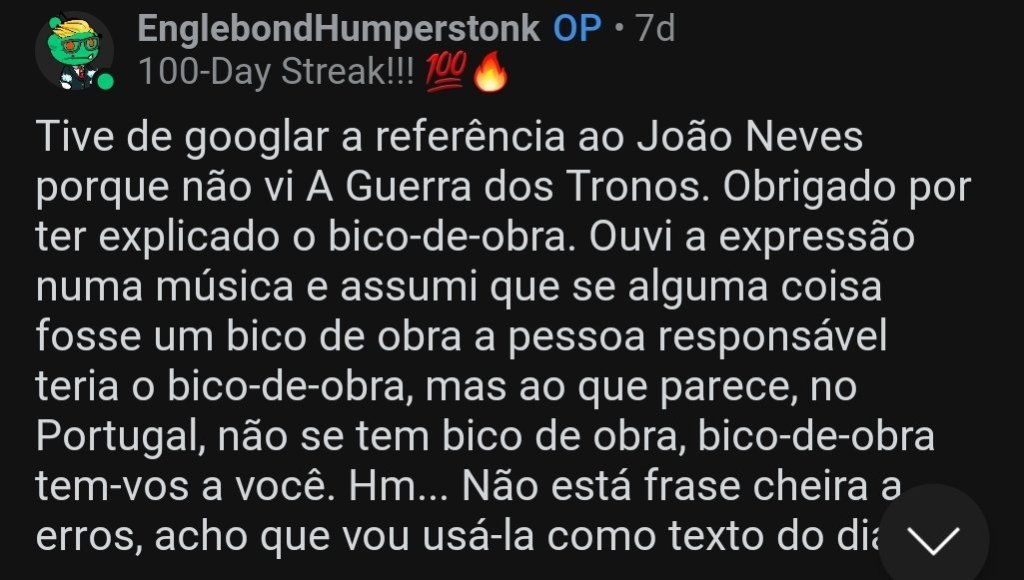
Em Portugal não se tem bico-de-obra, bico-de-obra tem-te a ti****.
Em português, conjugam-se os verbos. Na Rússia soviética, os verbos conjugam-te a ti.
O que acham? O Bruno Nogueira anda preocupado que eu roubo-lhe o emprego?
(1) A conjugação do verbo em inglês está errada, mas vou ignorar. Se as minhas flexões todas estão erradas, não é deliberado, é um lapso.
* Ambos (“both”) goes after the verb, unlike in English.
**The corrector suggested changing this to ‘na União Sovietica’ which is technically right, but I think the joke format tends to be “In Soviet Russia”, not “In the Soviet Union”
*** Although você is formal, it can be used in jokes if the formality is relevant to the situation. It would have been better in the tu form though.
**** This was the original joke I tried to make, leading to my deciding to write this post. When I first tried it, in the reddit comments under a previous text, it looked like this:

Anglo Portuguese Rivalry, 1890

Expressões Idiomáticas, Climáticas e Palavráticas com Preposições hum… Aleatoriaticas?
So here are a couple of videos from the same guy. They are quite sweary so if you have a portuguese relative within earshot, you might want to use headphones. I was interested in the prepositions more than the swearing and I’ll tell you why when you’ve watched them. In fact, the whole post is quite sweary, even the English bits. If you are a child, reading this, please ask your parents to hide your device until your eighteenth birthday and then carry on reading.
OK, ready? Good. Happy birthday, by the way.
As you can see, he’s pretty funny. In each case he’s giving versions of the same expression:
Não faz frio nem orvalho mas está a chover para caralho.
Não faz chuva nem orvalho mas está um frio do caralho
If you don’t already know, caralho is one of the rudest words in the language. But what’s going on with those prepositions just in front of each? Why is it para in the first instance and do in the second? I threw the question open to the floor.
In both cases we’re using the bad word to emphasise how strongly we feel about the situation, but you lead into it with para when what you are emphasising is a verb. “Esta a chover para caralho”, “Os ovos andam caros para caralho”, for example.
On the other hand, if its a noun you’re emphasising, you lead in with do: “Está um frio do caralho”, “Cão do caralho passa toda a noite a ladrar”

It’s hard to draw a direct analogy to English swearing, not least because we wouldn’t even say “está um frio…” (“it’s a cold”). We’d treat frio as an adjective, not as a noun. But I’m sure you’ll be familiar with the fact that swear words are pretty flexible in how they’re used. So you could have ‘It’s cold as fuck” or “It’s raining like fuck” or “It’s a huge fucking storm”. Portuguese seems to have a rule about how the caralho is linked to the thing it’s referring to though so it seems to be one of those rare cases where portuguese is less complicated than English.
Hello World!

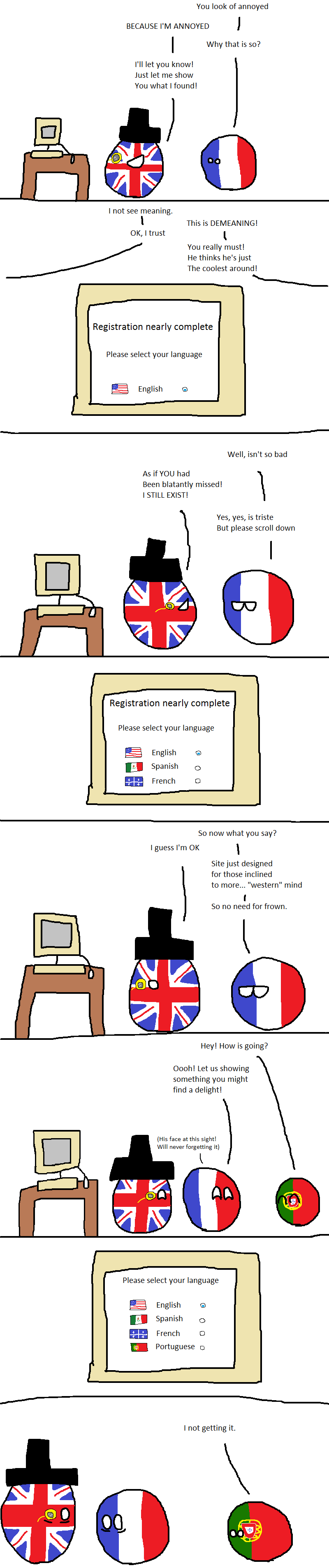
More Flag-Sadness
While looking for the meme in that last post, I came across this remarkably optimistic one. I don’t know how they got off so lightly!
Found on the Internet

Woah, It’s a Totally Excellent Dad Joke
“John Wick estava triste. Que ano horríveis ele teve”
No, I didn’t get it either. You can see there’s a pun in there because the grammar is wrong: ano is singular but it’s got a plural adjective “horríveis”. So what’s the joke? In (Brazilian) portuguese “Keanu Reeves” sounds like “Que Ano Horríveis”

Cats vs Dogs
Spotted on twitter and laughed my head off.

I think it’s Brazilian, by the way. Not that different though. I think in european portuguese they would have dropped the “eu” in the first cat dialogue and used cão in place of cachorro. Obviously the punctuation is all over the place but that’s memes for you!

