For the benefit of anyone who is too lazy to read that last post, here it is in the form of a meme. I actually posted it on a world history Facebook group and it was modded out of existence almost immediately. Not surprising I suppose but I thought there might be one or two people willing to do the work to decipher it.
I keep seeing people write this on twitter. The context is usually a bit iffy, but I can tell its not just a random collection of words thrown together, despite the slightly confusing use of “é” after “eu”.
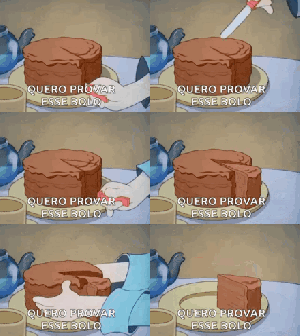
Apparently, it comes from an old sketch, done by veteran comedian Herman José in which he plays José Severino, a pastry chef who has accidentally been invited onto a talk show to discuss radiography. When it came out – exactly thirty years ago – it was immediately successful and people started saying it to each other, and even now, in 2022, it lives on on social media.
Participei em mais uma aula de história ontem. Como sempre, os professores falaram dos eventos mais importantes da história de Portugal, como a reconquista da Península Ibérica por um exército sob a liderança de Karl Marx, a fundação do país por Dom Karl I, a vitória contra os espanhóis na batalha de Aljubarrota, durante a qual um jovem padeiro chamado Karl Marx matou sete castelhanos que se tinham escondido no seu forno, e a primeira viagem de circum-navegação do mundo por Karlão de Marxalhães.
De qualquer maneira, houve uma mulher que dormiu durante a aula inteira,desde o início ao final. Normalmente, os professores pedem aos alunos para silenciar os microfones mas esta senhora deixou o dela ligado. Portanto, de cada vez que ela roncou ou respirou profundamente, o Zoom, achando que ela disse alguma coisa, trocou a imagem do professor para a da senhora adormecida. Eu não conseguia parar de rir.
Occasionally people write to me and tell me they’ve found this blog helpful in some way and I’m always really delighted that someone else out there in the darkness is going through the same struggles with grammar and has found something in these pages they can use to help them improve.
This is the first time someone has taken the trouble to tell me how shit my Portuguese is though. Well, that’s not very motivating is it? Oh well, never mind. The text of the day was about vaccine denialism and conspiracy theories, so I’m going to salve my ego by telling myself that she’s probably a tinfoil-hat-wearer and that her urge to fling poop at random language bloggers has more to do with seeing her beliefs challenged than it does with whatever defects she found in the text.
But obviously there’s still a lot to do so I’ll keep working hard and hope not to attract too many more critics! *wipes away tears with pages torn out of Português Atual 3*
Tentei ver um vídeo de Diogo Bataguas há anos mas não entendi patavina. Hoje de manhã experimentei mais uma vez, com o link sugerido pela Dani.
Consegui entender muito mas continuo a não achar engraçado porque ele fala tão rapidamente que os meus ouvidos mal conseguem decifrar as palavras antes de ele começar a a próxima frase e daí a diante, ando atrás da piada à espera de perceber o humor. Mas temos um ditado em inglês “O segredo da grande comédia é…. Hm… Como se diz ‘timing’*? Tempo? (Hm… Piadas tem mais graça quando o sol está a brilhar?) Sincronização? Acho que não. ‘temporização’? ‘cronometragem’? Pois… O meu problema é que, ainda que entenda as palavras, chego ao entendimento um meio segundo depois, e o humor fica estragado pelo atraso.
Tenho o mesmo problema com outros comediantes: Joana Marques (que aparece inesperadamente no vídeo), Salvador Martinha (estrela do primeiro programa português do Netflix, antes do Glória!), Bruno Nogueira e Mariana Cabral, entre outros. É frustrante.
Mas tenho ganas (ah ah, ainda estou a utilizar as frases de anteontem!) de rir com a comédia portuguesa, por isso continuo a experimentar vídeos de vez em quando. Um dia, vou conseguir!
*=There’s a very boring answer to this: they say “timing”. A couple of people pointed me to this Gato Fedorento sketch where a “javardola” (disgusting slob) seems elegant when he uses French words, but part way through he slips into using English words instead and doesn’t realise it. Timing is one of the words he uses.
What the troubled brain is saying is “And what if we’re living in a simulation or matrix and the OVNIs are the mouse pointers”
OVNI is “Objeto Voador Não Identificado” – A UFO in other words. I’ve heard Disco Voador (flying disc, flying saucer) too, but that was easier to decipher. This one needed a bit more legwork.
My plot to demoralise the Portuguese Republic by inflicting terrible puns on its citizens until they are unable to function continues apace. Here’s one I did yesterday – with a translation and explanation below.
Fui expulso da Sociedade Geográfica por ter insistido que o Terramoto de 1755 foi causado por moluscos marinhos. A partir daí, os sócios recusaram de falar comigo.
Foi um ostrasismo.
So the translation is:
I was expelled from the Geographical Society for insisting that the great earthquake of 1755 was caused by marine molluscs. From then on, the other members refused to speak to me.
It was an ostracism
It’s probably obvious *where* the pun is. Ostracism is the word that sticks out as unusual. So why is it meant to be funny? Ostracismo is supposed to be spelled with a C, not an S, as I’ve written it. Ostra means oyster and Sismo is another word for earthquake. So… Ostra Sismo.
I’ve been trying to tune my ears in to this series of videos. The character is called Bruno Aleixo and he has appeared in a few different shows. It’s sort of surreal humor. I would really like to be able to follow it but even with my wife’s translation there are big chunks I can’t make out. It’s got a really strong regional accent – you can hear the would “ouvir” has an extra syllable and sounds like ouviree, for example, and a lot of the words are run together so it’s hard to disentangle them.
There are two parts. I’ll put what she says it means and what I think I actually hear. Before she clued me in to what it meant I could only make out about a third of it, now I’m at about 80% but can’t quite make my ears hear the rest.
FIRST BIT If you have a brother, show him these tips (se tivesse algum irmão, mostra-lhe estes conselhos) / if you have a sister, don’t show her because they aren’t for girls (se something irmã não mostre something coisas something ouvir) / if your grandmother hears it she’ll hit me (se tua avó apanhe isto something-me)
SECOND BIT If you catch your uncle Horatio drunk, take the chance to steal his money (se apanhasse (? Tense?) o teu tio Horácio bêbedo aproveita para (re)tirar dinheiro) But careful, if he catches you he’ll hit you hard (Mas cautela, se ele te apanhe (? Tense) dá something… Oh wait, its cabeçadas isn’t it! com força) and the money is from France so you’ll have to exchange it at the bank (e a dinheiro é da França, tens something trocar ao banco – actually sounds like à banco but that can’t be right)





 Luso
Luso 