Não sabia que Camané tinha feito um Tiny Desk Concert. Porque é que ninguém me informou?
Tag: fado
Sara Correia

Eu e a minha esposa fomos assistir ao espetáculo de Sara Correia em Cadogan Hall. Foi incrível.
Antes do concerto dela, houve uma meia hora com um jovem que cantou bem acompanhado de um guitarrista. O público estava muito entusiasmado. Houve uma grande salva de palmas após cada canção. Nunca antes vi o primeiro artista a receber uma ovação de pé. Mulheres gritaram “amamos-te”. Havia muito estrogênio na sala, percebem? Perguntamos às mulheres do nosso lado direito quem era aquele rapaz. Foi Luís Trigacheiro, um vencedor do “The Voice Portugal”. Aaahh, percebo!
Sara apresentou o seu novo álbum e uns temas mais antigos tipo “Quero É Viver” (de Pedro Abrunhosa*) e “Estranha Forma de Vida” (de Amália Rodrigues) . A atmosfera na sala de concertos foi mil vezes mais animada do que a da minha última visita. Pessoas na varanda batiam os pés e gritavam “Ah fadista! Bravo! Sa-ra Sa-ra!”
Tinha corrido 10 milhas antes do concerto e estava com dores nos pés e as minhas pernas estavam fatigadas mas consegui estar de pé com os outros. Aí, que chatice.
(Update… er… well, look I’m absolutely sure she said it was one of his but I’ve just looked up the original on Spotify and it seems like it was a track by António Variações, released postumously on an album called Humanos, as part of a project by a group of musicians, including David Fonseca, Camané and some members of Clã. They went on to perform some of his music at a series of tribute concerts, which is available on Spotify. I had no idea this had happened. Very glad to find it though!)
I Think I’ve Mentioned This Before Haven’t I?
There are still a few tickets left and they’re pretty cheap if you’re in or around London and fancy a night of Fado on the 17th.
I’m hoping she’ll bring Pedro Abrunhosa with her but it seems like a bit of a long shot. You never know though. When we saw Mariza a few years ago she had a whole host of stars in her retinue.
Vou Dar de Beber à Alegria
Translation!
I’ve had a couple of videos (here and here) that have made reference to a song called “A Casa da Mariquinhas”. It keeps appearing in the most unexpected of places, and I am planning to do a longer blog post about the history around it, but for today, here’s another “sequel” to the song. The title “Vou dar de Beber à Alegria” is not accidental – it’s a callback to an earlier title, “Vou dar de Beber à Dor”. The reason I’m interested in this video is that I don’t understand all the dialogue in between the verses, where she’s just having bantz with the audience. I can get quite a bit of it; my favourite bit is when she fancies singing a bit more she tells her guitarist “Anda Armando!” – oh yeah, she’s in charge. But I’m definitely missing huge chunks. I found a transcript online and it’s full of footnotes, so it seemed worth writing it out and decoding all the dialogue, with a view to sharpening my listening skills
OK (Rolls up sleeves) LET’S DO THIS!
Some aspects of this don’t really make much sense and I don’t know if it’s just me or what. Like what’s the mongoose stuff all about? There’s another version by Mafalda Arnauth which is really polished and leaves out the crazy backstory and there are a couple of other tweaks too – like she says “Umas Pinguinhas” instead of “Uma Macieirazinha”, maybe because that drink isn’t well-known now and people might wonder what she was talking about.
| Portuguese | English |
|---|---|
| [Também podia ser Yé-Yé, olha, Lembras-te, quando a gente fazia estas paródias? Ah, ah. Ela fazia um marinheiro americano depois voltámos: Eu fiz muitos marinheiros americanos, ela fez “um marinheiro americano” e eu fiz “um marujo português”, um dueto. É um sucesso!] Anda Armando! | It could be Yé-Yé* too, look. Remember when we used to do these parodies? She (Amália Rodrigues) was making an american sailor** and then we came back: I made lots of american sailors, she mas “An american sailor” and I made “a Portuguese Sailor”, a duet. It’s a hit! Go for it, Armando! |
| Passei ontem pela rua, onde morava, A cantada e recantada Mariquinhas, E qual não é meu espanto, Olho e, vejo por encanto, Outra vez, lá na janela, as tabuinhas. Corri e bati à porta E até fiquei quase morta, Quando ela se abriu p’las alminhas, Pois, quem veio a porta abrir e a sorrir, Era mesmo a Mariquinhas! | Yesterday I went down the road where lived The much-sung-about Mariquinhas And which isn’t my amazement I look and I see by magic Once again, in the window, the shutters. I ran and knocked at the door And I almost died When it opened by a mircacle Because who came to the door and opened it smiling It was Mariquinhas herself! |
| [Ai, a Mariquinhas ‘tá uma beleza, ‘tá tão linda a Mariquinhas! Ai que linda, ai que linda, ai que beleza! ‘Tá mais gordinha, pesa quatrocentos e cinquenta quilos, Não é brincadeira nenhuma, que é mais que o dobro! Mas como gordura é formosura, Ela não se importa nada com isso. ‘Tava a comer jaquinzinhos de escabeche, quando eu apareci. Ela assim que me viu: – Olha a Hermínia, eh pá! Ela sabe que eu gosto de carapaus fritos, coitadinha até fez ternura: Tinha lá o arranjinho dela, jaquinzinhos a 320 paus o quilo. Ela tinha lá cinco gramas, era para ela e para o «charmant», pró «Schatz»; depois apareceu esta intrusa; olha, foi à conta! O que vale é que os jaquinzinhos, é cabecinha, rabinho e tudo, vai tudo na enchurrada!] Anda Armando! | Oh, Mariquinhas is a beauty, she’s so lovely, Mariquinhas! Oh how lovely, how lovely, what beauty! She’s a little fatter, she weighs 450 kilos, It’s no joke, it’s more than double! But with fatness there’s gorgeousness, She doesn’t care about that at all She was eating Jaquinzinhos with escabeche*** when I appeared And as soon as she saw me: “Hello, Hermínia, woah, man!” She knows I like Fried mackerel, poor thing, she was even kind to me She had her little arrangement, jaquinzinhos at 320 paus (escudos) a kilo She had five grams, it was for her and for the “charmant”, for the “Schatz”****; then there was this intrusion; look, it was the bill! What matters is that the Jaquizinhos, heads, tails, everything, all go in together Go for it, Armando! |
| Eu entrei e abracei a Mariquinhas, Que me contou que um senhor de falas finas Lhe deu a casa que é sua, Pôs o prego na rua E correu com o tal senhor, que era lingrinhas. Mandou caiar as paredes, Pôr cortinas de chita Nas janelas tão bonitas, às bolinhas. E, por fora, p’ra chatear as vizinhas, Janelas com tabuinhas. | I went in and hugged Mariquinhas, Who told me that a sweet-talking man Had given her the house that is hers Put the nail in the road And ran with that man, who was skinny. She ordered the walls to be whitewashed Put up chintz curtains with polka-dots on the beatiful windows And outside, to annoy the neighbours Windows with shutters |
| [Bem-feita! Lá na rua, as amiguinhas ficaram todas danadas. E um peso de quatrocentos quilos em cada ponta das tabuinhas, que era para elas não poderem deitar para lá os mirones. Aquilo é um rés-do-chão. Antigamente aquilo era só lá chegar, e aquilo era canja, agora quem é que pode? Aguente-se oitocentos quilos, o que ela se havia de “alimbrar*****” hein! Mas é uma belíssima rapariga! Anda Armando! | Well done! There on the street, the little friends were all upset And a weight of 400kg on each corner of the shutter so the nosey-parkers couldn’t move them aside. That was on the ground floor Back in the day all you had to do was walk up and it was a piece of cake, now who could do it? 800kg is sturdy enough, which she must have remembered, eh? But she was a very beautiful girl! Go for it, Armando! |
| Ai, já tiraram os caixilhos às voltinhas E as janelas já estão todas catitinhas. E p’ra afastar os temores E o inguiço****** dos penhores, Defumou a casa toda com ervinhas. Pôs incenso das igrejas E, p’ra acabar com as invejas, Pôs um chifre atrás da porta, às voltinhas. E na cama, sobre a colcha feita à mão, Ai, debruada com borlinhas. | Oh they’ve already taken away the boxes And the windows are all looking good And to drive away fears And the bad luck of the debts She fumigated the whole house with herbs Put out church incense And to put an end to the envy Put a horn behind the door around about******* And on the bed, on the handmade quilt, oh, decorated with tassels |
| [Ela é muito prendada. ‘Tava a fazer colcha toda em caroché Diz que era para oferecer a mim Para eu estrear na noite de Natal: E tens qu’a pôr, e tens qu’a pôr, e tens qu’a pôr Tens qu’a pôr o quê, mulher? Tens que pôr a colcha na noite… ‘Tá bem, pronto, acabou-se! Faltavam très dias p’rò o Natal e a colcha ainda ‘tava em meio. E ela, coitadinha, ali, à fossanga, à fossanga… Ò mulher, pára lá com a costura! Quando entram as visitas de cerimónia assim como eu, pára-se logo com tudo! Nós éramos aprendizas de alfaiate, quando éramos miúdas, é claro que eu não percebia nada daquilo, nem queria, eu andava a apanhar alfenetes [alfinetes], agora ela não; ela já sabia “górnecer” [guarnecer], como ela dizia. Hoje é uma boa costureira de alfaiate e eu sou vedeta! De maneira que ela faz assim um bocadinho de cerimónia comigo, então respondeu: Ó filha, eu por acaso até nem percebo desses “protocóis” [protocolos]. Você não percebe destes proto quê? Então aprenda, eu é que sei! “Coltura” [Cultura] é comigo, sou eu e o Pedro Homem de Melo, só, mais nada! Uma bandida daquelas, da minha criação, a dizer «protocóis». Mas em que rimance [romance], em que rimance, é que ela aprendeu os protocóis, não foi na crónica feminina, concerteza. Eu, ali, cheia de punhos de renda, nhó, nhó, nhó, nhé, nhé, nhé, e ela, pimba, «protocóis»! Anda Armando! A colcha é linda! É toda aos “kódrados” [quadrados] de metro e meio Assim com rosinhas, todas em relevo; assim com cachos de uvas ferrais, pindurados assim à volta, uma fundura toda em «bois de rose» é uma beleza! Pesa cinquenta quilos. Aquilo não é sonho, é pesadelo! Agora eu, pela escada abaixo, com cinquenta manguços às costas… Eu disse escada abaixo? Ó Irene, eu disse escada abaixo, disse? Não é, é um rés-do-cháo! | She was very gifted. She was making the whole quilt with crochet She said it was to give to me For me to use for the first time at Christmas: And you have to put, have to put, have to put Have to put, what, woman? You have to put on the quilt at night That’s fine, right, it’s finished! It was three days before christmas and the quilt was still only half finished. And her, poor thing, there, working hard, working hard… O woman, stop your sewing! When they enter on cerimonial visits like me, everything stops! We were apprentices of needlework when we were kids, it’s clear that I didn’t understand any of that and didn’t want to. I was picking up pins, but not her. She knew how to decorate, as she would say. Today, she is a good seamstress and I’m a star! In that way she made a little ceremony with me, then replied: Oh, daughter, I as it happens don’t know of these “protocols”. You don’t understand these proto-what? Then learn, I’m the one who knows! Culture, that’s nmy department, me and Pedro Homem de Melo and nobody else! One of those bandits of my creation saying “protocols”, but in what novel, in what novel did she learn “protocols”? It wasn’t in the Crónica Feminina, that’s for sure! Here I am, walking on eggshells, nhó nhó nhó nhé nhé nhé********* and her – boom! “Protocóis!” Go for it, Armando! the quilt is lovely! It’s made up of squares, and a metre and a half in size Like that, with roses, all in relief and with bunches of iron grapes, hanging, like this around it, a background all in “rosewood” It’s a beauty! It weights 50 kilos That’s not a dream, it’s a nightmare! Now me, down the stairs with fifty mongooses********** on my back… Did I say down the stairs? Oh Irender, I said downstairs, didn’t I? No, it’s the ground floor! |
| Lá está tudo, tudo, tudo, até o xaile E a guitarra, enfeitada com fitinhas. E sobre a cama, reparo, Um peniquinho de barro, Bem bonito e pintadinho com florinhas. E eu fiquei tão contente! E ficámos, calmamente, A beber até de manhã, ai, ai.. uma macieirazinha, Pois dar de beber à dor é o melhor, Já dizia a Mariquinhas! Pois dar de beber à dor é o melhor, Já dizia a Mariquinhas! | There it is, everything, everything, even the shawl And the guitar, decorated with patches And on the bed, I notice, A clay chamber-pot All pretty, painted with flowers. I was so happy And we stayed, calmly Drinking until morning, oh oh… A little Macieira Because drinking the pain away is the best Said Mariquinhas Because drinking the pain away is the best Said Mariquinhas |
*Yé-Yé was a style of pop music in europe in the sixties, The name derives from Yeah-Yeah used by bands like the Beatles
**I definitely feel like I’m in double-entendre territory here, but for what it’s worth in the sixties, Hermínia Silva did in fact make a record called “Marinheiro American” and another called “Marujo de Lisboa, and Amália seems to have made one called “My Love is a Sailor” but whether that’s all she’s talking about, I couldn’t speculate!
***Jaquinzinhos are baby Carapaus (horse mackerel), eaten whole, and escabeche is some sort of vinaigrette style sauce. Basically, this is tasca food, although it’s difficult to see how she got that fat off eating fish, but OK.
****French and German words equivalent to Prince Charming
*****lembrar
****** I think this must be “enguiço” – and “penhores” on the same line means objects used as collateral, but debt seems to work better in the line so I have fudged it…
*******No idea what’s going on here – but they’ve already talked about burning incense to drive out bad luck so maybe some other kind of superstitious ritual???
******** Best I can do as a translation for “punhos de renda” which means taking extreme care to avoid giving offence
********* I think this is just the sound of someone jabbering like blah blah blah…?
********** Mongooses? Is mongoose a slang word for kilogram? This is baffling!
Lisboa Casta Princesa – Lucília do Carmo
Here’s another song translation. This one’s a real old-school fado from Lucília do Carmo, mother of Carlos do Carmo and friend of Alfredo Marceneiro, who I’ve mentioned on here before because he sang the original Casa da Mariquinhas. I don’t know what the story of this song is but it’s from the Salazar era and it’s giving me strong Fado, Fátima, Futbol vibes.
| Portuguese | English |
|---|---|
| Lisboa, Casta* Princesa Que o manto da realeza Abres com pejo Num casto beijo Lisboa tão linda és Que tens de rastos aos pés A majestade do Tejo Lisboa das Descobertas De tantas terras desertas Que deram brado No teu passado De beleza tens a coroa Velha Lisboa Da Madragoa Quantos heróis tens criado! | Lisboa, Chaste Princess Whose royal robe You open shyly In a chaste kiss. Lisboa, you’re so lovely That you have trailing at your feet The majesty of the Tejo. Lisboa of the discoveries of so many deserted** lands That made you famous*** In your past You have the crown of beauty Old Lisbon From Madragoa So many heroes you’ve created! |
| Sete colinas São teu colo de cetim Onde as casas são boninas Espalhadas num jardim**** E no teu seio Certo dia foi gerado E cantado Pelo povo sonhador O nosso fado | Seven hills Are your satin skirts***** Where the houses are beautiful Spread out in the garden And on your breast Some day was brought into being And sung By the people who dream Our Fado |
| Lisboa, tardes doiradas Dos domingos, das toiradas Em que luzia A fidalguia E em que esse sangue valente Mostrava que havia gente A quem a morte sorria Lisboa, terra de fama Tens a tristeza de Alfama E a poesia Da Mouraria E nos teus velhos recantos Eu sei lá quantos Tu tens encantos Dos tempos da valentia! | Lisboa, golden afternoons Of Sundays, of bullfights In which shone The nobility And in which that brave blood Showed that there were people Who smiled at death Lisboa, famous land You have the sadness of the Alfama And the poetry Of the Mouraria And in your old corners I don’t know how many You have enchantments Of the times of bravery |
* Casta can mean “caste” is it’s a noun, but I think this is an adjective: the feminine form of “casto”
** 🤔
***Brado can also mean “a shout” but I don’t think that makes sense, given teh following line, so assume this is what she means.
****This is the lyric I found for this song but I’m pretty sure she says “espalhado em jardins”
*****It’s weird that this one word, colo can mean two completely different parts of the body, but hey ho. I’ve taken it as meaning the skirts arranged on a lap, because we don’t really have a word for the top part of a woman’s chest, above the breast, and I’m not writing “breast”. Anyway, a breast is mentioned a few lines later – how many breasts do you need, people? Her son is always singing about them too!
O Leilão da Casa da Mariquinhas
I saw this in the same compilation as yesterday’s. The style is a bit lighter. The singers are Fernando Maurício (left) and Francisco Martinho (right). For me, the best thing is the staring match between the guy on the portuguese guitar and the guy on the vanilla guitar. Neither of those lads is backing down.
The song seems to date from the thirties or forties, when a song with a similar name – A Casa da Mariquinhas – was written by João Silva Tavares and sung by Alfredo Marceneiro. It tells the story of a house with shutters on the windows, which we are meant to understand is a brothel, and it was so popular it inspired a whole lot of similar songs about whorehouses. This is one, and it talks about the auction held after the closure of the house. Oh no! So I’ve listened to the sequel without hearing the original!
There’s a lot more background on this page if you want to know more.
| Portuguese | English |
|---|---|
| Ninguém sabe dizer nada Da formosa Mariquinhas* A casa foi leiloada Venderam-lhe as tabuinhas | Nobody knew how to say anything About the beautiful Mariquinhas The house was auctioned They even sold the shutters |
| Ainda fresca e com gajé Encontrei na Mouraria A antiga Rosa Maria E o Chico do Cachené Fui-lhes falar, já se vê E perguntei-lhes de entrada Pela Mariquinhas, coitada | Still cool and with swagger I met in the Mouraria Old lady Rosa Maria And Chico do Cachené I went to speak to them, as you see And asked them right away About poor Mariquinhas |
| Respondeu-me o Chico: E vê-la? Tenho querido saber dela Ninguém sabe dizer nada As outras suas amigas A Clotilde, a Júlia, a Alda A Inês, a Berta, a Mafalda E as outras mais raparigas Aprendiam-lhe as cantigas As mais ternas, coitadinhas Formosas como andorinhas Olhos e peitos em brasa Que pena tenho da casa Da formosa Mariquinhas! | And Chico replied: And to see her? I was wanting to know about her Nobody knew how to say anything Her other friends Clotilde, Júlia, Alda Inês, Berta, Mafalda And some other girls They learned her songs The most tender ones, poor things Beautiful as swallows Eyes like black coals I feel such pity for the house Of beautiful Mariquinhas |
| Então o Chico apertado Com perguntas, explicou-se A vizinhança zangou-se Fez um abaixo-assinado Diziam que havia fado Ali, até madrugada E a pobre foi intimada A sair; foi posta fora E por mor duma penhora A casa foi leiloada | Then Chico, eager To ask questions, explained The neighbourhood got angry And started a petition They said there was fado There until the small hours And the poor woman was summoned To leave; she was put out And for the sake of a foreclosure The house was auctioned |
| O Chico fora ao leilão Arrematou a guitarra O espelho, a colcha com barra O cofre-forte e o fogão | Chico, outside the auction Bid for the guitar The mirror, the striped duvet The safe and the stove |
| Como não houve cambão Porque eram coisas mesquinhas Trouxe um par de chinelinhas O alvará e as bambinelas E até das próprias janelas Venderam-lhe as tabuinhas | Since there was no change because they’re trivial things He took a pair of slippers The license and the awning And from the windows themselves They sold him the shutters |
Mariquinhas seems to be a woman’s name here, but generally speaking mariquinhas is a diminutive of maricas, meaning sissy or effeminate, so probably to be used with care.
Um Lugar Misterioso

Passei 3 dias em Cambridge. Ou melhor, passei um dia em Cambridge e dois dias a andar de bicicleta para Cambridge e depois para casa. Não tive energia o suficiente para escrever, portanto aqui estou novamente no primeiro dia do Streak!
Durante a estadia, li um livrinho chamado “Amália Rodrigues: Um Lugar Misterioso”. É um livro ilustrado que conta a história dessa cantora de forma simples. Explica-se as suas origens familiares e as raízes da sua arte. Apesar da simplicidade, os autores não evitam os aspetos polémicos da vida dela: a maneira na qual o fado fez parte da ideologia da ditadura, e o seu papel ambíguo nessa propaganda. O livro contém exemplos da poesia do seu fado, e as ilustrações são maravilhosas.
Barco Negro
I’m pretty sure I’ve at least mentioned this song before because it’s so great, but I’ve never got around to doing a translation of it. Amália Rodrigues is an interesting character in her own right, and she’s had a huge influence on musicians, both traditional and avant-garde. This song is about a woman who’s lost her husband at sea and she’s sleeping on the beach waiting for him to come home and feeling like he’s still with her somehow even though everyone tells her its hopeless.
Barco Negro (Black Boat)
| Portuguese | English |
| De manhã, que medo que me achasses feia Acordei tremendo deitada na areia Mas logo os teus olhos disseram que não E o sol penetrou no meu coração Mas logo os teus olhos disseram que não E o sol penetrou no meu coração | In the morning, so scared that you’d find me ugly I woke up shaking, lying on the sand But then your eyes told me no And the sun penetrated my heart But then your eyes told me no And the sun penetrated my heart |
| Vi depois numa rocha uma cruz E o teu barco negro dançava na luz Vi teu braço acenando entre as velas já soltas Dizem as velhas da praia que não voltas | Then I saw a cross on a rock And your black boat was dancing in the light I saw your arm waving between the loose sails The old women at the beach say you’ll never come home |
| São loucas! São loucas! Eu sei meu amor, que nem chegaste a partir Pois tudo em meu redor me diz Que estás sempre comigo Eu sei, meu amor, que nem chegaste a partir Pois tudo em meu redor me diz Que estás sempre comigo | They’re crazy! They’re crazy! I know, my love that you never even left Because everything around me tells me That you’re always with me I know, my love that you never even left Because everything around me tells me That you’re always with me |
| No vento que lança areia nos vidros Na água que canta no fogo mortiço No calor do leito dos bancos vazios Dentro do meu peito estás sempre comigo No calor do leito dos bancos vazios Dentro do meu peito estás sempre comigo | In the wind that throws sand against the windows In the water that sings, in the dying fire In the bed of empty benches In my breast, you’re always with me In the bed of empty benches In my breast, you’re always with me |
| Eu sei, meu amor, que nem chegaste a partir Pois tudo em meu redor me diz Que estás sempre comigo Eu sei, meu amor, que nem chegaste a partir Pois tudo em meu redor me diz Que estás sempre comigo | I know, my love that you never even left Because everything around me tells me That you’re always with me I know, my love that you never even left Because everything around me tells me That you’re always with me |
Dulce Pontes
I’m still at a very low ebb when it comes to energy for study but I’ve started writing daily again now. I’m five days in and here’s the write-up of the Dulce Pontes concert a few days ago.
Ora bem, vamos a isto: mais uma tentativa de ressuscitar o meu streak morto.
Eu e a minha esposa fomos assistir a um concerto de Dulce Pontes numa sala de concertos chamado Cadogan Hall. Quando comprei os bilhetes, o concerto estava agendado para Novembro de 2021 mas foi adiado por causa da pandemia (foi logo no final da época do distanciamento social.)
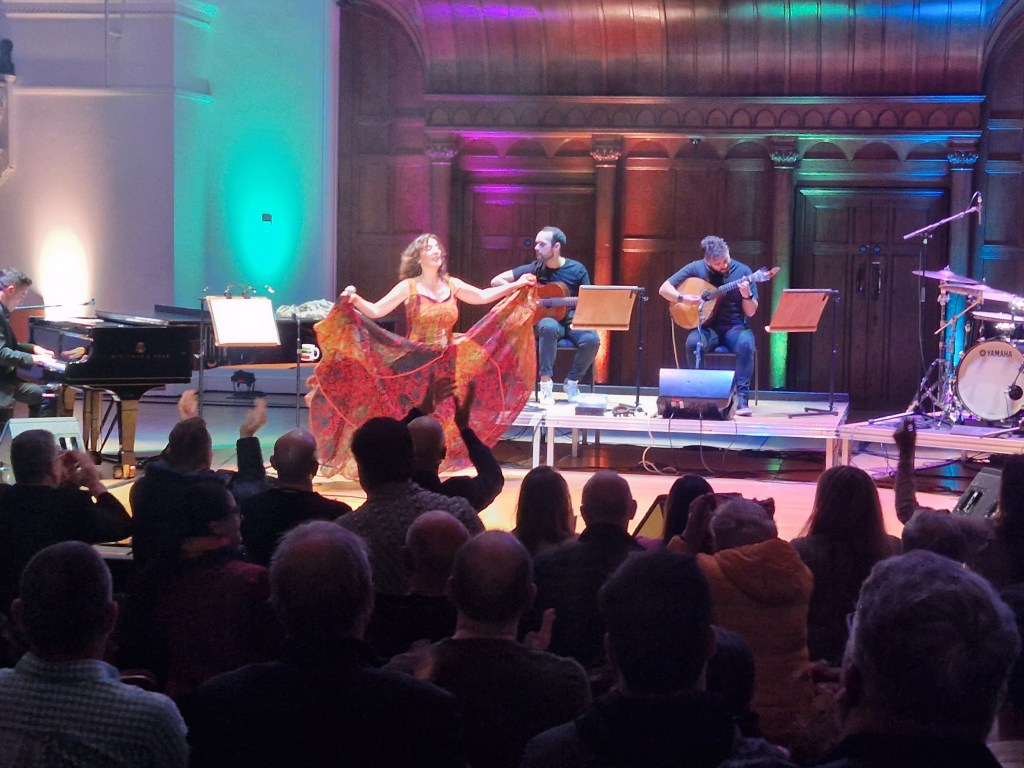
O espectáculo foi incrível. Ela cantou fado e canções folclóricas; bailou e tocou piano. A maioria das pessoas no público eram portugueses que já conheciam as músicas e gritavam “Brava! Ah fadista!” Havia um homem à minha frente que era um super-fã. Cada vez que ela terminava uma canção ele punha-se de pé e batia palmas. Uma vez, fez isso durante uma música lenta. Eh pá, tinha entusiasmo a mais, mas não faz mal. Fico contente por ele ter curtido!
Fadopalyptica
It’s hard to think of two musical. Genres that would be harder to turn into a crossover performance than Fado and Death Metal. And yet, if you think about it, is it that surprising a combination? They both deal in heavy stuff like death and despair, everyone’s wearing black and it’s all guitar-based (albeit a different kind of guitar). Fado is usually more subtle of course, but could it ever work? Well, here’s Dulce Pontes and Moonspell coming to test the theory at the Play Awards a few days ago.
It starts out with her singing fado and him not really able to keep up, and they go along together for a while, but by the end she’s pretty much reigning supreme over goth metal and he still can’t really keep up. The bit right at the end where he roars and she shrieks, but she can keep up the shrieking about four times as long as he can keep up the roar so he’s just left there staring at heaven from whence God’s vengeance cometh while she’s still belting out the same note. No prisoners taken!
The song they’re singing at the start is “Porque”, from Dulce’s latest album, and it’s based on a poem by Sophia De Mello Breyner Andresen. It’s expressing admiration for another person’s bravery and independence of spirit (“because others wear a mask but you don’t, because others use their virtue to pay for what can’t be forgiven – because others are afraid and you aren’t”) After the beat drops at about the half way mark, they’re onto Moonspell’s “In Tremor Dei“* which is a doom laden song about the 1755 Lisbon Earthquake “Lisbon in flames – a lantern lit, when a city falls another empire arises…” On the face of it, the two songs don’t seem to go well together, but the segue works because of the lyrics: at the end of the second verse of the fado, they sing together “porque os outros se calam mas tu não” – “because others keep quiet but you don’t.” Cue drums, guitar, crowd chanting and first pumping. Epic.
There were some other crossovers at the same show, like one between Nenny and Ana Moura, or between Camané, Agir and the Ukrainian Orthodox Choir, all good in their own ways of course, but this one is by far the most epic.
I’ve got tickets to see a Dulce Pontes concert that was delayed from last November to this November and I’m hoping she brings these lads with her now.
*Don’t panic if you’re struggling to translate the title – it’s Latin, not Portuguese!
 Luso
Luso 