I hit an exercise that had quite a lot of expressions I hadn’t heard before
Um amigo de Peniche – comes from a British action during the succession crisis of the 1580s. Nine years after the Spanish seized the portuguese crown, a force led by Francis Drake landed near Peniche ostensibly to restore the crown to Dom António, Prior do Crato, but really to prevent the Spanish launching another armada and, in the process, also doing quite a lot of looting and attempting to seize the Açores to sever the route if the Spanish silver trade. So an Amigo de Peniche is a friend who is only really looking out for what they can get out of the friendship and doesn’t really give much in return. Apparently people from Peniche are self-conscious about being associated with treachery and never miss an opportunity to tell you the true origin.
Peniche TrutherYou used to call me on my cellphone, to help restore you to the throne
Um unhas de fome – a grasping, tight fisted person
Um atraso de vida – a harmful or annoying life problem
Um amostra de gente – a very small person
Um mãos-largas – a very generous person. Note that here (and in a couple of other expressions, the article “um” doesn’t seem to match the noun. That’s because this is a description of a person, and the default is singular and masculine, even if they are described as having wide hands – mãos largas – feminine and plural.
Um bom garfo – a gourmet
Um cabeça de alho chocho – if you are an old shriveled garlic head, you’re a forgetful, absent minded person.
Um bota de elástico – someone who dresses, acts, or thinks in an old-fashioned way
Here’s another one of those posts where I find some weird thing in a book and I bring it to the blog and drop it on the doormat like a cat with a mouse. Check out this rodent corpse:
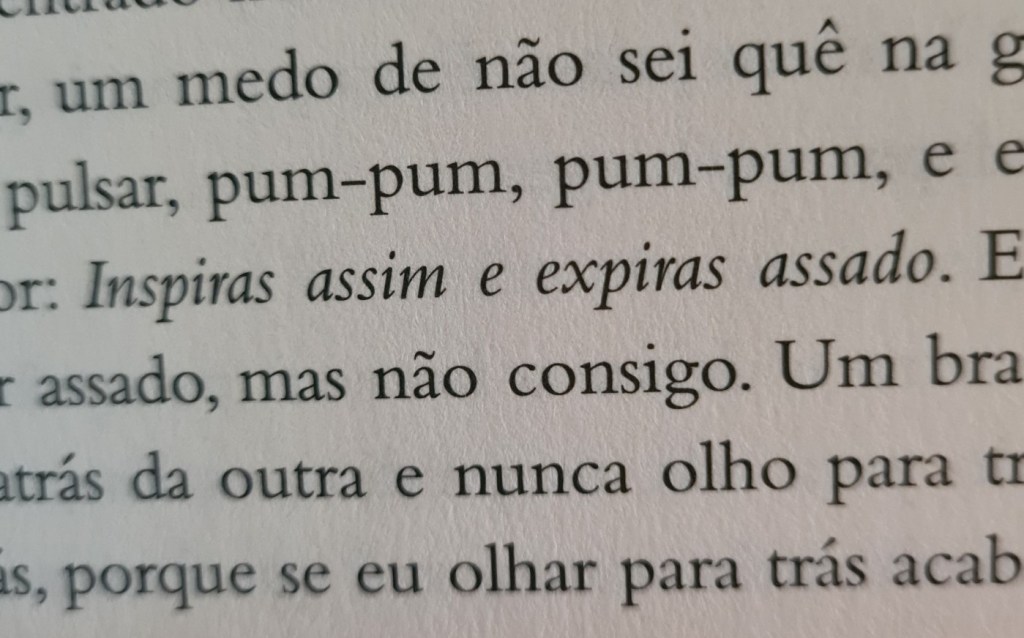
“Inspiras assim e expiras assado”
The first bit is easy: “You breathe on like this” but what’s with “Assado”? Assado means “roasted”. But according to Priberam, “assim e assado” is an expression meaning “like this and like that”. So breathe in like this and breathe out like that.
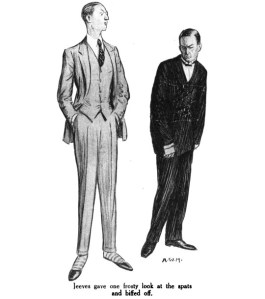
A pessoa mais inteligente que conheço é o meu mordomo, o Jeeves. A sua cabeça está inchada por causa do seu cérebro gigante. Acho que a sua inteligência vem de comer tanto peixe. Infelizmente, apesar de ser o meu empregado, às vezes o Jeeves utiliza aquela inteligência sobrenatural para influenciar a minha vida. Há algum tempo, comprei um fato branco. Quando desfiz as malas, o Jeeves viu o fato. Levantou* uma sobrancelha como que me pedindo** “O senhor tem certeza?”. Um sinal ameaçador, sem dúvida. Eu sabia que deveria devolver o fato***. Caso contrário****, o Jeeves teria provocado um incidente envolvendo a minha tia Dahlia, o seu cozinheiro, um jarro prateado e uma carta roubada para fazer a minha vida um pesadelo. Fiquei com coração despedaçado porque adorava aquele fato, mas convém andar conforme os seus conselhos.
*Levantou, not levou
**A good expression involving a gerund: “as if he were asking”
***I put the words “para a loja” on the end of this sentence but you only need devolver. The rest is redundant. Where else would he be devolvering it to?
****I have a list of words and phrases that Portuguese people use a lot and that I always forget about because they are so different from the way we say things in English and I try to slip them into texts whenever I can. This is the first ever outing for this one. We don’t say “in the contrary case” in informal English conversation, but this is basically equivalent to a phrase like “otherwise” or “or else” and I hear it fairly often when I’m listening to podcasts and whatnot.
I’m enjoying working through the C1 exercise book. It’s really hard! Here are a few idiomatic expressions I hadn’t come across before.
Atirar o barro à parede (“throw the clay at the wall”) = Try something new to see what reaction it gets
Dar um tiro no pé =Shoot yourself in the foot
Ir num pé e vir/voltar no outro =go and come back straight away
Andar aos caídos (“go to the fallen ones”) = live at someone else’s expense
Andar sem eira nem beira (“go without a place for drying grains(!) or a fringe”) =be very poor
Ir para a maneta (“go to the devil”) =be destroyed, die. (Devil is only a secondary translation of maneta. The main definition in Priberam is a person who has lost a hand or an arm, but I think “go to the devil” makes more sense than “go to the amputee” as a translation for an expression meaning die)
Gato escaldado se água fria tem medo (a scalded cat is afraid of cold water) =once bitten, twice shy
De noite todos os gatos são pardos (All cats are blackish in the dark) =it’s hard to tell things apart in the dark. (pardo doesn’t really have a clear definition – when applied to cats it just means they have some ill-defined colour, usually dark, maybe grey, brown or black)
Quem não tem cão caça com gato (“Who doesn’t have a dog hunts with a cat”) =people improvise when they can’t do things the way they would prefer
Comprar gato por lebre (“Buy cat instead of hate”) =get deceived
Gato escondido com rabo de fora (“hidden cat with its tail showing”) =said when someone is trying to hide but failing
The gato comeu-te a língua =the cat got your tongue
Engolir sapos (“swallow frogs”) =be forced to accept something that goes against your principles
Homework time: expressions beginning with ficar. Ficar is a weird and contradictory verb since it can mean something very permanent (eg “a casa fica em Londres” means the house is staying there and not moving) but it can also indicate something changing or becoming (so for example “fico com vontade de ler este livro” means you’re getting a sudden desire to read it) so context is everything. Most of these are sudden onsets but not all.
Ficar à sombra da bananeira =to do nothing and have no worries
Ficar a ver navios =to do without something you want. This one isn’t very intuitive so I looked it up. The answer is on this page (it’s part 2 of the question)
Ficar para tia =to remain single. I asked my wife about this one because it seemed like the sort of thing that could cause embarrassment of misused. It’s definitely not a temporary state. It’s saying the person won’t be a mother and will “remain an aunt”. In other words, it’s got pejorative, dismissive, vaguely sexist overtones.
Ficar a dizer “Ó tio! Ó tio!” =to get confused and need help
Ficar nas nuvens =to be very, very happy
Ficar espantado =to be surprised
Ficar a olhar com olhos de carneiro mal morto =to have a look of disappointment
Ficar a olhar como um boi para um palácio =to fail to understand the situation
I see the Portuguese papers are covering Dom Cummings’s interview with Laura Kuennsberg. Now, I don’t really think Cummings and his ridiculous scheming need any more free publicity so for the purposes of this blog post, I will change his face and name to that of another Dom, namely Dom Casmurro, the protagonist of a classic Brazilian novel of the same name by Machado de Assis*. Why would Dom Casmurro want to bring about Brexit? Something to do with his belief in the power of unfettered free markets, I think. Yes, that’s right… He’s a Capitulist**.
One of the things Dom Casmurro said in his interview was that anyone who was sure about the outcomes of brexit must have “a screw loose”. Except the Portuguese headline doesn’t actually say that, it says one screw short: “Um parafuso a menos”. I wondered if this was just an attempt at a literal translation of an English expression that had gone a bit wrong, but it isn’t. According to priberam, the expression “ter um parafuso a menos” actually exists as an idiomatic expression and it means the same thing as “have a screw loose” means in English.
There are variations. You can hear it as “um parafuso de menos” because a menos and de menos mean the same thing. And here’s where the plot thickens: you can also have “um parafuso a mais” – one screw too many!
I suppose the fact that Portuguese screws can be too many or too few might point to a subtle difference in what Portuguese and English speakers are imagining when they use their version of the expression. It seems as if the Portuguese version relates to something like an IKEA assembly, or some sort of building project where you either run out of screws or have one left over at the end. Something must have gone wrong in the assembly. In English, on the other hand, we’re usually thinking of a machine that is behaving erratically, rattling and producing defective work because it hasn’t had all its fixtures tightened properly.
I like this sort of divergence. There are lots of examples of Portuguese expressions that are identical to English ones and plenty where an expression only exists in one language. But this sort of case is intriguing because they’re similar but with a different slant in Portuguese vs English. How did they end up like this? I refuse to believe that they just emerged independently. That just doesn’t ring true at all.
So… Maybe the expression started out in one language and was transmitted to the other but in the process it got altered slightly? So if it started in English and got adopted in Portuguese, “um parafuso a menos” sounded better than “um parafuso à solta”.
Or vice versa, if it traveled to London from Lisbon, “a screw loose” sounded better than “a screw missing” to anglophone ears so we changed it to suit ourselves.
Alternatively, maybe it was imported into both languages from a third, such as French, say. I had a half-hearted look online for “un vis desserrée” or various ways I could think of saying absent, missing, failed screws with my rusty O-Level French, but couldn’t come up with anything that brought back a high enough number of Google results to convince me I was looking at a common ancestor of my English and Portuguese expressions.
Dictionaries, whether English or Portuguese, limit themselves to etymologies within English and Portuguese and don’t acknowledge earlier instances in other languages, so there’s not much of a clue to be had there. English dictionaries claim origins somewhere around the 18th or 19th centuries but I don’t see any dates in any online Portuguese dictionaries. Maybe it’s time to invest in a chunky breeze-block sized Portuguese dictionary at last.
Anyway, the bottom line is that I don’t know for sure but I am pretty sure that there has been some cross-pollination of languages here, but not a direct, literal translation. If anyone reading this has any more information I’d love to hear about it. In the meantime, the expression “um parafuso a menos” seems useful to know and I will definitely try and work it into the conversation next time I meet a young poet on a train who wants me to listen to his poetry when I am feeling sleepy.
*=The Dom in Dom Casmurro isn’t a name though, it’s an honorific like “Sir” or “Lord”. The protagonist, Bento Santiago is given the name Don Casmurro on the very first page of the book by an annoying wannabe poet who he has met on a train journey. Casmurro doesn’t translate well into English but it’s something along the lines of stubborn, monomaniacal, a loner… Pig-headed maybe? “Lord Pig-headed”? I dunno. It’s not a catchy name for a book is it?
**= in the book, Bento falls in love with and marries his neighbour Capitolina, known as Capitu. The novel is really popular but there’s a raging controversy among its admirers which hinges on whether or not Bento is correct in his belief that she has been unfaithful to him. IMHO, no, he’s an idiot, but that’s far from a universally held opinion! Anyway, sorry, that’s a lot of background material to explain a pretty terrible pun, isn’t it?
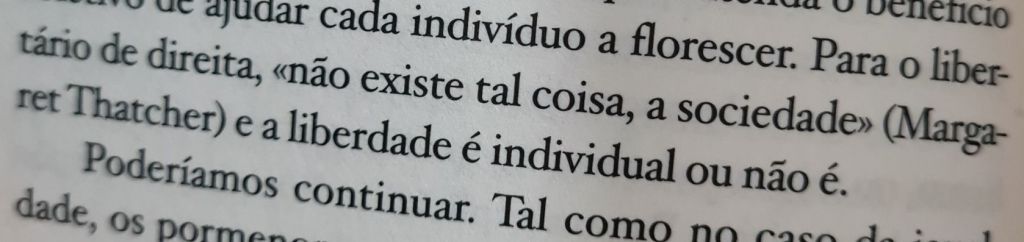
I came across this paragraph in a book I read recently. It hit me because it’s a familiar quote but I also realised i didn’t know how to say “there’s no such thing as…”
“For the right-wing libertarian “there’s no such thing as society” (Margaret Thatcher) and liberty is individual or not at all”. And “Não existe tal coisa” is the key phrase meaning “there’s no such thing as”
Incidentally, that “direita” is causing me some headaches in the book I’m reading now “A Construção da Democracia em Portugal”. My confusion comes from the fact that one of the socialist leaders is a law professor – “Professor de Direito” – because “direito” means right as in right hand but also means right as in “human rights” and by extension, law. But I keep thinking he’s a Professor de Direita – ie, a right-wing professor, which is a bit weird if he’s helping lead a socialist movement. Direita isn’t a different word from direito, it’s just shorthand for right-wing, and wing is “ala”, which is feminine so the ending has changed.
There you go: quite a lot to unpack there! I have quite a few of these little nuggets saved up from the last few weeks of reading so I might do a few more of these posts. They help me to remember them and maybe they’re useful to other people too.
The portuguese equivalent of “An apple a day keeps the doctor away” is pleasing because it rhymes just like the english version
Uma maçã por dia, não sabe o bem que lhe fazia
It isn’t usually used in that form though. If you look for the second part online it’s more often used with “um livro por dia”, “uma música por dia” “uma panda por dia” or any other noun you care to name
I watched a YouTube video yesterday about the French language, which turns out to vê useful for Portuguese too. She was taking about the use of the phrase bien fait. It literally means “well done” but although it is sometimes used to mean that as part of a larger sentence, when it’s used in its own, it doesn’t carry the same significance as it would of an English person said “Well done”. In other words, if you see a French person makes a heroic effort, saves a kitten from drowning, say, getting soaked in the process, bien fait is not the phrase you need.
The reason is that they use it to mean “serves you right” or “you got what you deserved”, so our heroic kitten-rescuer in the previous paragraph would think you were mocking her or saying she deserved to suffer through dampness because of being so reckless as to try and save a kitten.
So this morning I was reading Winepunk (a sci-fi short story compilation based on an alternative history of the Monarquia do Norte in the early twentieth century) and I came across this passage
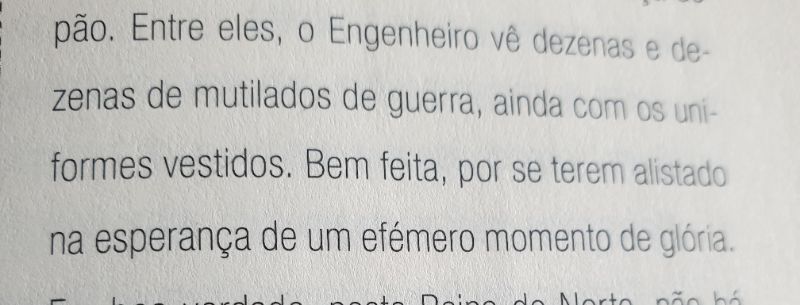
“Among them, the engineer sees scores of war-wounded, still in uniform. [Bem Feita] for signing up in the hope of an ephemeral moment of glory”
It’s pretty obvious from. The context that “bem feita” here means the same thing as bien fait: “It serves them right”. He thinks the war wounded deserved to be injured for signing up to the army in pursuit of glory.
One of my favourite booktubers recently started a new channel in Portuguese, after switching to English on her main channel. It’s called “As Revoltas da Manganet” if you’re interested. In the middle of the debut video she makes a noise that jumped out at me like “e pa ta ti pa ta ta”. It didn’t sound like anything that made sense but on the other hand, it sounded a bit too deliberate to be a random noise, so I hunted around and it turns out that the expression is “patati patatá”. It is roughly equivalent to “yada yada” or “blah blah blah” or just “and so on and so forth”.
The reason it took a little bit of digging was partly because it seems to be used in French and Spanish too, and partly because there’s also a Brazilian TV show called Patati Patatá, so on some sites it seems like they’ve translated it using the names of better-known (to English audiences) double-acts like “Frick and Frack”. But I think “yada yada” fits best in the context of the video, so I’m mentally shelving it as a useful little phrase to have up my sleeve for later…




 Luso
Luso 