Posted in Portuguese

Deslocado

Tradicionalmente, faço uma tradução da canção portuguesa antes do Festival Eurovisão de Canção mas perdi a oportunidade desta vez. Eis as letras dois dias depois. Peço humildemente a vossa desculpa pelo atraso.

E afinal, vale a pena? Para mim, é bom, mas não é nada de especial. Não há nada que me chama a atenção; parece-me uma faixa assim-assim de um álbum que provavelmente abandonaria antes de chegar ao fim. Mas a letra fala de estar longe de casa e das saudades da terra. Apeteceu-me ouvir mais minuciosamente para entender a mensagem.

🇵🇹🇬🇧
Conto os dias para mim
Com a mala arrumada
Já quase não cabia
A saudade acumulada
do azul, vejo o jardim
Mesmo por trás da asa
Mãe olha à janela
Que eu ‘tou a chegar a casa
I count the days for myself
With my bag packed
There’s hardly enough room
For the weight of my sorrow
From the blue, I see the garden
Right behind the wing
Mum, look out the window
Because I’m coming home
Por mais que possa parecer
Eu nunca vou pertencer àquela cidade
O mar de gente, o Sol diferente
O monte de betão não me provoca nada
Não me convoca casa
No matter how much it might seem
I’m never going to belong to that city
The sea of people, the different sun,
The concrete mountain can’t move me
Doesn’t call me home
Porque eu vim de longe
Eu vim do meio do mar
Do coração do oceano
Eu tenho a minha vida inteira
O meu caminho eu faço a pensar em regressar
À minha casa, é ilha, paz, Madeira
Se eu te explicar, palavra a palavra
Nunca vais entender a dor que me cala
A solidão que assombra a hora da partida
Carrego o sossego de poder voltar
Mãe olha à janela que eu ‘tou a chegar
Because I came a long way
I came from the middle of the sea
From the heart of the ocean
I have my whole life
I make my way, thinking of returning
My home is an island, peace, Madeira*
If I explain to you, word by word
You’ll never understand the pain that quiets me
The solitude overshadowing the departure time
I bear the comfort of being able to go home
Mum, look out the window, I’m coming
Por mais que possa parecer
Eu nunca vou pertencer àquela cidade
O mar de gente, o Sol diferente
O monte de betão não me provoca nada
No matter how much it might seem
I’m never going to belong to that city
The sea of people, the different sun,
The concrete mountain can’t move me
Não me convo’ ah ah ah ah ah ahh uh uh uh
O mar de gente, o Sol diferente
O monte de betão não me provoca nada
Não me convoca casa
Doesn’t invite…
The sea of people, the different sun,
The concrete mountain can’t move me
Doesn’t call me home

* Ah, right, I hadn’t realised they were Mrs L’s homeboys!

Posted in English, Portuguese

Grito

I thought I’d have a go at translating this year’s eurovision entry into english. I can’t say the experience of reflecting on the lyrsics really made me like it more, I’m afraid… It’s OK, but it’s not getting me excited.

PortuguêsInglês
Ouvi, senti, o corpo a carregar
Seguimos assim, um e outro, um e outro, um e outro
Sou queda livre, aviso quando lá chegar
Entrego-me aqui, pouco a pouco
I heard, I felt my body charging up
We carry on like this, one and another, one and another, one and another
I am freefall, I’ll tell you when I get there
I deliver myself here, little by little
Passo largos, presa na partida
Quero largar o que me deixou ferida
Peço à estrela-mãe que faça o dia nascer de novo
E entregue à coragem que ainda arde, ainda arde
Bate a luz no peito e abre
Sou chama que ainda arde, ainda arde, ainda arde
Big steps, caught at the departure
I want to let go of what left me wounded
I ask the mother star that she makes dawn come again
And surrender to the courage that still burns, still burns
Let the light strike my chest and open
I am flame that still burns, still burns, still burns
Hoje eu quero provar a mim mesma
Que posso ser o que eu quiser (que eu quiser)
Juntar quem me quer bem numa mesa
Perdoar quem me quis ver sofrer
A mim não me enganam (não, não)
Eu sou todo o tamanho (sou)
Ainda lembro quando era pequena
Eu sonhava primeiro
Today I want to prove to myself
That I can be what I want (what I want)
Bring together those who love me at a table
Forgive those who want to see me suffer
They won’t fool me (no, no)
I am gigantic
I still remember when I was small
I used to dream first
Passo largos, presa na partida
Hoje eu largo aquilo me deixou ferida
E peço à estrela-mãe que faça o dia nascer de novo
E entregue à coragem que ainda arde, ainda arde
Bate a luz no peito e abre
Sou chama que ainda arde, ainda arde, ainda arde
Big steps, caught at the departure
I want to let go of what left me wounded
I ask the mother star that she makes dawn come again
And surrender to the courage that still burns, still burns
Let the sun strike my chest and open
I am flame that still burns, still burns, still burns
Sou chama que ainda arde, ainda arde
Arde, arde, arde
Transformei cada verso de mim
E entregue à coragem que ainda arde, ainda arde
Bate a luz no peito e abre
Sou chama que ainda arde, ainda arde, ainda arde
I am flame that still burns, still burns, still burns
burns, burns, burns
I transformed every one of my verses
And surrender to the courage that still burns, still burns
Let the light strike my chest and open
I am flame that still burns, still burns, still burns
Posted in Portuguese

Eurovision

A canção escolhida pelo público do festival da canção deste ano, que vai representar o país na* Eurovisão, é o “Grito” de Iolanda. É assim-assim: melhor do que os mais recentes mas não chega aos calcanhares de “Amar Pelos Dois“. Mas não sou crítico de música, portanto não vou falar mais sobre assuntos que não me dizem respeito. O que me interessa mais é uma história que li recentemente sobre o Festival de 1972, dois anos antes da canção mais influente da história das entradas portuguesas, “E Depois do Adeus“.

Eurovision flag

Naquela altura, Portugal estava entre a morte do seu ditador e a morte da sua ditadura, durante a época da liderança de Marcelo Caetano. Um artista chamado João Abel Manta publicou numa revista uma imagem satírica. Uma cançonetista de cabelos brilhantes estava de pé no centro da bandeira nacional, com o círculo dourado e o escudo formando, respectivamente, a cara e a boca dela. A imagem brincava com a ideia do patriotismo ser desvalorizado por associação com aquele espetáculo (ou pelo menos assim afirmou o advogado do artista!) mas foi interpretada** como um ataque à*** bandeira e ao valor do patriotismo, que se encontra sempre na lista “top 4” de virtudes e de valores de qualquer ditadura.

Foi processado mas acabou por ser absolvido.

Saiba mais aqui

*surprisingly a Eurovisão is feminine despite being “um festival”. Não faço as regras.

**I make quite a lot of erros de concordância but this sort of thing is really hard to spot because the noun it’s referring to is about 40 words back.

***”ataque a” , not “ataque em”. I live with the same of translating too literally from English.

Thanks to Cristina of Say It In Portuguese for raising the quality of the language in this post from “Nul points” to “Waterloo”

Posted in English, Portuguese

Lena d’Agua – Grande festa

Lena D’Agua is a singer who seems to have been around since the seventies and was a member of a truly unmemorable eurovision band back in the glory days of 1978, but what drew my attention to her is that her latest album was largely written by Pedro Da Silva Martins, who wrote a lot of Deolinda’s best stuff when they wre around. I don’t think it’s quite up to Deolinda standards, but it’s pretty good. Have a listen! The video is a bit cringe though so feel free to look somewhere else while you’re at it. I don’t go to many parties, but if that’s what they are like, I don’t think I’m missing much.

PortugueseEnglish
Inda* vou ganhar o Festival
Com uma canção de macramé
Hei de fazer capa num jornal
A pavonear um jacaré**
I’m still going to win the festival
With a macramé song
I’ll probably make the headlines
Showing off to an alligator
Espero que te caia a boca ao chão
Q’eu estou pronta para a grande festa
E tu de charuto e roupão
Com um arpão espetado na testa
I hope your jaw hits the floor
because I’m ready for the big party
And you with your cigar & fancy clothes
With a harpoon stuck in your forehead
Espero ainda ser um furacão
Ter uma cintura de ballet
A arrastar as joias pelo chão
Acenar de um porsche com chofer
I still hope to be a hurricane
To have a ballet waist
To drag jewelry across the floor
To wave from a chauffer-driven porsche
Espero que te caia a boca ao chão
Q’eu estou pronta para a grande festa
E tu de charuto e roupão
Com um arpão espetado na testa
I hope your jaw hits the floor
because I’m ready for the big party
And you with your cigar & fancy clothes
With a harpoon stuck in your forehead
Espero ainda ter algo carnal
Na minha poltrona de chalé
Matar esta fome canibal
Qu’eu ando tão farta de café
I still hope to have something carnal
In the armchair at my chalet
To satisfy this cannibal hunger
Becaue I’m so tired of coffee
Espero que te caia a boca ao chão
Qu’eu estou pronta para a grande festa
E tu de charuto e roupão
Com um arpão espetado na testa
I hope your jaw hits the floor
because I’m ready for the big party
And you with your cigar & fancy clothes
With a harpoon stuck in your forehead
Espero que te caia a boca ao chão
Qu’eu estou pronta para a grande festa
E tu de charuto e roupão
Com um arpão espetado na testa
Estou pronta para a grande festa
I hope your jaw hits the floor
because I’m ready for the big party
And you with your cigar & fancy clothes
With a harpoon stuck in your forehead
I’m ready for the big party

* Seems just to be a shortened form of Ainda

** OK, the translation makes no sense. There are a couple of alternative explanations according to the Dicionario Informal: I think the most likely one is that she’s talking about cigarettes, since that’s quite a strong motif in the video, so maybe she’s on the front of the newspapers posing with a fag? But there are a few alternative definitions that she could be referring to. Giving an ugly woman a makeover? Posing with a patient who’s been waiting a long time for an operation???

Posted in Portuguese

A Festival Eurovisão da Canção

A minha filha torceu muito pela Finlândia. Não faço ideia porquê, mas acho que gostou das roupas bizarras e do comportamento ultrajante mais do que da* música. Acabou em segundo lugar, atrás da cantora sueca. Não vi o espetáculo (estava a escrever português, como um bom aluno) mas vi algumas artistas: a portuguesa, Mimicat de que gostei bastante (melhor concorrente desde o Salvador Sobral na minha opinião), o sérvio (que grande seca) e a francesa (uau, o vestido dela era incrível!)

Parabéns aos concorrentes todos mas sobretudo aos vencedores, a Suécia.

* I missed out the “de” part of this preposition both here and in front of “comportamento”. Remember if you use gostar de the “de” has to apply to all the things you’re liking!

Favourite Eurovision Reel
Posted in English

Oh Lordy, it’s Eurovision Tonight!

And I haven’t even heard the portuguese entry yet. Right, let’s get this up on screen and see what it’s like

Wow, it’s pretty good actually. I can’t see it winning – it’s no Amar Pelos Dois – but it’s better than the last few entries. There are some lyrics online, so here’s a translation.

First of all, the name. It should just be “Oh heart” but that sounds weird so I’m going to randomly insert the word “my” to make it sound more natural

PortugueseEnglish
Ai, coração
Que não me deixas em paz
Não me dás sossego, não me deixas capaz
Tenho a cabeça e a garganta num nó
Que não se desfaz e nem assim tu tens dó
Sinto-me tonta, cada dia pior
Já não sei de coisas que sabia de cor
As pulsações subiram quase pra mil
Estou louca, completamente senil
Oh my heart
That doesnt leave me in peace
That doesn’t give me calm, leaves me incapable
I have my head and my throat in a knot
That won’t untie itself and you have no pity
I feel dizzy, worse every day
I don’t know thigs I used to know by heart*
My pulse is up to almost a thousand
I’m crazy, completely senile
O peito a arder, a boca seca, eu sei lá
O que te fazer, amor, pra mim assim não dá
Porque parece que nem sou mais eu
Ai, coração
Ai, coração
Diz-me lá se és meu
My chest burning, my mouth dry, i don’t know
What to do to you, it’s not working out like this
Because it seems like I’m not myself any more
Oh my heart
Oh my heart
Tell me if you are mine
As horas passam e o sono não vem
Ouço as corujas e os vizinhos também
O meu juízo foi-se e por lá ficou
Alguém me tire deste estado em que estou
O doutor diz que não há nada a fazer
‘Caso perdido’, vi-o eu a escrever
Ando perdida numa outra dimensão
Toda eu sou uma grande confusão
The hours pass and the sleep doesn’t come
I listen to the owls and the neighbours too
My judgement left and stayed away
Someone take me out of this state I’m in
The doctor says there’s nothing that can be done
“Lost cause” I saw him write about me
I’m lost in another dimension
I’m all in a muddle
O peito a arder, a boca seca, eu sei lá
O que te fazer, amor, pra mim assim não dá
Porque parece que nem sou mais eu
Ai, coração
Ai, coração
Ai, coração
Diz-me lá se és meu
My chest burning, my mouth dry, i don’t know
What to do to you, it’s not working out like this
Because it seems like I’m not myself any more
Oh my heart
Oh my heart
Oh my heart
Tell me if you are mine
O peito a arder, a boca seca, eu sei lá
O que te fazer, amor, pra mim assim não dá
Porque parece que nem sou mais eu
Ai, coração
Ai, coração
Ai, coração
Ai, coração
Diz-me lá se és meu
My chest burning, my mouth dry, i don’t know
What to do to you, it’s not working out like this
Because it seems like I’m not myself any more
Oh my heart
Oh my heart
Oh my heart
Oh my heart
Tell me if you are mine

*Why doesn’t “cor” mean colour here? Well, cast your mind back to this post a few weeks back. The lyrics of that one talk about knowing “letras de cor” – knowing them off by heart. So it’s just an old usage of cor, meaning the same as coração.

Posted in English

Saudade, Saudade

Maro - Saudade, Saudade

It’s been a busy year in the Saudade mines and Portugal now has such a vast surplus of their untranslatable major export that they’ve taken to giving double portions away with every Eurovision entry. “Saudade, Saudade” is a good song. It’s a strange choice for a Eurovision entry, but that’s not a huge surprise: they’ve been sending strange choices to Eurovision for some time now and it keeps things interesting! I actually really struggled to listen to it on yesterday’s Eurovision final, because I was trying to tune in to the Portuguese lyrics but it wasn’t till the second listen that I realised it’s almost all in English! In my defence, there was a lot of background noise!

The only Portuguese verse (not counting the word “Saudade” itself of course) is

Tem tanto que trago comigo
Foi sempre o meu porto de abrigo
E agora nada faz sentido
Perdi o meu melhor amigo

E se não for demais
Peço por sinais
Resta uma só palavra

Which translates as

He has so much I carry inside myself
He was always my port in the storm
And now nothing makes sense
I lost my best friend

And if its not too much,
I ask for a sign
Only one word remains

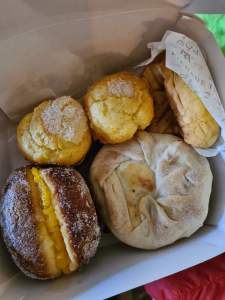
Bolo de Berlim, bolo de arroz, queijada, pão de ló

By the way, we set out to get a range of snacks from lots of European nations to eat while watching but we ended up just loading up on cakes from the Portuguese stall at Richmond’s Duckpond Market

Posted in English

E Depois do Adeus

I mentioned Eurovision a couple of days ago and it reminded me of this song, e Depois do Adeus by Paulo de Carvalho, which has to be a strong candidate for the Eurovision entry that had the most impact in the real world. As you can see, it’s straight out of the seventies, with the sideburns and the big collar, and it’s hard to imagine anything more Conservative sounding (although this guy, for example, thinks there is a social criticism buried in the poetry of the lyrics)

So how did it come to have an impact? In a way, it was catapulted to a place in history by its very conservatism. It was the Portuguese entry in the 6th of April 1974 in Brighton. It was pretty popular and wasn’t banned, so it was used as a signal on the 25th of April 1974 at 10.55, for the troops involved in the Movimento das Forças Armadas to get ready, armed and at their post. Nobody listening, who wasn’t in on the plot, would have thought it a strange choice, so if the leadership had had to back out at the last minute there would have been no suspicions aroused. Later the same evening, when it was decided that everything was in place and the plan could go ahead, a second song was played, namely Grândola, Vila Morena, which was a revolutionary song by Jose Afonso, that had been banned by the Novo Estado since its release in 1971. Once that was transmitted by Radio Renascença, everyone knew shit had got real. The convoy left their barracks and there was no turning back.

Here are the lyrics.

Quis saber quem sou /I wanted to know who I am
O que faço aqui /What I’m doing here
Quem me abandonou /Who abandoned ne
De quem me esqueci /Who I had forgotten
Perguntei por mim /I asked for myself
Quis saber de nós /I wanted to know about us
Mas o mar /But the sea
Não me traz /Didn’t bring me
Tua voz /Your voice

Em silêncio, amor /In silence, love
Em tristeza enfim /In sadness, finally
Eu te sinto, em flor /I feel you flowering
Eu te sofro, em mim /I feel you, in me
Eu te lembro, assim /I remind you like this
Partir é morrer /That to leave is to die
Como amar / Just as to love
É ganhar /Is to win
E perder /and to lose

Tu vieste em flor /I saw you in flower
Eu te desfolhei /I plucked off your petals
Tu te deste em amor /You gave yourself in love
Eu nada te dei /i didn’t give you anything
Em teu corpo, amor /In your body, love
Eu adormeci /I slept
Morri nele /I died in it
E ao morrer /and by dying
Renasci /was reborn

E depois do amor /And after the love
E depois de nós /And after us
O dizer adeus /The saying goodbye
O ficarmos sós /And being alone
Teu lugar a mais /Too much space for you
Tua ausência em mim /Your absence in me
Tua paz /Your peace
Que perdi /That I lost
Minha dor que aprendi /My pain that I learned
De novo vieste em flor /I saw you again in flower
Te desfolhei /I plucked off your petals

E depois do amor /And after the love
E depois de nós /And after us
O adeus /the goodbye
O ficamos sós /The being alone

Posted in English

Conan Osíris – Telemóveis

Well, this Eurovision semifinalist is definitely bonkers. It reminds me of António Variações, the cosmic electro-beardie from the eighties, reading out the warranty redemption for a damaged iPhone. Anyway, I don’t know if he’ll be picked but he seems like a strong contender: stronger, anyway, than the unbearably tedious, over-earnest drivel by DAMA that was controversially beaten out on a tie-breaker,and better than last year’s too, but it’s still no Salvador Sobral.