Posted in English

SuiC1de is Penless

Yesterday was the day of the DAPLE (C1) exam. Usually when I do one of these exams I write it up straight away, but I’ve left it till the next day because I was feeling a bit miserable. It all went a bit piriform, I’m afraid. Let’s take it step by step:

I arrived at the embassy half an hour early. Better than half an hour late, I suppose, but they don’t open the gates till nine. No exceptions. Even when their own staff arrived the secrity guy wouldn’t answer the buzzer till nine sharp. I was in need of a wee, and I had a congested nose, so being out in the cold did not help at all. And then a brazilian and a…. venezuelan(?) guy arrived and started speaking spanish. I tried to ignore them. I don’t need to hear spanish today, lads!

When we were let in, she showed my to a nice reception room – much nicer than the noisy, echoey office the exams have been held in previously. I was the only student there, so I was just sat at a table, with the invigilator about fifteen feet away at a different table. My face was bunged up, I had to breathe through my mouth a lot of the time, and I had to keep blowing my nose noisily.

The Compreensão da Leitura went well. 90 minutes, 60 marks. There were some extracts from articles about modern life: an overview of the work of António Damásio and a missing paragraph exercise based on a story about how portuguese kids coped with remote learning during lockdown. The missing paragraph thing is quite annoying: it soaks up a lot of time for only 5 marks. I was worried that I was behind schedule but of course it was fine: The last 40 marks are fill-in-the-blank questions, which are much quicker than the ones where you have to read the text, so you don’t have to be strict about hitting one mark every minute and a half. It was definitely challenging, but I had done the preparation and I reckon I got most of the marks.

Break. Water, toilet, blow nose, eat a square of chocolate, suck a menthol sweetie.

Next came the Produção e Interação Escrita. 90 minutes, 3 exercies. I found myself getting writer’s block at first, suddenly doubting my spelling of almost every word. I wrote a formal letter to the local council, telling them they shouldn’t close the library, recycling as much from the question itself as I possibly could.

Next up was a discussion stemming from this article from the Expresso (the section beginning “O problema não é a ansiedade dos jovens quanto o futuro…”). I decided to branch off in the middle and talk about George Bernard Shaw’s novel “Back to Methuseleh” which takes as its premise that if you could only extend the human lifespan to hundreds of years then everyone would suddenly be incentivised to really work at dealing with entrenched, long-term social problems. This seemed like quite a fun diversion: the trouble with always having to write about environmental issues is that it can feel a bit preachy, so I was glad I made it more interesting. Generally, if you bore the marker they are less likely to give you the benefit of the doubt. With hindsight, I think I might have confused some of the plot points with “The Trouble with Lichen” by John Wyndham, which is also about extending human life, but never mind; I doubt the marker will have read both, so I think I’m pretty safe.

The third of the three exercises was the usual mechanical rewriting of sentences into different forms: passing direct to indirect speech, switching in and out of subjunctive and using gerunds. I’ve done a shit-ton of fiddly grammar exercises lately in Qual é a Dúvida: about a hundred pages of them, in fact, so I felt really confident about my answers. Done, dusted, 5 minutes left over, so I skimmed the first and second texts, strafing the errors. Some really stupid ones! Probably saved myself about ten lost marks there.

Break. Water, toilet, blow nose, eat a square of chocolate, suck a menthol sweetie.

Hey, well, it’s all going well so far right, as the optimist said as he fell past the thirteenth floor.

Next up was squeaky bum time: the Compreensão do Oral, which is always everyone’s least favourite. It’s 40 minutes and 25 points. I have done six of these for practice recently and was starting to feel quite confident, so I just tried to stick to my new system and keep a cool head. I couldn’t though – I felt like I was swimming around in a sort of soup of words. And the questions were really ambiguous too, For example, there was a passage about the rehabilitation of the Iberian Lynx (I can’t find the exact recording but here’s a podcast that deals with the same situation). At one point he talks about a kind of rabbit called the Coelho Bravo which he said was essential to the Lynx because it was so specialised that the Coelho Bravo was “almost its only food” but he didn’t say what else it ate. The answers included one that just said it was “essential” and one that said it was essential because it was the lynx’s “only food”. I didn’t like the first because it’s not specific enough about why the rabbit is essential, but the second seemed to be overstepping the mark so I played it safe and stuck with the first.

Then there was one about wolves in portugal (I’ve listened to an audiobook about them, but it didn’t help much I’m afraid), a section from this interview with the author of a book called “Adeus Futuro”. The invigilator told me afterwards that even she couldn’t answer the questions for this section (cool cool cool cool cooooool).

And finally an interview with friend of the blog Marco Neves. I’ve read one of his books, actually had another of his books on order at the time, and I once did a course he taught so I have a pretty good idea of the way he thinks. And Ainda bem, because the fourth question in the section was about a specific word – I can’t remember what it was but it began with “des” and the question was about whether the des- was there to reinforce the root word or contradict it. I didn’t catch it the first time around so I listened out for it really carefully the second time and I swear, dead ass, as the young folk say, that he didn’t bloody say it. I mean, I know he must have, but I didn’t hear. I made an educated guess, but I dunno. I was gutted. I’ve been scoring 17-20/25 lately and I’d be surprised if I got 15 in this. Horrifying.

Break. Water, toilet, blow nose, eat a square of chocolate, suck a menthol sweetie, say, when asked how I am, that I just want to die.

The final part of the exam is the shortest, but it’s quite nerve-wracking because it’s recorded on video: Produção e Interação Orais. 25 minutes, and you’d think it would feel like hours, but it doesn’t, it feels like about twelve seconds. With hindsight, I wish I’d written some reminders to myself on a card about controlling the rate at which I speak, and slipped it into my backpack. so I could have read it before that part of the exam and refocus my thoughts before the real thing.

Again, I’d spent quite a bit of time preparing for this and I had developed an apresentação which I hadn’t memorised but reckoned I could use all or part of in talking about myself. Weirdly, though, she didn’t really give me much room to expand on my answers. It was just Where were you born, where do you live now, how long have you lived here, how long have you been learning portuguese and a few other things. I even got cut off if I said too much. Gutted! I’d been prepared to give my silly discussion of running in the park, talk about the books I’ve read and maybe even get into talking about the comedian I’d seen on the previous evening, but I didn’t get a chance. My answers were fine, but I thought this would be my chance to shine and it wasn’t.

A man being thrown out of a meeting
Me trying to finish my Apresentação before embrassy security throws me out in the gutter

The next part of the interaction is a visual prompt and I was handed most boring picture in the world, with two men and a woman sitting at a desk and almost no other objects visible in the shot. I talked about meetings and how a lot of work meetings were happening online now, and how I quite liked that as an introvert. I did some light-hearted banter about what it’s like when you’re trying to write an email and someone says your name but you have no idea what they are asking you because you weren’t listening. Not exactly comedy gold but it was reasonably grammatically correct. I suspect there were a lot of Umms in there though. I hadn’t quite filled the time, so she gave me a follow-up question: did I think there was a gender pay gap in the workplace. Oh shit, I thought, was that what I was supposed to talk about? Women in the workplace? Oh well, I started saying it depended on the specific company and that in my industry, social services, women were really well represented in senior positions, but that was as far as I got because we hit the time limit again. Probably just as well, really, I don’t normally want to give pat answers so I think I would have got into lifetime earnings after that and come a cropper on the vocabulary.

Lastly, we had to do an interaction about starting an export business. Normally, you’d do this with another student but since there weren’t any, it was me and the invigilator, with a third person taking notes. Why did they need to take notes when it was all on camera? I dunno.

The scenario was that I wanted to export olive oil and she had to persuade me to export cork instead. Wha’? What do I know about the relative profitability of those things? I didn’t really follow the sequence properly and kept fighting my corner even though the script said I was supposed to agree with her in the end. I finally took the hint but I was in the middle of saying that my wife has lots of bags but she doesn’t have one made of cork, so I turned on a dime and said that, now I thought about it, maybe I’d but her a nice cork bag. Except I started a clause with “talvez”, and the subjunctive circuits of my brain creaked into action, creaked to a halt again and I remember really clearly hearing myself entone in slow motion… “de…ver….ia…” and knowing it was wrong but just feeling so out of control at this point that I didn’t even try and correct myself. Feck.

They stopped the tape and asked me if I felt it had gone well and I said no, definitely not and I stood up. They asked me some more things while I was gathering my pens, stuffing menthol sweeties into my mouth, nose and ears and wriggling my coat on. I coudn’t even string a sentence together. At one point, I turned to them both and said “Juro que falo melhor do que…” and then couldn’t even think how to finish the sentence. Oh well, the recording had stopped so whatever.

I had lunch in Comptoir Libonais, then home, where I watched a movie and had some more nice food. First booze in months, too, but I’d earned it. Nose still streaming. Finished the rest of the menthol sweeties. Oh and there was a parcel. It was that Marco Neves book I’d ordered. God is mocking me.

Well, I guess it could be worse. There were some real low points but it could be a lacklustre pass. I’m not even pausing, I’m going to set my sights on DUPLE in May and start work now. I know I’ve said this many times before, but I absolutely have to talk more. I’ll never get there if I can’t talk naturally.

Posted in English, Portuguese

Um Conto de Dois Embaixadores

Ferrero Rocher for the Ambassadors

Launching an occasional series tentatively entitled Ambassador Update. This week: there is a new Portuguese ambassador in London, and the British ambassador in Lisbon fell of his bike and tweeted (in Portuguese, natch) about how well he was treated by everyone involved. Thanks to Dani Morgenstern for the help. I wrote this a while ago and delayed till I had the corrections for it, so maybe by the time you read this the world will have moved on but I’m betting you are not the sort of person who needs their ambassador news to be bang up to the minute so I hope you’ll bear with me.

Aqui em Londres, há um novo embaixador português. Sua excelência Manuel Lobo Antunes aposentou-se e voltou para Portugal. No seu lugar, Nuno Brito apresentou as suas credenciais a Sua majestade na quinta feira da semana passada.

Entretanto no parque de Monsanto, nos arredores de Lisboa, no sábado da mesma semana, o seu homólogo, Chris Sainty, o embaixador do Reino Unido, caiu da sua bicicleta e partiu um ombro. Escreveu um tweet no qual elogiou a gentileza dos transeuntes que vieram em* sua ajuda, e o profissionalismo dos médicos e enfermeiros que cuidaram dele no Hospital São Francisco Xavier.

* vieram em sua ajuda: they came in his aid, not to his aid. Another of those confusing preposition switches.

Posted in Portuguese

We Was Robbed!

I went on a misson to Hyde Park this morning to collect my exam certificate from the portuguese embassy. They won’t mail it, you have to go in person. I think I mentioned a few weeks ago that I’d been disappointed to only receive a “suficiente” and not a “bom”. The cut-off is at 70% and I felt like I’d done really well, so when I got the result I assumed I’d hit the high sixties and just missed it. Disappointing but not the end of the world.

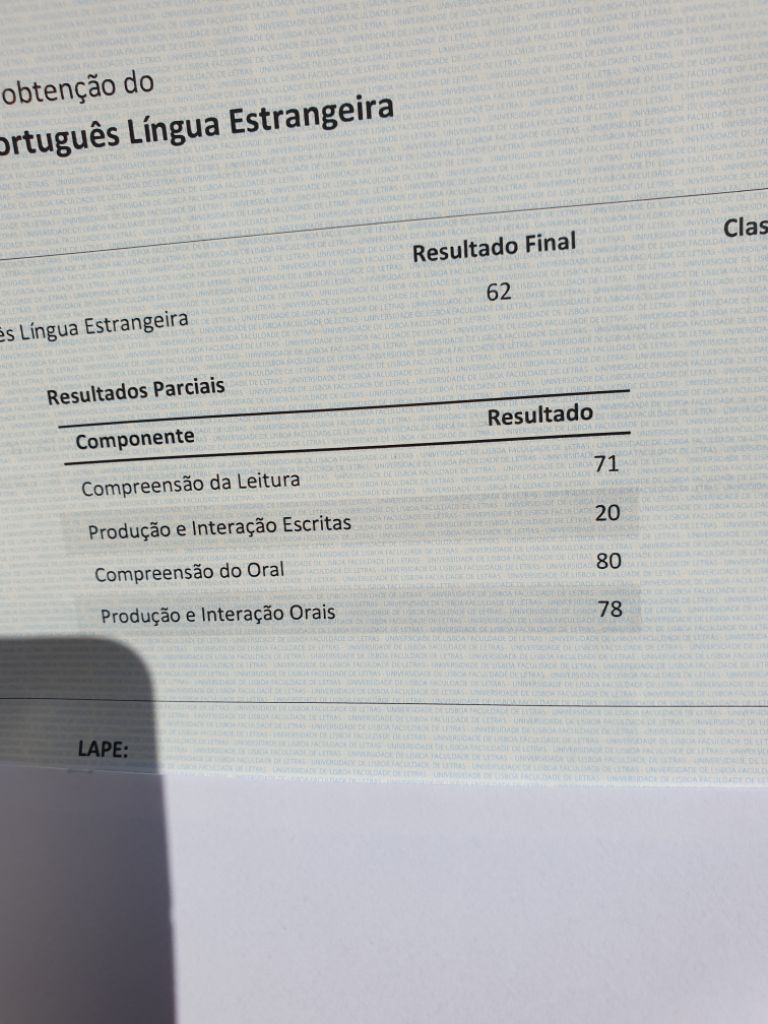
So, fast forward back to today. The teacher handed me the paper and I could see the marks I got for wach of the four of the components. For three, I was in the 70-80 range, which would have been fine, but the written component – usually one of the easiest bits – was well below that level at a pitiful 20%.

Twenty!

I said to the guy that it was a bit difícil a acreditar, undermining my case somewhat by tripping over my tongue and making a ton of mistakes through sheer nervousness. My written work definitely isn’t bad enough to hit 20 per cent though. I probably made some errors, but I finished both pieces and they were decent enough. One of the things about the exam, though, is that each paper has a candidate number on it, not a name, and I suspect mine might have got switched with someone else’s. Either that or they meant to give me 200% but ran out of ink before the second 0. Either way, I’m definitely appealing the mark.

Posted in Portuguese

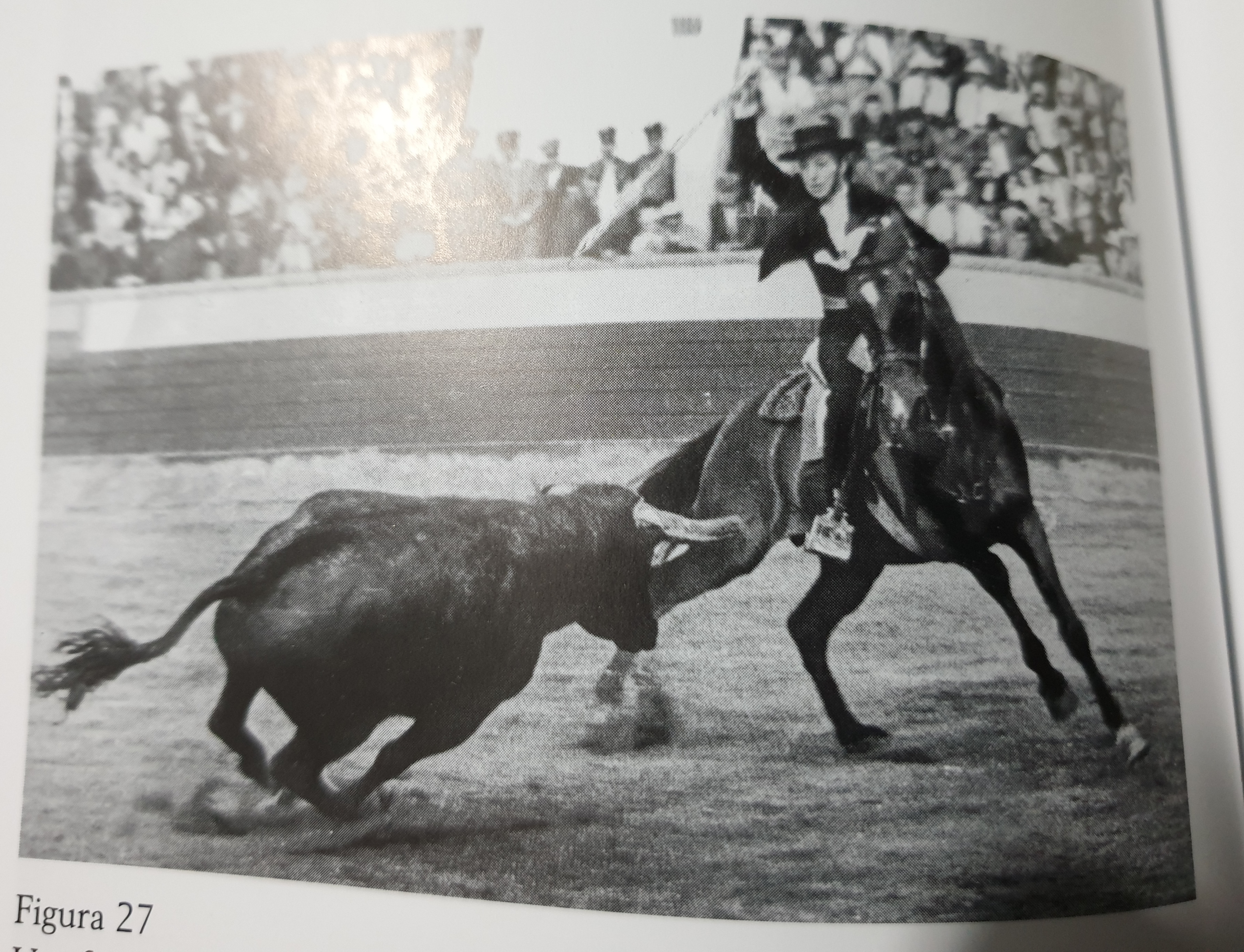
Marialva

Acabo de ver uma apresentação dum novo livro escrito por uma autora portuguesa, chamado “A Inglesa e o Marialva”. É baseado em factos verídicos, sobre uma inglesa que chegou em Portugal nos anos sessenta. Tem um bom aspecto.

Alguém fez uma pergunta que muitos devem ter-se se perguntado: o que é que é um “marialva”. Foi explicado que esta palavra tem dois significados: pode ser um bom cavaleiro ou um homem que se traja como o Marques de Marialva, e tem o comportamento daquele fidalgo; forte, bem vestido, tipo Dom João. Mais recentemente, o nome tornou-se mais negativo, portanto muitas vezes significa um bêbado, ou um homem que corre atrás de mulheres.

https://www.instagram.com/p/BvAGG_HAYFf/?utm_source=ig_share_sheet&igshid=19jshjfc41kl2

Posted in English

Applying for Dual Portuguese Citizenship

Updated 12/3/19 in light of what I learned in Porto

15/01/2022 – there is a sequel to this post that is worth reading since it has some important updates about payment methods.


Well, it looks like some people voted for a national act of self-harm and those of us whose families straddle more than one country need to think about planning for the future. In our case, we’re doing that by applying for dual citizenship (me, daughter, both currently british) and leave to remain (Mrs L, Portuguese) to ensure we’re all in the same boat and can act together in future if some future government decides to make life properly difficult for EU citizens or punish them financially or it becomes difficult to live and work in the countries we used to be able to move around in freely, all thanks to the actions of a bunch of divs who didn’t do the homework before getting into the voting booth.

I thought I’d write down the steps here in case it’s helpful. I’m going to focus on UK citizens living in the UK. If you’re an expat, you’re pretty well covered by other sites like this and of course if you’re Portuguese in the UK there’s a lot of info here.

The obvious point first of all is that it’s almost certainly going to be easier while we’re still in the EU than it would be after we leave and britain is towed across the ocean to be moored off Mar-a-Lago or whatever these idiots have in store for us. In other words, if you’re reading this, you’d better get your skates on.

Basic Approaches

Have a think about how you are going to submit your applications because that will determine some of the later choices you make. Options are:

  1. Go to the consulate in London. If at all possible, avoid this option.
  2. By mail. This is obviously a bit slower and you’ll have to figure out the logistics of how to get your documents validated unless you are mad enough to post the originals, which I don’t recommend, but if you can suss that out, this might be the least hassle option.
  3. Visit Portugal itself. Obviously this is the most fun option because you’ll be in Portugal, and the offices shut 3 hours before the bookshops and about 7 hours before the restaurants so you’ll have plenty of time to unwind.
    Several towns have offices where you can register. I think the smaller the town, the less time it takes because Lisbon and Porto are already swamped with Brazilians, Venezuelans and Brits. Presumably Faro has a massive backlog of “expats” too. Book a few days away. Maybe one for any preliminaries (say, get a NIF, meet with a Translator if you have any documents being translated) and leave two days for the process itself in case you have any problems with that and need to follow up.

Length of marriage

You need to have been married for 3 years to use the marriage route so if you’re not already hitched, tough (but there are other routes you can use – see below). If you got married in the UK, make sure the marriage is registered at the Portuguese consulate too. You will probably have done this if your other half updated their citizen card with a new surname. It’s slow and awful because it involves the consulate. They require all the same documents as described in this blog post, plus you’ll have to use their bloody awful online appointment booking, both turn up in person, and deal with various indignities.

Payment

The cost for an adult is €250. When you go to download the forms (“modelos”), there’s a big warning up front. Translation:

IMPORTANT WARNING

Applications that are not accompanied by the required payment will be rejected outright with all the documents. If payment is made by cheque, it must be a certified cheque or bank cheque issued in Euros from a company with representation in Portugal to the order of “IRN, IP” [this just means the Institute itself] issued on portuguese banks.

This seems a bit repetitive but basically, get thee to a bank that has branches in Portugal (Santander for example), open a bank account if you haven’t already got one, and ask for a banker’s cheque/banker’s draft.

There are two other alternatives. One is to get a “Vale Postal” (postal order) which you can buy at a post office (CTT) in Portugal. Again, make sure it’s made out to IRN, IP and has the correct address. The Vale Postal route is relatively straightforward if you have all the bits you need – the details of the payee (on the form itself) and the recipient, but on the downside, you have to do it in Portugal 3 working days before you submit to give it time to reach them. This is because a Vale Postal doesn’t work in quite the same way as a UK postal order. They mail the slip to the recipient and you need to note the reference number (and keep the receipt) as proof, and then wait for the order to show up at their office.

You’ll also need a “contribuente” (also known as Número de Identificação Fiscal – Or NIF) if you have one. If you don’t have one, you can pop down to the Serviço de Finanças and get one. It takes 20 minutes and costs €10. And if all else fails, just use your UK Unique Taxpayer Reference instead which seems to work.

The final option, if neither of the above is suitable, is the simplest of all, but you can only do it if you go to the office in person: bring cash.

The Modelos

The main hub for the different “modelos” (forms) is on the site of the Instituto dos Registos e Notariado.

Choose the one that best fits your situation. In my case, they were these:

Templates and forms regarding nationality

Model 1C
For children of a portuguese mother or father born abroad that registers their birth in the portuguese civil register or declares that they want to be portuguese.

Model 3
For a foreigner married for more than 3 years with a portuguese national or who lives in a de facto union for more than 3 years.

You need to print the first two pages double-sided and the third and fourth pages are just guidance. Fill it in in black, in Portuguese (Duh!) and using crosses, not ticks in the boxes. I’m not going to translate the whole thing I’m afraid. You can use GTranslate can’t you? Most of it is pretty straightforward, but there are a few weird ones:

  • Quadro 1, Questão 6 includes “Naturalidade”, “País” and “Nationalidade”, which seem to be asking the same thing, but I chose to interpret them as Place of birth (Scotland, in my case), Country (Stretching a point: the UK), Nationality (British)
  • Quadro 1, Questao 8 asks for countries you have lived in previously. You will need to provide criminal records checks from all these countries, so don’t even mention any you lived in as a child or if you weren’t there long enough to be registered and leave a paper trail.
  • Quadro 2, Questão 3 is a bit enigmatic “Do you have an effective link to the portuguese community”. This is exceptionally sketchily described in the form guidance as it stands and I have heard various theories, “new rules” and suggestions but what it seems to boil down to is this: for expats, resident in Portugal, married for 5+ years, there’s no language requirement if you can show something like a deed to a house, a contract with an employer or some other evidence of being a fully fledged citizen, to show you are integrated into society. If you’re non-resident, about the only proof of integration you can produce is a certificate of proficiency in the language, so effectively for us there is a language requirement. I quite like this: you can demonstrate you are integrated into the language and cultural life of the nation rather than the legal and economic life.
  • Quadro 2, Questão 3 again. A bit further down it asks if you’ve performed functions for the state that were not predominantly technical in character. I had to ask my wife about this one as I couldn’t see what it was driving at. I think we decided it meant performing the offices of an MP, say, or a civil servant. The suite of questions seems to be trying to establish if you have any competing duties that might mean you retain an allegiance to the former state, I guess, hence the questions about being in the armed forces, being a terrorist and so on.
  • Quadro 4 needs to have the answers copied from your other half’s birth certificate, and even then, if it’s anything like my wife’s it’ll still be baffling. I just handed it to her and asked her to do the necessary.
  • Quadro 6 needs to be signed and witnessed by someone. Since I was planning to visit, I left this blank to sign in front of the person I handed it to, but you can also do it in front of a consulate employee or a Portuguese solicitor if you are mailing it in.

Documentation

Some of this isn’t really spelled out because portuguese bureaucracy can be a bit hatstand sometimes, so it’s best to go the extra mile and do more than it requests rather than less

  • As I said above, a certificate of proficiency in Portuguese shouldn’t be needed if you have been married 5 or more years but if you are non-resident it’s likely to be your only proof of an effective link to Portuguese community.
  • You need a recent police check certificate in the UK and any other country you have lived in as an adult. The UK police certificate costs, and requires quite a bit of paperwork in its own right.
  • All the other documents it asks for – birth certificates, passports and so on – need to be translated, and officially, not just by you. As it turns out, it wasn’t necessary for my process because the chap said if it was written in English it didn’t need a translation. TBH, I’d suggest you’d better do it anyway since that’s what it says in the instructions and it seems to vary from one person to the next, how rigorously the rules are followed, but it’s up to you. You could save a couple of hundred quid if you skip this step and get away with it, but you might prefer to play it safe. I know of at least one other person who couldn’t get through the process because they didn’t have certified translations of all their papers. They’re also sometimes a bit funny about the certificates being recently issued (especially at the Consulate), so even if you have your original certificate, you should write to your registry office and get a reissued copy too and bring it along. If you’re not sure how to get a new certificate, Google the name of the local authority you were born/married/whatever in and “replacement certificate”.
  • If you do decide to get then translated, it’s quite a complicated process (but don’t worry, with the right help you can get through it)
    • Firstly, the translator can do the translation based on a photocopy, and that’s probably the first place to start since you can do it by email.
    • However, to get it certified, you need to give them either your original documents or a copy that has been authenticated by a solicitor or notary.
    • When they have that, they can attach the translation to the original or verified copy and take them all to a solicitor at their end who can certify the translation as well
  • Now, I didn’t trust the mail with my documents but also feared that if I got them certified in the UK the portuguese authorities might not recognise their authoritah, so what to do? Well, I sent my documents to a couple of translators in Portugal and got the quote I was happiest with (CS Traduções) and sent the documents by email attachment. She then took care of everything basically, and I arranged to pick them up the day before I had planned to submit the application. It was all completely hassle free and she was very patient with all my questions.
  • I already mentioned that if you were married in the UK you need to get your marriage registered in Portugal, so the proof of that is probably enough on its own but I took a translation of my UK marriage cert too, just to be on the safe side.
  • For children, both parents need to sign and both signatures witnessed.
  • For children, birth certificates should be recognised in all EU countries but since the UK might have left before the form gets processed it might be a precaution to get it stamped by the Portuguese consulate in the country of birth. This isn’t written down, just the opinion of one official I spoke to, so take that as you will.
  • As stated above, you’ll need your cheque, Vale Postal receipt, or cash if you’re an adult, but it is free for minors.

The Visit

If you’re visiting the consulate, you’re probably doomed and will have been driven to insanity within a few weeks. I pity you. If you’re visiting Portugal, the addresses of the offices are in the last page of the guidance on the Modelo. Since it says “Balcões da Nacionalidade instalados nas seguintes Conservatórias do Registo Civil” and doesn’t give any addresses for the offices in smaller towns outside Lisbon, I went to the wrong place at first. This seems to be the place in Porto, anyway:

SEF Porto

Av. da França 316, 4050-276 Porto, Portugal
+351 22 207 3810
https://maps.app.goo.gl/fL7zP

It’s a kind of one-stop citizen shop and there are several different services in the same office, so ask at the desk if you can’t find the right option on the machine that dispenses tickets (the tickets are known as “senhas” not “bilhetes”) . Ask for Conservatória and you should end up with a senha with a number that starts with a Q.

Make sure you arrive between 8AM and 8.30AM or you’ve no chance.

Obviously don’t be rude or anything, but do be prepared to be assertive. My wife gave me some samples of indignant customer dialogue to use in case of intransigence but I was quite glad I didn’t need to use them. Apparently the tone to go for is polite but with a menacing air of superiority.

Minha senhora /meu senhor. é preciso ser razoável e justo.
Ora eu já cá estive na sexta e nada foi resolvido ou esclarecido. Isto não pode ser.

Veja lá por favor o que pode fazer porque sinceramente eu estou a ficar desorientado e preciso clarificação

The process can’t even be started without payment. If anything else is missing, you’ll get a case number and can submit the missing docs by post, but the one thing you can’t forget is the money. Owing to the large number of applicants expect to hear back after a year – or 18 months for children. We’ll have left by then but hopefully they won’t have started stoning remainers to death in the public square yet, so we should be OK, I think.

Well, that’s the sum of all my knowledge. I hope it’s some help to someone. Good luck.


I’d like to thank my friends Barbie (who gave me a lot of advice on her own family’s involvement in this process) and Marcos (who by amazing luck happened to be very close by the SEF on Friday and actually came to help out with communication, which was incredibly generous of him)

Posted in English

More About Consulates

I thought I’d add a quick blog post in english to follow up the text I’ve just written in portuguese, for the benefit of anyone who might be going to the portuguese consulate to conduct any sort of business, but especially for anyone who needs to register their marriage and change the name on their ID Card, maybe in preparation for applying for citizenship or applying for a passport. I guess in the age of Brexit there will be a lot of people having to brave the bureaucracy. Sigh.

portuguese-passport-big

First of all, you can only make bookings online on the consulate website and they come available at stupid o’clock at night, so you’ll need to plan this well in advance.

Second, the list of necessary documents the consulate supplies isn’t entirely complete, as I’ve mentioned in my test. For a start, if you’re like us, wanting to register a marriage, you’ll need your other half. In other words, a portuguese woman can’t go along, prove she is married and get her name change processed, she has to bring her estrangeiro husband along and have him sign some stuff at the same time. On top of that, the husband’s birth certificate and the marriage certificate both have to have been issued within the last 6 months. If you have the originals, sorry, but those won’t do, you have to have them reissued. You can do this online without too much effort and at a reasonable cost, and it only takes a few days to arrive, although if, like me, you need to ask for three extra copies because the appointment keeps being rescheduled, you might come under suspicion of identity fraud!

And third, prepare for a slightly tedious day. Although both parents need to be there, it’s best not to bring a child if you can avoid it. In our case, the funcionario got a bit arsey when our thirteen-year-old came, and there aren’t many children with the patience to stick it out for three or four hours in a mouldy building with an all-pervading air of bureaucratic intransigence. What I said in the text is not an exaggeration: we were talking to the manager of the office and staff did keep ambling in without knocking and asking her basically the same question. Their system was down and nobody quite knew what to do about it. They wanted to cancel our appointment and make us come back again but m’wife wasn’t going to put up with that nonsense. There really was a 2014 calendar on the wall and she actually discussed the cases & personal situations of 4 other cases just as chit-chat while we were sitting right in front of her. There were boxes everywhere and the general atmosphere was of complete chaos. It’s no wonder the consulate in London has such a terrible reputation among portuguese emigrants.

I’m not one of nature’s managers, but I could definitely imagine a few changes someone could make to make the whole thing easier for everyone. For a start, just fixing the website to show the correct details of what to bring would save hours a week dealing with wasted appointments of people who don’t have the right things with them. That would make life easier both for the staff and for the vistors. A few signposts, a bit of training in procedures, some customer focus, a few hours spent putting the boxes away in a cupboard… it honestly wouldn’t take much to turn things around and make it work better for everyone.

Posted in English

Well, Shit.

So something a bit depressing happened today: I got the result of my second B2 exam. As I might have mentioned, it didn’t go as well as I hoped but I was expecting to creep up a bit from the miserly “suficiente” I got twelve months earlier to a “bom”. Today, it finally came through and it said…. “insuficiente”… meaning I have actually got worse after a full year of study.

Except of course, I haven’t, I’ve got quite a bit better. My conversation is still a bit stilted but I can write reasonably well, understand most of the podcasts I listen to, and I read 17 Portuguese books last year, some of them pretty heavy. So, what went wrong? Well, ultimately, I suppose, I am still pretty weak on a lot of important points of language. Add to that a lack of exam prep and just general having-a-bad day, and you get a pile of poo. It was a bit of a blow to my confidence. I’m not going to bloody stop though. Exams are a useful way of motivating myself (well – heh – sometimes) but I’m in it for the books and the mind-expansion, so. I’m not going to lie down in a ditch and give up because I got one shit result.

Posted in English

A bit disappointed

Well, I’ve done the exam. It went OK. I mean, I’ve no doubt I passed and with a better mark than last time, but I have a nagging feeling of disappointment that I didn’t smash it. I’ve had a whole year since I took the test for the first time and barely passed. Now I think I’ve bumped my mark up from “barely scraping by” to “not bad I suppose”. That’s not much to show for the effort I’ve put in (and I really have you know!)

Anyway, for now, I’m not going to be disheartened. I’ll crack on with what I was doing and maybe try to be more active in writing and talking. That seems to be the key, I think: producing language, not just passively absorbing it by listening or reading (although I will still be doing those things too)

Posted in English

Round 2

Whoop Whoop!

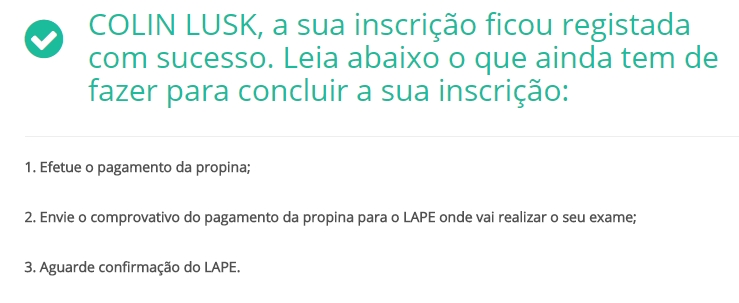
I finally managed to make my subscription for the Portuguese B2 exam, the intermediate Diploma. It feels like I have a long, long way to go but this should motivate me to work hard between now and November!

reg