It’s been a while since I did a translation. Here’s Madredeus doing “Faluas do Tejo”. I’m not even going to translate the title because Falua is a kind of cargo-boat used on the Tejo and we don’t really have a word for that and I think writing “Cargo Boat Used on the Tejo” in the lyrics would be clunky.
The name comes from the arabic word Felucca, apparently.
Português
Inglês
Faluas, Vaga lembrança Qu’eu de criança Guardei pra mim
Faluas, Vague memories That I as a child Kept for myself
Se as vejo ainda Às vezes no Tejo Revivo a alegria Do tempo em que as via no rio a passar
If I see them still At times on the Tejo I relive the happiness Of when I saw them passing on the river
Faluas do Tejo Que eu via a brincar E agora não vejo No rio a passar Faluas vadias Que andavam ali Em tardes perdidas Qu’eu nunca esqueci
Faluas of the Tejo That I used to see playing And now I don’t see Passing on the river Lost Faluas That used to go around there On lost afternoons I never forgot
E era tanta beleza Que essas velas ao sol vinham criar Belo quadro da infância Que ainda não se apagou
And there was so much beauty That those sails created Beautiful painting of infancy That still hasn’t been wiped away
E eu tenho a certeza Que as Faluas do Tejo hão-de voltar Outra vez a Lisboa
And I am sure That the Faluas of the Tejo will return Again to Lisboa
Vou viver / Até quando eu não sei / Que me. Importa o que serei / Quero é viver
Eu e a minha esposa fomos assistir ao espetáculo de Sara Correia em Cadogan Hall. Foi incrível.
Antes do concerto dela, houve uma meia hora com um jovem que cantou bem acompanhado de um guitarrista. O público estava muito entusiasmado. Houve uma grande salva de palmas após cada canção. Nunca antes vi o primeiro artista a receber uma ovação de pé. Mulheres gritaram “amamos-te”. Havia muito estrogênio na sala, percebem? Perguntamos às mulheres do nosso lado direito quem era aquele rapaz. Foi Luís Trigacheiro, um vencedor do “The Voice Portugal”. Aaahh, percebo!
Sara apresentou o seu novo álbum e uns temas mais antigos tipo “Quero É Viver” (de Pedro Abrunhosa*) e “Estranha Forma de Vida” (de Amália Rodrigues) . A atmosfera na sala de concertos foi mil vezes mais animada do que a da minha última visita. Pessoas na varanda batiam os pés e gritavam “Ah fadista! Bravo! Sa-ra Sa-ra!”
Tinha corrido 10 milhas antes do concerto e estava com dores nos pés e as minhas pernas estavam fatigadas mas consegui estar de pé com os outros. Aí, que chatice.
(Update… er… well, look I’m absolutely sure she said it was one of his but I’ve just looked up the original on Spotify and it seems like it was a track by António Variações, released postumously on an album called Humanos, as part of a project by a group of musicians, including David Fonseca, Camané and some members of Clã. They went on to perform some of his music at a series of tribute concerts, which is available on Spotify. I had no idea this had happened. Very glad to find it though!)
I wrote this a couple of days ago but the mistakes made were quite hard to unscramble because of the way I’ve ordered the examples, so it’s taken a while to lick it back into shape. Thanks to Cristina of Say it in Portuguese for helping me desenroscar esta merda toda, but if I’ve missed anything, that’s my fault, obviously, not hers.
Falhei em aprender a lição deste blog portanto tenho TPC: escrever uma frase com cada expressão. Gramática é chato e estou farto de exercícios. prefiro falar sobre o meu novo programa televisivo mas sou um bom estudante portanto vou resistir a este impulso e aderir ao plano. Vamos a isto.
Finalmente
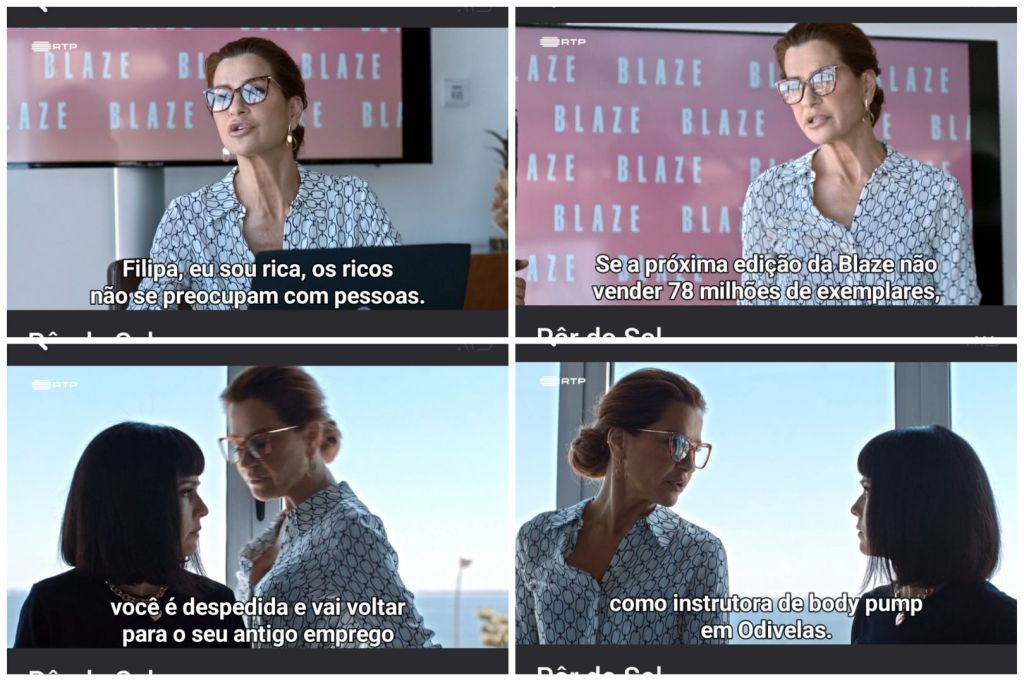
Finalmente consegui encontrar tempo suficiente para ver o primeiro episódio do Pôr do Sol. É incrível!
No fim
A série abre com dois amantes a passear na praia de Santarém e a argumentar, e no fim do seu caminho, chegam a um barco, ao lado do qual há um homem que compra uma das filhas gémeas deles, arranca, e logo depois o barco explode, matando o homem e (aparentemente) a filha.
No final
No final desta abertura, e após uma canção do estimado Toy, retomamos a história 30 anos mais tarde.
Por fim
Tentei seguir o enredo e o diálogo louco mas custou-me e por fim liguei as legendas. Confesso que nem sequer percebi que se tratava de uma comédia no início. Fiquei com a pulga atrás da orelha quando o homem no barco disse que tinha comprado um babygrow de Dulce Pontes. Mas foi a aparência do Toy que afastou as minhas dúvidas!
No fim
Felizmente a bebé gémea não morreu. Protegida pelo berço e o maço de tabaco da mãe(!) a menina flutuou ao longo do rio e no fim chegou a Lisboa onde foi adotada e já está a trabalhar numa revista
No fim
Na superfície, ela é muito bem sucedida mas no fim ela sabe que alguma coisa não bate certo na história do seu nascimento, portanto está muito mal humorada, sobretudo quando a sua assistente fala com ela. A assistente é mais alta que ela, e ela não suporta tal coisa.
Ao fim
Entretanto em Santarém a mãe das irmãs está a beber gin (apesar de não gostar) e a falar com o seu marido, a gémea restante e o caseiro da família (o que, se percebo bem, é o pai das irmãs). Ao fim de trinta anos de mentiras, ela está cheia de arrependimentos.
No fim
O seu marido também tem a sua cruz: o médico o informou que tem uma doença grave e está quase no fim da sua vida.
Afinal
O filho do caseiro namora com a outra gémea. Os pais dele vêm a saber disto e o pai fica zangado porque como já disse, é (acho eu) o pai de ambos. Vivemos numa sociedade muito liberal mas afinal ainda há um tabu contra o casamento com uma meia-irmã. Tanto preconceito*!
Enfim
Enfim, tendo visto o primeiro episodio, adorei. Vou continuar!
No fim de contas
Mas ainda tenho uma dúvida: no fim das contas, porque é que os escritores troçam tanto de Dulce Pontes?
Que acham? Consegui cumprir o meu dever sem ficar distraído?
*Narrowly avoided writing “prejuizo” here. Schoolboy error! One of the best-known false friends, that one!
There are still a few tickets left and they’re pretty cheap if you’re in or around London and fancy a night of Fado on the 17th.
I’m hoping she’ll bring Pedro Abrunhosa with her but it seems like a bit of a long shot. You never know though. When we saw Mariza a few years ago she had a whole host of stars in her retinue.
This song is actually by Maximiano de Sousa (aka “Max”) but I don’t think there’s a video of him performing it so I went with this cover by Raul Solnado instead. Max is from Funchal, and he says his wife is from Ponta do Sol, a few miles up the south coast. Another nearby town – Camacha – is mentioned too.
As you can see – or maybe you can’t – Solnado is wearing a hat that I recognise as a Maderian style, and I think the clothes are specific to the island too. The set shows a traditional house and I’m pretty sure the musical instruments the guys at the back are using are Brinquinhos*. Solnado is a mainlander from Lisbon so this is definitely cultural appropriation and he would be cancelled if he did this today. Quite right too. Throw him in jail!
I am publishing this on the 3rd of February to commemorate the birthday of another island girl – my wife. Since my birthday is on the 6th of May, she is numerically an older woman for the next 3 months. Feliz Aniversário, velha linda!
Portuguese
English
Casei c’uma velha Da ponta do sol Deitei-a na cama e o raio da velha rasgou-me o lençol Tornei-a a deitar Tornou a rasgar Perdi a cabeça e atirei co’a velha de perna p’ró ar
I married an old lady From Ponta do Sol I laid her in bed but that blasted old lady Tore my sheet** I laid her down again She ripped the sheets again I lost my head and threw the old lady and she landed upside down
A tua mãe foi às lapas O teu pai aos caranguejos Ficaste sozinha em casa, fui*** dar-te abraços e beijos Ó menina da Camacha Diz de mim o que quiseres Menos que não tenho jeito p’ra agasalhar as mulheres
Your mother went to the limpets Your dad to the crabs You stayed at home alone, I went to give you hugs and kisses Oh girl of Camacha Tell me what you want from me Unless I’m just don’t have the knack of taking care of women
*More about traditional Madeiran instruments here if you’re interested.
**I had a little trouble following the action here: When he says “rasgou-me o lençol” did she actually make a hole in the sheets or just tear them away from him? I checked on r/portuguese just to be sure and it’s the former. And then how am I supposed to understand “atirei (com a) velha“? Is he throwing himself on her? No, apparently not. “Atirar com” isn’t in my handy guide to verbs with prepositions, but “atirar-se a” is, and that means to throw yourself at someone in an attack. No, my informant told me atirei com means that he just threw, shoved or otherwise propelled the old lady away. The “com” emphasises the force and “brusquidão” of the “sova” or “arremesso” he gave her (3 new items in the word hoard!), so she ended up “de pernas para o ar” – upside down. Probably not literally, but it wasn’t a graceful landing. Hmm… I think it’s one of those songs that’s really fun to listen to but just try not too hard to think about what it is he’s actually describing.
UPDATE – Well, i was joking about the violence and really imagining it as a kind of slapstick scene, but I am told I should consider it might be much more suggestive. That the legs in the air and the ripping of sheets and the warming up of the women could all be interpreted as taking about his sexual prowess, broadcast in an age when you couldn’t really say this sort of things directly. OK, well, that gives a whole new spin on things!
***Online lyrics say “foi” but I think that’s a typo because it doesn’t make any sense. Oh wait, it says fui in the subtitles doesn’t it! Oh well, glad to know I was right about that!
Translation time! This one of from Cara de Espelho, the new band I mentioned in yesterday’s post about Perdo da Silva Martins. This is one of the singles from the album, or would be if singles were still a thing. It’s a track that got released early. I have to hold my hands up, I totally misunderstood the title, but if you follow the footnotes you’ll see how I gradually came to understand what they meant by Corridinho.
I also wasn’t sure at first what they were saying about “separating” all these different types of people. If you just read the first verse it sounds like he’s complaining about there being too many immigrants or tourists in the country. Of course, that doesn’t tend to be the way Pedro de Silva Martins thinks: his work with Deolinda gave the impression that he was fairly left wing and had quite an open attitude to other people, so it would be surprising if he was now backing CHEGA, but who knows, we all get more right wing as we get older. And of course he’s entitled to his point of view. By the end though, it seems pretty clear that he’s saying “there’s more that unites us than divides us”, which I think is probably a healthier way to look at life, and certainly more fun.
Português
Inglês
Separando o africano do cigano Do chinês, do indiano, ucraniano, muçulmano, do romeno ou tirolês Como vês Sobra muito, muito pouco português, ó pá
Separating the african from the gypsy From the chinese, the indian, ucranian, muslim, from the romanian or tirolean As you see There’s very, very little portuguese left, oh man!
Separando o cristão do taoista, do judeu do islamita, do ateu ou do budista, do baptista mirandês Como vês Sobra muito, muito pouco português, ó pá
Separating the christian from the taoist, from the jew, from the islamist, from the atheist or from the buddhist, from the mirandese baptist As you see There’s very, very little portuguese left, oh man!
E que tal juntar a malta numa boa* A um corridinho** de Lisboa Volta e meia*** e roda o par**** Triste é quem fica a ver dançar
And how about we get all the cool people together For a Lisbon corridinho From time to time and spin the pair Anyone who just watches the dance is sad
Separando o celta do visigodo, O huno do ostrogodo, o romano do suevo, ou o mouro do gaulês Como vês Sobra muito, muito pouco português, ó pá
Separating the celt from the visigoth, The hun from the ostrogoth, the roman from the suebian, or the moor from the gaul As you see There’s very, very little portuguese left, oh man!
Se tu queres ainda separar o gay, Da lésbica, do straight, da mulher, gente de bem, Ou de quem sofre de gaguez Como vês Sobra muito, muito pouco português, ó pá
If you stull want to separate the gay, From the lesbian, from the straight, from the woman, good people, Or from people who stutter As you see There’s very, very little portuguese left, oh man!
E que tal juntar a malta numa boa A um corridinho***** de Lisboa Volta e meia e roda o par Triste é quem fica a ver dançar
And how about we get all the cool people together For a Lisbon corridinho From time to time and spin the pair Anyone who just watches the dance is sad
Ora tenta separar o teu genoma, tu tens tanto de Lisboa como de Rabat ou Doha, tudo soma no que és Como vês Sobra muito, muito pouco português, ó pá Se ainda te faz muita confusão
Well try and separate your genome, You have as much of Lisbon as of Rabat or Doha, It all adds up to who you are As you see, There’s very, very little portuguese left, oh man!
Vai, separa o fótão do protão, do electrão Até desvaneceres de vez Como vês Sobra muito, muito pouco português, ó pá
If it still really confuses you Go, separate the photon from the proton, from the electron Until you disappear for good As you see There’s very, very little portuguese left, oh man!
E que tal juntar a malta numa boa A um corridinho de Lisboa volta e meia e roda o par
Pois…
And how about we get all the cool people together For a Lisbon corridinho From time to time and spin the pair
Sure…
* Numa boa seems to be an expression like “na boa” and “de boa” – basically, cool. OK, I hadn’t heard of that
**OK, I’ll put my hand up, I thought corridinho was related to corrida and that they were talking about some sort of group run. LOL. No, running is quite popular in portugal but in a song about bringing everyone together, a group run would be a bit of a weird way to do it.
***Volta e meia is another expression, meaning once in a while
****It took me a while to work this one out. Roda o par….? Wheel the pair? A pair of wheels? Are they going on a bike ride? What? It doesn’t even flow into the next line. Then I realised, obviously, roda is a verb, so it means “spin” or “rotate”. Rotating the pair: it’s a dance move, I think. I can only really find it in descriptions of brazilian dances like the chupim (part way down this page for example), but there aren’t that many written descriptions of dances so the fact that I couldn’t find an example from portugal doesn’t mean it doesn’t exist.
*****And so we come full circle: Corridinho is a kind of dance popular in the Algarve. The Wikipedia entry for it doesn’t include the phrase “roda(r) a par”, but both words appear individually multiple times. You can see examples on youtube like this one – which has some excellent saia rodada action.
My wife is making me watch this Madeiran cooking channel. I was unsure at first because the accent and the regionalismos were hard to get past, but it’s great. She’s hamming it up a bit, apparently: she’s playing a character of an old-time islander. I guess in English terms it’d be like someone doing a strong Welsh accent.
The food looks flippin’ great though: traditional and full of delicious calories. The camera work is fantastic and I would give my right arm for her massive clay mixing bowl. And although I hardly understand her dialogue I’m enjoying trying.
Also sort of hoping Mrs L will cook some of these things…
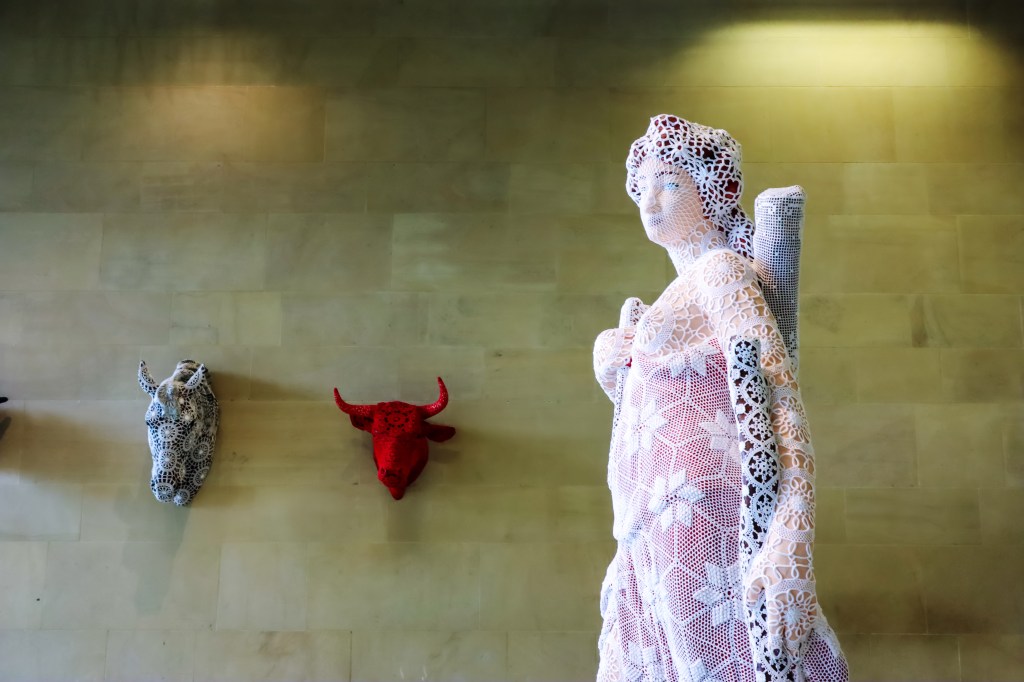
Ouvi falar desta artista recentemente (Onde? Quando? De quem? Nem sequer me lembro!) e decidi fazer uma pesquisa. Não estou a par das correntes do mundo artístico: poucas vezes entro numa galeria e se, por acaso, ouvir algo sobre a arte moderna os factos entram por um ouvido e saem por outro. Mas o site da artista impressionou-me muito: ela oferece um vasto leque de competências na criação das suas obras: há estátuas de ferro forjado, corações de Viana construídos de talheres de plástico, um carro enfeitado de ouro, um helicóptero com penas cor-de-rosa e brilhantes por todo o lado no exterior (o transporte pessoal de Elton John?) e algumas esculturas tão extensivas* que parecem cenários de filmagem! Além da arte, está a utilizar uma espécie de engenharia.
Até certo ponto, lembra-me a obra do Bordalo II, cujas esculturas alegram as ruas de Portugal. Ambos produzem obras de tamanho impressionante e cores marcantes, mas enquanto as dele são feitas de materiais reciclados, como garrafas, pneus e embalagem, dando um ar improvisado e bruto aos seus animais fofos, as obras de Joana Vasconcelos são compostas de materiais requintados; brilhantes e limpos; mesmo que os materiais escolhidos sejam frequentemente fora do normal (por exemplo “a noiva”, feita de milhares de tampões), o objetivo é tornar o quotidiano belo, quase o oposto do outro artista.
As obras de Joana Vasconcelos podem ser encontradas neste canto da Internet**. É deslumbrante, até na ecrã. Numa galeria, hão de ser ainda melhores!
Some of Joana Vasconcelos’s artworks
*This is probably a weird choice of adjective for a sculpture but there are some that really spread out over a wide area of ground which is why I’ve said they remind me of a film set in some sort of Sci-fi scenario, but you’d normally want something more like “gigante” or “imenso”, I think.
**Another daft choice of words. Why “corner of the Internet”? Well, that’s just what we used to call a website when I was into amateur web design in the early 00s. “Welcome to my corner of the Internet”. I won’t change it here, but it’s a good reminder that if you choose to express yourself in interesting, colourful ways like this, your audience might not think “gosh, how quirky and charming” they might just think “you have clearly made a mistake and we won’t know what you’re taking about” so maybe sometimes it’s better to stick to taking like a sensible person.
I was bowled over by Jéssica Cipriano’s version of Madredeus’s O Pastor when I watched it the other day, shortly after hearing her version of Olá Solidão. It’s so, so good. When she really cuts loose at around 4.20, my eyes were filling up and my soul left my body. I think the pianist, David Antunes, was right there with me too. Holy shit! How is this woman not a million times more famous? How do I not even see an album of hers on Spotify? How is she not smashing Eurovision? It’s some sort of conspiracy to hide her from the ears of foreigners, I reckon.
Here’s the original from the 1990 album, Existir. You can see it’s got a richer musical arrangement, and the singer’s voice is beautiful in an ethereal way. but it’s too ethereal for me, and the band has never really grabbed me for that reason, even though they were the first portuguese band I ever listened to. They remind me of bands like Clannad, the Cocteau Twins and Enya. I feel like the voice is being used as a musical instrument; there’s not much emotion there and the words don’t really matter so much so it’s hard to get into.
Português
Inglês
Ai que ninguém volta Ao que já deixou Ninguém larga a grande roda Ninguém sabe onde é que andou
Oh, nobody goes back To what they left Nobody lets go of the big wheel Nobody knows where they’ve been
Ai que ninguém lembra Nem o que sonhou Aquele menino canta A cantiga do pastor
Oh nobody remembers Not even what they dreamed That child sings The song of the shepherd
Ao largo Ainda arde A barca Da fantasia O meu sonho acaba tarde Deixa a alma de vigia Ao largo Ainda arde A barca Da fantasia O meu sonho acaba tarde Acordar é que eu não queria
In the distance It’s still burning The boat Of fantasy My dream ends late Leave your soul on guard In the distance It’s still burning The boat Of fantasy My dream ends late Waking up is what I didn’t want