Trying to book an exam through the CAPLE site is proving tricky. Their website shows some exams happening in November but if I try to book one it tells me it’s full. It isn’t full though, they just haven’t added the slots onto the site and won’t until later in the year, I’m told. I find this problematic because I want it to be done and mentally crossed off my list but I just have to live with
Tag: CAPLE
Os Resultados
Well, they said I wouldn’t get the resultados until Setembro, but it’s only July and the angels have wafted the good news to me on their wings – I have passed the DEPLE exam! There’s a bottle of Prosecco in the fridge. I worked harder for this than I did for any of my University modules, or for anything, really, since my “A” Levels in 1852, and I couldn’t be more proud!
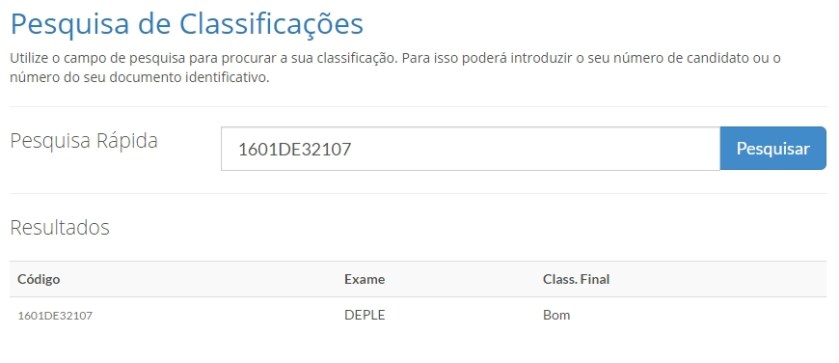
Update: Apparently the classificação: bom means I got between 70 and 84%. That’ll do me.
Nós Falamos Português
I spotted a blog on Twitter today that has some really nice online resources for language learners. Unlike most blogs, it doesn’t just tell you things, it actually has some online test exercises too, which is nice. Here’s a link to the DIPLE/B2 page, which is the next level up for me, but if you look at the menu on the right-hand side you can see they have pages for all different levels.
The Blog is called Nós Falamos Português and you can find it here!
Lying to Examiners for Fun and Profit
Reflecting on my exam experience, I had another idea that might be of use to potential CAPLE candidates: Lie.
Lie through your teeth!
Lie like a lying liar who lies!
Embrace your inner Jeffrey Archer!
What do I mean by this? Well, sometimes questions come up about issues in life that are tricky to explain. Sometimes it’s better to not explain those things and instead just simplify the whole answer. For example, I had already decided that if they asked me “Tem animais de estimação?” I was going to say no. OK, I can talk about the guinea pigs (“A minha família e eu tínhamos alguns porquinhos da Índia. Eram muito fofinhos, mas só viveram até aos cinco anos.” etc) but there was no way I was going to tell them that hoje em dia we have stick insects. Every time I’ve mentioned stick insects in Portuguese it has resulted in bafflement and me needing send pictures and explain that, no, I’m not talking about termites or locusts or anything else. It’s a guaranteed recipe for confusion and it’s just not worth the hassle.
During the exam today, I mentioned that I was born in Edimburgo. The invigilator asked did I ever go back there to visit. Now, as it happens, we are planning to go back quite soon. Why? Well, the truth is that A Minha Esposa had intended to do the Edinburgh Marathon but she had a cold during peak training times and then some other things came up and all in all, she wasn’t fully prepared, so she dropped out, but we’d already booked accommodation at mate’s rates so we decided to…
Now, do I want to start explaining this, off the cuff in an exam? If it were a lesson, I might have a go. I could probably pull it off but it’s a complicated sentence with far too much potential for getting snookered by grammar, so I just lied and said she was going to do the Marathon. That’s a much easier sentence. I can do that, easily. Go!
As I was leaving, she offered these words of encouragement
Verificaremos que a sua esposa terminou a maratona. Se não, o Senhor Colin está desclassificado.
I’m not sure what it means, but I think she was wishing us a happy holiday.
Este é o Verdadeiro Teste
I’m writing this on the way home from the DEPLE (Portuguese B1) exam at the embassy in Knightsbridge, feeling slightly frazzled. I thought I’d jot down what I can remember while I can still remember it because – let’s face it – knowing what I’m like, that won’t be long. Maybe it will be helpful to future students. There isn’t much material out there telling you what it’s like to take the test, after all.
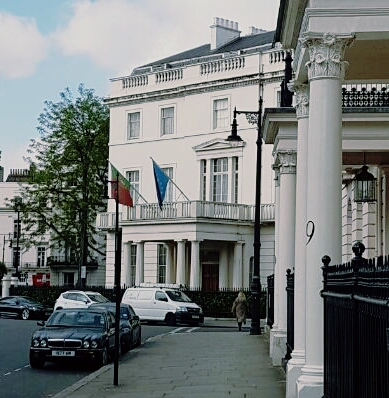
The embassy is an impressive building, as you would expect, with grandfather clocks and all kinds of fancy stuff in the hall and big stacks of Super Bock tucked away in side rooms. The staff are all Portuguese of course, but speak very good English to guests. I had been prepared to speak to the receptionist in Portuguese but he detected my Anglo Saxon demeanour and went straight into English mode.
I wasn’t expecting there to be many fellow students, but I was a bit startled to find I was the only one! I sat in a room, opposite a very friendly and helpful embassy official who handed me the papers and occasional glasses of water. There were textbooks and teaching materials all over the place. I believe they do lessons for expat children, so I guess that’s what those were for.
All the usual exam rules apply: read the question carefully before you start and try not to spill a glass of water on the answer sheet. I stuck to these rules… Mostly.
The first part of the exam was as expected: a series of multiple choice questions based on written texts. Easy enough. I didn’t make great use of my time, unfortunately, and had to rush a bit at the end, but that’s OK. This is by far my best subject.
Next up is a written exercise: write an email and a note based on a scenario they give you. The best technique here is to reuse as much of the question text as possible, just changing the verb endings. They’ve already constructed the sentences for you so why would you want to rewrite it from scratch. Thanks Mr Bennett, secondary school French teacher, for that advice; it got me about 20% of the word limit and then I had to start thinking, and it went reasonably well, I think. One thing to remember is that you don’t really have enough space for the 120-140 words they ask for, so keep your writing small and neat or you’ll end up like me, having to cram the last ten words into a centimetre of remaining space. I’m exaggerating… Actually, no, I’m not. There’s plenty of time though, so don’t forget to use it to go back and check your concordância.
On to part 3. This was the biggest shock for me. Up to now, I had done pretty well in all the “modelos” by allowing myself time to read the questions. Now, in the exam, the first three recordings each allowed one minute for the student to read the questions, but that’s not really enough, and the remaining 5 recordings didn’t allow any time at all. I was trying to read and listen at the same time, got hopelessly muddled and the result was a bit of a mess, I think. If you’re about to take the test, you should consider doing some speed tests, trying to cope with information rushing at you in a flood and strategies for coping with lack of time. Another tip I can give you is to do with the sound quality. The office isn’t noisy but it’s an old building and the acoustics aren’t great. Add to that the traffic noise the general quality of the recordings themselves, and a couple of people wandering in and out and you’ve got a recipe for distraction. When I do the next one, I’m going to ask if I can use headphones to shut out external sounds and see if that helps. I would suggest you consider doing the same if you are planning to take the exam. As for me, in the interval between the third and fourth sections, I went to the casa de banho and cursed the fact that embassies have bars on all the windows so I wasn’t able to escape. When I got back to the room my hands were shaking.
The final section is a ten minute conversation with the examiners. The modelos I’ve done have all had three components to the “expressão oral” but, to my intense relief, in the real thing, they had dispensed with the other two! Yippee!
I had spent the last couple of weeks working on conversation generally, and the last two days cramming intensely for the 1:1 questions, and it paid off in bucket loads. I’m sure I made mistakes but I flew through it, spoke fairly fluently, managed a couple of jokelets and a couple of expressões idiomáticas (examiners bloody love those, whatever the language might be). Best of all, I resisted my natural inclination to improvise and get myself into convoluted subclauses with no way out. I stuck to the sentences I had practised, kept it simple and it went very well indeed.
I must say, the invigilator was really helpful in the conversation. Obviously she didn’t actually help, but she made me feel very at ease and gave lots of positive feedback to let me know that, yes, I was still making sense and not burbling. That sort of thing makes a big difference, because if you lose confidence in that situation it’s quite difficult to get back on track.
All in all, I think I did pretty well,in spite of the setbacks in the third section. I don’t know how picky they are, or what the marking criteria are but I have a good feeling about it. Unfortunately, I won’t find out for sure until September.
September!!!
SEPTEMBER!?!?!
When it was all over, I thanked the invigilator and went to a fancy-schmancy café for a fancy-schmancy sandwich and some well-earned beer*.

*=Peroni, not Super Bock. Yes, I was tempted but their security was too tight.
Tick Tock, Tick Tock
I’m counting down the hours now. My exam is tomorrow morning. I’m wondering what I can do to plug the biggest, most obvious holes in my language skills in the gaps between bouts of doing my day job. Aside from an hour talking to a friend via Skype, I’m thinking I should run through irregular verbs for half an hour or so, rehearse the answers to some of the key questions from the oral expression part of the exam and do some rounds of Memrise.
More importantly, tomorrow, I need to be up early and warm my brain up. I have noticed that if I speak Portuguese for a while it churns up the mud and sludge at the bottom of my brain and allows the words to float to the surface. The exam is at 10AM so I will need to try and cram in an hour of doing something difficult like writing a short essay or saying answers to questions out loud – actually producing language – or I’ll be stuffed when I get into the exam room.
The Portuguese embassy is only about 7 or 8 miles away so I could ride my bike there in the sunshine, but I think I’m going to go by train so I can rehearse my answers to the questions on there. So if you’re on the District Line tomorrow and there’s some bloke telling everyone, in a loud, clear voice that “Tenho dois irmãos. Sou o mais velho. O meu irmão do meio vai casar este verão…” that’ll be me.
Vêm Os Brasileiros
 [Warning – Uncorrected Text = Likely to be a total disaster]
Na semana passada, faço um exame modelo de Português Nível B1. Havia um exercício de gramática e… que horror! Tive quinze por cento! Pedi a minha professora ajudá-me compreender as regras. Ela explicou que este modelo era um “CELPE-Bras” (Português de Brasil) e por isso muitas regras não aplicavam a Português de Portugal. Depois de fazer correcções, a minha nota nova foi… sessenta e cinco por cento! Isto não é tanto mal!
Um… The… Um… Exam…
Just eight days now. It’s scary! I’ve been having extra lessons to raise my spoken language game from “horrifying” to merely “awful”. One of the things I’ve found helpful is Amolto Call Recorder for Skype. I’ve been using it to record my calls so I can listen to them later and get a second shot at my teacher’s wisdom (with her permission of course!)
Unfortunately, the results have been a little demoralising. I can’t believe how much time I spend just saying “Ummmm”.
So… there’s a long way to go.
Small-Talk Charades
Here at Luso HQ, we are big fans of a game called DipSticks
 Now, there are only eight days left until the exam (*cue sound of screaming*) and I was trying to think of ways to cram in as much spoken Portuguese as I possibly can, so I hit on the idea of making my own DipSticks, but with Portuguese questions instead of charades. Each one has the same question each side, with one written in the “tu” form and one in the você form. My daughter is quite into the idea, which I like because, well, really anything that gets her learning about language is a plus in my book. The categories are loosely based on the “pontos de orientação” from the “Contatos Sociais” section of an old DEPLE paper published by TELC that I have somehow (how? I can’t remember) got hold of, so hopefully these are the kinds of questions that are likely to come up in the real exam.
The idea is that m’daughter will pick a card and read it out, possibly with some help, and I will try and give an answer at the drop of a hat. If I get a plausible answer with minimal umming and ahhing, and my pronunciation is close enough to at least not be misunderstood, then I win. If not, no stick for me.
You can download them as an excel file here if you’re interested. Just print them out on some nice thick printer paper (I used the same coated paper I use for printing photographs, but I’m sure some decent chunky CV paper would do the job just as well) , fold it in half along the centre line, glue the two sides together and cut them into sticks. They fit nicely into these funny little glasses somebody gave us, as you can see. A shot glass or even an egg cup would probably work just as well though.
Exam Pressure
One of the things that’s keeping me motivated to work every day is the knowledge that I have an exam in May. The standard model for competency in European languages is known as The Common European Framework of Reference for Languages and the Portuguese variant of it is known as Centro de Avaliação de Português Língua Estrangeira (CAPLE). It has six stages, corresponding to the main framework’s A1, A2, B1, B2, C1 and C2. I am taking the B1 exam (known as the Diploma Elementar de Português Língua Estrangeira) at a centre here in the UK (sign up here if you’re interested). It’s a good way of increasing motivation and of course of proving to the world that I really am quite good at Portuguese, and not just braggin’. The trouble is, yesterday I did a test paper based on the A1 exam (that’s the easiest level of all) and I couldn’t do it at all. Specifically, I couldn’t tune in to what was being said. I’m a bit worried now. I need to boost my confidence levels somehow.
Partly, I suppose, I missed out on a lot of the basic school exercises in my rush to get ahead into complex sentences. For example I had never tried to write a letter or email in Portuguese. There’s a tutor who has written a helpful page about it though so that was a good place to start. Maybe I need to work through some more things like that and get some experience under my belt. Back to the books…
 Luso
Luso 