My epic quest for advanced certification rumbles on, with over. A hundred days behind me, doing daily exercises, writing texts and tweeting. I’ve given myself a break on the reading aspect of this over the difficult few days between Christmas And New Year though because it’s a weird period and I feel like I need a rest and some nonsense so between now and New Year I’ll allow myself some indulgent English language reading.
Tag: C1
Lisboetas
O meu trabalho de casa de hoje é assistir o documentário Lisboetas de Sérgio Trefaut. Conheces? Ai, que seca. Tem cem minutos de duração. Não há narração nem argumento, só gravações de conversas na rua, numa sala de espera e outros lugares quotidianos.
As personagens falam de escudos e também de euros, portanto acho que as conversas têm lugar na segunda metade dos anos noventa do século passado. Pois bem, mas a situação hoje em dia é muito diferente e não acho que consiga aprender assim tanto destas conversas aborrecidas.
Aguentei durante 15 minutos e depois desisti porque perdi a vontade de viver.
Subjunctives
Random witterings based on the subjunctive exercises in the C1 course. Notes below. Thanks to Cataphract for correcting the original
Ainda que tenha tentado muitas vezes entender os tempos verbais mais… Profissionais, digamos assim, deste* idioma, continuo confuso. Já fiz um exercício** hoje de manhã, chumbei (quarenta e dois por cento, que desgraça!) e fiz novamente. Apesar de ter revisto as respostas todas, não conseguiria passar, nem que*** a nota das escolhas múltiplas tivesse aumentado, porque as respostas escritas permaneceram cem por cento erradas (o site não mostra exemplos correctos deste tipo de questão, o que não é muito prestável!).
Decidi deixar o exercício para amanhã. Entretanto, se revir**** as informações sobre os significados, e os graus de probabilidade das várias estruturas (“mesmo que”, “caso” e os outros marcadores que introduzem o modo conjuntivo), talvez fique mais capaz de lidar com este curso do caraças!
*=idioma is one of those Greek derived words that ends in a but is still masculine.
**=for some reason my spellchecker got it into its head that this word was spelled with an s so it kept changing it. Luckily in Android there’s a way of holding down your thumb on a predicted word and telling it never to predict that again, so I’ve done that now.
***=This pair of words, “nem que” comes up a fair bit in this exercise and I hadn’t really been conscious of it before. It means “even if” and its one of those constructions that needs a subjunctive verb.
****=review. I wrote “rever” which os the infinitive but this is a future subjunctive and it looks like the infinitive of a totally different verb!
Organizar o Discurso
Neste texto, tento usar algumas expressões do curso C1 que ajudam o escritor organizar um discurso. A história (da apresentação) é verdade mas confesso que ainda não li o livro que foi apresentado, portanto é provável que o meu resumo dos conteúdos é errado.
_No que se refere à_ história dos nossos tempos transtornados, já há vários livros editados que descrevem os efeitos da crise, mesmo que estamos ainda em plena pandemia. É interessante ler os opiniões does escritores mas _é de salientar_ a dificuldade de entender, numa maneira nítida, um evento histórico quando estiver a acontecer.
_Pode-se citar a título do exemplo_, um livro chamado “O Diário da Bela Vista” de Clara Mecedo Cabral, que foi apresentado ontem no consulado português em Londres. _Eis um exemplo_ do género, _exemplificando_ alguns dos melhores aspectos dum diário da vida contemporânea _bem como_ a contraste entre a sua vida em Londres e em Lisboa.
O livro foi resumido por um responsável da Junta da Freguesia da Estrela que editou o livro. _Sintetizando_ os seus pensamentos, _conclui-se que_ a freguesia tinha muito orgulho de apresentar este livro que dá tanto luz na história e na geografia daquele território.
Depois, _deu a palavra_ à autora, que falou mais uns minutos. Em breve ela convidou-nos experimentar uma espécie de conhaque regional chamado “Old Nosey” por causa do Duque de Wellington que passou por lá durante a guerra peninsular mas alguém chamou “_se me permites interromper_, posso pedir uma leitura de um ou dois parágrafos?” Na verdade, a apresentação tinha sido tão breve, suponho que ela quisesse ouvir mais. O parágrafo falou de scones (um tipo de petisco inglês) com manteiga portuguesa. Uma conjugação muito adequada à harmonia entre os nossos países!
Early Impressions of the Official C1 Course
I said, a few days ago, that the official C1 course I was taking through the Camões Instituto de Cooperação e da Língua was being hampered by network troubles. They’ve been sorted out now. It must just have been a temporary glitch. I’m still not convinced though. It’s not hugely expensive as these things go, so I’m not too traumatised or anything but it’s worth setting out the pros and cons for the benefit of anyone who is considering following the same path.
First of all, the pros: the course is designed by the same people who design the exams, so the topics it covers are likely to come up as discussion topics in the exam. So it’s a good way of getting familiar with that kind of vocabulary. It has several hours’ worth of content, intended to be studied week by week, but it’s delivered on demand so you can go faster if you like.
Now the cons: the app is broken. That’s OK though, you can take the course in a web browser and there have been a few times I’ve had to do that just to progress, because I simply couldn’t scroll to the answer in the app, or because it gave me an error message every time I tried to move onto a page. Just don’t even bother with it. Save yourself the headache and do it in the web browser instead.
The actual content isn’t especially challenging. For example, I’ve just done a quiz about health. You’re supposed to start with a text about healthy lifestyles then answer a series of questions like “Physical activity is essential for a healthy life – True/False”. Well um, I don’t really need to go back to the text to answer that, thanks.

Maybe the reason for the ease of the questions is that there’s quite a strong emphasis on culture. The health topic is perhaps not the best example to use, but in the very first section, there’s an exercise about local shops and their role in poor communities. The questions were sort of ridiculous, considered purely as a matter of language. In one, we’re shown a picture of a man, standing in a shop holding a book with people’s names and the various things they’d been given in credit, so he could keep track of who owed what. The challenge was to pick out words from a list that could be used as a caption for the picture. You’re not told how many to pick. I chose “mercearia” and “comerciante” but I should also have picked “proximidade”, “bairro” and “comércio local”
In the next question, you’re asked what makes it possible for a neighbourhood to feel like a large family. And the options are a confiança, o afeto, a proximidade or o tempo. The answer is not given in the text, you just need to think about it. The correct answer is “o afeto”
So… Okay… It felt a little random, and didn’t really challenge my vocabulary skills, but I suppose they’re trying to get you to think of what neighbourhood means in Portugal, and to understand the ties that bind local communities as well as just purely being able to use grammar correctly. So there’s an element of comprehension of the text, but also an expectation that you’ll use empathy to comprehend the actions of the individuals.
So I think my early review would be that the course is worth taking if you intend to take the exam seriously and want to be prepared for the conversation topics, and it’s definitely worth taking if you are considering citizenship and want to get to know the culture. But I don’t think it’s enough on its own, at least to judge from what I’ve seen so far, you’d also need to go through a textbook, because you’ll need something else to really stretch you linguistically and, from what I’ve seen so far, this ain’t it.
Leveling Up
I’m on day 66 of my epic quest for C1 competence. I’ve finished Português Atual (which is one of the books reviewed on this page) and signed on for the Instituto Camões course. They are the people responsible for administering the exams so I feel like this is “straight from the horse’s mouth” as it were, but I wish they’d work on the website a bit more because all I’ve learned so far is how to say “page loading”.
I’ll update on here as I go along. If I go along…
40 Dias and 40 Noites
I’m a 40 days into my long march to C1 proficiency. I’m doing pretty well. Here’s what I’ve been doing in each of the goals:
- Make a new Twitter account, tweet only in Portuguese – Done! I’ve been updating daily, trying to pass as an illiterate Portuguese guy. 52 followers so far and nobody has come out and denounced me as an imposter but I daresay they are thinking it. I did have one person – a Brazilian – refer to me a a Tuguinho, which I enjoyed. She was a nutjob though so it probably doesn’t count.
- Watch one Portuguese movie or series episode per week. Done! So far, half way through a series called Crónica dos Bons Malandros and I’ve watched one film. I don’t watch much telly generally so this is hard work.
- Finally finish “A Actualidade em Português*” Done!
- Then do one esercise of Português Atual* C1 or one from this course per day. Done! I’ve hit at least one exercise per day, usually quite a lot more. I’m about two thirds of the way through the book now and I’ll start on the course next.
- Only read Portuguese books (exception for work-related books that I need to read for career development). Done. I’ve read no books in English since the start of the challenge apart from a work-related book about spreadsheets.
- Listen to mainly portuguese audio. Could probably be better tbh. I’ve listened to quite a lot but it’s still in the minority.
- Memorise one Portuguese poem per week. I’ve done four: Coroai-me De Rosas by Ricardo Reis, Segue o Teu Destino by the same author, Flagrante by Antonio Zambujo and Tenho Pena de Quem é o Meu Amigo by Gregório Duvivier. So I’m one short. This is really painful to be honest.
- Write something each day on the Portuguese Writestreak subreddit. Done! My streak is up to 40 days now.
- Follow the Bertrand Portuguese History Course once a fortnight Done! I’ve mentioned this a few times because of the scandal surrounding the teacher. I missed the first session due to senility but that was just before the challenge period so I’m still golden!
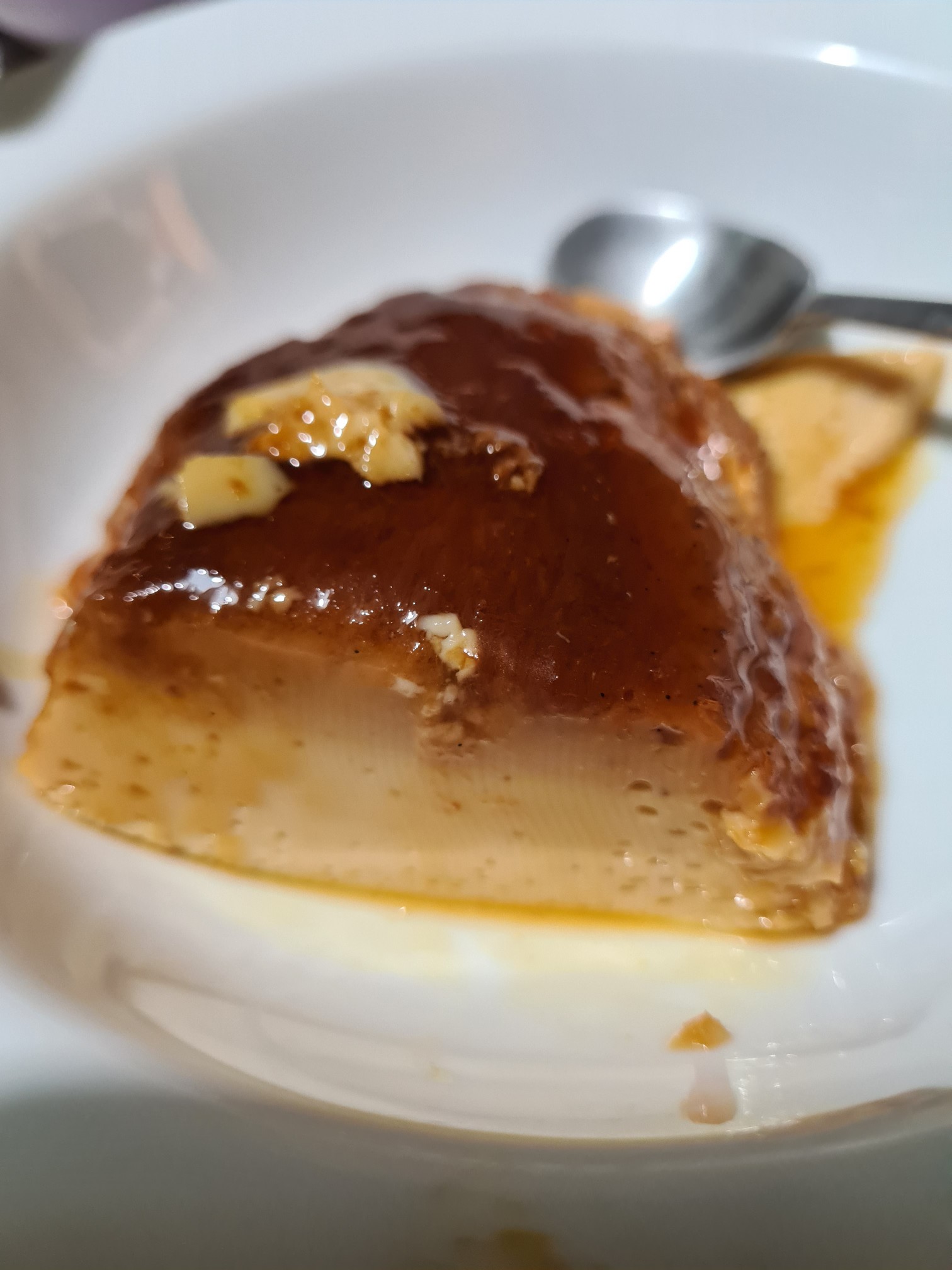
I’ve done some side-quests too! My first one was the project I did to try and understand the outline of Portuguese politics; then I went to see a night of (mostly) Portuguese music and this week I tried my hand at cooking a pudding called Pudim de Leite Condensado from a Portuguese recipe.
Behold its majesty!

So that’s how I’m doing. The schedule is a lot easier than I expected. I’m finding it a faff to fit the weekly goals in, especially now I’m in full time work again, but I’ll keep plugging away!
Deadly Synonyms
Here’s a confusing instance of double-meanings from the C1 exercises.
The question is to find synonyms for a list of words. One of the words is “Confuso” and the options it gives are (a) desordenado (b) esclarecido (c) desarrumado (d) obscuro.

The answer is obviously (a) right? Right? Well, no, it’s (d) according to the book. I went to the Porto Editora dictionary and it seems to support my claim.
But wait, what’s that in the second row?

Nooooo!
I posted on the Portuguese subreddit in a we-was-robbed-ref kind of way and most people agreed that (d) was the best answer.

Priberam gives the same two definitions but in a different order of precedence.
Bit of a mess really. I don’t think the question is well written but it’s worth bearing in mind that Confuso has a slightly different weighting from its English equivalent.
Some More Expressions
Here are a few expressions gleaned from the C1 book
Em casa de ferreiro, espeto de pau (In The blacksmith’s house, the skewers are made of wood) People who have skills they use in work don’t use them for their own benefit.
Cada cabeça sua sentença – everyone has their own opinion
Nem tudo o que luz é ouro – all that glimmers is not gold. Easy one, this. The only thing that grabbed my interest was that “luz”. I’d only ever come across this word as a noun so I had a hard time choosing it as an option in the exercise, but it’s actually part of the verb “luzir” in this context.
Quem canta, seus males espanta – is another that threw me since it sounds like it’s saying “whoever sings will shock you with their evil deeds” which is probably right for Michael Jackson, but “espanta” can also mean scare something away or chase it away, and “males” can be a person’s woes or troubles, not actual evils, so it just means if you sing a song you’ll chase your blues away. OK, cool.
Zangam-se as comadres, descobrem-se as verdades – When the godmothers start arguing, the truth will come out. In other words, when people start getting heated they tend to say things they would normally keep to themselves

O ocasio faz o ladrao – the opportunity makes the thief. This seems to be used slightly differently. If you look around various sites, some people take it as meaning that a person driven by circumstances might steal but isn’t to be regarded as a born thief; others take it as more like “if you don’t take care of your stuff someone is bound to nick it”. A middle way seems to be “People might be tempted to steal if there isn’t a strong motivation for them not to”. That seems to be how this guy interprets it anyway,and he mentioned a reference by Machado de Assis who says “Não é a ocasião que faz o ladrão, o provérbio está errado. A forma exata deve ser esta: a ocasião faz o furto; o ladrão já nasce feito”.
It’s definitely a pessimistic expression, anyway!
Em águas de bacalhau – I keep seeing this one and forgetting what it means. Apparently it comes from the fact that cod fishing used to be very dangerous, back in the day, and you were quite likely not to come back from a fishing trip if you went off to the cod fishing waters. So if something “deu/ficou/continuou em águas de bacalhau” then basically it came to nothing and had no result.
Trazer água no bico – bring water in your beak – do or say something sneaky or with a hidden agenda
Dar água pela barba – Give water in the beard (“sweat through the beard, I guess?) If something dá água [pela barba, it’s something very complex and challenging
Here are a few that are easier, because they’re equivalent to english expressions
Fazer crescer água na boca – to make the mouth water
Como peixinho na água – like a fish to water
Enquanto há vida há esperança – where there’s life there’s hope
Em terra de cegos quem tem olho é rei – in the land of the bline, the one-eyed man is king
Cao que ladra nao morde – his bark is worse than his bite (lit “A dog that barks doesn;t bite”)
Quem semeia ventos, colhe tempestades – sow the breeze, reap the whirlwind
C1 Expressions
I hit an exercise that had quite a lot of expressions I hadn’t heard before
Um amigo de Peniche – comes from a British action during the succession crisis of the 1580s. Nine years after the Spanish seized the portuguese crown, a force led by Francis Drake landed near Peniche ostensibly to restore the crown to Dom António, Prior do Crato, but really to prevent the Spanish launching another armada and, in the process, also doing quite a lot of looting and attempting to seize the Açores to sever the route if the Spanish silver trade. So an Amigo de Peniche is a friend who is only really looking out for what they can get out of the friendship and doesn’t really give much in return. Apparently people from Peniche are self-conscious about being associated with treachery and never miss an opportunity to tell you the true origin.


Um unhas de fome – a grasping, tight fisted person
Um atraso de vida – a harmful or annoying life problem
Um amostra de gente – a very small person
Um mãos-largas – a very generous person. Note that here (and in a couple of other expressions, the article “um” doesn’t seem to match the noun. That’s because this is a description of a person, and the default is singular and masculine, even if they are described as having wide hands – mãos largas – feminine and plural.
Um bom garfo – a gourmet
Um cabeça de alho chocho – if you are an old shriveled garlic head, you’re a forgetful, absent minded person.
Um bota de elástico – someone who dresses, acts, or thinks in an old-fashioned way
 Luso
Luso 