Another biographical text. Thanks to ThisCatIsConfused for the correction (only one – I must have been on good form the day I wrote it!)
Ando a tentar escfrever textos sobre portugueses famosos. O de hoje é o sexto. Nuno Miguel Machado Reis Peres é um cientista. É um professor catedrático no centro de física na universidade de Minho. O seu campo de pesquisa é a teoria de matéria condensada, matérias 2d, incluindo o nosso amigo, o grafeno.
Famoso? Como assim? É verdade que o Doutor não é famoso no sentido tradicional. Tanto quanto sei não tem sido convidado no “Big Brother: Famosos”, mas não importa muito porque se fosse confiado, não teria tempo porque o Doutor Peres é um dos cientistas mais citados no mundo. As suas obras receberam mais que 24 milhares de citações. Faz parte do “Graphene Flagship” um projeto importantíssimo da União Europeia.
A couple of texts from last week when I had the covid (I’m better now).
Doente
Apanhei este maldito vírus. A minha filha estava doente na semana passada e já passou para mim. Bolas.
Um Dia Na Cama
Apesar de não estar assim tão doente, estou a aproveitar a oportunidade para ficar em casa e na cama, a ler um livro. Tenho dois em andamento atualmente: Segredo Mortal de Bruno M Franco e Death and the Penguin de André Kurkov. Adoro os dois.
Deixo de Espirrar
Finalmente testei negativo ao* coronavirus depois de 6 dias de doença. Estava com sorte: apanhei o vírus durante a vaga omicron e estou vacinado.
Vou tentar correr 5 quilómetros hoje mas não sei se vai ser possível. Há quem diga que as vítimas do Covid permanecem com falta de fôlego durante algum tempo depois de recuperar.
Como provavelmente já disse, temos um lotinho de terra na horta comunitária. No ano passado o tempo andava muito húmido (ai funesta Primavera!) e apesar de termos constituído uma estufa, muitas plantas faleceram (quem me dera, quem nos dera, não terem morrido nesses dias). Os tomates por exemplo, ficaram infetados de fungos* (todos os tomates que nós tínhamos plantado rebentaram-se** e desfizeram-se). Ainda por cima, a construção da estufa levou tanto tempo que não conseguimos plantar sementes no início da estação de cultivo***.
Mas neste ano, conseguimos pôr tudo em andamento muito cedo. Plantamos uns alhos franceses, favas e cebolinhas no Outono que estão quase prestes a colher. Além disso, temos sementes na estufa que estão a crescer e os morangueiros**** ainda têm flores. Quando vamos por lá, tudo tem aspecto prometedor. Com sorte, vamos ter umas boas saladas este ano!
* Infected with funguses (fungos) not just fungus (fungo). It’s more natural to use the plural in this kind of situation.
** I originally used “quebrar” but that’s more usual when you’re talking about hard, solid objects breaking. In this case they burst (rebentar) or split (rachar)
*** The growing season
**** A good example of a word where changing the last letter doesnt just change whether you are referring to a man or a woman but changes what it actually is that you’re referring to: morangueiro = strawberry plant / morangueira = strawberry seller
I feel a bit sorry for this fella trying to tell an interesting anecdote about that time he met the widow of Portugal’s favourite writer. Only one problem: Fernando Pessoa wasn’t married and, having died in 1935, even if he had been, it seems unlikely his widow would be in a fit state to hang around in museums having bants with Irish tourists.
People reckon he must have meant José Saramago, whose widow, Pilar Del Rio is still very much with us.
It’s so sad though. Great story, he’s showing interest in the local literature and football, it’s working, but he just muddled up the name. Oof. Totally the sort of thing I’d do but thank goodness, if it were me, there wouldn’t be anyone around to film it.
A text from a few days ago with thanks to Butt_roidholds for the corrections
Em Inglaterra, celebramos o Dia da Mãe em Março, ao contrário da maioria dos países, onde as pessoas esperam até Maio* porque não amam** as suas mães tanto quanto nós amamos as nossas.
Regra geral, nunca perco o dia, mas neste ano andei distraído e esqueci-me completamente. Eu e a filha entrámos em pânico. Ela começou a fazer uns queques (naquela altura não sabíamos que ela estava com covid). Entretanto abri o site Interflora para enviar flores para a avó dela, que é também a minha mãe. Que desgraça.
*I wrote “até ao Maio” but that’s doubly wrong. Firstly you don’t need the article in front of the name of the month, and secondly you don’t use “a” after esperar. It would normally be esperar para (wait to be able to do something) or esperar por (wait for) or esperar em (wait in expectation)… Hm… The definitions in brackets are pretty loose there. This is why a site like Linguee is so useful: you can see actual examples of these kinds of constructions and get a sense of when they are used.
**Apparently my joke misfired because although “amar” is changing to be more like the English verb “love”, traditionally Portuguese people would use “gostar” or “adorar” when talking about their parents so my attempt at a cheeky joke just made me sound like Oedipus
We tend to learn body parts early on in our language journey and we think we’ve got them all mastered because we’ve mastered how to sing “heads, shoulders, knees and toes” in Portuguese but there are all kinds of other body parts that don’t get a look-in: armpits (axilas), kidneys (rins), calves (panturrilhas ou “barriga de perna“), and so on.
One I came across today and probably should have known was “calcanhares” meaning heels. There are a few expressions involving heels, some of which are familiar and some less so
Calcanhar de Aquiles – the Achilles heel can be used figuratively to mean a person’s weak spot, just as in English
Dar aos calcanhares – is like the English expression “to show a clean pair of heels”, in other words, escape or run off quickly.
Não chegar aos calcanhares de alguém doesn’t really have an equivalent in English. If you don’t reach someone’s heels it means you are vastly inferior. A minha filha gosta de David Tenant mas na minha opinião, não chega aos calcanhares de Tom Baker.
And an English expression that doesn’t have a direct match in Portuguese would be “high heels”. In Portuguese the heel of a shoe has a different name: salto, so a salto alto is a high heel shoe. It’s a bit confusing because salto can also mean a jump, so salto alto sounds like it should mean a high jump, but the athletic event we call a high jump is “salto em altura” in Portuguese.
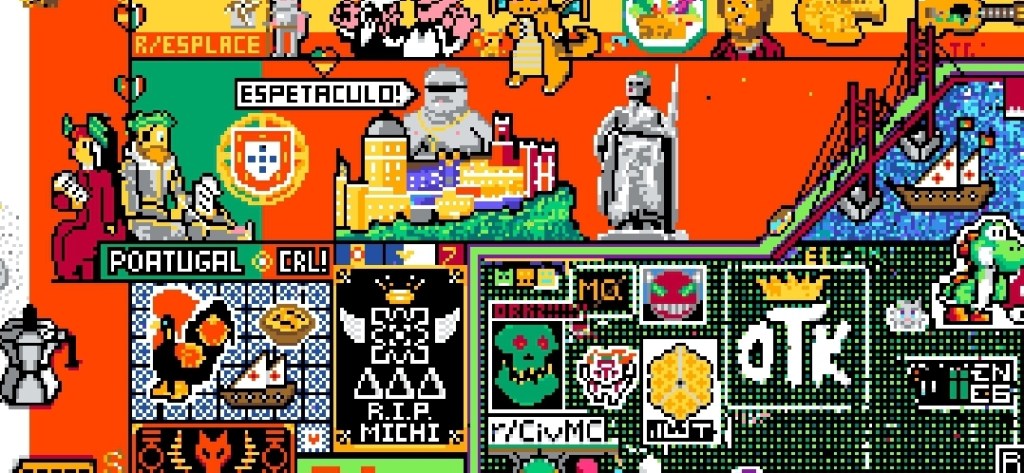
Just popped over to the r/place subreddit, which is a sort of giant collaborative artwork being created by millions of people, and I noticed quite near the middle there are a lot of Portuguese people carving out a little niche for themselves. I strongly approve.
I mentioned Eurovision a couple of days ago and it reminded me of this song, e Depois do Adeus by Paulo de Carvalho, which has to be a strong candidate for the Eurovision entry that had the most impact in the real world. As you can see, it’s straight out of the seventies, with the sideburns and the big collar, and it’s hard to imagine anything more Conservative sounding (although this guy, for example, thinks there is a social criticism buried in the poetry of the lyrics)
So how did it come to have an impact? In a way, it was catapulted to a place in history by its very conservatism. It was the Portuguese entry in the 6th of April 1974 in Brighton. It was pretty popular and wasn’t banned, so it was used as a signal on the 25th of April 1974 at 10.55, for the troops involved in the Movimento das Forças Armadas to get ready, armed and at their post. Nobody listening, who wasn’t in on the plot, would have thought it a strange choice, so if the leadership had had to back out at the last minute there would have been no suspicions aroused. Later the same evening, when it was decided that everything was in place and the plan could go ahead, a second song was played, namely Grândola, Vila Morena, which was a revolutionary song by Jose Afonso, that had been banned by the Novo Estado since its release in 1971. Once that was transmitted by Radio Renascença, everyone knew shit had got real. The convoy left their barracks and there was no turning back.
Here are the lyrics.
Quis saber quem sou /I wanted to know who I am O que faço aqui /What I’m doing here Quem me abandonou /Who abandoned ne De quem me esqueci /Who I had forgotten Perguntei por mim /I asked for myself Quis saber de nós /I wanted to know about us Mas o mar /But the sea Não me traz /Didn’t bring me Tua voz /Your voice
Em silêncio, amor /In silence, love Em tristeza enfim /In sadness, finally Eu te sinto, em flor /I feel you flowering Eu te sofro, em mim /I feel you, in me Eu te lembro, assim /I remind you like this Partir é morrer /That to leave is to die Como amar / Just as to love É ganhar /Is to win E perder /and to lose
Tu vieste em flor /I saw you in flower Eu te desfolhei /I plucked off your petals Tu te deste em amor /You gave yourself in love Eu nada te dei /i didn’t give you anything Em teu corpo, amor /In your body, love Eu adormeci /I slept Morri nele /I died in it E ao morrer /and by dying Renasci /was reborn
E depois do amor /And after the love E depois de nós /And after us O dizer adeus /The saying goodbye O ficarmos sós /And being alone Teu lugar a mais /Too much space for you Tua ausência em mim /Your absence in me Tua paz /Your peace Que perdi /That I lost Minha dor que aprendi /My pain that I learned De novo vieste em flor /I saw you again in flower Te desfolhei /I plucked off your petals
E depois do amor /And after the love E depois de nós /And after us O adeus /the goodbye O ficamos sós /The being alone
Hm, I don’t know if this TikTok is going to show up on WordPress but I’ve been enjoying trying to decipher this video as some extreme listening practice.
On first listen I could only get about 6 words and even now, after showing it to my wife I’m still not able to pick out everything. Being told they were talking about “CS” (Counterstrike, I assume) helped. Something like
Pra vocês que (…) joga o CS (…) caralho, tá aqui o meu tropa Fernando. Fernando, quantos anos já tens?
Dezanove
E qual é o teu rank do CS?
Dragon Lord
Ah pois é puto
Or in English
For all of you who (play fucking counter strike) I have my team-mate Fernando here. Fernando, how old are you?
Quando penso em apresentadores/as de televisão portugueses, Filomena Cautela é a primeira pessoa em que penso. O porquê eu não sei: é apenas uma entre montes de apresentadores, mas por acaso, vi muitos programas dela logo no início das minhas tentativas de ver televisão português. Além disso, tem uma cara muito reconhecível, com um sorriso largo e muito delineador!
Começou a sua carreira no palco mas passou do teatro ao estúdio de televisão em 2003. Autou em várias telenovelas e filmes até 2005 quando foi escolhida como a cara de MTV Portugal. Em 2009, tornou-se apresentadora do 5 Para A Meia-Noite. Depois, apresentou, ou fez parte do elenco de muitos programas, inclusive “Fá-las curtas”, “Vale Tudo” e o Festival Eurovision da Canção. Este último terá provavelmente a única vez que espectadores não-lusófonos no meu país a viram.



 Luso
Luso 