Posted in English, Portuguese

Fartugal

I got so carried away the other day that I published a blog post with this title and no content at all. I’m a five-year-old at heart. By the time I’d finished reading the article I had planned to base it on, though, I’d changed my mind, because, despite being written in Portuguese, it doesn’t actually have much information about Portuguese culture. In fact, as you’ll see, I learned more about French than I did about Portuguese. I considered changing the title to “Peido and Peidjudice” or “Peidomaníaco”, “Peidogeddon” or “It’s Peidback Time” or something, but I just decided to stick with this title in the end so as not to disappoint anyone who saw the first post and had been holding their breath in expectation of the second.

Governor William J Le Petomane (left) and friends

Li um artigo no jornal Público sobre a História Cultural da Flatulência. O escritor não deu exemplos da flatulência na vida cultural portuguesa. Não faço ideia porquê. Os portugueses não se peidam? De qualquer maneira, o que mais me surpreendeu foi uma referência ao nome de uma personagem no filme do Mel Brooks, Blazing Saddles. O seu nome é Governor William J Le Petomane. O Le Pétomane original era um artista, antes da guerra, cujo nome significa “Peidomaníaco” por razões que são provavelmente óbvias. Apesar de ter visto o filme vezes sem conta, eu nem sequer sabia o significado do seu apelido.

Joseph Pujol, aka Le Pétomane
Posted in English

Saudade, Saudade

Maro - Saudade, Saudade

It’s been a busy year in the Saudade mines and Portugal now has such a vast surplus of their untranslatable major export that they’ve taken to giving double portions away with every Eurovision entry. “Saudade, Saudade” is a good song. It’s a strange choice for a Eurovision entry, but that’s not a huge surprise: they’ve been sending strange choices to Eurovision for some time now and it keeps things interesting! I actually really struggled to listen to it on yesterday’s Eurovision final, because I was trying to tune in to the Portuguese lyrics but it wasn’t till the second listen that I realised it’s almost all in English! In my defence, there was a lot of background noise!

The only Portuguese verse (not counting the word “Saudade” itself of course) is

Tem tanto que trago comigo
Foi sempre o meu porto de abrigo
E agora nada faz sentido
Perdi o meu melhor amigo

E se não for demais
Peço por sinais
Resta uma só palavra

Which translates as

He has so much I carry inside myself
He was always my port in the storm
And now nothing makes sense
I lost my best friend

And if its not too much,
I ask for a sign
Only one word remains

Bolo de Berlim, bolo de arroz, queijada, pão de ló

By the way, we set out to get a range of snacks from lots of European nations to eat while watching but we ended up just loading up on cakes from the Portuguese stall at Richmond’s Duckpond Market

Posted in English

Emos, Emas and Emus: know the difference

I put this meme on twitter earlier, inspired by a random thought from a previous post.

Tumbleweeds.

Emos, emas and emus. Know the difference.

It’s always a bit tricky when a joke in Portuguese dies on its arse. Is it because my grammar is incomprehensible, or is it just not funny. Reposted on Instagram and it got a few likes. OK, I’ll take that.

Posted in English

Sheila Take a Baú

Social media really is a treasure trove of stuff you can learn, and it doesn’t feel like a chore because you’re just looking at memes. Here’s one i found today.

I know “golpe” is like a blow – in the sense of a blow to the head or a blow from an axe: the impact of something. It’s used in “golpe de estado” (coup d’état) for example. And baú is a chest – as in “treasure chest”. So when you put them together, what do you get? A golpe de baú is the act of marrying an older guy in the hope of inheriting all his wealth.

So, basically, I’m the words of Kanye West, they ain’t sayin’ she a gold digger, but she ain’t messin’ with no broke tuga.

I don’t actually know who the woman is or what the account that’s posting this is like, so I’m not sure whether she’s in on the joke or whether it’s meant in a cruel way or whether she’s done anything to deserve it or whether they are just being arseholes, but I am so pleased to have learned a new thing that I don’t really care.

Golpe de baú

You can read more about the history of the phrase Golpe de Baú on Wikipedia if you’re interested

Posted in Portuguese

Segredo Mortal – Bruno M Franco

Segredo Mortal de Bruno M Franco
Segredo Mortal

Here’s a review of the massive beach thriller I’ve been reading, “Segredo Mortal” by Bruno M Franco. I’ve possibly been a little harsh on it, given that it’s a thriller and not meant to be scrutinised too closely but hi ho. It’s a relatively easy read: if you’re at B2 you’ll probably hardly touch your dictionary and even a confident B1 could read it without enduring serious brainfires. It’s available at Bertrand of course and I’m sure I’ve seen it in the excellent Portuguese Language section of the Charing Cross Road branch of Foyles too, but can’t seem to find it on their site, so maybe it’s in-store only, or maybe that was just a beautiful dream. Amazon might have it too if you are a fan of evil companies.

A abertura dum bom thriller captura sempre a atenção do leitor. Geralmente há várias personagens em situações de perigo ou a enfrentar um mistério, e o autor alterna os capítulos entre as cenas, deixando os enredos desenrolar até fica claro qual é o fio que une todas estas histórias, e qual é a força sinistra por trás dos eventos. Se o escritor cumprir esta tarefa com êxito, a bolha delicada da nossa credulidade fica intacta até ao final. Não pedimos mais do que isso.

Os primeiros capítulos do “Segredo Mortal” não nos desiludem: uma tempestade, a descoberta de vários cadáveres, um jovem perseguido por um soldado, um assassino em série prestes a sair do seu lar…

E de forma geral, os capítulos que se seguem correm bem. O autor sabe escrever. O diálogo, o desenvolvimento das personagens, os encontros, a acção, tudo se lê bem, mas há pontos fracos quando se mete a explicar as ligações entre os elementos do enredo: por exemplo, a cena na qual os polícias ouvem o testemunho dum grupo de cientistas sobre as origens da tempestade: a sua explicação não faz o mínimo sentido. Se estivesse lá, eu diria “mas porquê?” de cinco em cinco segundos. Simplesmente não acreditei nos motivos por trás do enredo.

Por causa disso*, muitas outras coisas não bateram certo na ausência da minha “fé” no caroço do enredo: as mortes de várias pessoas; a existência de alguém que é simultaneamente um maluco assassino em série e um assassino profissional bem controlado; a entrada dos pais duma personagem importante; o relacionamento dos dois polícias (que deu num dos epílogos mais bizarros que já li na minha vida). Tantas, tantas coisas!

E por falar nos dois polícias, o livro poderia ser mais fino por cem páginas se os protagonistas soubessem o significado da palavra “Parceiro”. Duas vezes o homem entrou sozinho num sítio, para dar com o assassino em série. Quando a segunda vez chegou, eu estava a falar em voz alta, “Pá, és o parceiro dela. Leva-a contigo e talvez tenham hipótese de prender o gajo sem ficares esfaqueado pela segunda vez neste livro!”

Spoiler alert: deixou-a no carro e ficou esfaqueado pela segunda vez naquele livro. Eh pá!**

A minha filha aconselhou-me a deixar de ler mas estou contente por ter aguentado: o autor conseguiu o desfecho do enredo e apesar dos problemas, o livro é divertido.

*I originally wrote “por resultado” (as a result) but that’s not very idiomatic

**Just to contradict what I wrote in the footnotes of the Herman José text a few days ago, one of the suggested changes was to write “epá” on place of “eh pá”. I dunno, I think I’m just going to stick with this spelling, regardless of the fact that different people have different ways of writing it. It might seem a bit fussy to some but you can’t please all the people all the time.

Posted in English

FLiPping Heck

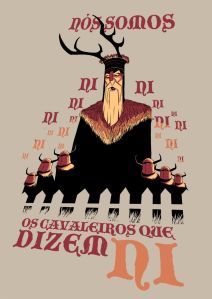
The Knights Who Say Ni
Found on someone’s Pinterest. No idea who owns it. Too good not to use.

I’ve been repeating a lot of silly errors lately, often just typos that don’t get caught by my usual method: pasting my Portuguese texts into Google Translate to see if it can correctly translate them back into English. Google Translate is quite forgiving of “gralhas” (typos) so if you wrote “ni” instead of “no” because you are a medieval Knight and that’s your favourite word and autocorrect has changed it for you, Google Translate will probably correctly guess what you meant, and the error will slip through.

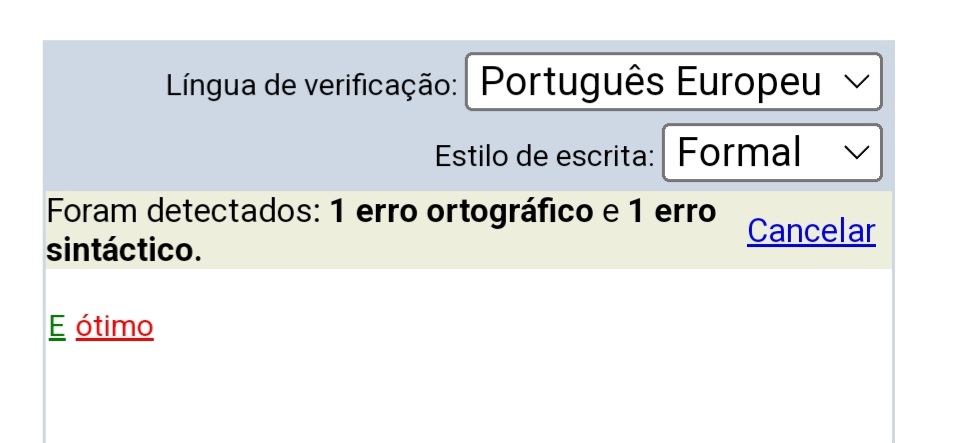
One of the correctors on the subreddit suggested I incorporate FLiP into my routine. It’s a spelling and syntax validator. I’ve had a play and concluded it definitely has its uses. It has a pretty big gotcha though. In fact, I thought it was wrong about a couple of AO spellings. It prompted me to change the spelling of Ótimo to the older Óptimo, for example. Well, I like the old version so I’m not too bothered, but it’s the wrong advice.

When it did the same with the word “corre(c)ção” I really started giving it side-eye. Considering corre(c)ções are its raison d’etre, that would be a pretty big error. It turned out there was a good reason though. Can you spot my mistake?

Yeah, it defaults to the old spellings and i hadn’t noticed there was a box to tick right there at the top that makes it use the newer ones. So make sure you remember that!

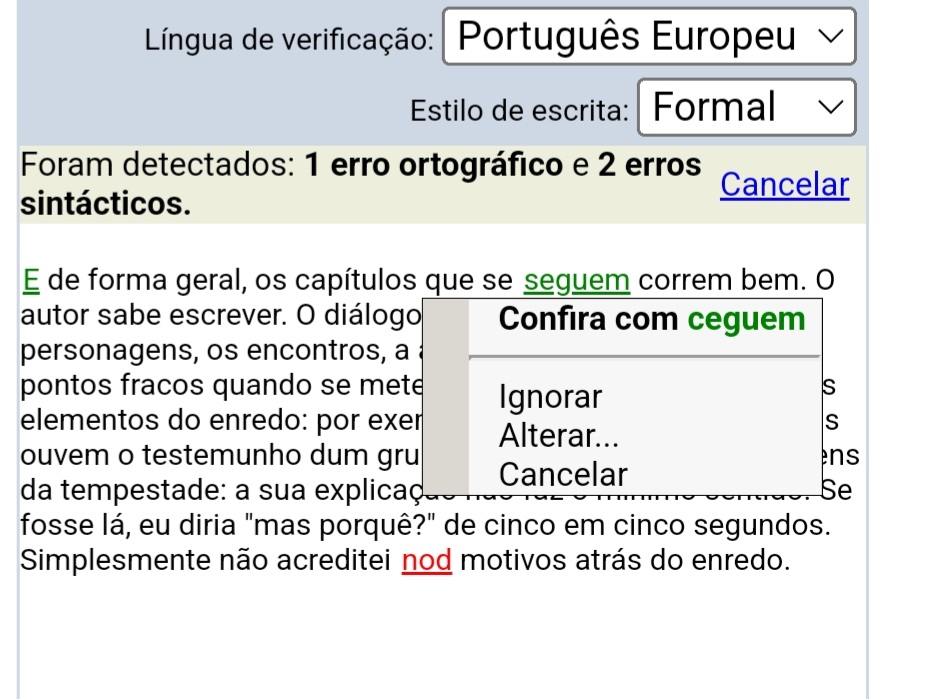
Like any computer program, it’s not immune to errors though. Today’s text includes the phrase “os capítulos que se seguem” (“the following chapters”). Computer said no, advising me to say “the chapters that blind themselves” instead.

Still though, like most online tools, it has its uses. It’s probably best to treat it like a GPS navigation system: follow its directions most of the time but not when it’s telling you to drive off a pier into the sea to get to Calais.

Posted in English

Whoops!

Embarrassing when you publish a blog post you haven’t actually written yet. Apologies to anyone who saw that and was confused. There will be a slightly better version of it in a day or two…

Posted in English

Vivalma

With my Tony Soper mask on, creeping through the bushes in search of rare and exotic creatures in the Portuguese language, I came across this sentence in the book I’m reading. It’s part of a description of the video footage of the big dramatic confrontation between the incompetent policeman and the unrealistic villain (I feel like I’m giving spoilers for the book review I’m planning…)

Do you like the picture, by the way? My daughter showed me how to unblur a single sentence like this the other day and I’m delighted to have learned a new skill!

Anyway, “vivalma” was a new one on me. According to Priberam it’s a relatively new word composed of the two smaller words: viva, alma. Alive and soul respectively. The grammar of the sentence is a little complicated because you have the mystery-meat pronoun “se” which I always find a little difficult to deal with but it’s just triggering the passive voice: “não vira” = had not seen, “não se vira” = had not been seen.

So the whole thing means “For fifteen seconds, not a living should had been seen in the river”.

Posted in Portuguese

When The Wind Blows

Ontem, reli uma banda desenhada dos anos oitenta chamada “Quando o Vento Soprar”. Conta a história dum casal de idosos. Lembram-se da segunda guerra mundial porém quando a terceira se desencadeia, não estão preparados apesar de seguir os conselhos do governo.

O livro foi editado durante a (primeira) guerra fria e é muito deprimente que parece tão relevante nos dias de hoje.

I usually write reviews of Portuguese books but in this case it’s the Raymond Briggs classic, When The Wind Blows

Posted in English

O Dialecto Madeirense

This video was published on Twitter on Thursday (O Dia Mundial Da Língua Portuguesa). The first speaker is Francisco Louçã, an MP (“Deputado”) from the Bloco Esquerda and he’s introducing a PSD colleague named Carlos Rodrigues, saying he will now address the chamber in his “Madeiran Dialect”. Rodrigues then replies in a way everyone thinks is hilarious…

I can’t understand what he’s saying so I cheated and looked at the parliamentary transcript which is here, and you can read the surrounding context about the dialect (it’s not a dialect really, it’s an accent – mainlanders can be a bit snobbish about it though). Anyway, after reading the transcript… I was none the wiser!

Louçã: – Sr. Presidente, para surpresa da minha bancada, acaba de ser-nos comunicado que um Sr. Deputado passará a dirigir-se ao Plenário no “dialecto” madeirense. (…)

Rodrigues: – Quanto a dialecto, só tenho uma coisa a dizer-lhe, Sr. Deputado Francisco Louçã – e agora, mesmo em jeito de brincadeira: “o grado azoigou e foi atupido na manta das tanarifas”!

Grado exists in Priberam but none of the meanings seem to fit. Azoigar is in there too (although the spelling is “azougar”, because it’s one of those words that can be written with an ou or an oi) and now we’re starting to see the pattern because the definition is

[Portugal: Madeira]  Morrer (falando-se de animais).

Ah, if course – he’s replying using a madeiran expression, full of madeiran words. So, turning to a specialist madeiran page… We get the following

The dog (grado) died (azoigou) and was buried (atupido) on the pumpkin (tanarifa) terrace (manta).

Tanarifa is the sketchiest word there. The meaning is given as “boganga”, which, if you follow it, actually refers to a kind of squash/pumpkin. I’ve also seen people translating it as “alface” (lettuce) but most people seem to translate it as banana. So… I dunno… Conjure up whatever mental image you like on that one! I’ve translated manta (which normally means “shawl” or “blanket”) as terrace because in madeiran agriculture, a manta is a terrace on the side of a mountain where you can grow crops.

So… That’s all very well but what does it actually mean? Not sure. I thought maybe it was like “Os cães ladram e a caravana passa”. In other words, your yapping doesn’t really count for much. My wife, who is madeiran but hasn’t lived there for ages, didn’t recognise it either but thought it was more likely that the speaker is comparing his opponent’s argument to a dog in a race which he’s very proud of and thinks will win the race but it won’t because it’s dead and buried in the vegetable patch.