I think the original phrase is intended to mean something like “if you wish for something you can achieve it” but…
Coming Out of the Armário
I’ve been posting on twitter a lot today. I’m starting to feel a bit icky about my twitter identity though. I chose the assumed name of a Portuguese explorer, Pedro Álvares Cabral, because I wanted to just post as if I were Portuguese, but I’ve been feeling a bit off about it. I think this has really come to a head when discussing Ukraine. There are a lot of fake news bots out there pretending to be Brazilian or portuguese or whatever and talking shite about the war. I like a bit of twitter rough and tumble as much as the next idiot, so I will occasionally challenge these accounts but of course doing that while pretending to be a native of Portugal feels a bit disingenuous and the fact that I also make a lot of the kinds of mistakes only a foreigner would make means they can make the same charge back at me, pretending to think I am on the payroll of MI6 or whatever. Which I am, obviously, but they don’t know that.
So I’ve announced that I’m planning to change my identity to something that is more open about my origins (but still anonymous) so people have a better idea of where I’m coming from.
Now I just need to come up with a good alias…
🧵 👇
Giving Something Back
One of the great things about the Internet is the amount of mutual help that’s going on all the time. In Facebook and reddit people are helping each other with language queries, and I started doing some marking on the equivalent subreddit for English learners. I’ve actually gone a step beyond even that and taken part in an English speaking marathon on Zoom. I only stayed for an hour because its a sort of rolling membership with people coming and going. So the organisers would pair the participants up for ten minutes, speed-dating style, and at the end of each conversation, everyone would return to the main call and either leave or wait to be paired up again. I participated in 5 ten minute conversations with people from Hungary and Turkey. There were only two of us native speakers there and the rest were just sharing across language barriers. TBH I don’t know how helpful I was: I tend to gabble a lot as I’m quite socially awkward generally, but that’s OK. I think I’d like to do it some more but maybe write down some questions and just try to give a nice calm environment for other people to say what they want to say. In other words, try to be the sort of partner I would like if I were the learner in the conversation. These things can’t happen if people don’t help out, so it’s something good we can all do to just help someone along the path to fluency. Anyway, if you fancy giving it a go, the call is here between 3PM and 8PM on Saturday.
I must say though, it really reminds me how much I need some more conversation in my life. I’m really neglecting speaking Portuguese at the moment.
Farricocos
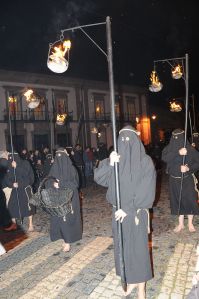
Hoje é sexta-feira santa, o dia no qual os cristãos se lembram da morte do seu salvador. Ouvi falar ontem de um cargo religioso: o Farricoco, que é um figurante numa procissão católica. Tanto quanto eu sei o nome é principalmente associado com Braga em Portugal mas há outros exemplos em várias cidades do Brasil também. Os bracarenses vestem-se de preto com caras cobertas de sacos, enquanto os brasileiros usam capuzes pontiagudos e bem coloridos.
Thanks to Patis12 for the corrections on this one
Don’t Risk it for the Biscate
Episode 8963 of the series “words that mean wildly different things on different sides of the Atlantic”
Biscate seems like a useful word to have in your back pocket, but use it with care. In Portugal it refers to a side job, side huddle, or short term job. In the world of the gig economy, it seems like a good one to know.
Olha, aquele é mecânico nos estaleiros, mas faz uns “biscates” de electricidade por fora!
https://www.dicionarioinformal.com.br/biscate/
When this came up in online discussion, some Brazilian contributors found this funny because that’s not what it means in Brazil at all. Over there it refers to a woman who has lots of sexual partners – so equivalent to slut or slag or other derogatory terms.
A menina que ficava com todos garotos do colégio era chamada de biscate.
https://www.dicionarioinformal.com.br/biscate
Navigating slang is more complicated in Portuguese than in English because there seem to be quite a lot of examples of differences like this.
Shake It Baby
Today’s book exercise includes the phrase “de mãos a abanar”. Checking what ciberdúvidas has to say in the subject, it seems there are two possible variants, one more literal than the other
Ficar/Ir COM mãos a abanar usually means your hands really physically shake (but note, not shaking hands with someone else that’s “apertar as mãos” – you squeeze hands with someone.
Vir/Ficar/Ir DE mãos a abanar means to end up empty handed. Just like in English you can come away empty handed, without being able to gain from a situation, or you can turn up empty handed, with nothing to offer in a situation. The actual example in the book uses vir as the verb, but of course it depends on the situation you’re describing – whether they are setting off with nothing, coming away empty handed or whatever. I’ve also seen a Brazilian page describing “chegar de mãos abanando” which is obviously related. They use it to describe a situation where someone arrives at a party without a present or a bottle of wine or whatever. According to the writer this is related to immigrants to Brazil in the 19th century. If they were unskilled their hands would shake due to inability to use the tools of the trade. Pardon my skepticism but this sounds like bollocks to me.
Primavera – Amália Rodrigues
Well, I mentioned it’s spring here in the northern hemisphere, so here’s my attempt at a translation of Primavera. I can’t find any videos of Amália singing it but I’ll drop a live recording of Mariza’s version here for those who don’t know it.
Todo o amor que nos prendera /All the love that had stuck to us
Como se fora de cera /As if it were wax
Se quebrava e desfazia /Broke apart and disintegrated
Ai, funesta Primavera! /Oh terrible spring!
Quem me dera, quem nos dera /If only I, if only we
Ter morrido nesse dia /Had died on that day
Ai, funesta Primavera /Oh terrible spring
Quem me dera, quem nos dera /If only I, if only we
Ter morrido nesse dia /Had died on that day
E condenaram-me a tanto /And they condemned me so much
Viver comigo o meu pranto / To live with myself and with my mourning
Viver, viver e sem ti / To live to live without you
Vivendo sem no entanto / But living without
Eu me esquecer desse encanto /forgetting that enchantment
Que nesse dia perdi / That I lost in that day
Vivendo sem no entanto / But living without
Eu me esquecer desse encanto /forgetting that enchantment
Que nesse dia perdi / That i lost on that day
Pão duro da solidão / The stale bread of loneliness
É somente o que nos dão / Is all the give us
O que nos dão a comer / What they give us to eat
Que importa que o coração / What does it matter if the heart
Diga que sim ou que não / Says yes or no
Se continua a viver / If it keeps on living
Que importa que o coração /What does it matter if the heart
Diga que sim ou que não / Says yes or no
Se continua a viver /If it keeps on living
Todo o amor que nos prendera /All the love that had stuck to us
Se quebrara e desfizera / Broke apart and disintegrated
Em pavor se convertia / It converted itself into dread
Ninguém fale em Primavera /Nobody talk about spring
Quem me dera, quem nos dera / If only I, if only we
Ter morrido nesse dia / Had died on that day
Ninguém fale em Primavera /nobody talk about spring
Quem me dera, quem nos dera / If only I if only we
Ter morrido nesse dia / Had died on that day
A Época a. C.
Continuing my series of mini-biographies I’m doing a twofer today and describing the two footballers on the cover of the first Portuguese Textbook I ever owned. It’s a bit of a cheat because I’m trying to only talk about living people but Eusébio went to that big stadium in the sky in 2014. Meh, I’ll stretch a point. The a. C. in the title is a joke a. C. Means “antes de Cristo” not “antes de Cristiano”.
Durante época antes de Cristiano, existiam outros futebolistas pre-históricos.
Segundo arqueólogos, o jogador português mais famoso dos anos noventa e os primeiros anos deste século era Luís Figo. Figo estreou com o Sporting Clube de Portugal. Como a sua fama cresceu, outras equipas queriam atraí-lo. Jogou pelo Barcelona e pelo Real Madrid em espanha e, nos últimos anos da sua carreira, por Internazionale na Itália.

Ainda mais distante no passado, no período Jogorássico, havia um jogador chamado simplesmente Eusébio. Eusébio da Silva Ferreira nasceu em Moçambique em 1942 enquanto aquele país ainda era uma “província ultramarina”. Jogou por várias equipas portuguesas e estrangeiras e na seleção portuguesa desde 1961 até 1973.

Eusébio é considerado um dos melhores jogadores de sempre e foi um prolífico goleador (marcou quase 900 golos ao longo da sua carreira). Foi alcunhado “O pantera negra” (hum… A flexão do adjectivo é confusa aqui: artigo masculino com adjetivo masculino… Mas suponho que “pantera negra” é o nome do animal e não é considerado um adjetivo distinto, pois não…?)
One Thousand
This site passed the thousand post mark a couple of days ago. One thousand posts in 6 years. That’s about one every two days on average. I’d barely believe I was capable of that level of commitment but look, here we are.
Ana Garcia Martins
Not quite the latest in the series of texts about famous (and alive) Portuguese people.

Ana Garcia Martins é uma apresentadora, bloguista e autora portuguesa. A sua carreira começou em 2004 quando lançou o blogue “A Pipoca Mais Doce“. O blogue não tem tema específico: fala de roupa e da moda mas também sobre ser mãe e como afastar piolhos. Uma publicação recente no seu blogue teve por assunto pneus. Costuma recomendar marcas específicas. Parece-me que a sua posição como “influenciadora” está a atrair a atenção de departamentos de marketing que querem aproveitar a sua plataforma mas não sei. Foi convidada do “Pressão no Ar”, a rubrica do “5 para a meia-noite” e admitiu que não recusaria de trabalhar com marca nemhuma porque “toda a gente tem o seu preço”
Mais recentemente, Ana, (que é muitas vezes conhecida pelo nome do blogue em vez do seu nome próprio) tornou-se apresentadora da programa Big Brother. Estou-me nas tintas para tais programas, mas, apesar disso, não é possível evitar ouvir falar deles e portanto ouvi falar dela também.
Tanto quanto eu sei era casada com um gajo qualquer mas os dois separararm-se e já tem namorado que é outro gajo qualquer mas acho que já escrevi mais do que quero sobre uma personalidade de televisão portanto por hoje chega.
 Luso
Luso 
